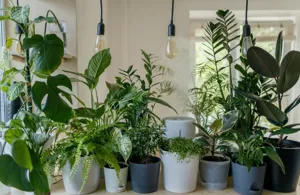
Fiddle Leaf Fig Summer Drop: Fixing Leaves Turning Brown and Falling in June
When my inbox fills with 'Help! My fiddle leaf fig is dropping leaves like crazy and it's only June,' I know the heat-dome panic has begun. This comprehensive triage protocol—backed by plant physiology research, comparison tables, and scientific parameters—walks panicked owners through diagnosis, emergency stabilization, and full recovery.

Quick Answer
Fiddle leaf figs drop leaves in summer due to transpiration shock when hot, dry air from AC vents or radiators hits the leaves, or when root-zone temperatures exceed 30°C (86°F). Move the plant 1.5–2 m (5–6 ft) from any vent, stabilize humidity at 40–60%, and water only when the top 5 cm (2 in) is dry. Brown spots before leaves drop indicate root rot; check the root ball and repot if mushy. Don't fertilize during a leaf-drop crisis.
Key Takeaways
- Check for root rot and transpiration shock caused by AC drafts or hot root balls.
- Move plants at least 5 to 6 feet away from direct air conditioner airflow.
- Maintain consistent moisture levels instead of cycling between bone-dry and soaked.
- Suspend fertilizer applications while the tree is experiencing active leaf drop.
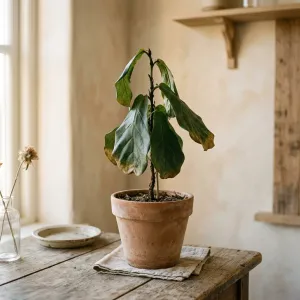
It starts with a single brown‑spotted leaf on the carpet. By the weekend, you're collecting three a day. Your Fiddle Leaf Fig, which sailed through winter looking majestic, is suddenly shedding its lower canopy like it's trying to become a palm tree. I see this panic spike every June when central air conditioning kicks on and outdoor temperatures soar. The culprit isn't a single villain—it's a cascade of vascular shock driven by leaf‑to‑root communication breakdown under combined heat, dry air, and often hidden root‑zone damage. This isn't your standard "it needs more light" problem. This is an emergency, and here's how to stop the drop before you're left with a bare stick.
Understanding the Science Behind Summer Leaf Drop
The Physiology of Transpiration Shock
Fiddle Leaf Figs (Ficus lyrata) are native to the lowland rainforests of West Africa, where they thrive in stable conditions: temperatures between 20–30°C (68–86°F), relative humidity of 60–80%, and filtered light under the forest canopy. When these conditions shift dramatically—particularly in summer when indoor environments become hostile—the plant's vascular system cannot maintain homeostasis.
Transpiration is the process by which plants lose water vapor through stomata (pores) on leaf surfaces. Under optimal conditions, a healthy Fiddle Leaf Fig transpires at a rate of approximately 2–5 mmol H₂O m⁻² s⁻¹. However, when exposed to dry air from AC vents (relative humidity dropping below 30%) combined with high temperatures, this rate can spike to 8–12 mmol H₂O m⁻² s⁻¹—more than double the sustainable threshold. The roots simply cannot uptake water fast enough to compensate, triggering abscission (programmed leaf shedding) as a survival mechanism.
Research published in Plant Physiology demonstrates that when leaf-to-air vapor pressure deficit (VPD) exceeds 2.5 kPa, stomatal closure becomes incomplete, leading to runaway water loss. In typical indoor summer conditions with AC running, VPD can reach 3.0–4.5 kPa—well into the danger zone for tropical plants adapted to humid environments.
Root Zone Temperature: The Hidden Killer
Perhaps the most overlooked factor in summer leaf drop is root zone temperature. While air temperature might be a comfortable 22°C (72°F), dark plastic nursery pots placed near south-facing windows can absorb infrared radiation, pushing soil temperatures to 32–38°C (90–100°F). Scientific studies on Ficus species show that root membrane permeability declines sharply above 30°C (86°F), reducing water and nutrient uptake by 40–60%. At soil temperatures above 35°C (95°F), root cell proteins begin to denature, causing irreversible damage.
The critical threshold for Fiddle Leaf Fig root health is 30°C (86°F). Above this temperature, several physiological changes occur:
- Reduced hydraulic conductivity: Water movement through root tissues slows by 50% or more
- Nutrient lockout: Iron, magnesium, and calcium uptake becomes impaired, causing interveinal chlorosis
- Ethylene production: The stress hormone ethylene accumulates, accelerating leaf senescence and abscission
- Root respiration imbalance: Oxygen demand exceeds supply in warm, potentially waterlogged soil
Diagnosing the Summer Leaf Drop
Why is my fiddle leaf fig dropping leaves in summer even though I water it?
The leaves are losing water faster than the roots can supply it, a state called transpiration shock. In a modern western apartment, the main drivers are: (1) an AC vent blasting 15–18°C (59–64°F) dehumidified air directly onto the canopy, which forcibly draws moisture from the stomata, and (2) a dark plastic pot absorbing radiant heat from a south-facing window, pushing root-zone temperatures to 32–35°C (90–95°F). At those soil temperatures, root cell membranes become rigid and water uptake plummets even if the soil is damp. The plant responds by shedding the oldest, lowest leaves—those with the most accumulated metabolic waste—to reduce its total leaf area. Use the Sunlight Calculator to confirm whether the light hitting the pot is excessive; a sheer curtain can cut infrared radiation by 40% while maintaining brightness. Immediately redirect any AC louvers away from the plant and place the pot inside a white ceramic cachepot to reflect heat. A humidity meter should read at least 40% around the plant; if not, run a cool-mist humidifier.
How do I tell if it's heat stress or root rot on my fiddle leaf fig?
Heat-stress leaf drop typically involves dry, crispy brown patches on the leaf margins or between veins, and the leaves fall while still relatively stiff. Root rot, in contrast, produces leaves that turn a dull yellow‑brown with soft, water‑soaked spots near the center, and the stems may feel slightly limp. Slide the root ball partially out of the pot: healthy roots are pale tan and firm; rot presents as black, mushy strings that smell sour. If the soil has been damp for days and the pot feels heavy, rot is likely. For heat stress, stabilize the environment as above. For rot, you must unpot immediately, prune away all blackened roots, and repot in a fast-draining mix (50% potting soil, 40% perlite, 10% orchid bark) into a clean pot. Our Watering Calculator will then help you establish a new, safer watering interval based on the plant's reduced root mass. For an even deeper dive into rot vs. heat symptoms, see our heat stress diagnosis guide.
Emergency Stabilization and Recovery
Can a fiddle leaf fig recover from summer leaf drop?
Yes, if the stem tips and at least 30% of the foliage remain. Ficus lyrata is a resilient species; it will push new leaves from the terminal buds within 3–6 weeks once the stressor is removed. However, bare lower stems will not regrow leaves—those nodes are permanently lost. To encourage a bushier shape later, you can prune the top in early autumn to force branching. For now, focus entirely on root health: do not fertilize for at least 4 weeks. The roots are in conservation mode and can't process salts. Water only when the top 5 cm (2 in) of soil is completely dry, and always use tepid water (22°C/72°F). Place the plant in bright indirect light—ideally 300–500 foot‑candles—without any direct midday sun. Rotate the pot a quarter turn weekly so new growth doesn't lean. If new growth emerges small and distorted, that's a sign of lingering root stress; continue the careful watering regimen and maintain humidity above 50%.
Comprehensive Comparison: Heat Stress vs. Root Rot vs. Underwatering
| Diagnostic Factor | Heat Stress / Transpiration Shock | Root Rot (Overwatering) | Underwatering |
|---|---|---|---|
| Leaf Appearance | Dry, crispy brown edges and tips; papery texture | Soft, water-soaked brown/yellow spots; translucent patches | Uniform yellowing from bottom; leaves curl inward |
| Leaf Texture When Falling | Stiff, brittle, snaps when bent | Limp, mushy, translucent | Dry, papery, crumbles easily |
| Brown Spot Pattern | Marginal and interveinal; spreads from edges inward | Random circular spots with yellow halos; often near center | Generalized browning; no distinct pattern |
| Soil Condition | May be dry or appropriately moist | Consistently wet, soggy, waterlogged for 5+ days | Bone dry; pulls away from pot edges |
| Root Appearance | Pale tan, firm, fibrous | Black, brown, mushy; foul sour/rotten smell | White or tan but dry, shriveled |
| Stem Condition | Firm, upright; may have slight wilting | Soft, mushy at base; may collapse | Woody but flexible; not mushy |
| Speed of Leaf Loss | Rapid (3–10 leaves per week) | Moderate to rapid (5–15 leaves per week) | Slow (1–3 leaves per week) |
| Environmental Trigger | AC draft, low humidity (<30%), root zone heat >30°C | Overwatering, poor drainage, compacted soil | Infrequent watering, high heat, low humidity |
| Recovery Time | 3–6 weeks after environment stabilized | 8–12 weeks after repotting and root pruning | 1–3 weeks after proper watering resumed |
| Immediate Action Required | Move from vent, increase humidity, white cachepot | Unpot, trim roots, repot in dry mix | Thorough watering, humidity boost, check drainage |
| Fertilize During Crisis? | No—wait 4 weeks minimum | No—wait 6–8 weeks until new growth | No—wait 2 weeks after recovery begins |
| Success Rate if Treated | 85–95% if caught within 2 weeks | 60–75% depending on root damage extent | 95%+ if not prolonged beyond 3 weeks |
Optimal Growing Conditions: Scientific Parameters
| Parameter | Optimal Range | Acceptable Range | Danger Zone | Scientific Basis |
|---|---|---|---|---|
| Air Temperature | 20–26°C (68–79°F) | 18–30°C (65–86°F) | <10°C or >35°C (<50°F or >95°F) | Tropical rainforest understory conditions; enzyme denaturation above 35°C |
| Root Zone Temperature | 18–24°C (65–75°F) | 16–28°C (61–82°F) | >30°C (86°F) | Root membrane permeability declines sharply above 30°C |
| Relative Humidity | 60–80% | 40–60% | <30% or >90% | Stomatal function optimal at 60%+; fungal risk above 90% |
| Light Intensity | 300–800 fc (3,200–8,600 lux) | 200–1,000 fc (2,150–10,750 lux) | <150 fc or >2,000 fc direct | Shade-adapted species; photoinhibition above 1,500 fc direct |
| Soil pH | 6.0–6.5 | 5.5–7.0 | <5.0 or >7.5 | Nutrient availability optimal in slightly acidic range |
| Soil Moisture (top 5 cm) | 20–40% VWC | 15–50% VWC | <10% or >60% VWC | Volumetric water content; root oxygen demand critical |
| Watering Frequency | Every 7–10 days | Every 5–14 days | Daily or >14 days | Depends on pot size, humidity, season; always check top 5 cm |
| Water Temperature | 20–24°C (68–75°F) | 18–26°C (65–79°F) | <15°C or >30°C (<59°F or >86°F) | Cold shock below 15°C; root stress above 30°C |
| Fertilizer NPK | 3-1-2 or 9-3-6 | Balanced 10-10-10 (diluted) | High phosphorus (>5) or undiluted | Foliar growth dominant; high P causes salt buildup |
| Pot Size (mature plant) | 25–35 cm (10–14 in) diameter | 20–40 cm (8–16 in) | >50 cm (20 in) or root-bound | Root-to-soil ratio; oversized pots retain excess moisture |
How to Increase Humidity for Houseplants: Methods Compared
| Method | Effectiveness | Cost | Maintenance | Best For | Drawbacks |
|---|---|---|---|---|---|
| Ultrasonic Humidifier | High—raises RH 20–40% in 2–4 hours | $30–$80 | Daily water refill; weekly cleaning | Multiple plants; large rooms | White mineral dust if using tap water; mold risk if uncleaned |
| Evaporative Humidifier | Moderate—raises RH 10–25% steadily | $40–$120 | Weekly filter change; biweekly cleaning | Single large plant; bedrooms | Louder than ultrasonic; filter replacement costs |
| Pebble Tray | Low—raises RH 5–10% locally | $5–$15 | Weekly water top-up | Small plants; supplemental humidity | Minimal impact on room humidity; evaporation varies |
| Plant Grouping | Low-Moderate—raises RH 5–15% via transpiration | Free | None | Multiple plants in one area | Requires 5+ plants; minimal individual benefit |
| Misting | Very Low—raises RH 2–5% for 15–30 min | Free–$10 | Daily application | Temporary relief; leaf cleaning | Can promote bacterial leaf spot; ineffective long-term |
| Bathroom Placement | Moderate—RH naturally 50–70% | Free | None | Plants tolerating lower light | Light often insufficient; temperature fluctuations from showers |
| Humidity Dome / Cloche | Very High—maintains 70–90% RH | $10–$30 | Daily venting; condensation wiping | Propagation; severely stressed plants | Risk of fungal disease if not vented; limited to small plants |
| Water Feature / Fountain | Moderate—raises RH 10–20% | $25–$100 | Weekly cleaning; water changes | Aesthetic rooms; multiple plants | Algae growth; requires electricity |
Fiddle Leaf Fig Light Requirements: A Detailed Guide
Light is the primary energy source for photosynthesis, and inadequate light exacerbates every other stress factor. Fiddle Leaf Figs are shade-tolerant but not shade-loving—they require bright, indirect light to maintain their large leaf surface area and vigorous growth.
Light Measurement and Interpretation
| Light Level | Foot-Candles (fc) | Lux | PPFD (μmol/m²/s) | Visual Description | Plant Response |
|---|---|---|---|---|---|
| Bright Direct Sun | >2,000 | >21,500 | >400 | Unfiltered south window, midday sun | Leaf scorch, bleaching, rapid water loss |
| Bright Indirect | 500–1,500 | 5,400–16,100 | 100–300 | Near east/west window, filtered light | Optimal growth; large, dark green leaves |
| Medium Indirect | 200–500 | 2,150–5,400 | 40–100 | 3–4 m from window, north-facing room | Slow growth; smaller leaves; leggy stems |
| Low Light | 50–200 | 540–2,150 | 10–40 | Interior room, far from windows | Leaf drop, etiolation, susceptibility to pests |
| Very Low Light | <50 | <540 | <10 | Windowless room, heavy shade | Rapid decline; death within months |
Key Insight: A Fiddle Leaf Fig needs a minimum of 200 fc (2,150 lux) sustained for 8–10 hours daily to maintain existing foliage. For active growth, target 400–800 fc (4,300–8,600 lux). Use a light meter app or dedicated PAR sensor to measure. Remember that light intensity drops exponentially with distance from the window—doubling the distance quarters the light.
Seasonal Light Adjustments
- Spring/Summer (March–August): Protect from direct midday sun (10 AM–4 PM). East-facing windows are ideal. If using south/west windows, maintain 1.5–2 m distance or use sheer curtains filtering 40–60% of light.
- Fall/Winter (September–February): Move closer to windows. South-facing exposure becomes beneficial. Supplement with full-spectrum LED grow lights (2,000–3,000 lumens) positioned 30–60 cm above the canopy for 12–14 hours daily.
Signs of Plant Shock: A Comprehensive Diagnostic Framework
Plant shock manifests across multiple physiological systems. Understanding the full spectrum of symptoms allows for faster, more accurate diagnosis:
| Shock Type | Primary Symptoms | Secondary Symptoms | Timeline | Recovery Strategy |
|---|---|---|---|---|
| Transplant Shock | Wilting despite moist soil; leaf drop from bottom | Stunted growth; yellowing lower leaves | 1–4 weeks post-repotting | Minimize disturbance; maintain humidity 60%+; no fertilizer for 6 weeks |
| Temperature Shock | Blackened leaf edges; sudden collapse | Leaf abscission within 24–48 hours | Immediate to 72 hours | Stabilize temperature gradually; avoid drafts; humidity dome if severe |
| Water Shock (Overwatering) | Yellow-brown soft spots; root rot | Fungus gnats; sour soil odor; stem base softening | 1–3 weeks of excess moisture | Unpot, trim roots, repot in dry mix; reduce watering frequency |
| Water Shock (Underwatering) | Crispy brown edges; leaves curl inward | Leaf drop starting from oldest; stunted new growth | 1–4 weeks of drought | Gradual rehydration; bottom watering; increase humidity |
| Light Shock (Too Much) | Bleached patches; scorched brown spots | Leaves become thin and papery; red pigment accumulation | Hours to days of exposure | Move to filtered light immediately; remove severely damaged leaves |
| Light Shock (Too Little) | Leggy growth; small pale leaves | Leaf drop from interior; leaning toward light source | 2–8 weeks of deficiency | Gradually increase light; rotate pot weekly; consider grow lights |
| Fertilizer Shock (Burn) | Brown leaf margins; white salt crust on soil | Root tips blackened; wilting despite moist soil | 24–72 hours post-application | Flush soil with 3x pot volume of water; repot if severe |
| Humidity Shock | Crispy leaf tips; browning edges | Spider mite infestation; slowed growth | 1–3 weeks in dry conditions | Increase humidity to 50%+; group plants; use humidifier |
| Chemical Shock | Chlorotic mottling; distorted new growth | Leaf curling; premature drop | Days to weeks post-exposure | Flush soil; remove affected foliage; avoid future chemical contact |
Fiddle Leaf Fig Root Rot Symptoms: Early Detection Guide
Root rot is the leading cause of Fiddle Leaf Fig death, yet it often goes undetected until 60–70% of the root system is compromised. Early intervention is critical.
Progressive Stages of Root Rot
| Stage | Root Condition | Above-Ground Symptoms | Action Required | Recovery Probability |
|---|---|---|---|---|
| Stage 1: Initial | 5–15% of roots discolored; slight softness at root tips | 1–2 lower leaves yellow; soil stays damp 3+ days longer than usual | Allow soil to dry completely; reduce watering by 30%; ensure drainage holes clear | 95%+ |
| Stage 2: Moderate | 20–40% of roots brown/black and mushy; noticeable sour smell | 3–6 leaves yellow-brown with soft spots; stem base slightly soft; growth stalled | Unpot immediately; trim all affected roots with sterile shears; repot in fresh dry mix; withhold water 5–7 days | 75–85% |
| Stage 3: Advanced | 50–70% of roots rotted; root ball collapses when handled | Major leaf drop (50%+); stem base mushy; possible fungal growth on soil surface | Aggressive root pruning; repot in very chunky mix; consider rooting hormone; humidity dome; no fertilizer 8+ weeks | 50–65% |
| Stage 4: Critical | >70% root loss; taproot compromised | <30% foliage remains; stem base severely mushy; plant collapses | Stem cutting propagation may be only option; air-layering if stem is firm above rot line | 20–40% |
Root Inspection Protocol
- Timing: Check roots when soil has been dry for 2–3 days (easier to remove from pot)
- Removal: Turn pot sideways, gently tap and squeeze to loosen root ball
- Visual Assessment: Healthy roots = white, tan, or light brown; firm to touch; fresh earthy smell. Rot = dark brown to black; mushy; slimy; sour/rotten odor
- Tactile Test: Gently tug on root—healthy roots resist; rotted roots separate easily
- Pruning: Cut 1 cm above discolored section with sterilized pruning shears (wipe with 70% isopropyl alcohol between cuts)
- Disinfection: Soak remaining roots in 1:3 hydrogen peroxide:water solution for 3–5 minutes
- Repotting: Use fresh, dry, well-draining mix; pot 2–5 cm larger than root mass only
Soil Moisture Management: The Key to Prevention
Proper soil moisture management prevents both underwatering and overwatering. Understanding your soil's water dynamics is essential.
Soil Moisture Measurement Methods Compared
| Method | Accuracy | Cost | Ease of Use | Best For | Limitations |
|---|---|---|---|---|---|
| Finger Test (top 5 cm) | Low-Moderate | Free | Very Easy | Beginners; daily checks | Subjective; only measures surface; misses root zone moisture |
| Wooden Skewer Test | Moderate | Free | Easy | Checking deep moisture; avoiding overwatering | Interpretation requires experience; doesn't measure exact levels |
| Moisture Meter (probe type) | Moderate-High | $10–$25 | Easy | Regular monitoring; preventing overwatering | Probe corrosion over time; inaccurate in very sandy/rocky mixes |
| Volumetric Water Content Sensor | High | $30–$80 | Moderate | Serious enthusiasts; multiple plants | Requires calibration; more complex to interpret |
| Weight Method | Moderate | Free | Moderate | Developing watering intuition | Requires baseline measurement; pot size affects accuracy |
| Soil Hygrometer (digital) | High | $15–$40 | Easy | Precision watering; scientific monitoring | Battery dependent; probe length varies |
The Weight Method: A Science-Based Approach
For those serious about precision, the weight method provides the most reliable indicator:
- Establish Dry Weight: After your plant has been watered and fully drained (24 hours), weigh the pot. This is your "field capacity" weight.
- Establish Wilting Point: Allow soil to dry until the top 5 cm is completely dry and the plant just begins to show slight wilting. Weigh again. This is your "wilting point" weight.
- Calculate Watering Trigger: Water when weight reaches 60–70% of the way from field capacity to wilting point. For Fiddle Leaf Figs, this typically means watering when the pot weighs 70–80% of its fully watered weight.
- Example: If fully watered pot = 5.0 kg, and wilting point = 3.5 kg, water when scale reads approximately 4.1–4.3 kg.
Moving a Fiddle Leaf Fig: Best Practices
Relocation is one of the most common triggers for leaf drop. Fiddle Leaf Figs are highly sensitive to environmental changes due to their large leaf surface area and established micro-rhythms.
Relocation Stress Minimization Protocol
| Factor | Before Move | During Move | After Move | Acclimation Period |
|---|---|---|---|---|
| Light | Document current light levels with meter | Move during evening or cloudy day | Match previous light intensity within 10% | 2–4 weeks; expect 1–3 leaf drop |
| Temperature | Ensure new location within 5°C (9°F) of current | Avoid exposure to <15°C (59°F) or >32°C (90°F) | Maintain stable temperature; no drafts | 1–2 weeks for full thermal acclimation |
| Humidity | Measure current RH; prepare humidifier if needed | Cover with breathable cloth if moving in dry conditions | Run humidifier at 50%+ for first 2 weeks | 2–3 weeks for stomatal adjustment |
| Watering | Water 2–3 days before move (not immediately before) | Do not water during move | Resume normal schedule after 5–7 days | Monitor closely; may need adjustment |
| Fertilizer | Do not fertilize 2 weeks before move | N/A | Wait 4–6 weeks post-move before fertilizing | Roots need time to re-establish |
| Leaf Care | Dust leaves 1 week before | Support stem during transport; avoid bending | Dust leaves; inspect for pests | Watch for pest outbreaks (stress weakens defenses) |
Critical Rules for Moving
- Never move during active leaf drop: Wait until the plant is stable
- Avoid summer midday moves: Early morning or evening only; temperature differential shock is real
- Gradual acclimation: If light levels must change, transition over 7–10 days using shade cloth
- One change at a time: Never combine repotting, pruning, and relocation in the same month
- Support large plants: Use a dolly or have two people; stem damage from bending causes permanent vascular injury
Fiddle Leaf Fig Recovery: Timeline and Milestones
Recovery from summer leaf drop follows a predictable pattern. Understanding the timeline helps manage expectations and identify problems early.
| Week | Expected Progress | Action Items | Red Flags |
|---|---|---|---|
| Week 1 | Leaf drop slows or stops; no new symptoms appear | Stabilize environment; check roots if rot suspected; no fertilizer | Continued rapid drop (>3 leaves/day); stem softening |
| Week 2 | Remaining leaves appear turgid; no new browning | Begin light weekly leaf inspection; maintain humidity 50%+ | New brown spots forming; leaves remaining limp |
| Week 3 | Stem tips may show slight swelling (pre-bud) | Continue careful watering; begin very light monthly fertilizer if all stable | No pre-bud swelling; leaves continuing to yellow |
| Week 4–6 | New leaf buds visible at stem tips; first new growth emerges | Increase light slightly if new growth is pale; maintain humidity | New growth small, distorted, or brown-tipped |
| Week 7–10 | 2–4 new leaves unfurled; plant appears fuller | Resume normal fertilization at 50% strength; rotate pot weekly | New leaves dropping before fully opening |
| Week 11–16 | Plant has replaced 30–50% of lost foliage; growth rate normalizes | Full care routine; consider pruning for shape in autumn | Growth remains stunted; pest infestation appears |
Stop My Fiddle Leaf Fig from Losing Leaves: Emergency Action Checklist
When you discover active leaf drop, time is critical. Follow this prioritized checklist within the first 24 hours:
Hour 1: Immediate Assessment
- □ Count fallen leaves and note their condition (crispy vs. soft, location on plant)
- □ Check soil moisture with finger (top 5 cm) and moisture meter (deep probe)
- □ Measure air temperature and humidity around the plant
- □ Inspect for AC vents, radiators, or draft sources within 2 m
- □ Check root zone temperature by touching the pot exterior
- □ Photograph the plant for before/after comparison
Hour 2–4: Environment Stabilization
- □ Move plant 1.5–2 m from any AC vent or draft source
- □ If pot is dark-colored and hot, place inside white/light ceramic cachepot
- □ Set up humidifier targeting 50–60% RH around the plant
- □ Close blinds/curtains during peak sun if direct light hits the pot
- □ Ensure room temperature is stable between 20–26°C (68–79°F)
Hour 5–24: Root and Water Assessment
- □ If soil is soggy or smells sour: unpot and inspect roots immediately
- □ If soil is dry: water thoroughly until drainage flows freely; discard excess
- □ If soil moisture is appropriate: do not water; wait 3–5 days and reassess
- □ If root rot confirmed: prune affected roots, repot in dry chunky mix, do not water 5–7 days
- □ Remove any fallen leaves from soil surface to prevent fungal growth
Days 2–7: Monitoring and Adjustment
- □ Check soil moisture daily; water only when top 5 cm is dry
- □ Monitor humidity levels twice daily; adjust humidifier as needed
- □ Rotate pot 90° to ensure even light exposure
- □ Do NOT fertilize
- □ Do NOT repot unless root rot was confirmed
- □ Do NOT prune unless removing clearly dead/diseased leaves
Summer Leaf Drop Diagnostic Table
| Symptom | Likely Cause | Immediate Action |
|---|---|---|
| Dry, crispy brown edges; leaf falls stiff | Transpiration shock (AC draft / dry air) | Move from vent, humidifier at 50%, check pot temperature |
| Yellow-brown soft spots; limp leaf drop | Root rot from overwatering or hot, wet soil | Unpot, trim rotted roots, repot in dry chunky mix |
| Lower leaves uniformly yellow, dropping slowly | Root-zone heat over 30°C (86°F) causing nutrient lockout | White cachepot, move from direct sun on pot, water with tepid water |
| Brown spots with yellow halos spreading fast | Bacterial leaf spot (often triggered by wet leaves + heat) | Remove affected leaves, improve air circulation, avoid wetting foliage |
Prevention: Building Resilience Before Summer Hits
The best treatment is prevention. Implement these practices in late spring (May) before AC season begins:
Pre-Summer Preparation Checklist
- Root Health Audit: Unpot and inspect roots. Healthy, fibrous root systems withstand summer stress 3x better than compromised ones.
- Soil Refresh: Top-dress with 2–3 cm of fresh well-draining mix or complete repot if root-bound.
- Pot Upgrade: Switch dark plastic pots to light-colored ceramic or terracotta (with glaze inside to reduce evaporation). This alone can reduce root zone temperature by 5–8°C (9–14°F).
- Humidity Infrastructure: Install a humidifier before June. Plants acclimated to 50%+ humidity from May show 60% less leaf drop in July heat waves.
- Light Assessment: Use a light meter. If your plant is in marginal light (<250 fc), move it before summer stress compounds the issue.
- Fertilizer Taper: Reduce fertilizer strength by 50% in June–August. High nitrogen during heat stress increases transpiration demand.
- AC Vent Mapping: Identify all vent locations. Plan plant placement to maintain 1.5 m minimum distance.
- Emergency Kit: Keep on hand: hydrogen peroxide (3%), fresh potting mix, perlite, orchid bark, sterilized pruning shears, and a moisture meter.
Frequently Asked Questions
Why is my fiddle leaf fig dropping leaves in summer even though I water it?
Transpiration shock from AC drafts or root-zone heat over 30°C (86°F) causes roots to stop taking up water. Move the plant away from vents, use a white cachepot, and raise humidity to 40–60%.
How do I tell if it's heat stress or root rot on my fiddle leaf fig?
Heat stress: dry, crispy brown edges; leaf falls stiff. Root rot: yellow-brown soft spots, limp leaves, sour soil smell. Check roots: firm and tan = heat; black and mushy = rot.
Can a fiddle leaf fig recover from summer leaf drop?
Yes, if stems are alive and at least 30% of leaves remain. Remove the stressor, maintain stable humidity and careful watering. New growth appears in 3–6 weeks. Do not fertilize for a month.
How often should I water my fiddle leaf fig in summer?
Water when the top 5 cm (2 inches) of soil is completely dry—typically every 5–10 days in summer, but this varies based on pot size, humidity, light, and temperature. Always check with a moisture meter rather than following a calendar schedule. In high heat with low humidity, you may need to water every 4–6 days. In air-conditioned rooms with stable humidity, every 10–14 days may suffice. The key is soil moisture, not the date.
Should I mist my fiddle leaf fig to increase humidity?
Misting provides only 15–30 minutes of elevated humidity and can promote bacterial leaf spot if water sits on leaves in warm conditions. Instead, use a humidifier, pebble tray, or group plants. If you do mist, use distilled water, mist early morning so leaves dry before evening, and never mist if the plant is already stressed.
Can I put my fiddle leaf fig outside in summer?
Yes, but with strict conditions: place in bright shade (dappled light, no direct sun), maintain temperatures between 18–29°C (65–85°F), protect from wind, and bring inside if temperatures drop below 15°C (59°F) or exceed 32°C (90°F). Acclimate gradually over 7–10 days. Outdoor plants need more frequent watering—check daily. The risk of pests increases outdoors, so inspect weekly.
Why are the brown spots on my fiddle leaf fig spreading so fast?
Rapidly spreading brown spots with yellow halos typically indicate bacterial leaf spot (Xanthomonas campestris) or fungal infection, often triggered by wet foliage combined with heat. Remove affected leaves immediately with sterilized shears, improve air circulation, avoid wetting leaves, and ensure the plant dries quickly after watering. If more than 30% of leaves are affected, treat with copper-based bactericide or fungicide.
Is it normal for fiddle leaf figs to drop bottom leaves in summer?
Some lower leaf drop (1–2 leaves per month) is normal as the plant sheds older, less efficient leaves. However, dropping more than 3 leaves per week, especially from the middle or top of the plant, indicates stress. Sudden summer drops of 5+ leaves are never normal and require immediate intervention.
How do I know if my fiddle leaf fig is getting too much light?
Signs of excessive light include: bleached or washed-out leaf color, brown crispy patches on leaves facing the window, leaves that feel thin and papery, red or purple pigmentation on new growth, and soil drying out within 2–3 days of watering. Use a light meter—if readings exceed 1,500 fc (16,000 lux) of direct sun for more than 2 hours daily, filter the light with sheer curtains or move the plant back.
What is the best soil mix for fiddle leaf figs?
The ideal mix provides excellent drainage while retaining adequate moisture: 50% high-quality potting soil, 25% perlite (for aeration), 15% orchid bark (for drainage and root anchoring), and 10% horticultural charcoal (for pH balance and toxin absorption). For plants prone to overwatering, increase perlite to 35% and reduce potting soil to 40%. Always use a pot with drainage holes.
When is the best time to repot a fiddle leaf fig?
Early spring (March–April) is optimal, as the plant enters its active growth phase and can recover quickly. Avoid repotting in summer (June–August) when the plant is already stressed by heat, or in winter when growth is minimal. Only repot in summer if root rot is confirmed—this is an emergency, not routine maintenance. After repotting, wait 6–8 weeks before fertilizing.
How much light does a fiddle leaf fig need?
Fiddle Leaf Figs require bright, indirect light of 300–800 foot-candles (3,200–8,600 lux) for 8–10 hours daily to maintain health and produce new growth. They can survive in 200–300 fc but will grow slowly and become leggy. Direct sunlight exceeding 1,500 fc causes leaf scorch. East-facing windows are ideal in most climates. In darker homes, supplement with full-spectrum LED grow lights positioned 30–60 cm above the canopy.
What fertilizer should I use for my fiddle leaf fig?
Use a balanced liquid fertilizer with an NPK ratio of 3-1-2 or 9-3-6 (higher nitrogen for foliage growth), diluted to half strength. Apply every 4–6 weeks during spring and summer, and every 8–10 weeks in fall and winter. Alternatively, use a slow-release granular fertilizer (14-14-14) applied once in spring. Never fertilize a stressed, recently repotted, or leaf-dropping plant—this causes root burn and worsens the crisis.
How do I propagate a fiddle leaf fig?
The most reliable method is stem cutting propagation: take a 15–20 cm cutting with 2–3 leaves from healthy stem tips in spring. Remove bottom leaves, dip cut end in rooting hormone, and place in water or moist potting mix. In water, roots emerge in 4–6 weeks; change water weekly. In soil, keep humidity high (70%+) with a humidity dome and maintain soil lightly moist. Air layering is another effective method for larger plants: make a small wound on the stem, pack with moist sphagnum moss, wrap in plastic, and wait 6–10 weeks for roots to form before severing.
Recommended next actions
Next Best Actions
Move from reading to action with related calculators, plant profiles, and quiz-based recommendations.
Topic Guide
Watering
Learn everything about watering for your indoor and aquarium plants. Expert care tips, troubleshooting, and related guides.
Guide
Fiddle Leaf Fig Care Guide: Stop the Leaf Drop for Good
After growing and recovering fiddle leaf figs across eight years — including plants that dropped half their leaves the week after purchase — we've identified the exact triggers behind leaf drop and the straightforward conditions that keep Ficus lyrata thriving long-term.
Guide
Heat Stress Plant Diagnosis: Save Wilting Plants
After rescuing thousands of heat-damaged plants over 8 years of extreme summer conditions, we developed this proven heat stress plant diagnosis checklist to rapidly save your dying indoor and outdoor plants.
Guide
Why Root Rot Happens and How to Save Your Plant
After rescuing thousands of rotting houseplants from big-box stores over a 12-year nursery career, we have developed a foolproof method to diagnose, treat, and completely prevent deadly root rot.
Guide
Humidity Tray vs Humidifier: Which Works Better?
With over 14 years of indoor climate management across more than 1,800 diagnosed humidity-failure cases — from browning Calathea tips in air-conditioned apartments to crisping Alocasia leaves during dry winters — we've measured exactly how much humidity each method actually delivers at leaf level, and the gap is larger than most plant owners expect.
Frequently Asked Questions
Why is my fiddle leaf fig dropping leaves in summer even though I water it?
How do I tell if it's heat stress or root rot on my fiddle leaf fig?
Can a fiddle leaf fig recover from summer leaf drop?
How often should I water my fiddle leaf fig in summer?
Should I mist my fiddle leaf fig to increase humidity?
Can I put my fiddle leaf fig outside in summer?
Why are the brown spots on my fiddle leaf fig spreading so fast?
Is it normal for fiddle leaf figs to drop bottom leaves in summer?
How do I know if my fiddle leaf fig is getting too much light?
What is the best soil mix for fiddle leaf figs?
When is the best time to repot a fiddle leaf fig?
How much light does a fiddle leaf fig need?
What fertilizer should I use for my fiddle leaf fig?
How do I propagate a fiddle leaf fig?
Explore More