Perlite
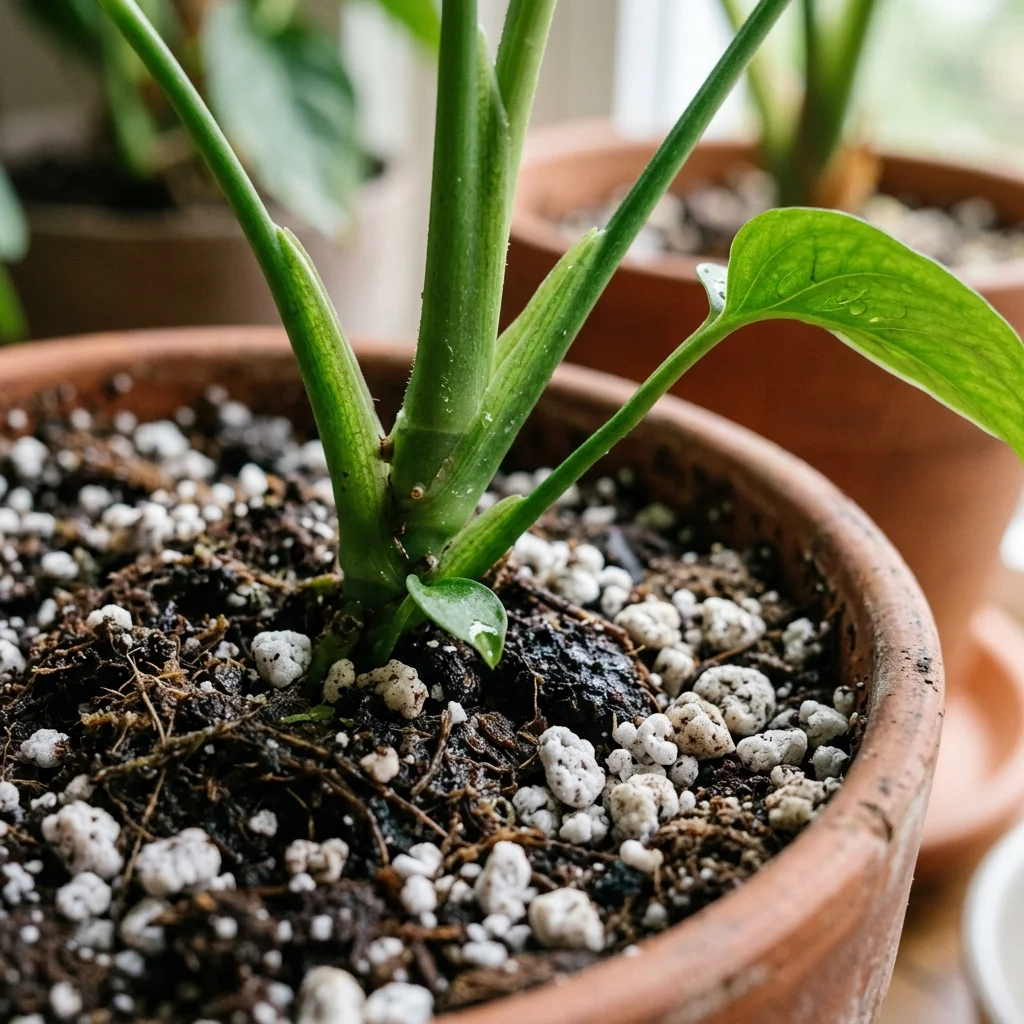
Perlite is a lightweight, expanded volcanic glass amendment that improves soil structure by creating air spaces within potting mix. It is inert and contributes minimal nutrients, but its porous particles can improve root-zone aeration and drainage. Unlike organic amendments such as compost, peat, or bark, perlite does not decompose in the same way. It can therefore remain useful in a potting mix for many years. However, physical conditions can change over time: particles may become crushed, migrate toward the surface, or become less effective as the surrounding growing medium breaks down and compacts. When repotting, there is usually no need to replace perlite simply because it has reached a certain age. Instead, assess the condition of the entire growing medium and refresh or replace the mix when it has become compacted, degraded, or otherwise unsuitable for the plant.
Quick Answer
Perlite can remain functional in potting soil for many years because it is an inert volcanic-glass material that does not decompose like organic amendments. Over time, individual particles can become crushed or displaced, while the surrounding potting mix can break down and compact. Rather than replacing perlite on a fixed schedule, assess the condition of the entire potting mix when repotting.
What Is Perlite?
Perlite is a lightweight, expanded volcanic glass amendment. It is naturally occurring volcanic glass that is heated to high temperatures until it expands into porous, white, popcorn-like particles.
Properties of Perlite
- Inert and Stable: Perlite is a mineral material that does not decompose like organic amendments such as compost, peat, or bark.
- Lightweight: Its expanded structure is physically very light, reducing the overall weight of large potted plants.
- Neutral to Near-Neutral: Perlite generally has little effect on the overall chemistry of a properly formulated potting mix.
- Minimal Nutrient Value: It contributes virtually no nutrients to the growing medium. Its primary function is physical rather than nutritional.
What Perlite Does
In horticulture, perlite is valued primarily for its physical ability to improve soil structure and the root environment.
Aeration
Because healthy roots require oxygen for respiration, poorly aerated soils can limit root function. Perlite particles create physical air spaces within a growing medium, helping maintain oxygen exchange around the root zone.
Drainage
Perlite can disrupt the dense structure of peat- or coir-based growing media, creating additional pore spaces that allow excess water to drain more readily. Appropriate drainage can help reduce prolonged waterlogging.
Root-Zone Structure
Perlite helps maintain a more open growing medium. Over time, however, repeated watering, root growth, handling, and decomposition of organic components can change the structure of a potting mix.
Propagation
Perlite is frequently used in propagation because it provides a porous growing environment with good air exchange. It can be used alone or combined with other propagation materials depending on the plant and propagation method.
How Long Does Perlite Last in Soil?
Perlite can remain functional in potting soil for many years because it is an inert volcanic-glass material and does not decompose like organic amendments. There is no universal replacement interval that applies to every pot or growing medium.
Does Perlite Decompose?
Perlite does not biodegrade like compost, peat, bark, or other organic materials. Its main changes over time are physical rather than biological. Individual particles can be crushed or broken through handling and repeated physical stress.
Why Does Perlite Sometimes Disappear From the Soil?
Perlite is very lightweight, so repeated watering and movement can cause some particles to migrate toward the surface or become redistributed within the container. It can also become less visible as roots grow and the surrounding growing medium changes.
Does Old Perlite Stop Working?
Perlite does not suddenly expire. Its usefulness depends on the physical condition of the particles and the surrounding growing medium. Crushed particles may contribute less to large pore spaces, while an aged potting mix may become compacted even when some perlite remains intact.
When Should You Replace Perlite?
There is generally no need to replace perlite on a fixed schedule. When repotting, evaluate the entire growing medium. If the mix has become compacted, degraded, poorly draining, or otherwise unsuitable for the plant, replacing or refreshing the mix is usually more appropriate than replacing perlite based solely on its age.
Perlite vs. Vermiculite vs. Pumice
Choosing the right amendment depends on the plant's moisture and structural requirements.
| Amendment | Water Retention | Aeration & Drainage | Best Used For |
|---|---|---|---|
| Perlite | Low to Moderate | Excellent | Houseplants, propagation, and mixes where additional pore space is needed |
| Vermiculite | High | Moderate | Moisture-retentive mixes and seed starting |
| Pumice | Low to Moderate | Excellent | Long-lasting mineral mixes and situations where greater particle weight is useful |
Tools and Materials You'll Need
- Horticultural perlite: Choose a particle grade appropriate for the growing medium and plant.
- Potting mix: Provides organic matter and nutrient-holding capacity.
- Protective mask: Recommended when handling dry perlite because fine dust can become airborne.
Step-by-Step: How to Apply Perlite
- Wear appropriate respiratory protection and lightly moisten dry perlite before handling to minimize airborne dust.
- Measure the growing medium and prepare a clean mixing container.
- For most houseplants, use a suitable proportion of perlite based on the drainage and aeration requirements of the plant and the characteristics of the existing potting mix.
- For succulents and cacti, use a more mineral-rich, freely draining mix appropriate for the particular plant rather than relying on a single universal perlite ratio.
- Blend the ingredients thoroughly so the perlite is distributed throughout the root zone.
Frequently Asked Questions
Does perlite really improve plant growth?
Perlite can support healthier root conditions by increasing pore space, aeration, and drainage within a growing medium. It does not supply significant nutrients, so its benefit comes primarily from improving the physical environment around the roots.
When is the best time to add perlite to soil?
Perlite is easiest to incorporate when preparing a new potting mix, potting a plant, or repotting. Mixing it throughout the growing medium provides more consistent distribution around the root zone.
Can perlite be used by itself for propagation?
Yes. Perlite can be used as a propagation medium for some plants because it provides good air exchange while retaining some moisture. The appropriate method depends on the plant and propagation technique.
How long does perlite last in soil?
Perlite can remain functional in potting soil for many years because it is an inert volcanic-glass material that does not decompose like organic amendments. Individual particles can become crushed or displaced over time, while the surrounding potting mix can break down and compact. Instead of replacing perlite on a fixed schedule, assess the condition of the entire growing medium when repotting.
Does perlite expire or go bad?
Perlite does not have a typical expiration date. Because it is an inert mineral material, it does not rot or biodegrade like organic amendments. Its physical condition and the condition of the surrounding potting mix are more important than its age.
Why does perlite float to the top of my pot?
Perlite is very lightweight, so watering and movement can redistribute particles within a container and cause some to appear at the surface. This does not necessarily mean the perlite has stopped working.
When should I replace perlite in a pot?
There is no universal schedule for replacing perlite. When repotting, inspect the entire growing medium for compaction, breakdown, poor drainage, or other problems. Refresh the mix when its overall condition requires it rather than replacing perlite solely because it is old.
What is the difference between horticultural perlite and construction perlite?
Horticultural perlite is produced and graded for growing-media applications. Construction products can differ in particle size, formulation, and intended use, so a product should only be used for plants when its specifications indicate that it is suitable for horticultural applications.
Explore More
Related Topics
Related Plant Guides
No specific plant guides found matching this topic.
Recommended next actions
Continue Exploring
Dive deeper into related plant care tools and profiles.
Topic Guide
Potting Mix
Learn everything about potting mix for your indoor and aquarium plants. Expert care tips, troubleshooting, and related guides.
Topic Guide
Drainage
Learn everything about drainage for your indoor and aquarium plants. Expert care tips, troubleshooting, and related guides.
Topic Guide
Watering
Learn everything about watering for your indoor and aquarium plants. Expert care tips, troubleshooting, and related guides.