Potting Mix Calculator: Get the Right Perlite, Bark & Coco Coir Ratio
Calculate the ideal potting mix ratios for any plant type — from moisture-loving tropicals to drought-tolerant succulents.
Quick Answer
By factoring in your specific plant type and environmental conditions, you can precisely tailor your care routine to ensure optimal health and prevent common issues like root rot.
Enter your details
Enter your details below to generate a custom recommendation.
Recommended Output
Base Soil / Cocopeat
Aeration Material
Bark or Coarse Chips
Potting Mix / Worm Castings
Mix Guidance
The Problem
Many plant owners guess at their care routines, leading to root rot, burned leaves, or stunted growth. Generic advice doesn't factor in specific plant species and local climate.
When to Use This Tool
Use this calculator when you bring home a new plant, when seasons change, or if your plant is showing signs of distress.
Who is this for?
- Beginner houseplant owners looking to avoid common mistakes
- Advanced collectors wanting to optimize growth rates
About this calculator
Using this calculator removes the guesswork from your plant care routine.
How to Use
- Select your plant type.
- Input your environmental conditions.
- Get your personalized recommendation.
The Importance of Precision
Every plant species has adapted to specific conditions in the wild. By mimicking those conditions in your home, you can dramatically increase the lifespan and vitality of your collection.
Visual Reference: Ideal Texture
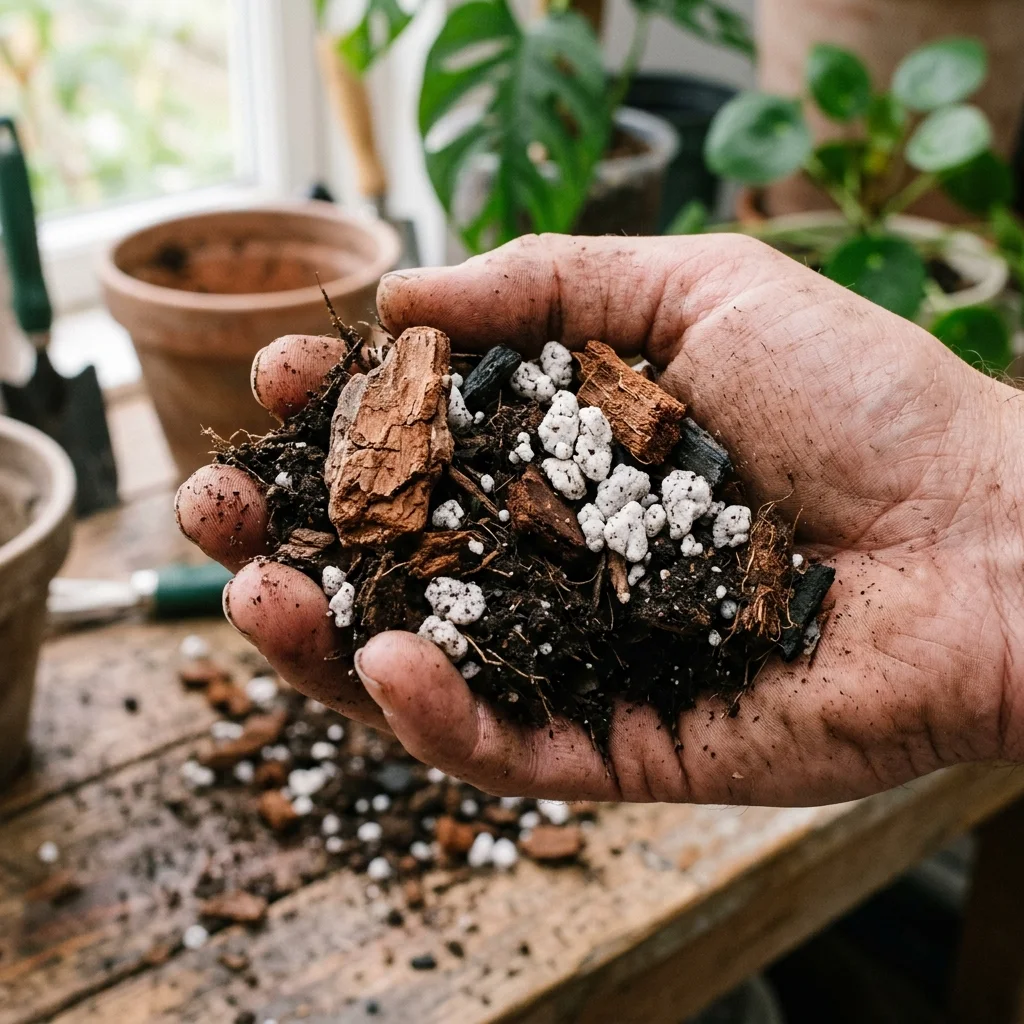
Chunky Aroid Mix: Notice the large pieces of orchid bark and white perlite mixed into the dark soil. This structure creates large air pockets (macropores) that prevent root rot while allowing rapid drainage.
Recommended next actions
Next Best Actions
Use the result in a real care workflow with plant profiles, guides, and personalized quizzes.
Calculator
Repotting Calculator: Does Your Plant Need a Bigger Pot?
Find out if your plant needs repotting now and get the correct new pot size based on species, current pot size, and root health indicators.
Calculator
Grow Bag Size Calculator: Find the Right Bag for Every Plant
Find the perfect grow bag size for your plant based on root depth, plant type, and expected mature size.
Potting Mix Ratio Calculator Variations & Requirements
| Variation | Light Requirement | Watering Frequency | Difficulty |
|---|---|---|---|
| Standard | Bright Indirect | Weekly | Medium |
| Variegated | High Light | Weekly | Hard |
| Dwarf | Medium Light | Bi-Weekly | Easy |
Troubleshooting & Diagnostics Guide
1 Plant is dropping leaves despite following the recommendation
Diagnosis: Drafts, sudden temperature changes, or pest issues not related to the calculator's focus area.
Treatment: Isolate the plant, check for pests, and ensure it is away from heating/cooling vents.
Glossary of Terms
- Transpiration
- The process of water movement through a plant and its evaporation from aerial parts.
- Photoperiod
- The period of time each day during which an organism receives illumination.
Frequently Asked Questions
Is this calculator accurate for store-bought potting soil?
Are these soil recipes safe for sensitive plants like orchids?
What is the difference between perlite and pumice?
Why do aroids need orchid bark in their soil?
Can I use outdoor garden soil instead of indoor potting mix?
Why is my potting mix staying wet for over two weeks?
Why is water running straight through the pot without absorbing?
How do I adjust this recipe for a self-watering pot?
Reader Feedback
Feedback from PlantSolve readers who have used this guide. (5 reviews)
Nina B.
Berlin, DE
Calculated custom soil component ratios
Helped me work out the right proportion of perlite and orchid bark to add into my potting soil for improved drainage.
Justin W.
Portland, OR
Helped me scale a potting mix batch
I wanted to batch mix coco coir, perlite, and compost for several indoor containers. Calculating the combined dry volume made it easy to prep the whole batch at once.
Hannah G.
Salt Lake City, UT
Determined bag count from container diameters
I had six 8-inch round pots and four 10-inch containers to fill. Entering those diameters gave me the total cubic feet I needed so I could pick up the right bag count.
Lucas R.
Orlando, FL
Broke down parts for bucket mixing
Setting custom percentages for bark, perlite, and peat moss gave me the calculated parts needed to fill a five-gallon bucket for repotting.
Abby M.
Indianapolis, IN
Converted container dimensions to dry quarts
Entered the dimensions for my container arrangement and got the volume in cubic feet and dry quarts, making bag calculations much simpler.