Paludarium Water Volume Calculator: Gallons & Liters
Calculate the gross aquatic zone volume and estimate net usable water volume of a paludarium in gallons and liters. Deduct foundation and hardscape displacement.
Quick Answer
Use this calculator to find the gross geometric water volume of your paludarium and estimate the net usable volume by subtracting displacement from hardscape and substrate.
Enter your details
Enter your aquatic-zone dimensions and optional displacement values to estimate the usable water volume in your paludarium.
Recommended Output
Estimated net usable water volume (Liters)
Estimated net usable water volume (US Gallons)
Gross geometric aquatic volume (Liters)
Gross geometric aquatic volume (US Gallons)
Total displacement (Liters)
Total displacement (US Gallons)
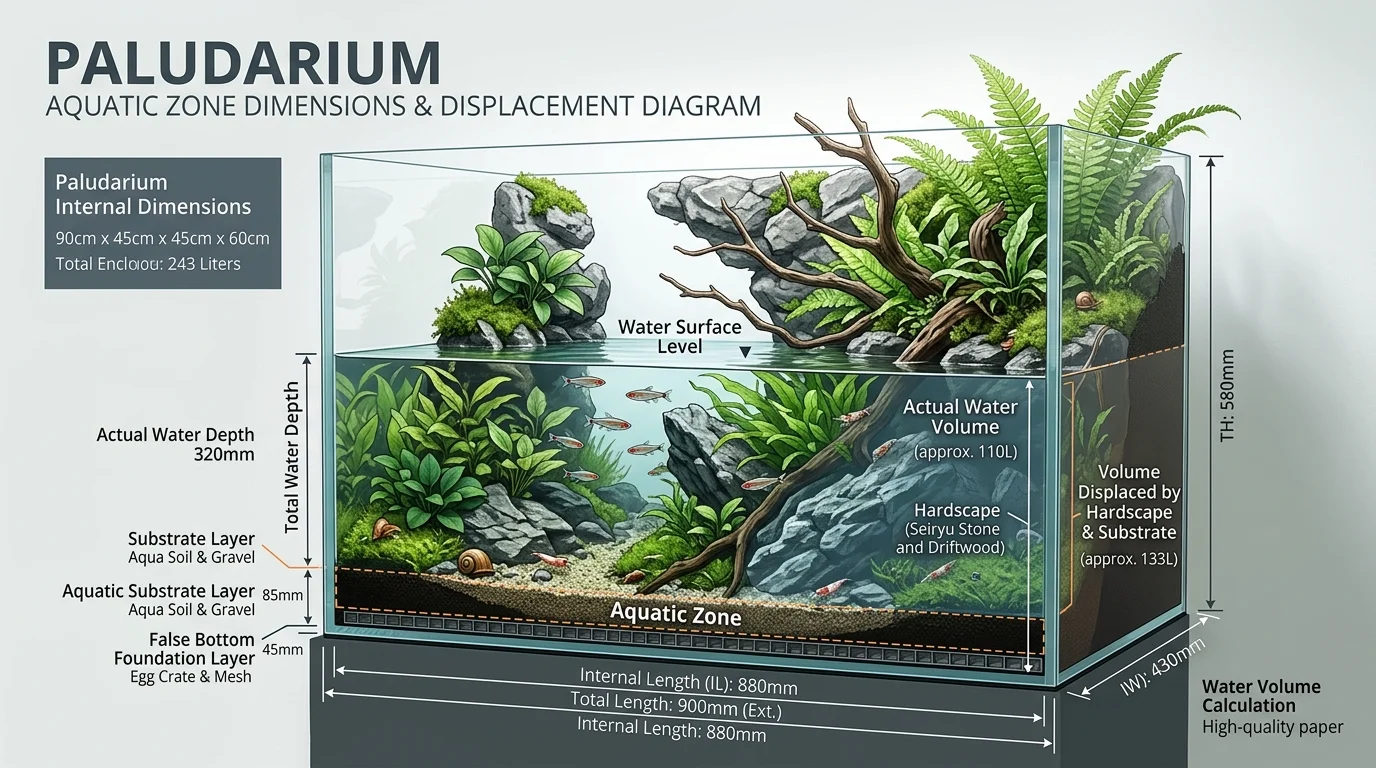
What this calculator measures
A paludarium is a hybrid ecosystem combining terrestrial land sections with an aquatic zone. Because water fills only a fraction of the enclosure and because land foundations, substrate layers, and hardscapes occupy significant space inside the water column, the actual usable water volume is far lower than outer tank dimensions suggest.
This calculator determines the gross geometric aquatic volume of your water column and estimates your net usable water volume by explicitly deducting displacement from foundations, substrates, and hardscape features.
Understanding the inputs & dimensions
To get an accurate result, enter the following key dimensions into the calculator above:
- Internal Length (in / cm): The inside length of the water-holding section (excluding glass thickness and dry land side barriers).
- Internal Width (in / cm): The inside width from front to back glass within the aquatic zone.
- Actual Water Depth (in / cm): The vertical distance from the top surface of the main substrate bed up to the water line. Do not measure total tank height.
- Foundation Displacement (gal / L): Optional volume consumed by false bottoms, egg crate grids, PVC risers, or drainage bricking submerged in the water column.
- Substrate Displacement (gal / L): Optional volume of extra gravel or aqua soil banked up inside the measured free-water column.
- Hardscape Displacement (gal / L): Optional volume of submerged Seiryu stone, dragon stone, lava rock, or driftwood occupying water space.
Common paludarium setups & reference values
If you are planning a build or estimating volume before filling your enclosure, use these standard reference values as baseline benchmarks for common paludarium tank sizes:
| Tank Type / Enclosure | Dimensions (L × W × Depth) | Gross Water Volume | Est. Displacement | Net Usable Water Volume |
|---|---|---|---|---|
| 10 Gallon Nano Paludarium | 19.5 in × 9.5 in × 5.0 in | 4.01 US gal (15.18 L) | 0.80 US gal (3.03 L) | ~3.21 US gal (12.15 L) |
| 20 Gallon Long Paludarium | 29.5 in × 11.5 in × 6.0 in | 8.81 US gal (33.35 L) | 1.80 US gal (6.81 L) | ~7.01 US gal (26.54 L) |
| 40 Gallon Breeder Paludarium | 35.5 in × 17.5 in × 7.0 in | 18.83 US gal (71.28 L) | 3.80 US gal (14.38 L) | ~15.03 US gal (56.90 L) |
| 55 Gallon Standard Paludarium | 47.5 in × 12.5 in × 8.0 in | 20.56 US gal (77.83 L) | 4.50 US gal (17.03 L) | ~16.06 US gal (60.80 L) |
How to measure irregular hardscape displacement
Rocks, driftwood, and custom foam backgrounds have complex, irregular shapes. The easiest way to measure their true displacement volume is the bucket displacement method:
- Fill a bucket with a known baseline volume of water.
- Completely submerge the rock or wood piece.
- Note the new water level. The difference in volume is the exact displacement of that piece.
Recommended next actions
Next Best Actions
Use the result in a real care workflow with plant profiles, guides, and personalized quizzes.
Calculator
Paludarium Water Volume & Land Ratio Calculator
Calculate net paludarium water volume, land and water surface areas, false bottom void capacity, and minimum pump flow in metric or imperial units.
Topic Guide
Paludarium Water Pumps: Sizing, Waterfall Plumbing & Circulation
Size and plumb paludarium pumps: GPH vs head height calculation, hidden pump chambers, drip wall plumbing, avoiding dead zones, and pump maintenance.