What Is a Paludarium? Design, Anatomy, and Ecosystem Setup
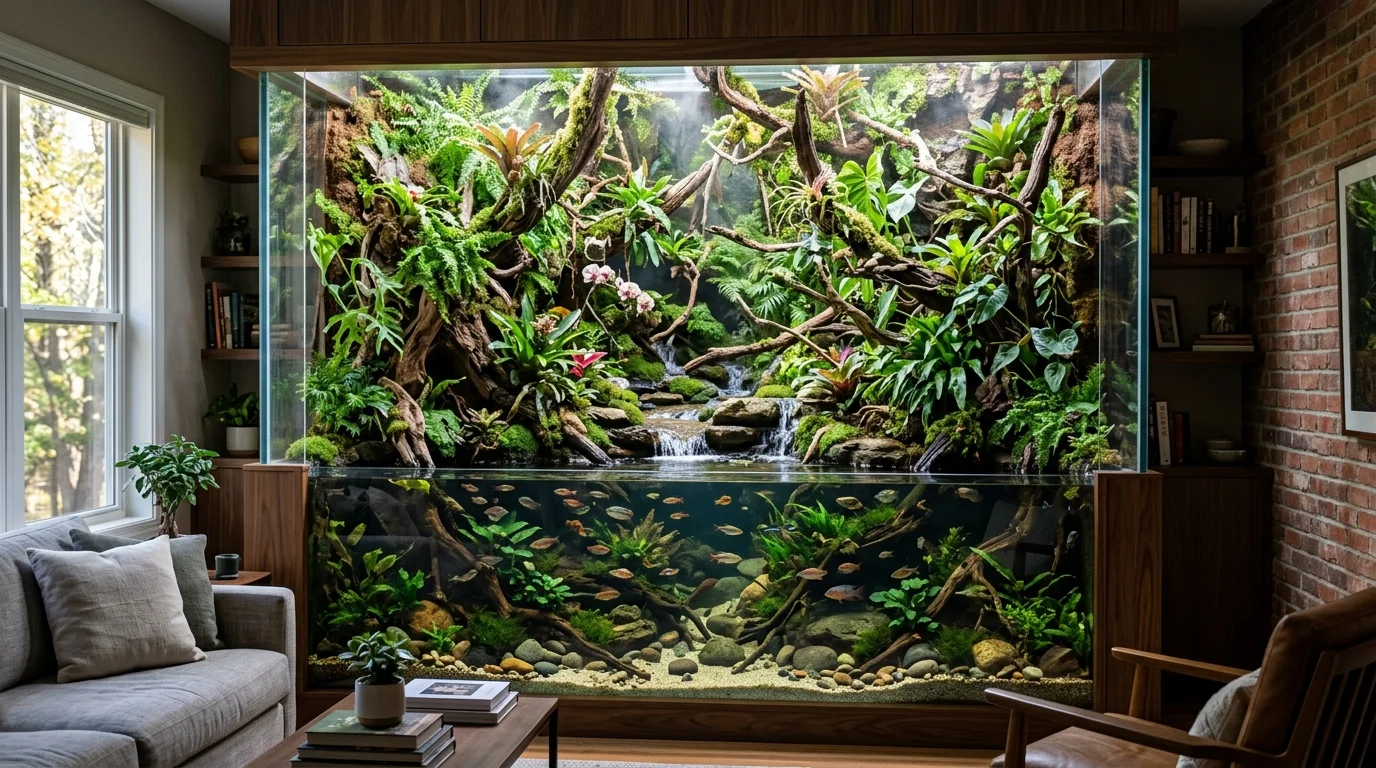
A paludarium combines land and water within the same enclosure, creating a transition between terrestrial and aquatic habitat. The most successful designs treat the enclosure as an integrated system rather than simply placing a pool of water inside a terrarium. Land elevation, drainage, substrate, water movement, humidity, planting, and access all need to work together. There is no single land-to-water ratio that defines every paludarium. The appropriate proportions depend on the intended plants, animals, enclosure dimensions, aquatic volume, and how much terrestrial habitat must remain above the waterline. The biological side of a paludarium is equally important: moisture moves through the substrate, water evaporates into the enclosure, plants interact with both zones, and microbial communities process organic matter. A paludarium can therefore range from a mostly terrestrial planted enclosure with a small aquatic section to a substantially aquatic display with elevated planting areas. The defining characteristic is the intentional integration of land and water rather than a particular percentage or construction recipe.
Quick Answer
A paludarium is a planted enclosure that combines a terrestrial or semi-terrestrial land zone with a permanent or semi-permanent aquatic zone in one controlled environment. Unlike a conventional terrarium, which is primarily terrestrial, a paludarium deliberately incorporates water as part of the habitat. Unlike an aquarium, it is not primarily an underwater environment: land, emergent plants, substrate, humidity, drainage, and water circulation all contribute to the design.
Key Takeaways
- A paludarium intentionally combines terrestrial and aquatic zones in one enclosure.
- There is no universal land-to-water ratio; proportions should follow the intended plants, animals, and enclosure design.
- The land-water boundary needs to be structurally stable so substrate cannot continually collapse into the aquatic zone.
- Drainage and water circulation are separate functions: drainage manages excess moisture in the land zone, while circulation moves water through the aquatic system.
- Bioactive paludariums rely on living plants, microorganisms, and often decomposer organisms to process organic material, but biological activity does not eliminate the need for maintenance.
- Aquatic volume should be calculated from the actual water zone rather than the total external dimensions of the enclosure.
- A pump can provide circulation without necessarily providing biological or mechanical filtration.
- Plant selection should account for whether roots remain submerged, saturated, or in well-drained terrestrial substrate.
What Is a Paludarium?
A paludarium is an enclosed habitat that intentionally combines a terrestrial zone with an aquatic zone. The word is commonly used for semi-aquatic planted displays in which land, water, vegetation, substrate, humidity, and water movement are designed as parts of the same system.
The important distinction is not a particular percentage of land versus water. A paludarium is defined by the integration of terrestrial and aquatic environments. One enclosure may contain a large terrestrial planting area with a small pool, while another may devote much more space to water and use elevated land for emergent plants.
This makes paludarium design an exercise in managing transitions. Water must remain where it is intended to be, terrestrial substrate must remain structurally stable, roots need an appropriate moisture environment, and the aquatic zone needs enough circulation and maintenance for its intended biological load.
Paludarium vs. Terrarium vs. Aquarium
A paludarium sits between the design concepts of a terrarium and an aquarium, but it should not be treated as simply an aquarium with some plants sticking out of the top or a terrarium with a decorative puddle.
| Enclosure | Primary Environment | Land | Water | Main Design Priority |
|---|---|---|---|---|
| Paludarium | Terrestrial + aquatic | Functional | Functional | Integration of land, water, planting, moisture, and circulation |
| Terrarium | Primarily terrestrial | Dominant | Usually incidental | Planting, substrate, humidity, and drainage |
| Aquarium | Primarily aquatic | Usually absent | Dominant | Water quality, aquatic habitat, circulation, and filtration |
The boundaries are not absolute in hobby terminology, and different builders may use the terms somewhat differently. For practical design purposes, the useful question is which environmental zones are deliberately being maintained and what biological requirements those zones create.
The Anatomy of a Paludarium
A well-designed paludarium can be understood as several connected zones rather than a single container of soil and water.
Terrestrial Zone
The terrestrial zone supports plants and, where appropriate, terrestrial or semi-terrestrial animals. Its substrate must hold plants securely while retaining enough moisture for the intended species without remaining unnecessarily saturated.
Land elevation is often created with hardscape, retaining structures, inert materials, or other stable construction methods. The goal is not simply to pile substrate above the waterline: loose substrate at the shoreline can erode into the aquatic zone and gradually change the shape and volume of both habitats.
Aquatic Zone
The aquatic zone is the portion of the enclosure intentionally maintained as water. Its usable volume depends on the actual water footprint and water height, not simply the outside dimensions of the enclosure.
For rectangular water sections, geometric water volume can be calculated from length × width × water height. Hardscape, substrate, roots, and other objects occupying the water can reduce the actual usable water volume. When that distinction matters, calculate the geometric volume first and account separately for estimated displacement.
For a rectangular aquatic section, the Paludarium Water Volume Calculator can calculate the geometric volume and estimate net usable water volume after user-entered displacement.
Transition Zone
The transition between land and water is one of the most important structural areas in a paludarium. It is where substrate, roots, water movement, hardscape, and evaporation all interact.
A stable transition prevents the terrestrial substrate from continuously washing into the aquatic zone. It also allows plants to occupy the shoreline without forcing every root system into the same moisture conditions.
Drainage Zone
Terrestrial substrate can receive substantial moisture from watering, condensation, splash, capillary movement, and evaporation. A drainage zone gives excess water somewhere to collect instead of requiring the root-zone substrate to remain saturated.
Drainage should not be confused with filtration. A drainage layer can collect water beneath the substrate, but it does not automatically make that water suitable for aquatic animals or provide biological filtration.
Land and Water: How Much of Each?
There is no universal land-to-water ratio that defines a paludarium. The correct balance depends on what the enclosure is designed to support.
- A plant-focused display may devote most of its area to terrestrial substrate with a relatively small aquatic section.
- A semi-aquatic animal habitat may require substantially more accessible land or shoreline than a purely decorative planted display.
- A display built around emergent plants may use water as the dominant lower zone while providing elevated planting surfaces.
- A deeper aquatic zone requires greater attention to water volume, circulation, access, and maintenance than a shallow decorative pool.
Instead of choosing a ratio first and forcing the inhabitants into it, design backward from the biological requirements. Determine how much usable terrestrial habitat and aquatic habitat the intended plants or animals require, then construct the boundary between those zones.
Water Circulation and Moisture Flow
Water moves through a paludarium in several different ways. It may be deliberately pumped through the aquatic zone, move through drainage pathways, evaporate into the enclosure air, condense on cooler surfaces, or be absorbed by substrate and plant roots.
These processes should be considered separately. Circulation moves water. Drainage removes excess water from the terrestrial root zone. Filtration treats water through mechanical, biological, chemical, or combined processes depending on the equipment and design.
A pump therefore does not automatically equal filtration. A small circulation pump can move water between zones while providing little or no dedicated filtration. Conversely, filtration equipment may require a circulation system to move water through the filter.
The amount of circulation required depends on aquatic volume, livestock or organic load, plant density, temperature, enclosure geometry, and the purpose of the aquatic zone. A decorative water feature has different requirements from an aquatic habitat carrying a significant biological load.
Bioactive Paludarium Mechanics
A bioactive paludarium uses living organisms and biological processes as part of its maintenance system. Plants, microorganisms, decomposer organisms, and organic substrates can interact to process fallen leaves and other organic material.
The biological community is not a substitute for system design. Good bioactive construction still requires appropriate drainage, suitable substrate, controlled moisture, stable hardscape, and regular observation.
Decomposition also produces nutrients and dissolved organic material. If organic material accumulates faster than the system can process it, maintenance is still required. Removing excessive waste, dead plant material, and decaying material remains part of responsible husbandry.
For the substrate side of a bioactive enclosure, see Bioactive Substrate for Paludariums.
Planting the Land-Water Boundary
Plant selection becomes more flexible when the enclosure contains several moisture zones. Some plants tolerate consistently moist terrestrial substrate, some prefer a periodically drying root zone, and others can grow with their roots submerged while their leaves remain above water.
The key question is therefore not simply whether a plant is labelled an "aquatic" or "terrarium" plant. Consider where its roots will sit, how much oxygen remains available around those roots, whether the leaves will remain above the waterline, and how quickly the substrate drains.
Plants should be selected according to their actual environmental requirements rather than assuming that high humidity means every part of the enclosure should remain wet.
Hardscape and Structural Stability
Hardscape performs more than a decorative function in a paludarium. Rocks, wood, retaining structures, and other inert construction elements can define elevation, support substrate, create planting pockets, and separate land from water.
Any structure supporting elevated substrate or heavy hardscape should be stable before plants and animals are introduced. A failure that occurs after the enclosure is established can change water volume, bury plants, damage equipment, or trap animals.
Build the structure first, then establish the drainage and substrate layers around it. Avoid relying on loose substrate alone to hold back a significant volume of water.
Humidity, Ventilation, and Condensation
Because water is deliberately exposed inside a paludarium, evaporation can substantially increase enclosure humidity. High humidity can be beneficial for suitable tropical plants, but permanently saturated air is not automatically better.
Ventilation helps exchange air and manage condensation. The appropriate balance depends on enclosure design, temperature, plant density, exposed water surface, and the requirements of the organisms being kept.
Persistent condensation can obscure viewing surfaces and keep terrestrial foliage wet for long periods. If fungal growth repeatedly appears on leaves or surfaces, evaluate airflow and moisture management rather than simply adding more humidity.
Maintenance: A Paludarium Is an Ecosystem, Not a No-Maintenance System
A mature paludarium may stabilize some biological processes, but it still needs observation and maintenance. Plants grow, roots change the structure of the substrate, organic matter accumulates, pumps and filters require cleaning, and water chemistry can change as biological material enters or leaves the system.
- Inspect the land-water boundary for erosion or substrate movement.
- Check pumps and circulation pathways for obstruction.
- Remove excessive dead plant material before it accumulates.
- Observe terrestrial substrate for persistent saturation.
- Monitor the aquatic zone according to its biological load and inhabitants.
- Trim plants before growth blocks ventilation, access, or circulation.
- Reassess hardscape stability if roots or substrate begin shifting structures.
Common Paludarium Design Mistakes
- Designing the water feature first without considering the land zone: The aquatic section can consume space that terrestrial plants or animals actually need.
- Treating drainage as filtration: A drainage reservoir does not automatically provide suitable aquatic water treatment.
- Using unstable substrate as a retaining wall: Loose soil can erode into the water and change the enclosure over time.
- Ignoring actual aquatic volume: The external enclosure dimensions can substantially overstate the amount of usable water.
- Assuming every humid plant wants wet roots: High air humidity and saturated root-zone substrate are different environmental conditions.
- Adding circulation without considering flow: Excessive current can disturb substrate, uproot plants, or create unsuitable conditions for intended inhabitants.
- Assuming bioactive means maintenance-free: Biological processing reduces some maintenance demands but does not eliminate observation, pruning, cleaning, or water management.
How to Plan a Paludarium Before Building
- Define the biological goal. Decide whether the enclosure is primarily a planted display, a semi-aquatic habitat, or a mixed system built around specific organisms.
- Map the land and water zones. Establish the usable terrestrial and aquatic areas before selecting decorative materials.
- Design the transition. Make the shoreline structurally stable and prevent uncontrolled substrate erosion.
- Plan drainage separately from aquatic circulation. Excess water in terrestrial substrate and water movement in the aquatic zone are related but different engineering problems.
- Calculate aquatic volume. Use the actual water dimensions and account for major displacement when determining usable water volume. Use the Paludarium Water Volume Calculator for accurate estimates.
- Select plants by root-zone requirements. Match each species to the moisture and oxygen conditions where its roots will actually grow.
- Install circulation and filtration where appropriate. Match equipment to water volume and biological load rather than assuming every paludarium needs the same equipment.
- Test the system before stocking. Allow water movement, drainage, humidity, and structural stability to be observed before introducing sensitive organisms.
Paludarium Taxonomy & Ecosystem Comparisons
Choosing the correct enclosure layout depends on whether your livestock and botanical goals require a deep aquatic reservoir, an open-water plant filter, or a purely terrestrial drainage setup:
- Paludarium vs Riparium: Compares a true false-bottom landmass against an 80–95% water display using floating trellises and hanging planters.
- Paludarium vs Vivarium: Compares dual-habitat circulation with terrestrial bioactive enclosures designed for non-swimming species like dart frogs.
- Paludarium vs Terrarium: Contras dynamic circulating hydraulic systems with closed evaporation-condensation loops.
- Open vs Closed Paludarium: Evaluates microclimate humidity retention, condensation control, and evaporation buffer physics.
Core Engineering & Botanical Systems
Detailed engineering and horticultural breakdowns for every paludarium zone:
- Filtration & Pumps: Circulation, turnover rates, and concealing intake vaults.
- Paludarium Lighting: Managing PAR loss across air, glass lids, and water depth.
- Waterfall Construction: Flow plumbing, splash containment, and acoustic dampening.
- Paludarium Moss: Attachment methods, capillary wicking, and drip-wall hydration.
- Emersed vs Submerged Plants: Physiological leaf transitions and cuticle development.
- Plant Melting & Root Hypoxia: Diagnosing bacterial soft rot, foul substrate, and transition shock.
Frequently Asked Questions
What is the difference between a paludarium and a terrarium?
A paludarium intentionally contains both terrestrial and aquatic zones, while a conventional terrarium is primarily terrestrial. A terrarium may contain moisture, drainage, or a small water feature, but water is not normally treated as a second functional habitat. In a paludarium, the land-water boundary is part of the core design.
Does a paludarium need both land and water?
Yes, in the practical hobby sense, a paludarium is designed around the coexistence of terrestrial and aquatic environments. The amount of each can vary considerably. There is no single land-to-water percentage that defines every paludarium.
How much water should a paludarium have?
There is no universal water depth or percentage for all paludariums. The aquatic zone should be sized according to the intended plants, animals, circulation system, access requirements, and enclosure dimensions. For a rectangular aquatic section, calculate the actual water volume from its length, width, and water height rather than using the external enclosure dimensions.
Does a paludarium need a filter?
Not every paludarium needs the same filtration equipment. The requirement depends on aquatic volume, biological load, water movement, plants, and whether animals are being kept in the water. A circulation pump and a filter are not the same thing: a pump moves water, while filtration provides a mechanism for removing or processing particular types of waste.
Can a paludarium be bioactive?
Yes. A bioactive paludarium incorporates living plants, microorganisms, and often decomposer organisms into the system so that biological processes contribute to organic-matter processing. Bioactive design does not eliminate maintenance; excessive waste, dead plant material, equipment buildup, and water-quality issues still need attention.
Do paludariums need a drainage layer?
A separate drainage zone can be useful when the terrestrial substrate receives more water than it should retain. It provides somewhere for excess water to collect below the root-zone substrate. Whether a particular construction requires a conventional drainage layer depends on the enclosure architecture, substrate design, and how water is managed.
Can I use normal potting soil in a paludarium?
A generic houseplant potting mix should not automatically be treated as suitable for every paludarium. The substrate must be evaluated for its moisture retention, structure, particle size, decomposition behavior, and interaction with the aquatic zone. If the substrate will remain continually saturated, a conventional terrestrial mix may not provide the root-zone conditions intended for plants that require aerated soil.
How do I keep the land from collapsing into the water?
Build a stable physical boundary between the terrestrial substrate and aquatic zone. Hardscape, retaining structures, mesh-supported construction, or other appropriate structural methods can prevent loose substrate from continuously eroding into the water. Do not rely on a pile of loose soil to retain a substantial water boundary.
Can plants grow with their roots underwater in a paludarium?
Some plants can grow with submerged or permanently wet roots, while others require an aerated terrestrial root zone. Plant selection should therefore be based on the conditions at the roots rather than humidity alone. Emergent growth can also allow leaves to remain above water while roots occupy a saturated or aquatic environment.
Is a paludarium the same as a riparium?
No. The terms describe overlapping but different design concepts. A paludarium broadly integrates terrestrial and aquatic habitat, while a riparium generally emphasizes plants and structure associated with the margins of a body of water. Hobby terminology is not completely standardized, so the actual physical design is more useful than the label alone.
Sources & References
-
Source: en.wikipedia.org
-
Source: practicalfishkeeping.co.uk
-
Source: neherpetoculture.com
-
Source: neherpetoculture.com
Explore More
Related Articles
Related Plant Guides
No specific plant guides found matching this topic.
Recommended next actions
Continue Exploring
Dive deeper into related plant care tools and profiles.
Topic Guide
Paludarium Plants: Choosing Plants for Land & Water Zones
Learn how to choose paludarium plants by land, emergent, humid, and aquatic zones, with guidance on light, moisture, growth, and maintenance.
Topic Guide
How to Build a Paludarium Step by Step
A practical step-by-step construction workflow covering planning, enclosure selection, terrain structure, drainage, substrate, hardscape, water systems, lighting, planting, filling, testing, and stabilization.
Topic Guide
Paludarium Water Volume: Calculating Your Usable Aquatic Space
A guide to determining the true usable water volume in a paludarium setup, with worked examples, displacement estimates, and equipment sizing.
Topic Guide
Paludarium Filter and Pump Guide
A practical hydraulic and equipment guide for sizing paludarium pumps and filtration around net water volume, operating head, plumbing resistance, shallow-water intake geometry, flow control, evaporation, heating, biological media, canister filters, and serviceability.
Topic Guide
Paludarium Lighting Guide
A practical engineering guide to paludarium lighting covering plant-level PAR targets, terrestrial and submerged gradients, photoperiod, spectrum, fixture elevation, optical losses, heat and evaporation.
Topic Guide
Paludarium Waterfall Guide
A practical construction guide for paludarium waterfalls covering cascading flow paths, expanding-foam baffles, slate tiers, structural support, splash mitigation, acoustic dampening, mold prevention and hidden plumbing service access.