Paludarium vs Riparium: Technical Differences, Build Requirements, and Which to Choose
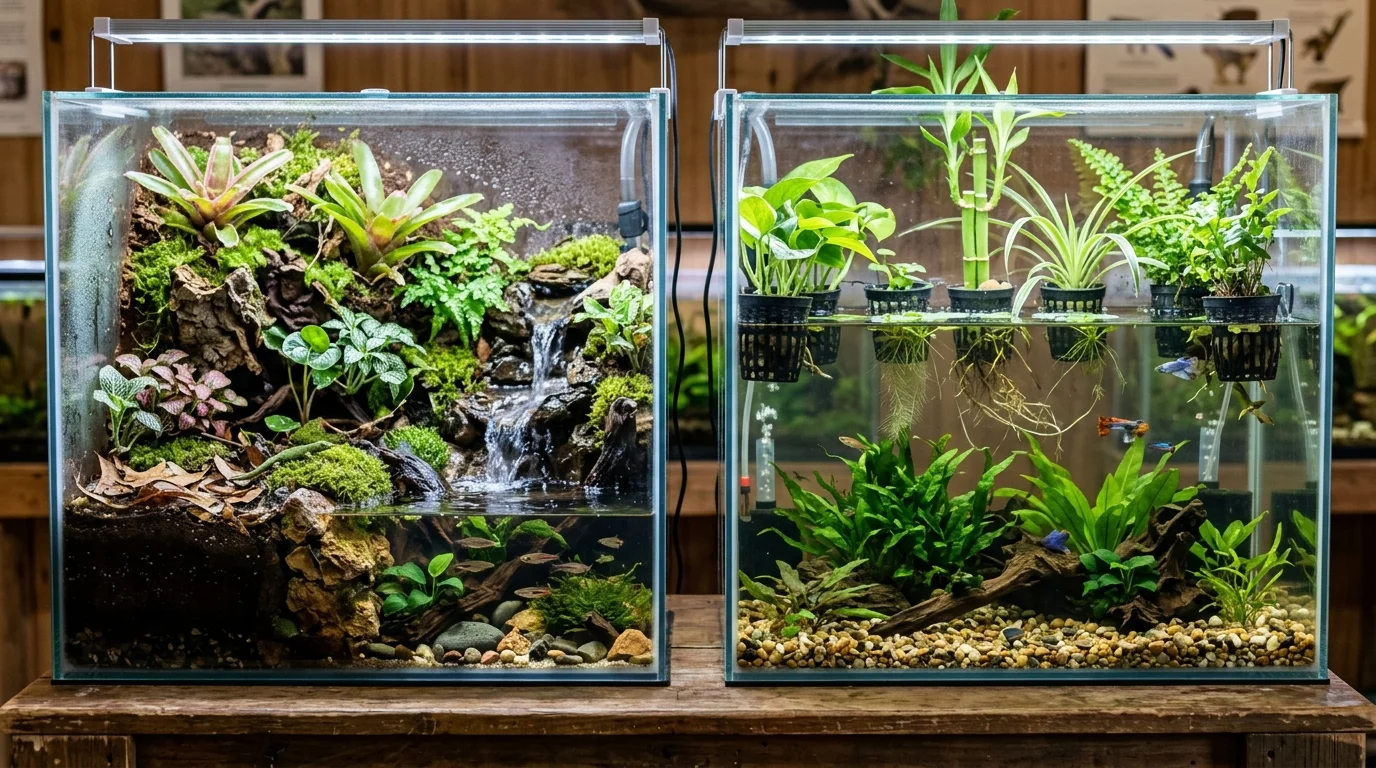
A paludarium is a two-zone engineered habitat with a true terrestrial area, typically 30–70% land built over a false bottom and drainage barrier, while a riparium is essentially an aquarium, roughly 80–95% water, extended upward by emergent plants held in hanging planters or floating trellis rafts. Paludariums add waterfalls, pumps, and managed humidity and suit ferns, bromeliads, mosses, and terrestrial livestock. Ripariums use standard aquarium equipment in ambient room conditions and suit heavy-nutrient emergent feeders such as Peace Lily, Cyperus, Pothos, and Echinodorus that export nutrients from the water column. Ripariums are cheaper and simpler to build and maintain, and an existing aquarium converts to a riparium far more easily than to a paludarium. Choose by deciding first whether a true land zone, terrestrial flora, or humidity-dependent livestock is required.
Quick Answer
A paludarium is a hybrid enclosure with a true terrestrial zone, typically 30–70% land built over a false bottom, drainage barrier, and substrate, and it is usually managed as a humid, partially closed microclimate. A riparium is essentially an aquarium, roughly 80–95% water, in which emergent plants grow with their roots in the water and their foliage above it, held by hanging planters or floating trellis rafts along the back glass, with no real landmass. Choose a paludarium when you want land, terrestrial flora, waterfalls, and humidity-dependent species. Choose a riparium when you want a simple, low-cost, nutrient-exporting planted aquarium with lush emergent growth. Use the paludarium hub for the full overview, the how to build a paludarium guide for construction, and the paludarium plants guide for flora selection.
Key Takeaways
- The deciding variable is land: if you need a real terrestrial zone (soil, drainage layer, terrestrial flora), build a paludarium; if the plants only need their roots in water and their leaves in the air, a riparium delivers that with far less engineering.
- A paludarium is an engineered system (false bottom, drainage barrier, often a pump and waterfall), while a riparium is a standard aquarium plus hanging planters or trellis rafts, so build complexity and cost scale accordingly.
- Ripariums run as open or lightly covered tanks in ambient room humidity, whereas paludariums depend on managed humidity and airflow, so humidity and condensation control is a paludarium problem, not a riparium problem.
- Riparium emergent feeders pull nitrate and phosphate straight from the water column and act as nutrient export, so stock plants to your fish load; paludarium terrestrial flora draw from substrate and humid air and are selected for microclimate tolerance instead.
What Is the Core Difference Between a Paludarium and a Riparium?
Both enclosures combine water with plants growing above it, which is why they are so often confused. The difference is structural: a paludarium contains a dedicated terrestrial zone, while a riparium does not. In a paludarium, part of the enclosure is land, built from soil or an ABG-style mix, supported by a false bottom and separated from the water by a drainage barrier. In a riparium, the enclosure is an aquarium, and the "land" is replaced by emergent plants whose roots sit in the water while their stems and leaves grow into the air above it.
That single decision cascades into everything else: how the tank is built, what plumbing and drainage it needs, which plants are suitable, how humidity behaves, how much maintenance it demands, and what it costs. This guide compares the two systems on each of those variables so the choice can be made on engineering and horticultural grounds rather than aesthetics alone.
Paludarium vs Riparium at a Glance
| Variable | Paludarium | Riparium |
|---|---|---|
| Land-to-water ratio | Roughly 30–70% land | Roughly 80–95% water, no true landmass |
| Terrestrial zone | Yes, soil or ABG-style mix over a drainage layer | No, emergent plants grow from planters or rafts |
| Core structure | False bottom, drainage barrier, hardscape, often a waterfall | Standard aquarium with hanging planters or floating trellis rafts |
| Plant roots | Substrate and humid-air rooting, plus aquatic zones | Roots in the water column |
| Typical enclosure | Partially or fully covered, humidity-managed | Open top or lightly covered, ambient room conditions |
| Livestock role | Amphibians, reptiles, invertebrates, and fish depending on design | Fish and invertebrates, with plants acting as nutrient export |
| Build complexity | High | Low |
For the broader category definition and design philosophy, see the paludarium hub.
Land-to-Water Ratio
The land-to-water ratio is the cleanest way to tell the two systems apart. A paludarium dedicates a meaningful share of its footprint to land, commonly somewhere between 30% and 70% depending on the design. That land is a real substrate volume: it holds moisture, supports terrestrial roots, hosts microfauna, and gives terrestrial livestock somewhere to live.
A riparium inverts that proportion. Water typically accounts for roughly 80–95% of the enclosure, and the plant mass sits on the margins in hanging planters or on floating trellis rafts rather than on any landmass. The planted area is an extension of the water body, not a separate terrestrial habitat.
This ratio also changes how you size the system. A paludarium needs a water volume that is calculated separately from its land volume, because the false bottom, substrate, and hardscape displace usable water. The paludarium water volume calculator handles that displacement. A riparium is sized much like any aquarium, because nearly the whole interior is water.
Structural Engineering: What Each System Requires
A paludarium is built as a layered system. A common stack runs from the base upward: a false-bottom support such as LECA or egg-crate grid, a drainage barrier that separates substrate from the water reservoir, a terrestrial substrate layer, and the planted or hardscaped surface. Many designs add a waterfall and a pump to return water from the reservoir, and some include a drainage or overflow path so excess water does not saturate the land zone.
A riparium needs none of that. It uses standard aquarium glass at normal water levels, a filter and heater suited to the livestock, and a planter or raft system for the emergent plants. The engineering is concentrated in how the plants are held and kept stable, not in managing two separate environments inside one box.
| Component | Paludarium | Riparium |
|---|---|---|
| False bottom (LECA or egg-crate) | Usually required | Not used |
| Drainage barrier | Required between substrate and water | Not used |
| Terrestrial substrate | Soil or ABG-style mix | None |
| Waterfall and return pump | Common | Optional and usually absent |
| Plant support | Substrate, hardscape, and backgrounds | Hanging planters or floating trellis rafts |
| Water level management | Reservoir level must be controlled below the land | Standard aquarium water level |
| Service access | Needed for pump and drainage layers | Needed mainly for planters and filter |
PALUDARIUM (layered, two zones)
Terrestrial surface (plants, hardscape)
↓
Substrate layer (soil / ABG-style mix)
↓
Drainage barrier
↓
False bottom (LECA / egg-crate)
↓
Water reservoir → pump → waterfall return

RIPARIUM (single water body)
Emergent foliage above the waterline
↓
Hanging planter or floating trellis raft
↓
Roots in open water column
↓
Standard aquarium water volume → filter
For the full construction sequence of the layered system, including false-bottom geometry and drainage design, use the how to build a paludarium guide.
How Riparium Hanging Planters and Rafts Work
The defining riparium hardware is the hanging planter, a small basket or cup that hooks over the rim or back glass and holds an emergent plant so that its roots reach the water while its foliage stays above. Floating trellis rafts achieve a similar result by supporting plants on a buoyant frame that rides at the waterline.
- Choose planters that hook securely over the back glass or rim and sit with their base at or just below the waterline.
- Fill the planter with a coarse, inert medium such as lava rock, clay pebbles, or similar material that holds the plant upright without breaking down into the water.
- Rinse any soil from the plant roots before planting so the water column does not take on organic load.
- Seat the plant so the crown stays above water and the roots can extend through the planter openings into the tank.
- Position planters along the back glass, leaving room for light to reach the foliage and for the filter outflow to move water past the roots.
- Allow the roots to extend into the water and establish before adding a large number of additional planters.
Roots that grow freely in the water column are what make the system function as a nutrient sink. The more root surface in contact with the water, the more dissolved nutrient uptake the plants can provide.
Plant Selection: Terrestrial Flora vs Emergent Feeders
Plant choice follows directly from the structure. A paludarium supports terrestrial flora that root in substrate and tolerate high humidity, including ferns, bromeliads, and mosses, along with aquatic and marginal plants in the water zone. A riparium supports emergent feeders: plants that tolerate, and often prefer, having their roots in nutrient-rich water while their foliage grows in open air.
| Plant Group | Paludarium | Riparium |
|---|---|---|
| Ferns | Strong fit on land and humid walls | Poor fit, most need substrate and humid air |
| Bromeliads | Strong fit on hardscape and elevated land | Poor fit, roots do not suit constant water immersion |
| Mosses | Strong fit across wall, splash, and submerged zones | Minor role, mostly attached to hardscape or submerged |
| Peace Lily (Spathiphyllum) | Possible in the terrestrial zone | Strong fit, roots in water and foliage above |
| Cyperus (umbrella palm types) | Possible in wet marginal zones | Strong fit as a heavy emergent feeder |
| Pothos (Epipremnum) | Strong fit climbing hardscape and backgrounds | Strong fit, roots in water and vines trailing above |
| Echinodorus | Possible in the water or marginal zone | Good fit as an emergent-grown aquatic plant |
The practical contrast is feeding behavior. Riparium emergent plants pull nitrate, phosphate, and other dissolved nutrients directly from the water, so they provide meaningful nutrient export when enough root mass is present. Paludarium terrestrial plants draw on substrate moisture and humid air, so their success depends more on microclimate and drainage than on the water-column chemistry. For broader species-selection decisions on the paludarium side, use the paludarium plants guide.
Enclosure Physics: Humidity, Airflow, and Canopy Management
The two systems behave very differently as air environments. A paludarium commonly uses a full or partial cover to hold humidity for terrestrial flora and moisture-dependent livestock. That makes it a managed microclimate: humidity, condensation, temperature, and airflow all interact, and a sealed canopy can trap stagnant, saturated air that favors mold and decay.
A riparium is typically open at the top or covered only enough to control jumping and evaporation. Its foliage lives in ambient room humidity and airflow, so there is no sealed microclimate to balance. The plants are chosen to tolerate room conditions, and the enclosure physics reduce to normal aquarium evaporation and light management.
| Physical Factor | Paludarium | Riparium |
|---|---|---|
| Cover | Full or partial canopy to hold humidity | Open top or light cover |
| Humidity source | Water surface, wet substrate, waterfall, misting | Ambient room air plus water surface |
| Humidity control | Actively managed with ventilation and misting | Largely unmanaged |
| Condensation risk | High in closed designs | Low |
| Stagnant air risk | Real, requires airflow design | Minimal |
| Light requirement | Layered for land, water, and shaded zones | Light must reach foliage above the waterline |
In a riparium with a hood or fixture, keep the light high enough above the waterline that the emergent foliage is not scorched or pressed against hot surfaces, and leave a gap for air movement.
Maintenance and Cost Comparison
A riparium is generally the simpler and cheaper system to build and maintain. It uses standard aquarium equipment plus inexpensive planters or rafts, and its routine tasks resemble ordinary aquarium care with the added job of trimming emergent growth. A paludarium typically costs more upfront because of the false bottom, drainage materials, substrate, pump, plumbing, and lighting designed for multiple zones, and its ongoing care is broader because land, water, and humidity all need attention.
| Factor | Paludarium | Riparium |
|---|---|---|
| Upfront equipment | Higher, with false bottom, drainage, pump, substrate, and multi-zone lighting | Lower, with standard aquarium gear and planters |
| Build effort | High, layered and planned | Low, mostly placement |
| Routine maintenance | Water, land, humidity, pump, and canopy checks | Aquarium water care plus trimming emergent plants |
| Failure modes | Waterlogged substrate, mold, pump failure, stagnant air | Root rot in planters, algae, overgrown planters shading the tank |
| Plant replacement | Moderate, tied to microclimate stability | Easy, planters can be lifted out |
| Livestock flexibility | High, including terrestrial species | Aquatic livestock focus |
How to Decide: Paludarium or Riparium?
- Decide whether you need a true terrestrial zone. If the answer is yes, only a paludarium provides it.
- Identify the livestock. Terrestrial or semi-aquatic animals require land; a purely aquatic community does not.
- List the target plants. Ferns, bromeliads, and moss walls point to a paludarium; Peace Lily, Cyperus, Pothos, and emersed Echinodorus point to a riparium.
- Assess your tolerance for engineering. A paludarium rewards careful planning of drainage and humidity; a riparium rewards simple placement and regular trimming.
- Set a budget and maintenance ceiling. Choose the riparium if you want the lowest cost and effort for lush emergent growth.
- Check space and light. Confirm you can provide the lighting geometry each system needs above and below the waterline.
Converting an Existing Aquarium
An existing aquarium converts to a riparium far more easily than to a paludarium. For a riparium, add hanging planters or a floating trellis raft, stock emergent plants, and adjust the lighting so it reaches the foliage. The tank stays a single water body and the existing filter and heater remain in use.
Converting to a paludarium is effectively a rebuild. It requires installing a false bottom, a drainage barrier, a substrate layer, and usually a pump and waterfall, and it changes the usable water volume and the lighting layout. Plan it as a new build and use the how to build a paludarium guide, and size the reservoir with the paludarium water volume calculator.
Common Mistakes When Choosing Between the Two
- Calling any tank with plants above the waterline a paludarium when it has no true terrestrial zone.
- Expecting ferns and bromeliads to thrive with roots permanently submerged in a riparium.
- Building a layered false-bottom system when the plants only needed their roots in water.
- Sealing a canopy to chase humidity without planning airflow, which invites mold and stagnant air.
- Overloading a riparium with fish but too little emergent root mass to offset the nutrient load.
- Letting riparium planters grow dense enough to shade the water and starve submerged plants of light.
Final Comparison Framework
A paludarium is a two-zone engineered habitat; a riparium is a single water body extended upward by emergent plants. If the goal is land, terrestrial flora, waterfalls, and a managed humid microclimate, build a paludarium and accept the added engineering, cost, and maintenance. If the goal is a clean, low-cost, nutrient-exporting display with lush emergent foliage in ambient room conditions, build a riparium. When in doubt, start from the plants and livestock you want, then choose the structure that supports them with the least complexity.
Frequently Asked Questions
Can I convert an existing aquarium into a riparium or a paludarium?
A riparium is the easier conversion: add hanging planters or a floating trellis raft, stock emergent plants, and make sure the light reaches the foliage above the waterline. A paludarium is effectively a rebuild because it needs a false bottom, drainage barrier, substrate, and usually a pump and waterfall, and it reduces usable water volume.
How do I control humidity in a paludarium compared with a riparium?
A paludarium uses a full or partial cover and is managed actively through ventilation, misting, and drainage so humidity stays high without creating stagnant, saturated air. A riparium is typically open or lightly covered and runs at ambient room humidity, so humidity control is rarely a concern.
Which is easier to maintain, a paludarium or a riparium?
A riparium is generally easier because its care resembles ordinary aquarium maintenance plus trimming emergent growth. A paludarium requires attention to water, land, humidity, the pump, and canopy airflow, and its failure modes such as waterlogged substrate and mold are more varied.
How do hanging planters work in a riparium?
A hanging planter hooks over the rim or back glass and holds a plant in an inert medium so its crown stays above the water while its roots extend into the tank. The roots take up dissolved nutrients from the water column, which is why more root mass in contact with the water increases nutrient export.
How do the costs of a paludarium and a riparium compare?
A riparium usually costs less because it relies on standard aquarium equipment plus inexpensive planters or rafts. A paludarium typically costs more because it adds a false bottom, drainage materials, substrate, a pump and plumbing, and lighting designed for multiple zones.
Explore More
Related Articles
Related Plant Guides
No specific plant guides found matching this topic.
Recommended next actions
Continue Exploring
Dive deeper into related plant care tools and profiles.
Topic Guide
What Is a Paludarium? Design, Anatomy, and Ecosystem Setup
Learn what a paludarium is, how land and water zones work together, and how to plan drainage, circulation, substrate, planting, and maintenance.
Topic Guide
Paludarium Plants: Choosing Plants for Land & Water Zones
Learn how to choose paludarium plants by land, emergent, humid, and aquatic zones, with guidance on light, moisture, growth, and maintenance.
Topic Guide
Emersed vs Submerged Plants in a Paludarium
A practical guide to the physiological and morphological differences between emersed and submerged aquatic plants, including cuticles, stomata, leaf structure, gas exchange, transition shock, and humidity acclimation.
Topic Guide
How to Convert an Aquarium into a Paludarium
A comprehensive guide to transitioning a standard aquarium into a dual-zone paludarium, with fish stocking, terrarium conversion, and maintenance advice.
Topic Guide
Water Quality for Houseplants
Compare tap, filtered, distilled, and rainwater for houseplants. Learn which water is best for sensitive plants and how to prevent mineral buildup.
Topic Guide
How to Build a Paludarium Step by Step
A practical step-by-step construction workflow covering planning, enclosure selection, terrain structure, drainage, substrate, hardscape, water systems, lighting, planting, filling, testing, and stabilization.