Paludarium Plants: Choosing Plants for Land & Water Zones
Paludarium planting works best when plants are matched to their actual position in the enclosure. Terrestrial plants can grow in the land substrate, emergent plants can have roots in water or saturated media while their foliage remains above the waterline, and some plants are better suited to consistently humid conditions. Root-zone oxygen, water movement, light, temperature, humidity, plant size, and compatibility with enclosure inhabitants all affect long-term success.
Quick Answer
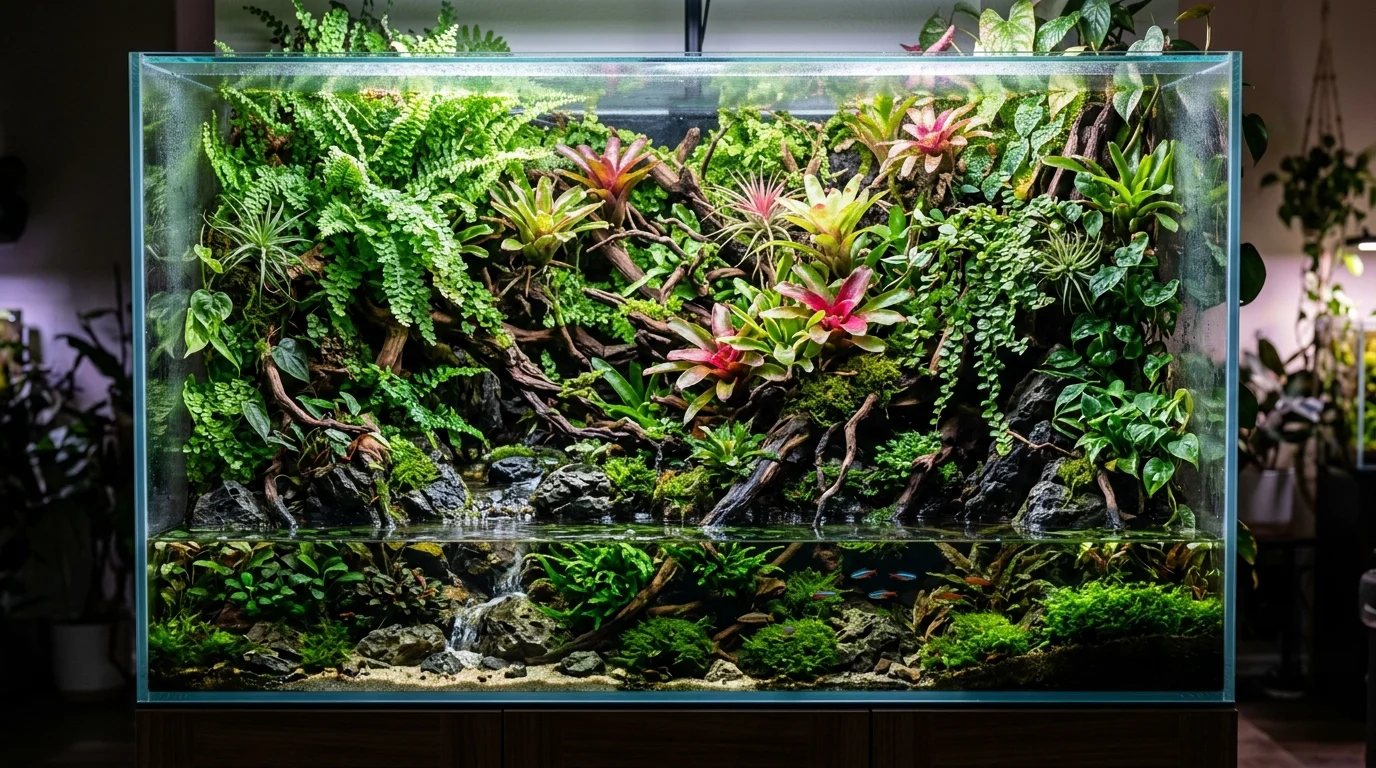
Paludarium plants are plants selected for the distinct terrestrial, emergent, or humid zones of a land-and-water enclosure. The best choices depend on where the roots will remain, how much light reaches the plant, how wet the substrate stays, and whether the plant can tolerate the temperature and humidity of the enclosure. A paludarium should be planted by habitat zone rather than by choosing plants solely because they tolerate high humidity.
Key Takeaways
- Choose paludarium plants by habitat zone, not humidity tolerance alone.
- Terrestrial plants need a suitable root zone rather than continuously saturated substrate.
- Emergent plants can tolerate or prefer wet roots while keeping foliage above the waterline.
- Light availability is often more important than simply maintaining high humidity.
- Good drainage helps prevent terrestrial root zones from remaining permanently waterlogged.
- Plant size and growth habit should be considered before planting because many species outgrow small enclosures.
- Plants sharing an enclosure with animals should be selected with physical and feeding interactions in mind.
- A paludarium may contain several plant microhabitats, so different species can be matched to different zones.
What are paludarium plants?
Paludarium plants are plants grown in a land-and-water enclosure where conditions can range from terrestrial and humid to saturated or fully aquatic. The important distinction is not simply that the enclosure is humid. Different parts of a paludarium can have very different root-zone conditions.
A plant growing in the terrestrial section may need a moist but aerated substrate, while an emergent plant may tolerate roots in water with foliage above the surface. Aquatic plants have different requirements again.
Successful planting therefore starts by identifying the zone where each plant will live and then matching the plant to that microhabitat.
Terrestrial, emergent, and aquatic plants
Terrestrial plants
Terrestrial plants grow above the waterline in the land section of the enclosure. Their roots need a substrate with suitable moisture and air-filled pore space.
High humidity does not mean that terrestrial roots should remain permanently saturated. A plant can tolerate humid air while still requiring drainage around its roots.
Emergent plants
Emergent plants grow with roots or lower stems in water or saturated conditions while their foliage remains above the waterline. This makes them particularly useful around the transition between the aquatic and terrestrial sections.
The key requirement is adaptation to wet root conditions. A plant that merely tolerates humidity is not automatically suitable for permanent wet-root growth.
Aquatic plants
Aquatic plants are adapted to growing with submerged roots, stems, leaves, or the entire plant depending on the species. They belong to the aquatic portion of the paludarium rather than the ordinary terrestrial substrate.
Do not assume that a terrestrial plant will become an aquatic plant simply because it can survive temporarily underwater.
How to choose plants for a paludarium
Start with the enclosure rather than with a list of attractive plants. Identify the available light, temperature range, humidity, waterline, substrate depth, drainage, and available planting space.
Then divide the enclosure into planting zones. A paludarium may have a dry upper hardscape, a humid land section, a wet transition edge, and an aquatic area. Each zone can support a different plant community.
This approach also makes it easier to avoid a common mistake: choosing plants because they are frequently described as terrarium or paludarium plants without checking whether their actual root conditions match the intended location.
Light comes first
Humidity cannot compensate for insufficient light. Before selecting plants, consider how much usable light reaches the actual planting position.
Hardscape, glass, floating vegetation, taller plants, and the enclosure lid can all change the light available at leaf level. A plant placed in the shaded rear of an enclosure may receive substantially less light than a plant directly beneath the fixture.
Match the plant's light requirements to the location rather than assuming that one enclosure-wide lighting label applies equally to every plant.
Moisture and the root zone
Root-zone conditions are one of the most important differences between plants that can otherwise look similar above the waterline.
Many terrestrial plants perform best in substrate that remains appropriately moist but still contains air spaces. Persistent saturation can reduce oxygen availability around roots and may lead to poor growth or root problems in species that are not adapted to waterlogged conditions.
Plants intended for wet transition zones should be chosen specifically for their ability to tolerate saturated or fluctuating conditions. Emergent plants are a different category again because their natural growth form can include wet roots and aerial leaves.
Planting around the waterline
The waterline is often the most visually distinctive part of a paludarium, but it is also one of the easiest areas to plant incorrectly.
Instead of placing an ordinary terrestrial plant directly into standing water, create a transition where the substrate moisture and water exposure match the selected plant. The exact construction depends on the enclosure and hardscape.
Emergent plants can be particularly useful here because their growth form naturally bridges the aquatic and terrestrial environments. Their foliage can remain exposed while roots access water or saturated media.
Plants for hardscape
Wood and rock create additional planting surfaces. Some humid-environment plants can grow around or attach to hardscape rather than requiring a deep terrestrial substrate.
These plants can be useful where the land area is limited or where the design calls for vegetation emerging from a branch or rock face. Their roots still require appropriate moisture and oxygen, even when the plant is mounted rather than buried.
Do not pack every available surface with plants. Leave enough open space for growth, airflow, animal movement, and maintenance.
Plant size and growth rate
A plant's nursery size is not its final enclosure size. Before planting, consider the mature dimensions, growth rate, runners, climbing habit, and pruning requirements.
Fast-growing plants can quickly shade slower species or cover water surfaces. In a small paludarium, a plant that looks appropriately sized at purchase may become difficult to manage after several months of growth.
Plan the enclosure around mature growth rather than the appearance of newly purchased plants.
Plant compatibility with animals
Plants should also be selected according to the animals sharing the enclosure. Animals may climb, burrow through substrate, move hardscape, consume plant material, or repeatedly disturb roots.
A delicate plant may therefore fail even when its temperature, humidity, and light requirements are correct. Consider the physical behavior of the enclosure's inhabitants when deciding where and how to establish each plant.
For vampire crab paludariums, plant selection should be integrated with the terrestrial habitat rather than treated as a decorative layer added afterward. See the vampire crab paludarium guide for the broader habitat context.
Plants and bioactive substrate
Plants are one of the central biological components of a bioactive enclosure. Their roots interact with the substrate while fallen leaves and other plant material contribute to the decomposer food web.
A suitable substrate should therefore support both plant roots and the biological community. Drainage, structure, moisture retention, and organic material all need to be considered together.
For substrate architecture and ABG-style formulations, see the bioactive substrate guide.
Common paludarium planting mistakes
- Choosing by humidity alone: a humidity-tolerant plant may still be unsuitable for permanently saturated roots.
- Ignoring light: high humidity cannot replace adequate light for photosynthesis.
- Planting terrestrial species directly into standing water: wet-root and aquatic conditions require appropriate adaptation.
- Ignoring mature size: a small nursery plant can become dominant in a confined enclosure.
- Overcrowding the hardscape: dense planting can restrict airflow and make pruning or maintenance difficult.
- Using contaminated plant material: pesticides and other residues can be hazardous in closed animal enclosures.
- Ignoring animal behavior: burrowing, climbing, feeding, and movement can damage otherwise suitable plants.
- Treating every paludarium zone identically: land, transition, emergent, and aquatic areas can have very different conditions.
Establishing new paludarium plants
After planting, give the enclosure time to stabilize. Monitor leaf condition, root-zone moisture, condensation, new growth, and the behavior of any animals sharing the habitat.
New plants can experience some adjustment after moving from a nursery or previous growing environment. Avoid responding to every early change by repeatedly changing several environmental variables at once.
Instead, identify the likely limiting factor—such as light, moisture, temperature, or root disturbance—and make measured adjustments.
Maintenance and pruning
Regular pruning helps maintain the intended structure of a planted paludarium. Remove unhealthy material when necessary, thin plants that are blocking light, and prevent aggressive growth from covering water surfaces or access areas.
When pruning, consider where the removed plant material will go. In a bioactive enclosure, some healthy fallen material can contribute to decomposition, but excessive organic accumulation should not simply be left indefinitely.
Also monitor the waterline. Growing plants can gradually change water movement, shade, and access between terrestrial and aquatic zones.
Frequently asked questions
What plants are best for a paludarium?
There is no universal best plant list. The appropriate plants depend on the light, temperature, root-zone moisture, available space, and whether the plant will occupy a terrestrial, emergent, hardscape-mounted, or aquatic position.
Can I use regular houseplants in a paludarium?
Some houseplants can adapt to paludarium conditions, but they should be evaluated for light, temperature, humidity, root-zone moisture, mature size, and compatibility with the enclosure's inhabitants rather than assumed to be suitable.
Can terrestrial plants grow with their roots in water?
Only species adapted to wet-root or emergent conditions should be deliberately grown with roots continuously in water. Ordinary terrestrial plants should not be assumed to tolerate permanent saturation.
Do paludarium plants need high humidity?
Many plants used in humid paludariums tolerate or benefit from high humidity, but humidity alone does not determine suitability. Light, temperature, root-zone conditions, and plant type also matter.
Can paludarium plants grow in normal potting soil?
Do not assume that ordinary potting soil is appropriate. Commercial mixes may contain fertilizers, wetting agents, perlite, or other materials that are unsuitable for some enclosed animal habitats. Select substrate components according to the plants and animals in the system.
How much light do paludarium plants need?
Light requirements vary by species. Match each plant to the intensity available at its actual position and account for shading from hardscape, taller plants, and floating vegetation.
Can I grow plants on paludarium wood?
Yes, some humid-environment plants can be mounted or established on wood and other hardscape. The plant still needs suitable moisture, light, and physical support.
Why are my paludarium plants turning yellow?
Yellowing can have several causes, including inappropriate light, water stress, nutrient issues, root problems, temperature stress, or natural replacement of older leaves. Check the plant's actual growing conditions before changing multiple variables at once.
Can paludarium plants live underwater?
Only plants adapted to submerged or aquatic growth should be expected to remain healthy underwater. A plant that tolerates temporary flooding is not necessarily an aquatic plant.
Should I plant the entire paludarium?
No. Open areas can be useful for animal movement, airflow, maintenance, and visual separation between habitat zones. Plant density should reflect the mature size and growth habit of the selected species.
Frequently Asked Questions
What plants are best for a paludarium?
There is no universal best plant list. The appropriate plants depend on the light, temperature, root-zone moisture, available space, and whether the plant will occupy a terrestrial, emergent, hardscape-mounted, or aquatic position.
Can I use regular houseplants in a paludarium?
Some houseplants can adapt to paludarium conditions, but they should be evaluated for light, temperature, humidity, root-zone moisture, mature size, and compatibility with the enclosure's inhabitants rather than assumed to be suitable.
Can terrestrial plants grow with their roots in water?
Only species adapted to wet-root or emergent conditions should be deliberately grown with roots continuously in water. Ordinary terrestrial plants should not be assumed to tolerate permanent saturation.
Do paludarium plants need high humidity?
Many plants used in humid paludariums tolerate or benefit from high humidity, but humidity alone does not determine suitability. Light, temperature, root-zone conditions, and plant type also matter.
Can paludarium plants grow in normal potting soil?
Do not assume that ordinary potting soil is appropriate. Commercial mixes may contain fertilizers, wetting agents, perlite, or other materials that are unsuitable for some enclosed animal habitats. Select substrate components according to the plants and animals in the system.
How much light do paludarium plants need?
Light requirements vary by species. Match each plant to the intensity available at its actual position and account for shading from hardscape, taller plants, and floating vegetation.
Can I grow plants on paludarium wood?
Yes, some humid-environment plants can be mounted or established on wood and other hardscape. The plant still needs suitable moisture, light, and physical support.
Why are my paludarium plants turning yellow?
Yellowing can have several causes, including inappropriate light, water stress, nutrient issues, root problems, temperature stress, or natural replacement of older leaves. Check the plant's actual growing conditions before changing multiple variables at once.
Can paludarium plants live underwater?
Only plants adapted to submerged or aquatic growth should be expected to remain healthy underwater. A plant that tolerates temporary flooding is not necessarily an aquatic plant.
Should I plant the entire paludarium?
No. Open areas can be useful for animal movement, airflow, maintenance, and visual separation between habitat zones. Plant density should reflect the mature size and growth habit of the selected species.
Sources & References
-
Source: practicalfishkeeping.co.uk
Type: paludarium-reference
-
Source: neherpetoculture.com
Type: vivarium-reference
-
Source: neherpetoculture.com
Type: vivarium-reference
Explore More
Related Articles
Related Plant Guides
No specific plant guides found matching this topic.
Recommended next actions
Continue Exploring
Dive deeper into related plant care tools and profiles.
Topic Guide
What Is a Paludarium? Design, Anatomy, and Ecosystem Setup
Learn what a paludarium is, how land and water zones work together, and how to plan drainage, circulation, substrate, planting, and maintenance.
Topic Guide
How to Convert an Aquarium into a Paludarium
A comprehensive guide to transitioning a standard aquarium into a dual-zone paludarium, with fish stocking, terrarium conversion, and maintenance advice.
Topic Guide
Emersed vs Submerged Plants in a Paludarium
A practical guide to the physiological and morphological differences between emersed and submerged aquatic plants, including cuticles, stomata, leaf structure, gas exchange, transition shock, and humidity acclimation.
Topic Guide
Paludarium Plants Melting: Causes, Diagnosis & Recovery
A troubleshooting guide for diagnosing and stopping plant melt, tissue lysis, soft rot, root decay, rhizome damage, and environmental stress in terrestrial, marginal, and submerged paludarium zones.
Topic Guide
Paludarium Moss: How to Attach, Hydrate, and Maintain Moss
A technical guide to using moss across terrestrial, splash, transition, and submerged paludarium zones, covering attachment mechanics, hydration, PAR, airflow, algae control, and maintenance.
Topic Guide
Paludarium Lighting Guide
A practical engineering guide to paludarium lighting covering plant-level PAR targets, terrestrial and submerged gradients, photoperiod, spectrum, fixture elevation, optical losses, heat and evaporation.