Open vs Closed Paludarium: Humidity, Evaporation, Plants, and Livestock
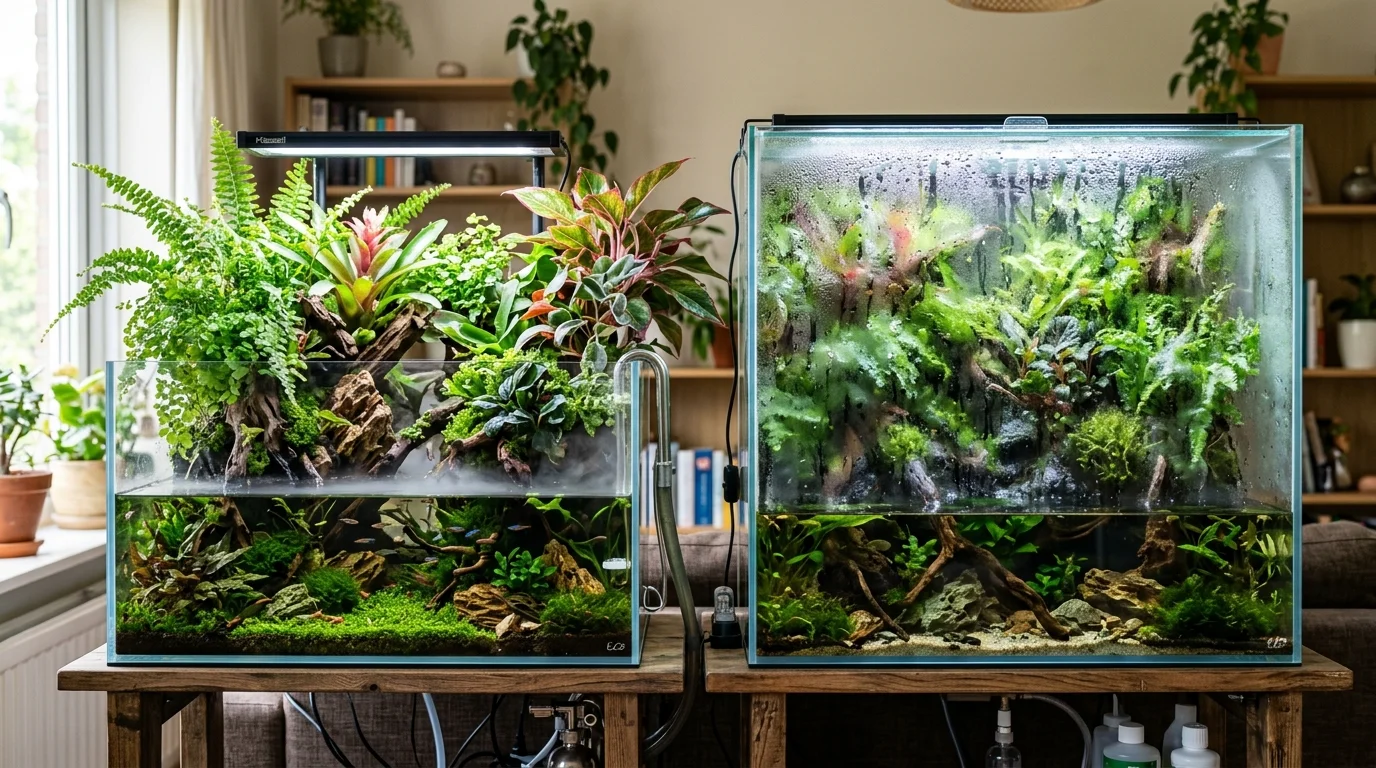
Closed paludariums trap 75-95% RH and conserve water; open tops follow room humidity (35-60% RH), allow emergent growth, and lose water faster. Choose closed for delicate high-humidity plants, moss walls, and climbing livestock like vampire crabs. Choose open for robust emergent plants and fog-free views with frequent top-offs.
Quick Answer
Choose a closed paludarium if you want delicate high-humidity plants (ferns, mosses, jewel orchids), climbing semi-aquatic livestock (vampire crabs, amphibians), or minimal top-offs. Closed canopies maintain 75–95% RH and stabilize water levels, but require planned ventilation to prevent glass fogging and mold. Choose an open-top paludarium if you want robust emergent plants that breach the rim into room air (Pothos, Peace Lily, Monstera), clear viewing glass, and natural gas exchange, but prepare for 10–25 mm weekly water evaporation. Use the paludarium hub for the core overview, the how to build a paludarium guide for construction, and the Paludarium Water Volume Calculator to size your evaporation buffer.
Key Takeaways
- Closed canopies hold 75–95% RH and stabilize water levels, but need planned ventilation to avoid condensation, stagnation, and mold.
- Open tops follow room humidity (35–60% RH) and can lose 10–25 mm or more of water per week, so size an evaporation buffer to protect pump intakes.
- Use open tops for robust emergent plants and closed canopies for delicate ferns, orchids, Marcgravia, and moss walls.
- Climbing, jumping, or humidity-dependent livestock such as vampire crabs and frogs require a closed or tightly screened canopy.
Quick Answer: Open or Closed?
Choose closed if you want delicate high-humidity plants, climbing semi-aquatic livestock, or minimal top-offs. Choose open-top if you want robust emergent plants, easy access, and a clear view, and you accept faster evaporation. Many builders end up with a hybrid: a partial lid, a screen strip, or a mesh cover that sits between the two.
This single decision shapes humidity, evaporation, mold risk, lighting, and which plants and animals can live in the build, so make it before you cut glass or plan hardscape. Closed systems hold humidity far more easily, and anyone keeping wandering animals such as crabs must choose an escape-proof closed system.
Microclimate and Humidity Physics
A closed canopy traps water vapor and forms a stable, humid boundary layer. Relative humidity typically sits at 75–95%, which suits tropical epiphytes, mosses, and delicate emersed marginals. The cost is condensation on glass and a stagnant layer of air that can favor fungal and bacterial growth.
An open-top paludarium follows room humidity, typically 35–60% RH. Plants grow out into free air, the glass stays clear, and there is no condensation to manage. However, drier air raises transpiration stress on leaves and speeds evaporation from the basin.
CLOSED
Water → vapor → condensation on lid/glass → runoff ↓ basin
RH 75–95% | stable level | needs venting

OPEN-TOP
Water → vapor → room air (lost)
RH 35–60% | faster water drop | free gas exchange
Evaporation Rates and Water Reserve Safety
Open tops commonly lose 10–25 mm or more per week, and warm rooms, strong airflow, and waterfall agitation push that higher. In a shallow basin, this can expose the pump intake in days, which risks dry running and burnout.
Closed tops return moisture as condensation runoff, so levels stay stable between routine top-offs. Use the evaporation buffer calculation to size your reserve:
Evaporation buffer (L) = A × D
A = water surface area (dm²)
D = acceptable level drop (dm)

Example: 7.2 dm² × 0.25 dm (25 mm) = 1.8 L
Here, 1 dm² of surface losing 1 dm of depth equals 1 L. Make sure the buffer drop still leaves at least a few centimeters of water over the pump intake. If you top up with tap water, remember that evaporation removes only pure water, so dissolved minerals concentrate over time. Use the Paludarium Water Volume Calculator to work out your reserve limits.
Airflow, Stagnation, and Mold Control
Closed setups need planned ventilation. Options include screen strips, passive vents at low and high points, or an internal micro-fan, and they should be balanced so humidity does not collapse. Too much mesh drains humidity rapidly, while too little invites mold. Springtails help control mold, and periodic lid-opening clears excess moisture.
Open setups provide continuous atmospheric gas exchange, including a steady supply of CO2 to emersed leaves, and the view is never obscured by fog. The trade-off is drying: foliage that evolved in humid air can crisp at the edges.
Flora Suitability and Emergent Growth
Open-top favors plants with waxy cuticles and heavy emergent growth, such as Pothos, Peace Lily, Monstera, Cyperus, and emersed Echinodorus, all of which can breach the rim into room air. Mosses need direct capillary wicking or placement in splash zones.
Closed is essential for high-humidity foliage: delicate tropical ferns, Marcgravia, jewel orchids, micro-bromeliads, and Fissidens moss walls. Typical aquarium plants grown emersed at normal room humidity often dry out, which is why closed or partly covered builds are recommended for them. For the physiology behind this, see Emersed vs Submerged Plants, and for zone placement see Paludarium Plants.
| Plant group | Closed | Open-Top |
|---|---|---|
| Delicate tropical ferns | Excellent | Poor without extra misting |
| Marcgravia, jewel orchids, micro-bromeliads | Excellent | Poor to marginal |
| Fissidens moss walls | Excellent | Needs capillary wicking or splash zone |
| Pothos, Monstera, Peace Lily | Good, but may outgrow the lid | Excellent; can breach the rim |
| Cyperus, emersed Echinodorus | Good | Excellent with a water-edge root zone |
| Anubias, Bucephalandra (rhizome plants) | Good | Good if roots stay wet and RH is tolerable |
Livestock Biosecurity and Escape Prevention
Open tops are limited to non-climbing, non-jumping aquatic livestock. Vampire crabs, frogs, newts, and snails readily escape, and jumping nano-fish need at least a tight mesh cover. A closed or tightly screened canopy is mandatory for semi-aquatic climbers and humidity-dependent amphibians. Closable cable inlets are useful because they let you route wires and tubing without creating an escape route.
| Livestock | Closed | Open-Top |
|---|---|---|
| Vampire crabs (Geosesarma) | Required (escape-proof lid) | Not suitable |
| Frogs and newts | Required for humidity-dependent species | Escape risk; avoid |
| Snails | Fine, with a tight lid | Frequent escapes |
| Jumping nano-fish | Required, or a tight mesh cover | Mesh cover is essential |
| Non-climbing, non-jumping aquatic species | Fine | Fine |
Core Comparison
| Factor | Closed / Covered Paludarium | Open-Top Paludarium |
|---|---|---|
| Internal RH | 75–95% (trapped boundary layer) | 35–60% (tracks room humidity) |
| Water loss | Low; condensation runs back into the system | About 10–25 mm+ per week from the surface; more with a waterfall |
| Glass condensation | High risk; view can fog | Minimal |
| Air movement | Stagnant unless ventilation is planned | Continuous natural gas exchange |
| Mold and rot risk | Higher, needs venting and cleanup | Lower, but leaves foliage prone to drying |
| Top-off routine | Occasional | Frequent; automate if possible |
| Heat and light loss | Lid traps heat; glass reduces light slightly | Heat escapes freely; light reaches plants unobstructed |
Lighting, Heat, and Condensation
A glass lid loses some light, can trap heat from fixtures, and fogs when the glass is cooler than the air inside. An open top lets heat escape and removes the lid as a light barrier, but also increases evaporation. Match fixture placement and ventilation to your choice, and see Paludarium Lighting for fixture heat and glass loss details.
Decision Checklist
- List the livestock. Any climber, jumper, or humidity-dependent amphibian points to closed.
- List the plants. Delicate ferns, orchids, and moss walls point to closed; robust emergents point to open.
- Check your room humidity. If it is under 50% RH, an open top will be hard on foliage.
- Check the basin depth. If it is shallow, calculate the evaporation buffer before choosing open.
- Decide how much routine you accept: occasional venting (closed) or frequent top-offs (open).
- Consider a hybrid, such as a partial lid, front vent strip, or mesh cover.
For construction steps that apply to either approach, see How to Build a Paludarium, and for the broader overview return to the Paludarium hub.
Frequently Asked Questions
How do you prevent mold in a closed paludarium?
Add planned ventilation (screen strips, passive vents, or a micro-fan), keep a cleanup crew such as springtails, avoid stagnant pockets behind hardscape, and open the lid periodically to clear excess moisture. Aim to keep humidity high without leaving the air completely still.
How much faster does water evaporate in an open paludarium?
Open tops commonly lose about 10-25 mm or more per week, and warm rooms or waterfalls can push this to 1-3 cm. A closed top keeps most of that moisture inside as condensation runoff, so levels stay stable between occasional top-offs.
Can vampire crabs be kept in an open paludarium?
No. They climb and escape easily, so they need a closed or tightly screened canopy. Use closable cable inlets so wires and tubing do not create gaps.
How do you prevent glass condensation from blocking the view?
Add front or top ventilation, keep airflow moving with a small fan, and avoid large temperature differences between the glass and the air inside. A front ventilation strip is a common way to keep the viewing pane clear.
Which plants grow best out of an open-top paludarium?
Robust, waxy-leaved emergent growers such as Pothos, Peace Lily, Monstera, Cyperus, and emersed Echinodorus do well when they can breach the rim into room air. Mosses need direct capillary wicking or splash zones.
Explore More
Related Articles
Related Plant Guides
No specific plant guides found matching this topic.
Recommended next actions
Continue Exploring
Dive deeper into related plant care tools and profiles.
Topic Guide
What Is a Paludarium? Design, Anatomy, and Ecosystem Setup
Learn what a paludarium is, how land and water zones work together, and how to plan drainage, circulation, substrate, planting, and maintenance.
Topic Guide
Paludarium Plants: Choosing Plants for Land & Water Zones
Learn how to choose paludarium plants by land, emergent, humid, and aquatic zones, with guidance on light, moisture, growth, and maintenance.
Topic Guide
Paludarium Lighting Guide
A practical engineering guide to paludarium lighting covering plant-level PAR targets, terrestrial and submerged gradients, photoperiod, spectrum, fixture elevation, optical losses, heat and evaporation.
Topic Guide
Humidity
Learn everything about humidity for your indoor and aquarium plants. Expert care tips, troubleshooting, and related guides.
Topic Guide
Misting
Learn everything about misting for your indoor and aquarium plants. Expert care tips, troubleshooting, and related guides.
Topic Guide
Water Quality for Houseplants
Compare tap, filtered, distilled, and rainwater for houseplants. Learn which water is best for sensitive plants and how to prevent mineral buildup.