Anubias Nana Care Guide: Light, Attaching to Rock & Fixing Melting Leaves
Anubias Nana is a hardy, slow-growing, low-light epiphyte perfect for beginner aquariums and aquascaping. Learn mounting, light, fertilizer and fixes for melting, rot and algae.
-
Difficulty
easy
-
Light
Thrives in low to medium light conditions.
-
Temperature
22-28°C (72-82°F)
-
Growth
very slow
-
Humidity
N/A (Aquatic)
-
pH range
6.0-7.5
-
Biggest Owner Mistake
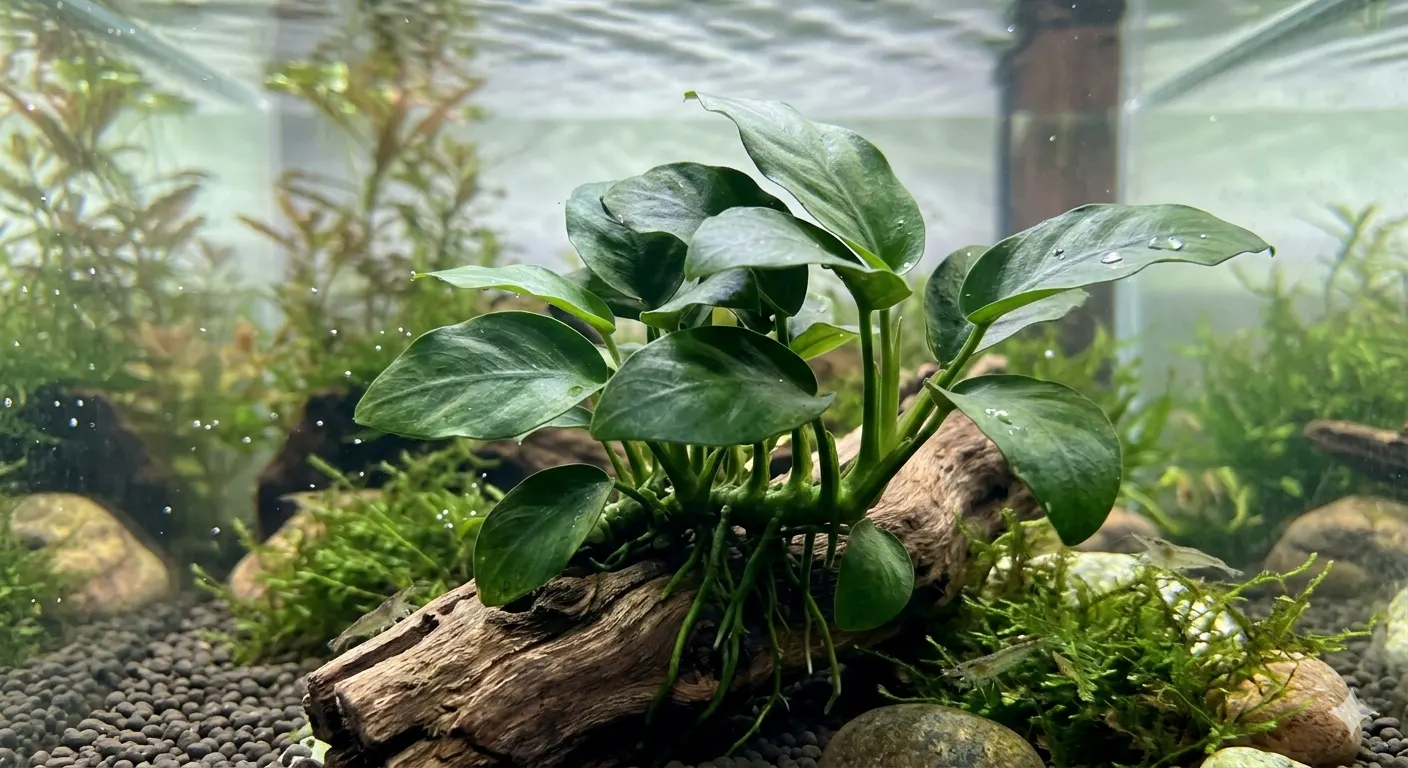
Burying the rhizome (the thick horizontal stem) in the substrate—when covered, it rots and kills the plant within weeks. The rhizome must remain fully exposed above the substrate; only the roots should be anchored, ideally by attaching the plant to driftwood or rock.
-
What Nobody Tells You
Green spot algae on slow-growing leaves is very common in lit aquariums. It is mostly cosmetic and doesn't harm the plant, and the best fix is balancing light duration and nutrients. Nerite snails may help graze it, but don't rely on shrimp or snails alone. CO₂ injection is unnecessary for Anubias, and stable conditions matter more than adding equipment.
-
Real Home Conditions
In brightly lit tanks, leaves quickly become coated in algae because Anubias grows too slowly to outcompete algae for nutrients. Positioning it in shaded areas under floating plants is the most effective long-term solution.
Quick Answer
Anubias nana is a slow-growing, low-light aquarium plant. Attach its rhizome to rock or driftwood and never bury it, keep lighting low to moderate (no CO2 needed), and hold the water at 72-82°F (22-28°C).
Key Takeaways
- Attach to aquarium rocks or driftwood using gel superglue or fishing line.
- Ensure the thick horizontal rhizome remains exposed above the substrate.
- Provide low to moderate aquarium lighting to prevent green spot algae growth.
- Safe for all freshwater fish, dwarf shrimp, and herbivorous species.
- Fertilize lightly; heavy dosing mostly feeds algae on its long-lived leaves.
- Leaves can last for years, so trim only dead or decaying leaves.
- Plants grown above water may melt and regrow when moved underwater; this is normal.
Anubias Nana Care at a Glance
- Light: Low to moderate. Standard aquarium LEDs are enough. Check your setup with the Anubias Nana sunlight calculator.
- Planting: Attach the rhizome to rock or driftwood. Never bury it.
- Water: 72-82°F (22-28°C), pH 6.0-7.5, with regular water changes. See our guide to water quality.
- CO2 and substrate: Neither is required.
- Fertilizer: A light dose of liquid fertilizer every 2 weeks is plenty. Use the aquarium fertilizer calculator to avoid overdosing.
- Growth: Very slow; typically 2-4 inches tall.
- Common problems: Rhizome rot, melting leaves and green spot algae.
What Is Anubias Nana?
Anubias Nana (Anubias barteri var. nana, also sold as Dwarf Anubias and sometimes misspelled as “anubis nana” or “anubia nana”) is arguably the most resilient plant in the aquarium hobby. Native to the streams of West Africa (Cameroon), it is an epiphyte, meaning it naturally grows on rocks and wood rather than in soil. Its thick, dark green leaves provide excellent cover for shy fish and resting spots for slow-swimming species.
This compact form has been grown commercially for the aquarium trade since the 1970s and is now one of the most widely sold aquarium plants in the world. Its slow growth rate makes it an ideal choice for aquascapers who want a low-maintenance setup. It can adapt to a wide range of water parameters, making it beginner-friendly.
- Anubias Nana is a true aquatic plant that is perfect for low-tech setups.
- Its leathery leaves make it resistant to most herbivorous fish, such as goldfish and many cichlids.
- It is commonly used as a foreground or midground plant in freshwater aquariums.
- The plant helps improve water quality by absorbing excess nitrates.
Botanical Profile
The botanical name is Anubias barteri var. nana. It is a slow-growing aquatic herb with dark green, broad leaves that are thick and leathery to the touch.
The plant features a rhizome—a horizontal stem that grows along the surface and can reach roughly 4-6 inches (10-15 cm) or more over time. This rhizome is the most vital part of the plant and should never be buried.
- Anubias Nana is small, typically reaching only 2-4 inches in height.
- Individual leaves can last for several years, which is why slow-growing algae can settle on them if light is too strong.
- It can be propagated easily by cutting the rhizome into pieces, ensuring each piece has at least 3-4 healthy leaves.
- The plant can flower underwater in healthy aquarium conditions, producing a small white spathe.
Anubias Nana Light Requirements and Placement
Anubias Nana prefers low to medium light. It is highly adaptable but thrives best when shaded from direct, intense light to prevent algae accumulation on its leaves.
It does not need high-tech lighting or CO2. Standard aquarium LEDs on a moderate photoperiod (roughly 6 to 8 hours a day) are enough, and extra light mostly feeds algae on its slow-growing leaves. Use the Anubias Nana sunlight calculator to sanity-check your light setup.
Place it attached to driftwood, rocks, or other hardscape features in the foreground or midground of your aquarium.
- Avoid placing the plant directly under high-intensity lighting.
- If you notice Green Spot Algae on the leaves, move the plant to a shaded area or reduce your light duration.
- Floating plants or taller stem plants can provide natural shade over Anubias.
- Good water circulation around the rhizome is essential for preventing rot.
How to Attach Anubias Nana to Rock or Driftwood
- Remove the plant from its pot or rockwool and gently rinse off any loose material.
- Pick a rock or piece of driftwood where the rhizome (the thick horizontal stem) can sit on the surface.
- Fix the rhizome in place with a small dab of cyanoacrylate gel superglue, or tie it on with cotton thread or fishing line. Keep the glue off the leaves and roots where possible.
- Place the hardscape in the tank so the rhizome stays above the substrate and clear of sand or gravel.
- Over the following weeks the roots grip the surface. If you used line or thread, remove it once the plant holds on by itself.
Another simple option is to wedge the rhizome into a crack between two rocks, or to buy a plant that is already mounted on a coconut shell or wood. You can also anchor only the roots in gravel, as long as the rhizome stays clear of the substrate.
Where to Place Anubias Nana in Your Aquarium
Because it stays small and tolerates low light, Anubias Nana fits almost anywhere in a freshwater tank. In a nano aquarium it works as a foreground feature on a small rock. In a larger tank it suits the midground, where it can soften the base of hardscape.
- Pair it with other epiphytes. Java fern, Java moss and Bucephalandra use the same mounting method and similar low-tech conditions, so they combine well on one piece of driftwood.
- Shrimp tanks. Its broad leaves give shrimp surfaces to graze on and shelter to hide in.
- Tanks with digging or large fish. The leaves are rarely eaten, but digging fish can knock loosely mounted plants over. Mount Anubias on heavy rock or wood so it stays put.
- Keep the rhizome clear. Leave a little space around it so debris and fine substrate do not pile up against it.
Fertilizing Anubias Nana
Anubias Nana grows slowly and absorbs most of its nutrients from the water column, so it needs very little. A light dose of a complete liquid fertilizer every couple of weeks is enough for most tanks, and many established tanks with fish already supply what it needs.
More is not better. Heavy dosing mainly feeds algae on the plant’s long-lived leaves. Use the aquarium fertilizer calculator to work out a sensible dose for your tank volume, and read our guide to dosing macro and micro nutrients in a planted tank if you run a more advanced setup. Root tabs are optional, since the plant feeds mainly through its leaves and roots in the water, not by growing in soil.
Anubias Nana Above Water and in Paludariums
Anubias Nana can also grow with its leaves above the waterline (emersed), which makes it a popular choice for paludariums, ripariums and planted terrariums with a water section. Keep the rhizome and roots in contact with moisture and give it high humidity and moderate light.
Emersed-grown plants often flower more readily. If you move a plant between emersed and submerged conditions, expect some leaves to melt and be replaced by new ones adapted to the new environment. For more on this style of setup, see our guides to paludarium plants, paludarium lighting and converting an aquarium to a paludarium.
Care and Maintenance
The most important rule for Anubias is to keep the rhizome exposed to the water column. If buried, it will rot. Attaching it to hardscape is the standard method.
Maintenance is minimal. Occasional pruning of dead or decaying leaves is all that is required to keep the plant healthy. Because each leaf can last for years, do not trim healthy leaves just to tidy the plant.
- Remove decaying leaves promptly to maintain water quality.
- Clean the leaves gently if they become covered in algae or detritus.
- Ensure the aquarium water has good oxygenation and filtration.
How to Propagate Anubias Nana
Propagation is straightforward and usually done by division. Use a clean, sharp pair of scissors or a razor blade to cut the rhizome.
Each section must have a piece of the rhizome and several leaves to survive. Once cut, reattach the pieces to rocks or wood using fishing line or glue.
- Sterilize tools before cutting to prevent infection.
- Allow the cut section to heal for a few minutes before attaching.
- The plant will slowly re-establish its root system on the new surface.
Anubias Nana Problems: Melting Leaves, Rhizome Rot, Yellow Leaves and Algae
Anubias Nana is generally hardy, but ‘melting’ or rhizome rot is the most common issue. This is usually due to poor water flow or burying the rhizome.
Algae issues, specifically Green Spot Algae, are common due to the plant’s slow growth rate.
Melting leaves
Melting after purchase is common when a plant grown above water (emersed) is placed underwater. The old leaves break down and new, submerged-adapted leaves grow in. Keep the rhizome healthy and exposed, keep conditions stable, and be patient. Melting that continues for weeks, or that comes with a soft rhizome, points to burial, poor flow or sudden water-parameter swings instead.
Rhizome rot
A brown, mushy rhizome with a bad smell is rot. Cut away the rotting section with clean tools, keep the healthy part, and remount it on hardscape with good water flow around it.
Yellow leaves
An occasional old leaf turning yellow is normal, since leaves do not last forever. Remove it when it is fully dead. Many yellow leaves at once usually point to very low light, a buried rhizome, or a major change in water conditions.
Green spot algae
Green spot algae (GSA) shows up as hard green dots on older leaves. It is mostly cosmetic and best managed by reducing light intensity or duration, avoiding nutrient overdosing and keeping conditions stable. Some snails, such as nerite snails, may help graze it from leaves.
- Monitor for signs of rhizome decay (mushy texture, bad smell).
- Ensure regular water changes to maintain stable parameters.
- Adjust light levels if algae becomes a persistent problem on the leaves.
Anubias Nana vs Java Fern vs Bucephalandra
These three epiphytes are often grown together. They share the same basic rule (keep the rhizome out of the substrate), but they differ in size and look.
| Plant | Typical size | Light | Growth | Best for |
|---|---|---|---|---|
| Anubias Nana | 2-4 in (5-10 cm) | Low to medium | Very slow | Foreground and midground, nano tanks |
| Java Fern | Taller; often 6-12 in (15-30 cm) | Low to medium | Slow | Midground and background hardscape |
| Bucephalandra | Small; often 2-6 in (5-15 cm) | Low to medium | Slow | Detailed aquascapes |
Sizes are typical ranges and vary with variety and growing conditions. If you want the simplest, most forgiving choice for a first planted tank, Anubias Nana is hard to beat.
Anubias Nana Varieties (Petite, Mini, Gold) and Price
Beyond the standard form, several highly sought-after varieties exist. Anubias Nana Gold features striking, lighter yellowish-green leaves and requires slightly more light to maintain its vibrant color. Anubias Nana Mini (often used interchangeably with ‘Petite’) is perfect for nano tanks, offering the same hardiness in a much smaller footprint. Because of its extremely slow growth rate, Anubias Nana is typically more expensive than fast-growing stem plants. Prices generally range from $6 to $15 per pot or bare-root portion depending on the size and variety, with rare varieties like ‘Gold’ or ‘Pinto’ commanding higher prices. Prices vary by seller and region.
Buying tips
- Check the rhizome. Choose plants with a firm, light-colored rhizome and healthy roots, not a soft or dark one.
- Know the form you are buying. Potted, bare-root, tissue-culture cups and pre-mounted plants are all common. Tissue-culture plants are usually clean of pests and algae but start small.
- Expect an adjustment period. Plants grown above water may lose leaves after you place them underwater.
- Quarantine briefly. Rinse new plants and check them for algae and snail eggs before adding them to an established tank.
Anubias Nana vs Other Anubias
Anubias nana is the smallest of the commonly sold Anubias. Larger types such as Anubias barteri, Anubias coffeefolia and Anubias hastifolia grow bigger leaves and suit background placement, but they follow the same rule: keep the rhizome out of the substrate.
Related Guides
Recommended next actions
Next Best Actions
Use calculators and guides to turn this plant profile into a practical care routine.
Topic Guide
Watering
Learn everything about watering for your indoor and aquarium plants. Expert care tips, troubleshooting, and related guides.
Calculator
Plant Light Calculator: Find the Best Window for Your Plant
Determine the ideal indoor light placement for your plant based on species, window direction, and seasonal light availability.
Plant Guide
Java Fern
Ultimate Java Fern (Microsorum pteropus) care guide. Learn planting, propagation, solving black leaves, potassium deficiency, and the best low-tech aquarium setup.
Guide
Tap Water vs Filtered Water for Houseplants: Which Is Better?
Most houseplants tolerate tap water without issue — but a specific group of fluoride-sensitive and mineral-sensitive plants develop brown leaf tips from ordinary municipal water. This guide compares tap water vs filtered water, identifies which plants are actually at risk, and gives you the cheapest effective fix for each scenario.
Plant Guide
Bucephalandra
A slow-growing Bornean rheophyte that must be attached to rock or wood, never buried, and rewards stable water with metallic, iridescent foliage.
Plant Guide
Java Moss
Java Moss (Taxiphyllum barbieri) is an adaptable aquatic bryophyte suited for freshwater aquariums, shrimp tanks, and humid paludarium walls.
Structured Plant Data
Plant Data Profile
The following data is extracted directly from our botanical knowledge graph for accuracy and transparency.
Growth Characteristics
Growth Rate
very slow
Mature Height
2-4 inches
Mature Spread
3-6 inches
Life Cycle
Perennial
Flowering Season
rare (can flower submerged)
Container Friendly
yes
Indoor Capable
yes
Environmental Parameters
| Parameter | Recommended | Survivable |
|---|---|---|
| Temperature | 22-28°C (72-82°F) | 20-30°C (68-86°F) |
| Humidity | N/A (Aquatic) | N/A |
| Soil PH | 6.0-7.5 | 5.5-8.0 |
Lighting
Description
Thrives in low to medium light conditions.
Nutrients
Nitrogen Demand
low
Phosphate Demand
low
Potassium Demand
low
Micronutrient Notes
Absorbs nutrients primarily through the water column.
Fertilizer Frequency
Liquid fertilizer once every 2 weeks.
Organic Options
Root tabs can be used if planted in substrate (though not recommended for the rhizome).
Relationships
-
Light
Requirement | Strength 7
Low light is preferred; excessive light encourages algae growth on the leaves.
-
Rhizome Exposure
Requirement | Strength 10
The rhizome must be exposed to water flow; burying it will cause rot.
-
Green Spot Algae
Vulnerability | Strength 8
Slow growth makes it susceptible to Green Spot Algae in high-light conditions.
Anubias Species & Requirements Comparison
| Variation | Light Requirement | Growth Rate | Difficulty |
|---|---|---|---|
| Anubias Nana | Low | Very Slow | Easy |
| Anubias Nana Petite | Low to Medium | Very Slow | Easy |
| Anubias Barteri | Low | Slow | Easy |
| Anubias Nana Gold | Medium | Very Slow | Easy |
| Anubias Nana Mini | Low to Medium | Very Slow | Easy |
| Anubias Coffeefolia | Low to Medium | Slow | Easy |
| Anubias Hastifolia | Low to Medium | Slow | Easy |
Troubleshooting & Diagnostics Guide
1 Rhizome Rot
Diagnosis: Buried in substrate or poor water flow
Treatment: Remove from substrate, attach to hardscape, and ensure water movement around the rhizome.
Prevention: Maintain optimal care conditions.
2 Algae on Leaves
Diagnosis: Too much light or excess nutrients
Treatment: Move to a shaded area or reduce the daily light photoperiod.
Prevention: Maintain optimal care conditions.
3 Melting Leaves
Diagnosis: Buried rhizome, poor water flow, sudden water-parameter change, or transition from emersed (above-water) growth to submerged
Treatment: Expose the rhizome and attach it to hardscape, improve flow, keep conditions stable, and remove dead leaves. If the plant was grown above water, new submerged leaves will replace the melted ones.
Prevention: Keep the rhizome above the substrate, avoid sudden large water-parameter changes, and acclimate new plants gently.
4 Yellowing Leaves
Diagnosis: Natural aging of old leaves, very low light, buried rhizome, or a major change in water conditions
Treatment: Remove fully dead leaves. If many leaves yellow at once, check rhizome exposure, light and water parameters.
Prevention: Provide low to moderate light, keep the rhizome exposed and keep water conditions stable.
5 Leaves Dying After Purchase
Diagnosis: Emersed (above-water) grown plant adjusting to submerged conditions
Treatment: Keep the rhizome healthy and exposed, remove melted leaves and wait for new submerged leaves to grow.
Prevention: Buy tissue-culture or submerged-grown plants if you want to avoid the adjustment period.
Authoritative Resources
For additional peer-reviewed information on plant diseases, toxicity, and care, consult these trusted botanical and agricultural extensions:
Glossary of Terms
- Rhizome
- The thick, horizontal stem of the plant from which roots and leaves grow. This part must remain above the substrate.
- Epiphyte
- A plant that grows on the surface of another object, such as a rock or piece of wood, rather than rooting in soil.
- Aquascaping
- The craft of arranging aquatic plants, rocks, stones, and driftwood in an aesthetically pleasing manner within an aquarium.
- Green Spot Algae (GSA)
- Hard, round green spots that form on slow-growing leaves, usually under strong light or unbalanced nutrients.
- Emersed Growth
- Growth with leaves above the waterline. Many aquarium plants are grown this way commercially and may shed leaves when placed underwater.
- Photoperiod
- The number of hours per day the aquarium light is on.
- Tissue Culture
- Plants grown in a sterile cup in a lab. They are typically free of pests and algae.
Frequently Asked Questions
Is Anubias Nana safe for all aquarium fish?
How do I attach Anubias Nana to rocks?
Can I bury the roots in the substrate?
Do I need CO2 for Anubias Nana?
Why are there green spots on the leaves?
Why is my Anubias melting?
Why is the rhizome turning brown and mushy?
How much light is too much for my Anubias?
How much does Anubias Nana cost?
What is the difference between Anubias Nana Petite and Mini?
How much light does Anubias Nana need?
What water temperature does Anubias Nana need?
Can Anubias Nana grow out of water?
Why are my Anubias Nana leaves turning yellow?
How fast does Anubias Nana grow?
How do I propagate Anubias Nana?
Is Anubias Nana or Java Fern better for beginners?
Will fish uproot or eat Anubias Nana?
Should I fertilize Anubias Nana?
Sources & References
-
Source: aquaticplantcentral.com
-
Source: theaquariumcalculators.com
-
Source: aquasabi.com
Explore More