Macro and Micro Separate Dosing for Planted Tanks: A Step-by-Step Protocol
Mixing macro and micro fertilizers in the same dose is one of the most common planted tank mistakes. This guide gives you the exact alternating schedule, dose calculations, and rest-day protocol used by competitive aquascapers.
Quick Answer
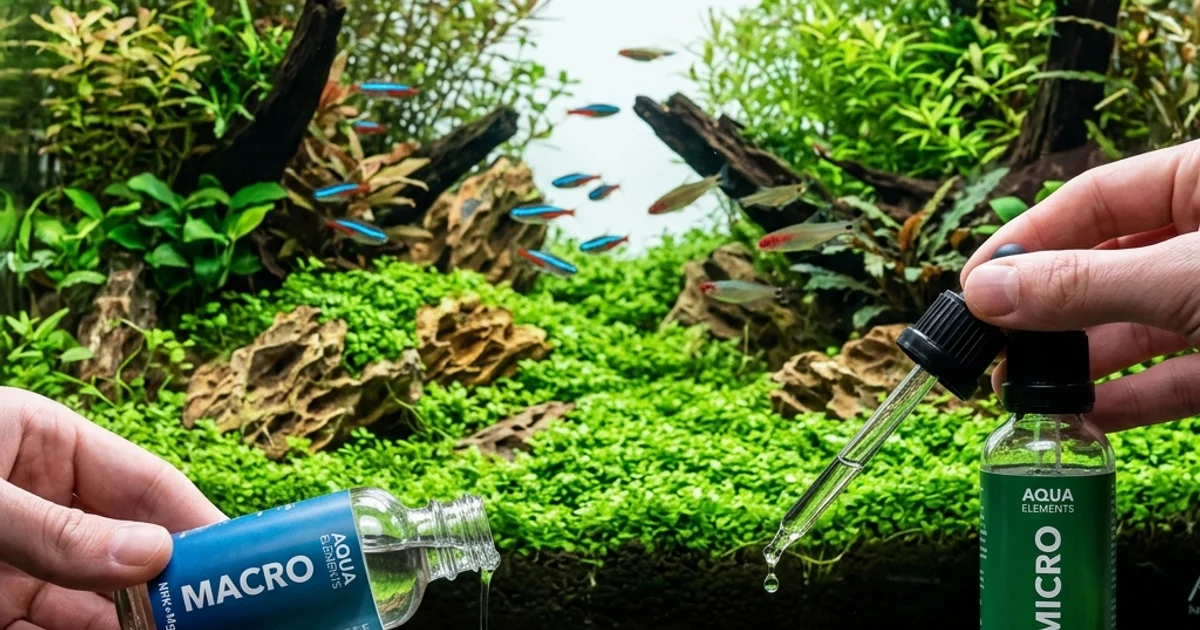
Dose macro fertilizers (nitrogen, phosphorus, potassium) and micro fertilizers (iron, manganese, trace elements) on separate days to prevent chemical precipitation. A standard schedule is: macros on Monday, Wednesday, Friday — micros on Tuesday, Thursday — water change and rest on Sunday. Use the Estimative Index (EI) as a starting point: 6–8 ppm NO3, 1–2 ppm PO4, and 10–20 ppm K per dose, calibrated to your plant mass and CO2 level.
Key Takeaways
- Dose macronutrients (NPK) and micronutrients (iron/trace) on alternate days.
- Prevent chemical binding and precipitation of iron phosphate in the water column.
- Follow a structured weekly schedule paired with a 50% weekend water change.
- Calibrate nutrient concentrations to plant biomass, lighting levels, and CO2 injection.
Why Separate Dosing Matters
Why dose macros and micros separately in a planted tank?
Macro nutrients — primarily nitrogen (N), phosphorus (P), and potassium (K) — and micro nutrients — iron (Fe), manganese (Mn), and other trace elements — react chemically when combined in a concentrated solution. Phosphate ions bond with iron and calcium ions to form insoluble precipitates that settle out of the water column before plants can absorb them. The result looks like cloudy water or a fine white dust on the substrate, and your plants begin showing deficiency symptoms despite regular feeding.
Dosing on alternating days keeps each group dilute enough that precipitation cannot occur at the concentrations your tank water contains. Plants absorb nutrients throughout the day regardless of which group you added, so the 24-hour gap between macro and micro doses has no negative impact on uptake — only a positive impact on availability.
Can I dose macros and micros on the same day?
You can add them to tank water (not concentrated together in a cup) if your tank volume is large enough to dilute both solutions instantly. A 200-litre tank with good circulation will usually dilute both doses before significant precipitation occurs. However, tanks under 100 litres or those with poor flow distribution are at high risk. The safest practice regardless of tank size is always to alternate days — the benefit is measurable and the cost is simply remembering a schedule.
The Standard Alternating Dosing Schedule
What is the Estimative Index dosing method?
The Estimative Index (EI), developed by Tom Barr, is a high-nutrient dosing method designed to keep all macro and micro elements in excess throughout the week, then reset with a large water change on the weekend. The principle is simple: if nutrients are always abundant, deficiency can never be the cause of poor plant growth. This removes one variable from troubleshooting — if your plants look poor with EI dosing and CO2, the issue is almost certainly light or CO2, not nutrients.
A standard EI schedule for a high-tech planted tank (with CO2 injection) looks like this:
- Monday, Wednesday, Friday: Dose macro fertilizers (KNO3 for nitrogen and potassium, KH2PO4 for phosphorus)
- Tuesday, Thursday, Saturday: Dose micro fertilizers (chelated iron and trace element mix)
- Sunday: 50% water change to reset accumulated nutrients and prevent long-term imbalance
For low-tech tanks without CO2, halve all doses and do a 30% water change weekly. Plants in low-tech tanks grow slowly and cannot consume nutrients fast enough to justify full EI rates.
Calculating Your Doses
How do I calculate macro doses for my tank size?
The standard EI starting targets per dose (added three times per week) are:
- Nitrate (NO3): 6–8 ppm per dose
- Phosphate (PO4): 1–2 ppm per dose
- Potassium (K): 10–20 ppm per dose
To convert ppm targets into grams of dry fertilizer salts, use these formulas for a 100-litre tank:
- KNO3 (potassium nitrate) for NO3 + K: 1 gram per 100 litres raises NO3 by approximately 6 ppm and K by 3.7 ppm
- KH2PO4 (monopotassium phosphate) for PO4: 0.1 gram per 100 litres raises PO4 by approximately 0.7 ppm
Scale these values linearly for your tank volume. Our aquarium plant fertilizer dosage calculator can automate this for liquid fertilizers — enter your tank volume and target ppm to get the exact millilitres per dose.
Tank Size Quick-Reference Dosing Chart
For those who want approximate dry-dose amounts without doing the math each week, use this quick-reference chart. It assumes standard EI targets (7 ppm NO3, 1.5 ppm PO4 per macro dose) and a trace mix dosed at the manufacturer's standard concentration of 5 ml per 100 litres. Common products used for macro doses include water-soluble balanced ratios such as NPK 19-19-19 or NPK 20-20-20, each dissolved at lower-than-label concentration to hit the ppm targets above without overshooting.
| Tank Size | KNO3 per Macro Dose | KH2PO4 per Macro Dose | Trace Mix per Micro Dose |
|---|---|---|---|
| 20 litres | 0.2 g | 0.02 g | 1 ml |
| 50 litres | 0.5 g | 0.05 g | 2.5 ml |
| 100 litres | 1.0 g | 0.1 g | 5 ml |
| 200 litres | 2.0 g | 0.2 g | 10 ml |
| 300 litres | 3.0 g | 0.3 g | 15 ml |
Weigh dry salts with a milligram-precision scale where possible — kitchen scales are not accurate below 1 gram and will cause significant dosing errors in smaller tanks.
How do I know if my plants are getting enough macro nutrients?
Macro deficiency signs are distinct and appear in a predictable pattern. Nitrogen deficiency plants show uniform yellowing of older (lower) leaves first, because the plant cannibalizes nitrogen from old tissue to feed new growth. Phosphorus deficiency causes dark green or purple-tinted leaves and stunted roots. Potassium deficiency causes yellow or brown holes and pinhole-like perforations in older leaves, sometimes with crispy brown edges.
If you see these signs while using EI dosing, the cause is almost never insufficient fertilizer — it is almost always insufficient CO2 preventing plants from processing the nutrients available, or a pH that is locking out uptake. Test CO2 with a drop checker and test pH before adjusting your fertilizer schedule.
Deficiency Diagnosis at a Glance
| Symptom | Likely Cause | Nutrient Group | First Response |
|---|---|---|---|
| Yellowing of oldest leaves, whole-leaf and uniform | Nitrogen deficiency | Macro | Increase KNO3 dose or frequency |
| Dark green or purplish new growth, stunted roots | Phosphorus deficiency | Macro | Increase KH2PO4 dose |
| Pinhole or torn-edge holes in older leaves | Potassium deficiency | Macro | Increase K2SO4 or KNO3 |
| Yellowing between veins on new growth, veins stay green | Iron or manganese deficiency | Micro | Increase chelated trace dose, check pH |
| Twisted or distorted new leaf tips | Calcium or boron deficiency | Micro | Check GH, consider a Ca-boosting supplement |
| Melting or translucent leaves across many species at once | Not a nutrient issue | N/A | Check CO2 levels and drop checker colour first |
Dosing Schedule at a Glance
| Day | Dose Type | Target Nutrients | Example Salts / Products |
|---|---|---|---|
| Monday | Macros | NO3, PO4, K | KNO3, KH2PO4, K2SO4 |
| Tuesday | Micros | Fe, Mn, Zn, Cu, B, Mo | Chelated trace mix (DTPA or EDTA) |
| Wednesday | Macros | NO3, PO4, K | KNO3, KH2PO4, K2SO4 |
| Thursday | Micros | Fe, Mn, Zn, Cu, B, Mo | Chelated trace mix |
| Friday | Macros | NO3, PO4, K | KNO3, KH2PO4, K2SO4 |
| Saturday | Micros | Fe, Mn, Zn, Cu, B, Mo | Chelated trace mix |
| Sunday | Water change (50%) | Reset all levels | Dechlorinated tap water |
Choosing a Dosing Method: EI vs Alternatives
EI is not the only dosing philosophy in the hobby, and it is not always the right fit. Tanks with heavy stocking of shrimp, low light, or a preference for minimal maintenance often do better on a leaner method. The table below compares the three most common approaches.
| Method | Philosophy | Water Change Requirement | Best For | Main Drawback |
|---|---|---|---|---|
| Estimative Index (EI) | Dose in excess, reset weekly | 50% weekly, non-negotiable | High-tech, high-light, CO2-injected tanks with fast-growing plants | Highest algae risk if CO2 or light is inconsistent |
| PPS-Pro | Dose to match daily uptake, minimal water change | Optional, mainly for TDS control | Stable, established tanks where uptake rates are known | Requires more precise tracking of consumption over time |
| Lean Dosing / PMDD-style | Keep nutrients near-zero, dose small and often | Small, frequent partial changes | Shrimp tanks, low-light tanks, sensitive livestock | Less margin for error; deficiencies show up faster |
Chelated Iron: DTPA vs EDTA vs Gluconate
Not all iron sources behave the same way once they hit your tank water, and the chelate you choose matters more in high-pH or high-light tanks. Chelates are molecules that bind iron so it stays dissolved and available to plants instead of oxidizing into an unusable rust-coloured precipitate.
| Chelate Type | Effective pH Range | Stability in Light | Best Use Case |
|---|---|---|---|
| EDTA | Below 7.0 | Breaks down quickly under aquarium lighting | Soft, acidic water tanks with CO2 injection |
| DTPA | Up to 7.5 | More stable than EDTA under light | Moderate hardness tanks, most general-purpose trace mixes |
| EDDHA | Up to 9.0 | Very stable, resists breakdown | Hard, alkaline water or tanks with crushed coral substrate |
| Gluconate | Broad range, weaker binding | Breaks down fastest | Supplemental, short-duration dosing only |
If you consistently see interveinal yellowing on new leaves despite regular micro dosing, check your tank pH first. A trace mix using EDTA in an 8.0 pH tank will largely precipitate out before plants can use it, and switching to a DTPA or EDDHA-based product often resolves the issue without changing the dose at all.
Common Mistakes and How to Fix Them
The most common error is skipping the weekly water change, believing that topping off evaporated water is equivalent. It is not — evaporation concentrates all dissolved salts, so without a true water change, total dissolved solids accumulate week over week until plants show salt stress symptoms. The weekly 50% change is non-negotiable with EI dosing. If you also grow houseplants and want to apply a similar steady low-concentration approach on soil, see the micro dosing fertilizer protocol for indoor plants.
The second most common error is adding micros to the same dosing solution as phosphate outside the tank. Never pre-mix your fertilizers in a concentrated stock solution unless you are using a purpose-made all-in-one product specifically designed to prevent precipitation. Always add each dose directly to the tank water, separately, and allow circulation to dilute each one before adding the next if you choose to dose both on the same day.
Frequently Asked Questions
How long after a water change should I resume dosing?
Dose immediately after a water change, once dechlorinator has been added and circulation has mixed the fresh water in — typically 15 to 30 minutes. Waiting longer only delays nutrient availability to your plants without any added benefit.
Do shrimp tanks need different fertilizer dosing?
Yes. Shrimp are sensitive to copper, which is present in most trace element mixes, and to sudden shifts in TDS. Shrimp keepers typically use a copper-free trace mix, dose at half the standard EI rate, and favour smaller, more frequent water changes over a single large weekly change to avoid stressing moulting shrimp.
Can I combine liquid dosing with root tabs?
Yes, and for heavy root-feeding species like Amazon swords, Cryptocoryne, and many bulb plants, this combination often produces better results than liquid dosing alone. Root tabs deliver nutrients directly to the root zone in the substrate, while liquid macro and micro dosing feeds water-column feeders and epiphytes like Anubias and Java fern. The two methods do not interfere with each other since root tabs release nutrients locally rather than into the open water column.
Recommended next actions
Next Best Actions
Move from reading to action with related calculators, plant profiles, and quiz-based recommendations.
Calculator
Aquarium Fertilizer Calculator: Macro & Micro Doses
Calculate exact macro and micro fertilizer doses for your planted aquarium based on tank volume, plant density, CO2 system, and dosing strategy.
Fertilizer Guide
NPK Ratio Comparison: 10-10-10 vs 19-19-19 vs 20-20-20 Guide
A side-by-side comparison of common NPK fertilizer analyses, their concentration differences, and how to choose between them without assuming a universal dosage.
Guide
Fertilizer Burn on Houseplants: Symptoms & Fix Guide
Fertilizer burn is one of the most misdiagnosed houseplant problems because its symptoms — brown tips, wilting, yellowing leaves — are nearly identical to overwatering, underwatering, and root rot. The treatment for root rot is opposite to the treatment for fertilizer burn, which means getting the diagnosis wrong makes the plant worse. This guide is built around that diagnostic problem first.
Guide
Summer Micro-Dosing Fertilizer Strategy: The 'Weakly, Weekly' Guide
Having coached 800+ indoor growers through the ‘weakly, weekly’ transition, I’ll give you the exact ppm targets, seaweed add‑ins, and schedule that avoid nutrient shock during long, hot summer days.
Explore More