Java Fern Care: Fix Black Leaves, Propagate Easily and Set Up Low-Tech Tanks
Ultimate Java Fern (Microsorum pteropus) care guide. Learn planting, propagation, solving black leaves, potassium deficiency, and the best low-tech aquarium setup.
-
Difficulty
Easy
-
Light
Low to Moderate. Avoid high light >60 PAR to prevent algae on leaves.
-
Temperature
22-28 C
-
Growth
Slow
-
pH range
6-7.5
-
Biggest Owner Mistake
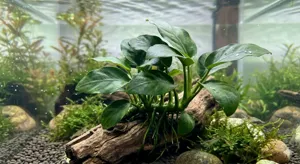
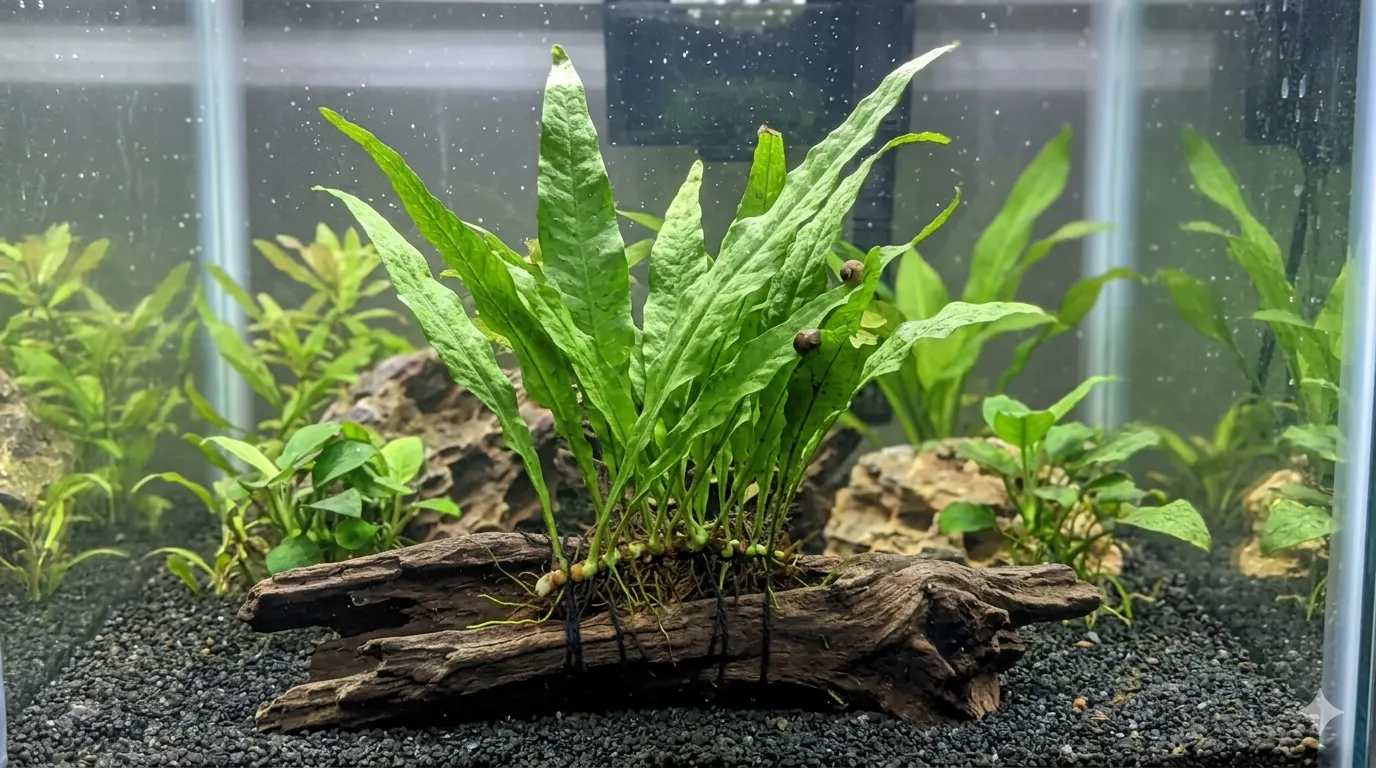
Burying the rhizome (the thick horizontal stem) in the substrate—when the rhizome is covered, it rots within days and the plant dies. Only the roots should touch substrate; the rhizome must remain exposed and is best secured to driftwood or rock with fishing line or glue.
-
What Nobody Tells You
Black spots on the undersides of mature leaves are adventitious plantlets (baby ferns), not disease or pest damage—leaving them attached allows them to grow directly on the leaf until they're large enough to detach and anchor elsewhere. Scraping them off destroys natural propagation.
-
Real Home Conditions
In high-intensity aquarium lighting, leaves yellow and quickly become blanketed in green spot algae because the fern grows too slowly to use the available nutrients. It thrives in shaded tank positions under floating plants, with no CO₂ injection needed.
Quick Answer
Java Fern is an easy-to-grow aquatic epiphyte. The most critical rule is to never bury its rhizome in the substrate. Attach it to driftwood or rocks, provide low to moderate lighting, and dose liquid potassium to prevent leaf pinholes. Our experience shows that providing a stable environment helps the plant establish a strong root system faster.
Key Takeaways
- Attach to aquarium driftwood or rocks; never bury the horizontal rhizome in gravel.
- Provide low to moderate aquarium lighting to prevent foliar black spot algae.
- Supplement with liquid potassium to prevent pinholes in older aquatic leaves.
- Propagate by separating adventitious plantlets that form naturally on leaf surfaces.
Overview
Java Fern (Microsorum pteropus) is one of the most resilient and beginner-friendly aquatic plants used in freshwater aquariums. Native to Southeast Asia, this slow-growing epiphytic fern naturally grows attached to rocks, driftwood, and roots in shaded forest streams and rivers.
Its thick, leathery leaves provide excellent shelter for shrimp, fry, Bettas, Angelfish, and community fish. Unlike rooted aquarium plants, Java Fern absorbs most nutrients directly from the water column, making it ideal for low-tech aquariums, bare-bottom tanks, shrimp tanks, and beginner aquascapes.
Java Fern is highly adaptable and can survive in a wide range of water parameters. As long as the rhizome remains exposed and unburied, the plant is extremely durable and easy to maintain.
Planting and Attachment
Never bury the thick green rhizome in aquarium substrate. Buried rhizomes quickly rot and may kill the plant within weeks.
Instead, attach Java Fern to driftwood, lava rock, aquarium stones, decor structures, or mesh walls using aquarium-safe super glue gel (cyanoacrylate), cotton thread, or fishing line. Over time, the roots naturally grip the surface permanently.
Lighting Requirements
Java Fern performs best under low to moderate aquarium lighting between 20–50 PAR.
Excessively strong lighting may encourage algae growth, especially black beard algae (BBA), on the slow-growing leaves. In high-light planted tanks, maintain stable nutrients and consistent CO2 to minimize algae issues.
Recommended lighting duration:
- Low-tech tanks: 6–8 hours daily
- High-tech tanks: 7–9 hours daily
Water Parameters
Java Fern tolerates a wide range of freshwater aquarium conditions, making it ideal for beginners.
- Temperature: 22–28°C
- pH: 6.0–7.5
- Hardness: Soft to moderately hard water
- Flow: Mild to moderate circulation
Stable water parameters are more important than chasing perfect values.
Nutrients and Fertilization
Java Fern primarily feeds from the water column rather than substrate nutrients.
Although CO2 injection is optional, regular liquid fertilization improves coloration, leaf size, and overall health.
Potassium deficiency is one of the most common nutrient issues in Java Fern and usually appears as pinholes in older leaves, yellowing tissue, or transparent spots.
Dose a quality liquid potassium fertilizer weekly to prevent deficiencies.
If new leaves appear pale or weak, supplement micronutrients containing chelated iron.
Propagation Methods
Java Fern propagates easily through multiple natural methods.
1. Adventitious Plantlets
Small plantlets naturally develop along the edges or tips of mature leaves.
Wait until each plantlet develops 3–4 leaves and visible roots, then gently detach and reattach the new plant elsewhere in the aquarium.
2. Rhizome Division
Use sharp aquascaping scissors to divide the rhizome into multiple sections.
Each section should contain healthy roots and at least 3–4 leaves.
This method rapidly produces identical clones of the parent plant.
Common Problems and Solutions
Rhizome Rot
Symptoms: Black mushy rhizome, detached leaves, foul smell.
Cause: Buried rhizome or poor circulation.
Solution: Trim rotten sections and reattach the healthy rhizome above substrate.
Black Beard Algae (BBA)
Symptoms: Dark fuzzy algae on leaf edges.
Cause: High light, unstable CO2, or excess organics.
Solution: Reduce lighting intensity, maintain stable CO2, spot treat with liquid carbon, and use hydrogen peroxide dips carefully.
Leaf Melting After Purchase
Most commercially grown Java Fern is cultivated emersed (above water).
When submerged in aquariums, older leaves may melt during transition. This is completely normal.
Trim dying leaves and allow new submerged growth to emerge over the next 2–4 weeks.
Pale New Leaves
Usually caused by iron or micronutrient deficiency.
Dose a comprehensive liquid fertilizer containing trace minerals and chelated iron.
Advanced Growth Tips
For exceptionally lush growth, maintain stable water conditions, provide low-level CO2 (10–15 ppm), use consistent liquid fertilization, and avoid sudden lighting changes.
Java Fern also grows well emersed in paludariums and humid terrariums, where growth may accelerate significantly.
To create a Java Fern wall, attach multiple rhizome cuttings to mesh, position vertically in the background, and allow roots to naturally spread and cover the structure.
Popular Java Fern Varieties
- Microsorum pteropus 'Narrow Leaf' — Long narrow leaves with elegant flowing growth
- Microsorum pteropus 'Windelov' — Decorative forked leaf tips
- Microsorum pteropus 'Trident' — Branching leaves with unique textures
- Microsorum pteropus 'Needle Leaf' — Extremely thin compact foliage
All varieties share similar care requirements and thrive under low-tech aquarium conditions.
Tank Compatibility
Java Fern is compatible with most freshwater aquarium species including Bettas, Discus, Angelfish, Tetras, Shrimp, Snails, Community fish, and many cichlid species.
Its tough leaves are usually ignored by herbivorous fish, making it one of the few reliable plants for African cichlid and goldfish aquariums.
However, avoid copper-based medications whenever possible, as Java Fern can react negatively to elevated copper levels.
Recommended next actions
Next Best Actions
Use calculators and guides to turn this plant profile into a practical care routine.
Topic Guide
Watering
Learn everything about watering for your indoor and aquarium plants. Expert care tips, troubleshooting, and related guides.
Guide
Tap Water vs Filtered Water for Houseplants: Which Is Better?
Most houseplants tolerate tap water without issue — but a specific group of fluoride-sensitive and mineral-sensitive plants develop brown leaf tips from ordinary municipal water. This guide compares tap water vs filtered water, identifies which plants are actually at risk, and gives you the cheapest effective fix for each scenario.
Calculator
Plant Light Calculator: Find the Best Window for Your Plant
Determine the ideal indoor light placement for your plant based on species, window direction, and seasonal light availability.
Topic Guide
Fertilizer
Learn everything about fertilizer for your indoor and aquarium plants. Expert care tips, troubleshooting, and related guides.
Structured Plant Data
Plant Data Profile
The following data is extracted directly from our botanical knowledge graph for accuracy and transparency.
Growth Characteristics
Emersed Capable
Yes
Rhizome Plant
Yes
Floating Plant
No
Growth Rate
Slow
Max Height
30 cm (12 inches)
Max Width
20 cm (8 inches)
Environmental Parameters
| Parameter | Recommended | Survivable |
|---|---|---|
| Temperature | 22-28 C | 18-32 C |
| P H | 6-7.5 | 5-8 |
| Hardness | 3-15 dKH | 1-25 dKH |
Lighting
Description
Low to Moderate. Avoid high light >60 PAR to prevent algae on leaves.
PAR range
20-50 PAR
Nutrients
Co2Requirement
None
Nitrate Demand
Low
Phosphate Demand
Low
Potassium Demand
Moderate
Micronutrient Demand
Low (iron, manganese)
Relationships
-
Fish Betta
Compatible_with | Strength 0.9
Excellent broad leaves for Betta resting.
-
Fish Discus
Compatible_with | Strength 0.85
Provides shelter and spawning surfaces. Thrives in discus temperature range.
-
Shrimp Cherry
Compatible_with | Strength 1
Perfect grazing surface for biofilm. Safe for all shrimp.
-
Snail Nerite
Compatible_with | Strength 1
Nerite snails will clean algae from leaves without damaging them.
-
Chem Potassium
Sensitive_to_deficiency | Strength 1
Leaves will develop pinholes if potassium is low.
-
Chem Copper
Highly_sensitive_to | Strength 1
Java Fern is sensitive to copper-based medications; prolonged exposure causes leaf drop.
Java Fern Variation & Feature Comparison
| Variation | Leaf Shape | Ideal Placement | Difficulty |
|---|---|---|---|
| Standard Java Fern | Broad, flat, and tall | Background | Easy |
| Windelov (Lace) Fern | Finely branched/forked tips | Midground | Easy |
| Narrow Leaf / Trident | Thin, deeply lobed or needle-like | Midground attached to wood | Easy |
Troubleshooting & Diagnostics Guide
1 Black mushy rhizome
Diagnosis: Buried in substrate or lack of water flow
Treatment: Unbury immediately, trim away rot, and attach to hardscape above the substrate.
Prevention: Maintain optimal care conditions.
2 Pinholes in older leaves
Diagnosis: Potassium deficiency
Treatment: Dose a liquid potassium fertilizer weekly.
Prevention: Maintain optimal care conditions.
3 Leaves melting after purchase
Diagnosis: Transitioning from emersed to submerged growth
Treatment: Trim dead leaves. The healthy rhizome will sprout new, adapted submerged leaves.
Prevention: Maintain optimal care conditions.
4 Black fuzz on leaf edges
Diagnosis: Black Beard Algae (BBA) from high light or unstable CO2
Treatment: Reduce light intensity, increase flow, and spot treat with liquid carbon or a hydrogen peroxide dip.
Prevention: Maintain optimal care conditions.
Authoritative Resources
For additional peer-reviewed information on plant diseases, toxicity, and care, consult these trusted botanical and agricultural extensions:
Glossary of Terms
- Rhizome
- The thick, horizontal stem of the plant from which both roots and leaves grow. It must remain above the substrate to prevent rot.
- Epiphyte
- A plant that grows upon another plant or object (like driftwood or rocks) and derives its moisture and nutrients from the surrounding water.
- BBA (Black Beard Algae)
- A stubbornly adhering dark brush algae that frequently colonizes slow-growing aquatic plants when light or organics are too high.
Frequently Asked Questions
Is Java Fern safe for goldfish and African cichlids?
Does Java Fern need CO2 injection or fertilizers?
Can I use glue to attach Java Fern? Will it harm my fish?
How do I propagate Java Fern?
Why are my Java Fern leaves turning black and mushy?
What causes black spots or black edges on Java Fern leaves?
Why is my new Java Fern melting after I bought it?
How do I calculate the correct fertilizer dose for my Java Fern tank?
Sources & References
-
Source: aquaticplantcentral.com
-
Source: theaquariumcalculators.com
Explore More