Java Moss Care Guide: Attaching, Trimming, and Paludarium Growth
Java Moss (Taxiphyllum barbieri) is an adaptable aquatic bryophyte suited for freshwater aquariums, shrimp tanks, and humid paludarium walls.
-
Difficulty
easy
-
Light
Grows under low to medium light. Bright light accelerates growth but increases filamentous algae risk.
-
Temperature
21-25°C (70-77°F)
-
Growth
moderate
-
Humidity
N/A submerged; 75-95% emersed in paludariums
-
pH range
6.0-7.5
-
Attaching Thick Clumps
The most common mistake is applying Java Moss in thick clumps. The bottom fronds are starved of light and oxygen, turn brown, and rot. The entire clump will inevitably peel off and float away. Always pull moss apart into thin, spiderweb-like sheets before gluing or tying.
-
Algaecide Sensitivity
Liquid carbon additives (glutaraldehyde) and standard aquarium chemical algaecides will dissolve Java Moss. Because mosses are primitive bryophytes with delicate cellular membranes, dosages safe for vascular plants will melt moss leaves within days.
-
Emersed Moisture Continuity
When grown emersed on paludarium drip walls, Java Moss handles high ambient light provided its rhizoids remain saturated via continuous capillary wicking or gentle flow. Interrupting the water flow for even a single warm afternoon can scorch the fronds.
Quick Answer
Java Moss (Taxiphyllum barbieri) is an adaptable, low-light aquatic bryophyte. Attach it in thin layers to rock or wood using gel superglue or cotton thread—never bury it in substrate. It thrives submerged or in high-humidity (>75% RH) paludariums at 70-77°F (21-25°C) and requires periodic trimming to stop internal mat browning.
Key Takeaways
- Mount onto rocks, driftwood, or mesh using gel glue or thread; avoid burying in substrate.
- Spread in thin sheets so light reaches the attachment zone and prevents bottom rot.
- Thrives submerged or in emersed paludarium settings with relative humidity above 75%.
- Prune regularly to maintain water circulation and prevent detritus accumulation.
Java Moss Care at a Glance
- Lighting: Low to medium; thrives without high-tech lights.
- Attachment: Secure to rock, driftwood, or mesh using gel glue or thread. Never bury in substrate.
- Water Parameters: 70-77°F (21-25°C), pH 6.0-7.5. Tolerates a broad range of hardness.
- Emersed / Paludarium Use: Thrives on drip walls and splash zones with humidity above 75%.
- Maintenance: Regular light trimming to stop internal mat browning and detritus buildup.
- Common Issues: Hair algae entanglement, browning under thick mats, and detachment from poor initial bonding.
What Is Java Moss?
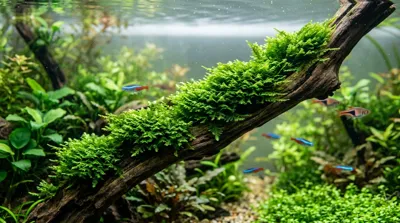
Java Moss (Taxiphyllum barbieri) is one of the most widely cultivated bryophytes in freshwater aquascaping and vivarium design. Originating from Southeast Asia, it naturally carpets submerged stones, damp river embankments, and tree roots subject to seasonal flooding. Unlike vascular plants, it possesses no true roots, stems, or vascular veins; it absorbs water and nutrients directly through its single-cell-thick leaves.
Instead of true roots, Java Moss anchors itself using microscopic multicellular structures called rhizoids. These hair-like filaments grip onto wood grain, stone pores, and textured backgrounds. Its fine, interwoven branching creates an ideal micro-habitat for beneficial biofilm, making it a staple nursery plant for dwarf shrimp and newly hatched fish fry.
Botanical Profile & Taxonomy
For decades, Java Moss was commonly misidentified in the hobby as Vesicularia dubyana (Singapore Moss). Modern botanical classifications distinguish Taxiphyllum barbieri by its less structured, more irregular branching angle and elongated leaf cells. Under submerged conditions, it creates loose, sprawling mats; when grown emersed in high humidity, its foliage tightens into a denser, deep-green terrestrial creeping carpet.
- Botanical Name: Taxiphyllum barbieri
- Family: Hypnaceae
- Origin: Southeast Asia (Vietnam, Indonesia, Thailand)
- Foliage Architecture: Tiny, pointed, overlapping leaves along irregular branching stems
- Attachment Mechanism: Surface-clinging rhizoids
Submerged vs. Emersed Paludarium Growth
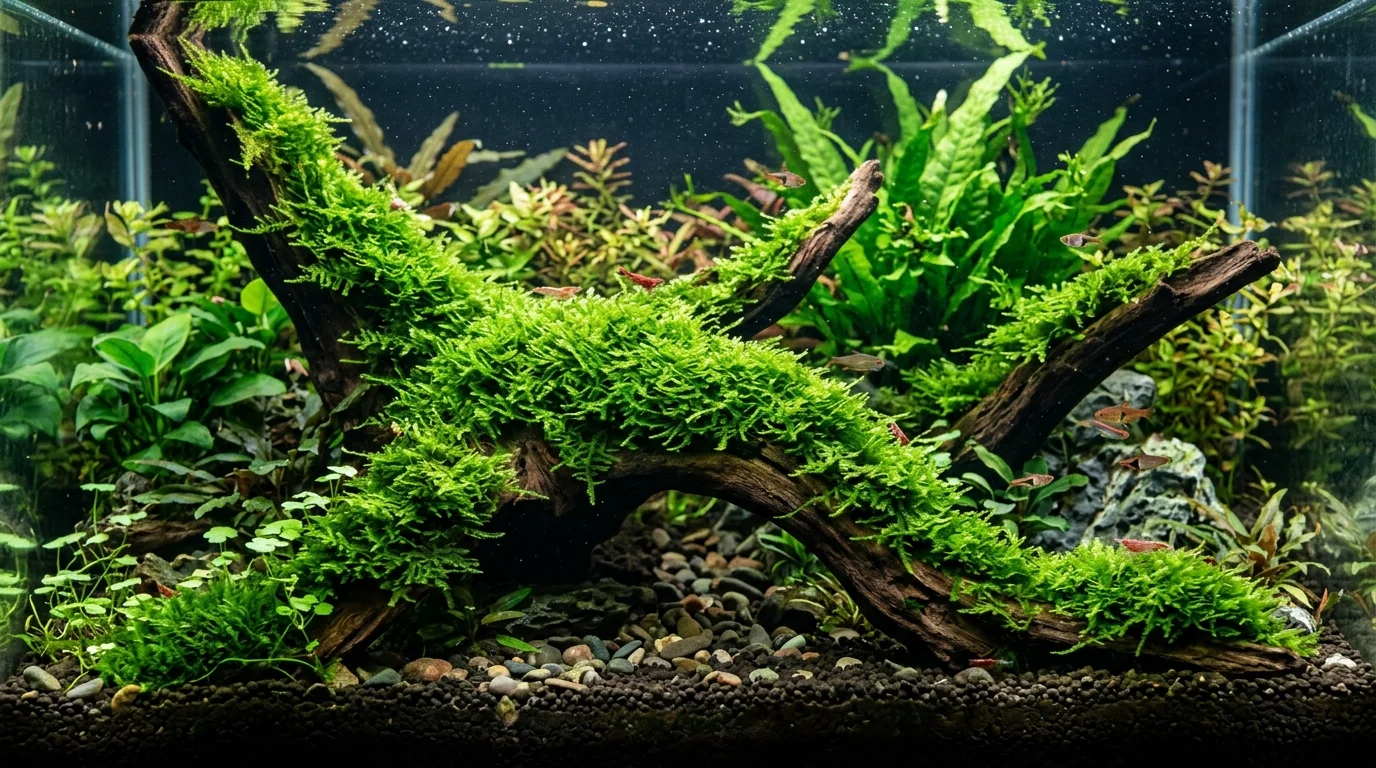
Java Moss is amphiphilic, moving easily between fully aquatic and emergent settings. In an open or closed paludarium, it serves as a botanical bridge uniting the water basin with vertical terrestrial hardscape.
Submerged Cultivation
Submerged in an aquarium, Java Moss produces pale to vibrant green trailing stems. It requires minimal care, but water circulation is essential. In stagnant water, organic detritus settles into the fine foliage, blocking light and promoting cyanobacteria or hair algae blooms. Position it in areas with moderate water flow to keep the mats clean.
Emersed Paludarium & Drip Wall Growth
In high-humidity enclosures (75-95% RH), Java Moss forms a tight, moisture-retaining moss wall. It excels on waterfall splash rocks, hygrolon or epiweb backgrounds, and the shoreline transition zone. If relative humidity drops below 60%, or if the moss is elevated beyond the reach of capillary action or misting, the fronds turn crispy and brown. For construction details, consult the Paludarium Moss Guide.
How to Attach Java Moss to Hardscape
- Thin Out the Clump: Tease the moss into a thin, translucent layer. Thick clumps will rot at the base because light cannot reach the bottom layer.
- Select Your Fastener: Use cyanoacrylate gel superglue for instant adhesion on dry or slightly damp wood/rock, or wrap it snugly with 100% cotton sewing thread.
- Glue Application: Apply tiny dots of gel glue to the hardscape, press small pinches of moss onto each dab, and let it set for two minutes before submerging.
- Thread Wrapping: Wind the thread around the hardscape with 1/4-inch spacing between loops. The cotton thread will naturally disintegrate after 6-8 weeks, by which time the rhizoids will have anchored the plant.
- Yogurt/Slurry Method (Terrariums/Emersed Walls): Blend moss fragments with water or an aquasoil slurry and paint it onto textured background surfaces in a sealed, high-humidity environment.
Light Requirements and Water Parameters
Java Moss is tolerant of varied water parameters. It handles water temperatures ranging from 59°F to 86°F (15-30°C), but it grows most cleanly and vigorously between 70°F and 77°F (21-25°C). In warmer water above 82°F (28°C), growth slows noticeably and the risk of filamentous algae increases.
Keep lighting in the low to moderate range (roughly 20-40 PAR at the plant level). While high lighting increases growth speed, it rarely benefits moss unless coupled with pressurized CO2 and clean water. Without CO2, high light invites staghorn, black beard, or green hair algae that choke the delicate stems. Use our Paludarium Water Volume Calculator to balance liquid nutrients with net water capacity.
Pruning and Maintenance
Regular trimming is necessary to maintain a healthy moss colony. As the fronds grow outward, they shade the foundational layer attached to the stone or wood. Without light and fresh water flow, the underlying layer turns brown, dies, and loses its grip, causing the entire cushion to detach and float away.
- Trim the moss every 3 to 5 weeks using sharp, curved aquascaping scissors.
- Turn off filters and powerheads before cutting to keep moss fragments from scattering across the enclosure.
- Siphon out trimmed fragments immediately; any stray stem left behind will root and start a new patch elsewhere.
- Occasionally hover a siphon tube half an inch above the moss mat to pull out trapped detritus.
Troubleshooting Common Java Moss Problems
Moss Turning Brown or Black
Browning is usually caused by excessive mat thickness, sudden temperature spikes, or an overdose of algaecides containing glutaraldehyde. Chemical algae treatments frequently melt mosses. If browning occurs, trim away dead fronds, stabilize water temperatures below 78°F, and maintain consistent mechanical filtration.
Filamentous Algae Infestation
Because Java Moss grows relatively slowly and collects organic waste, hair algae is a common issue. Reduce light intensity, cut the photoperiod to 6 hours daily, increase water flow, and add an active cleanup crew such as Amano shrimp (Caridina multidentata) or Neocaridina shrimp to browse the fronds.
Recommended next actions
Next Best Actions
Use calculators and guides to turn this plant profile into a practical care routine.
Topic Guide
Paludarium Moss: How to Attach, Hydrate, and Maintain Moss
A technical guide to using moss across terrestrial, splash, transition, and submerged paludarium zones, covering attachment mechanics, hydration, PAR, airflow, algae control, and maintenance.
Topic Guide
How to Build a Paludarium Step by Step
A practical step-by-step construction workflow covering planning, enclosure selection, terrain structure, drainage, substrate, hardscape, water systems, lighting, planting, filling, testing, and stabilization.
Topic Guide
Emersed vs Submerged Plants in a Paludarium
A practical guide to the physiological and morphological differences between emersed and submerged aquatic plants, including cuticles, stomata, leaf structure, gas exchange, transition shock, and humidity acclimation.
Plant Guide
Anubias Nana
Anubias Nana is a hardy, slow-growing, low-light epiphyte perfect for beginner aquariums and aquascaping.
Calculator
Aquarium Fertilizer Calculator: Macro & Micro Doses
Calculate exact macro and micro fertilizer doses for your planted aquarium based on tank volume, plant density, CO2 system, and dosing strategy.
Calculator
Paludarium Water Volume Calculator
Calculate the gross aquatic zone volume and estimate net usable water volume of a paludarium in gallons and liters. Deduct foundation and hardscape displacement.
Structured Plant Data
Plant Data Profile
The following data is extracted directly from our botanical knowledge graph for accuracy and transparency.
Growth Characteristics
Growth Rate
moderate
Mature Height
1-4 inches (forms dense sprawling cushions)
Mature Spread
Sprawls indefinitely along surfaces
Life Cycle
Perennial
Flowering Season
Non-flowering (reproduces via spores and fragmentation)
Container Friendly
yes
Indoor Capable
yes
Environmental Parameters
| Parameter | Recommended | Survivable |
|---|---|---|
| Temperature | 21-25°C (70-77°F) | 15-30°C (59-86°F) |
| Humidity | N/A submerged; 75-95% emersed in paludariums | N/A submerged; >60% emersed |
| Soil PH | 6.0-7.5 | 5.0-8.0 |
Lighting
Description
Grows under low to medium light. Bright light accelerates growth but increases filamentous algae risk.
Nutrients
Nitrogen Demand
low
Phosphate Demand
low
Potassium Demand
low
Micronutrient Notes
Absorbs nutrients entirely across its leaves and stems directly from the water column or mist.
Fertilizer Frequency
Light liquid micro-fertilizer weekly or bi-weekly.
Organic Options
Shrimp and fish bio-load generally provide sufficient organic nitrates.
Relationships
-
Light
Requirement | Strength 7
Tolerates very low light; excessive light combined with low CO2 leads to hair algae infestation.
-
Water Flow
Requirement | Strength 8
Requires gentle to moderate water circulation to prevent detritus accumulation inside the moss mat.
-
Hair Algae
Vulnerability | Strength 9
Its dense, delicate branch structure makes mechanical removal of entangled filamentous algae difficult.
Aquarium & Paludarium Moss Species Comparison
| Moss Variety | Scientific Name | Growth Habit | Light Need | Best Placement |
|---|---|---|---|---|
| Java Moss | Taxiphyllum barbieri | Irregular, sprawling mat | Low to Medium | Driftwood branches, rocks, splash zones |
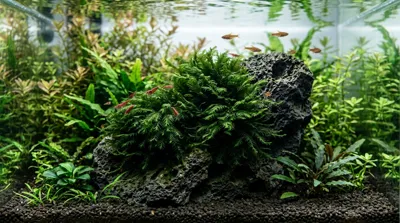
| Christmas Moss | Vesicularia montagnei | Triangular, fir-tree fronds | Medium | Vertical walls, foreground ledges |
| Phoenix Moss | Fissidens fontanus | Feathery, delicate fronds | Medium | Foreground stone accents, drip ledges |
| Flame Moss | Taxiphyllum sp. 'Flame' | Vertical upward spiraling shoots | Medium | Midground wood roots, vertical accents |
| Taiwan Moss | Taxiphyllum alternans | Soft, tiered weeping fronds | Low to Medium | Overhanging wood, branch tips |
Troubleshooting & Diagnostics Guide
1 Browning or dying lower mat
Diagnosis: Moss mat grown too dense, blocking light and flow from under-layers
Treatment: Trim outer growth heavily with curved scissors and siphon out decayed debris.
Prevention: Prune every 3-4 weeks to keep the cushion under 1.5 inches in depth.
2 Filamentous hair algae entangled in fronds
Diagnosis: Excessive light duration, nutrient imbalance, or detritus settling in moss
Treatment: Reduce photoperiod to 6 hours, manually remove algae with a toothbrush, and add Amano shrimp.
Prevention: Position moss away from direct light fixtures and maintain gentle water circulation.
3 Fronds detaching and floating away
Diagnosis: Rhizoids failed to anchor before initial binding deteriorated, or underlying wood decayed
Treatment: Re-tie thin layers using cotton thread or spot-glue onto stable hardscape with cyanoacrylate gel.
Prevention: Apply moss in thin, sparse layers so new rhizoids make direct contact with the hardscape.
Authoritative Resources
For additional peer-reviewed information on plant diseases, toxicity, and care, consult these trusted botanical and agricultural extensions:
Glossary of Terms
- Rhizoid
- A slender, hair-like filament produced by mosses that anchors the plant to hardscape without absorbing nutrients like vascular roots.
- Bryophyte
- A group of non-vascular land plants, including mosses, that absorb moisture and nutrients directly across their leaves rather than through internal vascular structures.
- Capillary Wicking
- The passive physical draw of water upward through fine spaces and porous media, supplying moisture to emersed plants above the water line.
Frequently Asked Questions
Can Java Moss grow out of water in a paludarium?
How do you attach Java Moss to rocks and driftwood?
Why is my Java Moss turning brown underneath?
Does Java Moss require CO2 injection?
How do you clean detritus or algae out of Java Moss?
How fast does Java Moss grow?
Can Java Moss be planted in substrate?
What is the difference between Java Moss and Christmas Moss?
Does Java Moss soften aquarium water?
How do you propagate Java Moss?
Sources & References
-
Source: aquaticplantcentral.com
-
Source: tropica.com
Explore More