Christmas Moss Care Guide: Attaching, Trimming, and Paludarium Use
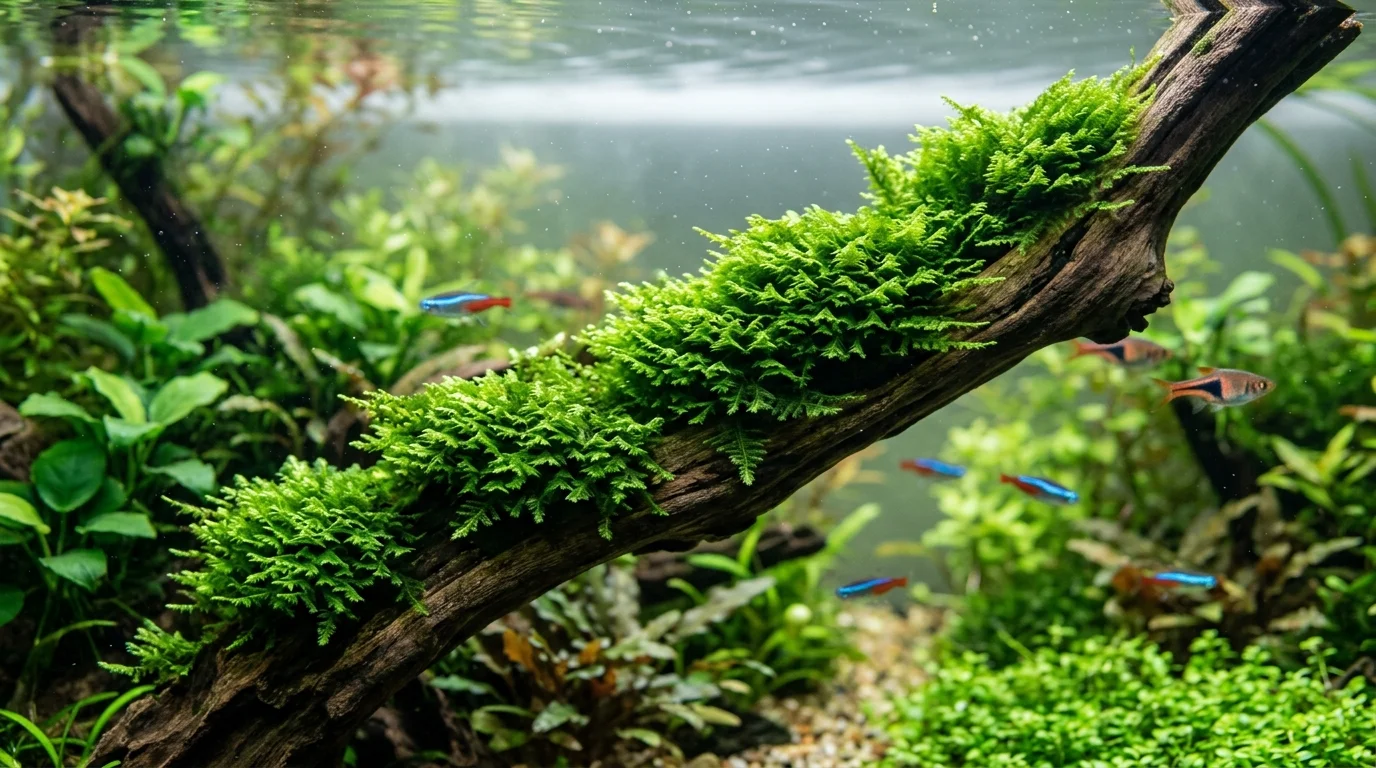
Christmas Moss (Vesicularia montagnei) is an aquatic bryophyte known for its dense, triangular fir-tree branching, ideal for aquascapes and humid paludarium walls.
-
Difficulty
easy
-
Light
Prefers medium light to display distinct triangular branching; under very low light, branches elongate and lose triangular definition.
-
Temperature
20-25°C (68-77°F)
-
Growth
moderate
-
Humidity
N/A submerged; 80-95% emersed in paludariums
-
pH range
6.0-7.2
-
Running Tanks Too Warm
A frequent mistake is keeping Christmas Moss in warm tropical setups (80°F+/27°C+). Unlike Java Moss, Christmas Moss native streams are cooler; high temperatures cause the fronds to stretch out, lose their iconic triangular boughs, and eventually turn brown.
-
Light Shapes the Pattern
If Christmas Moss looks like ordinary Java Moss in your tank, the issue is almost always insufficient light. It requires at least 30-40 PAR at the plant level to trigger the genetic expression of dense, triangular lateral branching.
-
Waterfall Splash Dynamics
In paludariums, Christmas Moss thrives along splash lines where moving water regularly mist-coats the fronds. Submerged flow keeps it free of biofilm, while emersed fronds exposed to turbulent spray develop thick, waxy, deep-green growth.
Quick Answer
Christmas Moss (Vesicularia montagnei) is a low-to-medium light bryophyte celebrated for its triangular fir-tree branching. Attach it in thin sheets to rock or wood using gel glue or thread—never bury it in substrate. It thrives in cool water at 68-77°F (20-25°C) or in humid paludariums (>80% RH), requiring regular trimming to keep the attachment layer healthy.
Key Takeaways
- Attach to hardscape using gel superglue or cotton thread; never bury in substrate.
- Prefers cooler water (68-77°F / 20-25°C) to prevent melting and browning.
- Requires medium light to develop and maintain its iconic triangular fronds.
- Thrives emersed in paludariums and vivariums with relative humidity above 80%.
Christmas Moss Care at a Glance
- Lighting: Medium light (30-50 PAR); higher light produces the best triangular fir-tree structure.
- Attachment: Secure to wood, rock, or mesh using gel glue or cotton thread. Never bury in substrate.
- Water Parameters: 68-77°F (20-25°C), pH 6.0-7.2. Sensitive to high heat above 80°F.
- Paludarium / Emersed: Excellent on drip walls and splash rocks with relative humidity above 80%.
- Maintenance: Regular pruning to keep the mat thin and prevent lower-layer suffocation.
- Common Issues: Hair algae entanglement, loss of triangular shape in low light, and browning from heat or chemical algaecides.
What Is Christmas Moss?
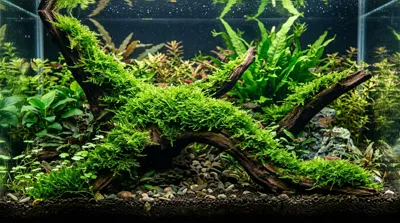
Christmas Moss (Vesicularia montagnei) is a freshwater aquatic bryophyte native to Southeast Asia, where it grows along shaded tropical stream banks, submerged boulders, and tree trunks subject to splashing water. It owes its common name to its distinct lateral growth pattern: each secondary branch divides in a symmetrical, triangular habit that resembles miniature fir tree boughs hanging over the hardscape.
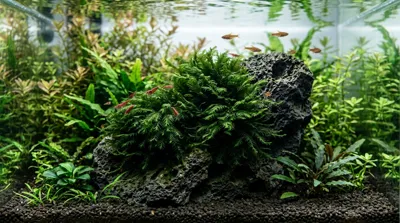
Because of this tiered architecture, Christmas Moss is prized in aquascaping for creating 'moss trees,' cascading waterfall ledges, and vertical wall backgrounds. It produces microscopic anchoring filaments called rhizoids, allowing it to grip tight to porous stones, wood, and artificial mesh.
Botanical Profile & Taxonomy
Vesicularia montagnei is a non-vascular land plant that thrives both submerged and in high-humidity emersed environments. Unlike Taxiphyllum barbieri (Java Moss), whose shoots branch irregularly and sprawl in all directions, healthy Christmas Moss produces flat, drooping, triangular branch networks when supplied with adequate light and stable nutrients.
- Botanical Name: Vesicularia montagnei
- Family: Hypnaceae
- Origin: Southeast Asia (India, Indonesia, Thailand, Malaysia)
- Foliage Architecture: Flat, densely spaced triangular fronds with ovate leaves
- Attachment Mechanism: Surface-gripping rhizoids
Submerged vs. Emersed Paludarium Growth
Christmas Moss transitions between aquatic and emersed forms with ease, provided the terrestrial environment remains damp and humid.
Submerged Aquascaping
Submerged in an aquarium, Christmas Moss displays its most pronounced triangular fronds when given medium light and gentle, consistent water circulation. Adequate flow delivers dissolved minerals directly to its single-cell leaf membranes while carrying away trapped organic waste. In stagnant water, detritus settles into the tiered fronds, encouraging cyanobacteria and thread algae to smother the moss.
Emersed Paludarium & Vertical Drip Walls
In humid paludariums and bioactive vivariums (80-95% RH), Christmas Moss forms a lush green carpet along waterfall edges, hygrolon background panels, and shoreline hardscape. It absorbs water through capillary action from adjacent splash zones or automated misting systems. If room air drops below 65% RH without supplemental misting, the delicate tips dry out and stop producing lateral branches. For step-by-step background construction, consult the Paludarium Moss Guide.
How to Attach Christmas Moss to Hardscape
- Separate into Thin Strands: Spread out the moss clump into a thin, web-like sheet. Thick clumps quickly rot at the base because light and water cannot penetrate the inner core.
- Choose Your Fixing Method: Use cyanoacrylate gel superglue for instant bonding to dry hardscape, or tie it securely with 100% black cotton sewing thread or fine monofilament line.
- Glue Spotting: Place small dots of gel glue across the hardscape surface, press the moss lightly against the dots, and allow it to cure for two minutes before submerging.
- Thread Wrapping: Wrap the thread around the branch with 1/4-inch spacing. The cotton thread breaks down naturally over 6 to 8 weeks, by which point the moss rhizoids have firmly anchored.
- Mesh Sandwiches (Wall Method): Sandwich a thin layer of moss between two sheets of stainless steel or plastic mesh to create a vertical green wall, then fasten it to the back glass with suction cups.
Lighting, Water Parameters, and Heat Sensitivity
Christmas Moss requires slightly cooler conditions than Java Moss. Its optimal temperature range is 68°F to 77°F (20-25°C). When maintained in warmer water exceeding 80°F (27°C), it undergoes heat stress: fronds lose their triangular definition, shoot outward in thin strings, and turn yellowish-brown.
Provide low-to-medium illumination (30-50 PAR). Under very low light, Christmas Moss survives but grows like ordinary Java Moss, losing its dense fir-tree pattern. Avoid high light unless injecting CO2, as high-intensity lighting easily leads to green hair algae and staghorn algae. Balance liquid fertilization with your enclosure's true water capacity using the Paludarium Water Volume Calculator.
Pruning and Maintenance
Regular maintenance keeps Christmas Moss healthy and anchored over the long term. As new fronds layer over older growth, the lower layer attached to the stone or wood becomes shaded. Without light, this bottom layer dies and detaches, causing the entire sheet to peel off into the water column.
- Prune every 3 to 4 weeks using sharp, curved spring scissors.
- Turn off filters and flow pumps before trimming to stop loose fronds from scattering.
- Siphon clippings immediately from the surface; any viable snippet left in the tank can sprout a new patch.
- Hover a siphon tube directly above the moss during routine water changes to lift out detritus.
Troubleshooting Common Christmas Moss Problems
Loss of Triangular Frond Structure
If your Christmas Moss is growing in long, thin, irregular strands rather than dense triangular boughs, it is light-starved. Increase PAR levels moderately (up to 40-50 PAR) or thin out overhanging floating plants that block the light.
Browning from Algaecides and Chemicals
Bryophytes lack the protective cuticles of vascular plants and absorb liquids directly through their leaf cells. Chemical algaecides and liquid carbon (glutaraldehyde) destroy moss cell membranes, turning the entire patch gray-brown within days. Discontinue liquid algaecides immediately, perform a 30% water change, and rely on Amano shrimp or Nerite snails for organic maintenance.
Recommended next actions
Next Best Actions
Use calculators and guides to turn this plant profile into a practical care routine.
Topic Guide
Paludarium Moss: How to Attach, Hydrate, and Maintain Moss
A technical guide to using moss across terrestrial, splash, transition, and submerged paludarium zones, covering attachment mechanics, hydration, PAR, airflow, algae control, and maintenance.
Topic Guide
How to Build a Paludarium Step by Step
A practical step-by-step construction workflow covering planning, enclosure selection, terrain structure, drainage, substrate, hardscape, water systems, lighting, planting, filling, testing, and stabilization.
Topic Guide
Open vs Closed Paludarium: Humidity, Evaporation, Plants, and Livestock
A technical comparison of open-top and closed-canopy paludariums covering relative humidity, evaporation buffers, mold mitigation, emergent plant cuticles, and livestock biosecurity.
Plant Guide
Java Moss
Java Moss (Taxiphyllum barbieri) is an adaptable aquatic bryophyte suited for freshwater aquariums, shrimp tanks, and humid paludarium walls.
Plant Guide
Anubias Nana
Anubias Nana is a hardy, slow-growing, low-light epiphyte perfect for beginner aquariums and aquascaping.
Calculator
Aquarium Fertilizer Calculator: Macro & Micro Doses
Calculate exact macro and micro fertilizer doses for your planted aquarium based on tank volume, plant density, CO2 system, and dosing strategy.
Structured Plant Data
Plant Data Profile
The following data is extracted directly from our botanical knowledge graph for accuracy and transparency.
Growth Characteristics
Growth Rate
moderate
Mature Height
1-3 inches (forms tiered drooping fronds)
Mature Spread
Expands outward across surfaces via branching stems
Life Cycle
Perennial
Flowering Season
Non-flowering (reproduces via spores and fragmentation)
Container Friendly
yes
Indoor Capable
yes
Environmental Parameters
| Parameter | Recommended | Survivable |
|---|---|---|
| Temperature | 20-25°C (68-77°F) | 15-28°C (59-82°F) |
| Humidity | N/A submerged; 80-95% emersed in paludariums | N/A submerged; >65% emersed |
| Soil PH | 6.0-7.2 | 5.5-7.8 |
Lighting
Description
Prefers medium light to display distinct triangular branching; under very low light, branches elongate and lose triangular definition.
Nutrients
Nitrogen Demand
low
Phosphate Demand
low
Potassium Demand
low
Micronutrient Notes
Absorbs dissolved minerals directly through leaflet membranes from water column or mist.
Fertilizer Frequency
Lean liquid micro-dosing once weekly.
Organic Options
Fish and shrimp bio-load typically covers base macronutrient requirements.
Relationships
-
Light
Requirement | Strength 8
Requires moderate lighting (30-50 PAR) to trigger tight, triangular 'fir-tree' frond formation.
-
Temperature
Requirement | Strength 7
Sensitive to elevated temperatures; growth slows above 26°C and leaves become prone to melting.
-
Hair Algae
Vulnerability | Strength 9
Dense tiered branching traps debris and filamentous algae if flow is stagnant.
Christmas Moss vs Common Aquascaping Mosses
| Moss Variety | Scientific Name | Branch Pattern | Temperature Tolerance | Key Advantage |
|---|---|---|---|---|
| Christmas Moss | Vesicularia montagnei | Distinct triangular fir-tree | 68-77°F (Cooler preferred) | Tiered weeping effect on wood & walls |
| Java Moss | Taxiphyllum barbieri | Loose, irregular tangle | 59-86°F (Very broad) | Extreme hardiness in any light |
| Phoenix Moss | Fissidens fontanus | Feathery, delicate plumes | 65-78°F | Tight compact growth on foreground rock |
| Flame Moss | Taxiphyllum sp. 'Flame' | Spiraling vertical shoots | 68-80°F | Creates vertical forest flame accents |
| Weeping Moss | Vesicularia ferriei | Strongly downward drooping | 65-77°F | Creates weeping canopy overhangs |
Troubleshooting & Diagnostics Guide
1 Fronds losing triangular shape and stretching
Diagnosis: Insufficient light intensity; stems are reaching upward toward the light source
Treatment: Increase light output to 30-50 PAR or remove surface shade plants.
Prevention: Provide steady, moderate illumination for 6-8 hours daily.
2 Base of the moss cushion turning brown and detaching
Diagnosis: Cushion has grown too thick, starving the foundation layer of light and water flow
Treatment: Heavily shear back the upper layer, siphon debris, and re-tie loose sections to hardscape.
Prevention: Prune monthly to keep the overall thickness below 1.5 inches.
3 Fronds turning yellow and melting in summer
Diagnosis: Water temperature sustained above 80°F (27°C)
Treatment: Cool the tank to 72-75°F using aquarium cooling fans or a chiller.
Prevention: Maintain stable temperatures between 68°F and 77°F.
Authoritative Resources
For additional peer-reviewed information on plant diseases, toxicity, and care, consult these trusted botanical and agricultural extensions:
Glossary of Terms
- Rhizoid
- Microscopic anchoring structures produced by mosses to grip surfaces without absorbing nutrients.
- Bryophyte
- Non-vascular land plants that absorb water and dissolved nutrients directly through cellular membranes.
- Triangular Branching
- The distinctive lateral growth pattern of Vesicularia montagnei that creates tiered, fir-tree-like foliage.
Frequently Asked Questions
How do you tell Christmas Moss apart from Java Moss?
Can Christmas Moss grow out of water in a paludarium?
How do you attach Christmas Moss to driftwood and rock?
Why is my Christmas Moss turning brown?
Does Christmas Moss need CO2 injection?
How do you prune Christmas Moss without making a mess?
Can Christmas Moss be planted in substrate?
How fast does Christmas Moss grow?
What water temperature does Christmas Moss prefer?
Is Christmas Moss safe for dwarf shrimp?
Sources & References
-
Source: aquaticplantcentral.com
-
Source: tropica.com
Explore More