Phoenix Moss Care Guide: Mounting, Trimming, and Paludarium Use
Phoenix Moss (Fissidens fontanus) is a slow-growing aquatic bryophyte with delicate feather-like fronds, ideal for aquascapes, nano tanks, and humid paludarium drip walls.
-
Difficulty
easy
-
Light
Thrives under low to medium light. Very bright lighting without adequate CO2 encourages hair algae, which can choke its delicate plumes.
-
Temperature
18-25°C (64-77°F)
-
Growth
slow
-
Humidity
N/A submerged; 80-95% emersed in paludariums
-
pH range
6.0-7.4
-
Spot-Treating Algae with Liquid Carbon
Spot-treating hair algae on Phoenix Moss with hydrogen peroxide or liquid carbon (glutaraldehyde) will melt the moss. Because Fissidens leaflets are only a single cell thick, chemical algaecides rupture cell walls instantly. Clean algae using shrimp and light adjustments instead.
-
Clean Water is Mandatory
Phoenix Moss struggles in dusty or high-waste aquariums. The feathery leaflets trap silt, which smothers the lower layers and triggers browning. Gentle, steady flow and pristine mechanical filtration are critical to keeping the cushions green.
-
Drip-Wall Performance
Phoenix Moss performs exceptionally well on vertical paludarium drip walls where water trickles continuously across limestone or porous lava rock. The consistent moisture delivery keeps the plumes saturated without detritus accumulation.
Quick Answer
Phoenix Moss (Fissidens fontanus) is a slow-growing bryophyte featuring compact, feather-like plumes. Attach thin pinches to porous rock or wood using gel glue or thread—never bury it in substrate. It thrives submerged or on humid paludarium drip walls (>80% RH) in cool water at 64-77°F (18-25°C) with clean flow and low-to-medium lighting.
Key Takeaways
- Mount onto porous stone or wood using gel glue or thread; avoid burying in substrate.
- Prefers clean, cool water (64-77°F / 18-25°C) with steady gentle circulation.
- Requires low to medium light; highly sensitive to liquid carbon and chemical algaecides.
- Flourishes emersed in humid paludarium drip walls and waterfall splash zones (>80% RH).
Phoenix Moss Care at a Glance
- Lighting: Low to medium (20-40 PAR); easily choked by algae under high light.
- Attachment: Glue or tie thin layers to porous rock or driftwood. Never bury in substrate.
- Water Parameters: 64-77°F (18-25°C), pH 6.0-7.4. Sensitive to warm water over 79°F.
- Paludarium / Emersed: Thrives on waterfall splash ledges and drip walls with humidity above 80%.
- Maintenance: Light cosmetic trimming; keep water clean and free of suspended silt.
- Common Issues: Detritus smothering, hair algae entanglement, and chemical melting from algaecides.
What Is Phoenix Moss?
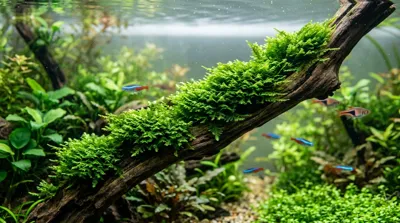
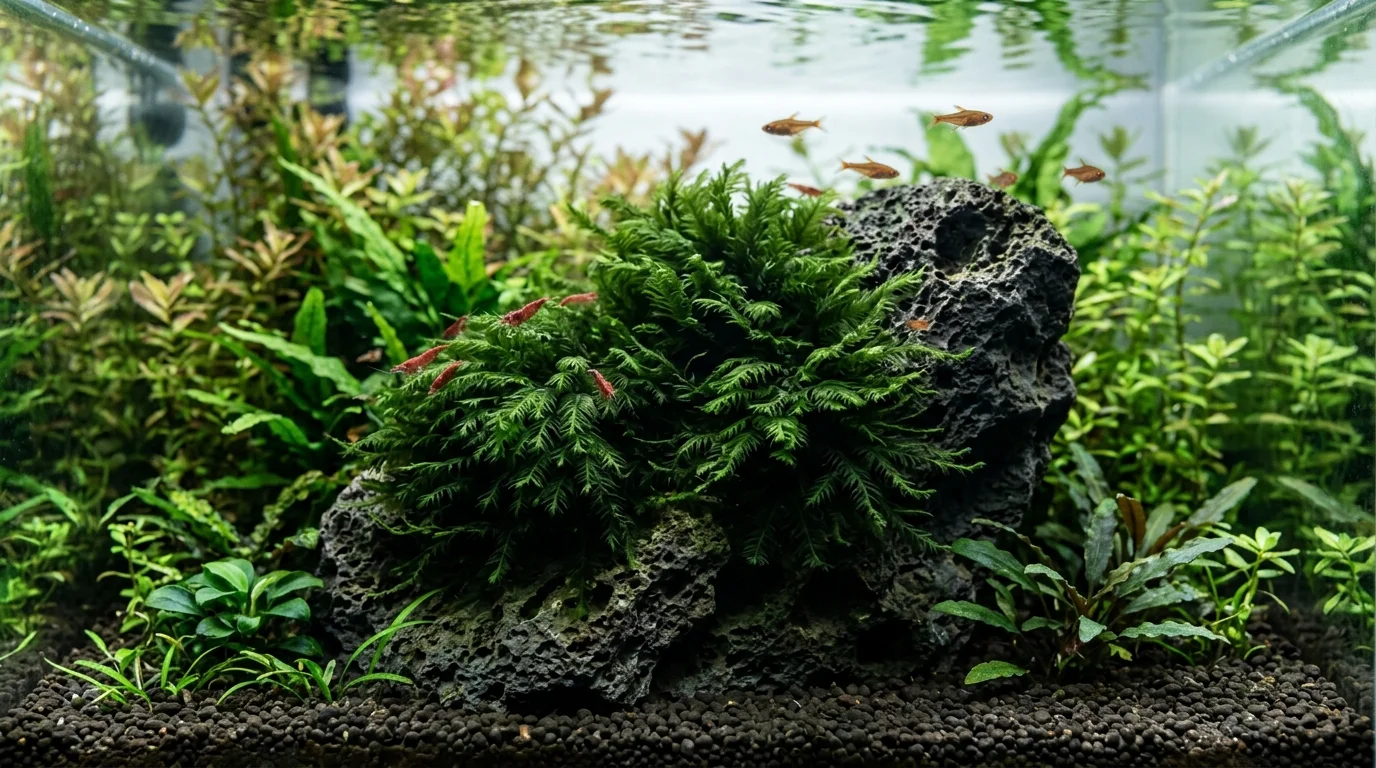
Phoenix Moss (Fissidens fontanus), often called US Fissidens, is an aquatic bryophyte native to North America. It inhabits spring-fed limestone creeks, submerged tree branches, and shaded river rocks bathed in steady, cool water. It takes its name from its distinctive leaf architecture: each lateral frond divides into overlapping pairs of leaflets, creating an intricate feathery plume that arches outward like bird feathers.
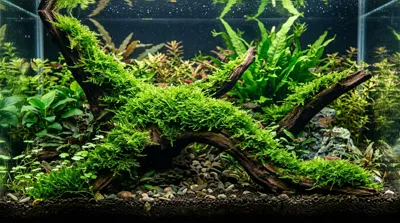
Unlike fast-spreading mosses that form tangled mats, Phoenix Moss develops tight, compact mounds that conform closely to the shape of the rock or wood underneath. It anchors using microscopic rhizoids that penetrate micro-crevices in hardscape, making it a favorite for detailing foreground rocks, stone stairs, and tree branch tips in high-end aquascaping.
Botanical Profile & Taxonomy
Fissidens fontanus belongs to the family Fissidentaceae, a primitive order of mosses recognized by their distichous (two-ranked) leaf arrangement. The leaflets sit in a single flat plane on either side of the stem, producing clean, plume-like fronds rather than the irregular three-dimensional tangles seen in Taxiphyllum species.
- Botanical Name: Fissidens fontanus
- Family: Fissidentaceae
- Origin: North America
- Foliage Architecture: Flat, arching, feather-like fronds with dark green, translucent leaflets
- Attachment Mechanism: Microscopic anchor rhizoids
Submerged vs. Emersed Paludarium Growth
Phoenix Moss grows both fully submerged and in humid emersed environments.
Submerged Aquascaping
Submerged in an aquarium, Phoenix Moss develops into dense, velvety mounds. It demands clean, particulate-free water; because the fine plumes act like mechanical filters, floating detritus readily settles into the foliage. In tanks with heavy waste or low filtration, trapped silt blocks light and induces bottom rot. Ensure steady water flow passes over the fronds without blasting them off their anchors.
Emersed Paludarium & Waterfall Drip Walls
In humid paludariums and enclosed bioactive vivariums (80-95% RH), Phoenix Moss flourishes along vertical rock ledges, waterfall splash lines, and hygrolon fabric backdrops. It wicks moisture efficiently through capillary action from flowing water channels. If room air humidity drops below 70% without supplemental misting, the delicate leaflets dry out and turn dark brown. For integration details, see our Paludarium Moss Guide.
How to Attach Phoenix Moss to Hardscape
- Use Clean Hardscape: Porous stones such as lava rock, dragon stone, or textured driftwood provide the best surface for rhizoid attachment.
- Spread Sparsely: Divide the moss cushion into small, penny-sized pinches. Thick clumps will rot at the base before the rhizoids have a chance to bond with the stone.
- Cyanoacrylate Gel Glue: Dab tiny dots of gel superglue onto the rock or wood, press the base of the moss pinch firmly against the glue for 10-15 seconds, and let it set for two minutes before submerging.
- Cotton Thread or Netting: Wrap fine black cotton thread around the hardscape at 1/4-inch intervals. The thread will break down naturally over 6 to 8 weeks, leaving the moss permanently anchored.
- Yogurt/Slurry Method for Emersed Walls: In closed paludariums, chop Phoenix Moss finely, mix with water or a pinch of clay powder, and paint it directly onto moist rocks or background foam under 100% humidity.
Lighting, Water Parameters, and Heat Sensitivity
Phoenix Moss prefers cooler water. Its ideal temperature range is 64°F to 77°F (18-25°C). Sustained temperatures above 79°F (26°C) cause the plumes to turn dull, stall growth, and become vulnerable to bacterial decay.
Keep lighting in the low to moderate range (20-40 PAR). High lighting without pressurized CO2 almost always leads to hair algae or staghorn algae infestations, which are nearly impossible to remove from the delicate fronds by hand. To avoid overdosing liquid nutrients in small water basins, calculate net volume with the Paludarium Water Volume Calculator.
Pruning and Maintenance
Because Phoenix Moss grows slowly, maintenance is minimal compared to Java or Christmas moss.
- Trim outer fronds every 6 to 8 weeks with sharp curved spring scissors to maintain neat cushion contours.
- Turn off filters and powerheads before cutting to prevent loose leaflets from drifting across the aquarium.
- Siphon trimmed fragments immediately using a small hose.
- Hover a siphon tube 1/2 inch above the mounds during weekly water changes to lift away collected silt without disturbing the moss.
Troubleshooting Common Phoenix Moss Problems
Detritus Smothering and Browning
When Phoenix Moss turns brown at the base, silt accumulation is usually the culprit. Increase mechanical filtration, avoid stirring substrate near the moss, and introduce Amano shrimp or dwarf Neocaridina shrimp to keep the plumes clean.
Algaecide Sensitivity (Liquid Carbon Melt)
Like most bryophytes, Phoenix Moss has thin, unprotected leaf cells that are vulnerable to chemical algaecides. Dosing liquid carbon (glutaraldehyde) directly onto or near Phoenix Moss will dissolve the plumes within 48 hours. Stop liquid algaecides, perform a partial water change, and manage algae through lighting duration and nutrient balance.
Recommended next actions
Next Best Actions
Use calculators and guides to turn this plant profile into a practical care routine.
Topic Guide
Paludarium Moss: How to Attach, Hydrate, and Maintain Moss
A technical guide to using moss across terrestrial, splash, transition, and submerged paludarium zones, covering attachment mechanics, hydration, PAR, airflow, algae control, and maintenance.
Topic Guide
How to Build a Paludarium Step by Step
A practical step-by-step construction workflow covering planning, enclosure selection, terrain structure, drainage, substrate, hardscape, water systems, lighting, planting, filling, testing, and stabilization.
Plant Guide
Java Moss
Java Moss (Taxiphyllum barbieri) is an adaptable aquatic bryophyte suited for freshwater aquariums, shrimp tanks, and humid paludarium walls.
Plant Guide
Christmas Moss
Christmas Moss (Vesicularia montagnei) is an aquatic bryophyte known for its dense, triangular fir-tree branching, ideal for aquascapes and humid paludarium walls.
Plant Guide
Anubias Nana
Anubias Nana is a hardy, slow-growing, low-light epiphyte perfect for beginner aquariums and aquascaping.
Calculator
Aquarium Fertilizer Calculator: Macro & Micro Doses
Calculate exact macro and micro fertilizer doses for your planted aquarium based on tank volume, plant density, CO2 system, and dosing strategy.
Structured Plant Data
Plant Data Profile
The following data is extracted directly from our botanical knowledge graph for accuracy and transparency.
Growth Characteristics
Growth Rate
slow
Mature Height
0.5-2 inches (forms dense, compact rounded tufts)
Mature Spread
Forms slow-expanding circular mats across hardscape
Life Cycle
Perennial
Flowering Season
Non-flowering (reproduces via spores and fragmentation)
Container Friendly
yes
Indoor Capable
yes
Environmental Parameters
| Parameter | Recommended | Survivable |
|---|---|---|
| Temperature | 18-25°C (64-77°F) | 15-27°C (59-80°F) |
| Humidity | N/A submerged; 80-95% emersed in paludariums | N/A submerged; >70% emersed |
| Soil PH | 6.0-7.4 | 5.5-7.8 |
Lighting
Description
Thrives under low to medium light. Very bright lighting without adequate CO2 encourages hair algae, which can choke its delicate plumes.
Nutrients
Nitrogen Demand
low
Phosphate Demand
low
Potassium Demand
low
Micronutrient Notes
Absorbs minerals directly through delicate, single-cell leaflet margins from the water column or spray.
Fertilizer Frequency
Lean micro-fertilization weekly or bi-weekly.
Organic Options
Shrimp bio-load and organic fish waste generally supply all necessary macronutrients.
Relationships
-
Water Cleanliness
Requirement | Strength 9
Requires clean, detritus-free water; suspended particulate matter settling on the fine fronds causes suffocation.
-
Temperature
Requirement | Strength 8
Prefers cool water; growth arrests and fronds turn dull brown when water temperatures exceed 26°C (79°F).
-
Hair Algae
Vulnerability | Strength 9
Slow growth rate makes it vulnerable to green hair and staghorn algae infestations in high-light tanks.
Phoenix Moss vs Other Aquascaping Mosses
| Moss Variety | Scientific Name | Growth Rate | Appearance | Best Use |
|---|---|---|---|---|
| Phoenix Moss | Fissidens fontanus | Slow | Feathery, arched plumes | Foreground stone accents, drip ledges |
| Java Moss | Taxiphyllum barbieri | Fast / Moderate | Irregular, tangled mat | General cover, fry and shrimp shelter |
| Christmas Moss | Vesicularia montagnei | Moderate | Tiered triangular fir fronds | Vertical walls, moss trees |
| Flame Moss | Taxiphyllum sp. 'Flame' | Moderate | Vertical spiraling shoots | Upright root accents |
| Mini Pellia | Riccardia chamedryfolia | Very Slow | Coral-like lobes | Hardscape crevices, nano scapes |
Troubleshooting & Diagnostics Guide
1 Fronds coated in fine silt or organic sludge
Diagnosis: Insufficient mechanical filtration or high particulate matter settling on dense foliage
Treatment: Hover a siphon hose over the mat during water changes and increase gentle water circulation.
Prevention: Position moss away from direct substrate drop zones and maintain steady water filtration.
2 Foliage melting and turning black after maintenance
Diagnosis: Direct exposure to glutaraldehyde (liquid carbon) or chemical algaecides
Treatment: Immediately stop chemical algaecide dosing and perform a 30-40% water change.
Prevention: Never spot-dose liquid algaecides directly onto bryophytes.
3 Fronds turning pale yellow-brown in summer
Diagnosis: Water temperature sustained above 79°F (26°C)
Treatment: Lower water temperature to 72-75°F using cooling fans.
Prevention: Maintain stable water temperatures between 64°F and 77°F.
Authoritative Resources
For additional peer-reviewed information on plant diseases, toxicity, and care, consult these trusted botanical and agricultural extensions:
Glossary of Terms
- Distichous
- Arranged in two alternating vertical ranks on opposite sides of an axis, giving Phoenix Moss its flat, feather-like plume appearance.
- Rhizoid
- Microscopic filamentous outgrowths that anchor bryophytes to hardscape without vascular root functions.
- Bryophyte
- A group of non-vascular land and aquatic plants, including mosses, that absorb water and minerals directly across cellular membranes.
Frequently Asked Questions
What is the difference between Phoenix Moss and Java Moss?
Can Phoenix Moss grow out of water in a paludarium?
How do you attach Phoenix Moss to rocks and driftwood?
Why is my Phoenix Moss turning brown or black?
Does Phoenix Moss need CO2 injection?
How fast does Phoenix Moss grow?
Can Phoenix Moss be planted into aquarium soil or sand?
How do you clean dirt and algae out of Phoenix Moss?
What water temperature does Phoenix Moss need?
How do you propagate Phoenix Moss?
Sources & References
-
Source: aquaticplantcentral.com
-
Source: tropica.com
Explore More