Hydrocotyle tripartita 'Japan' Care Guide: Carpet, Trimming & Emergent Growth
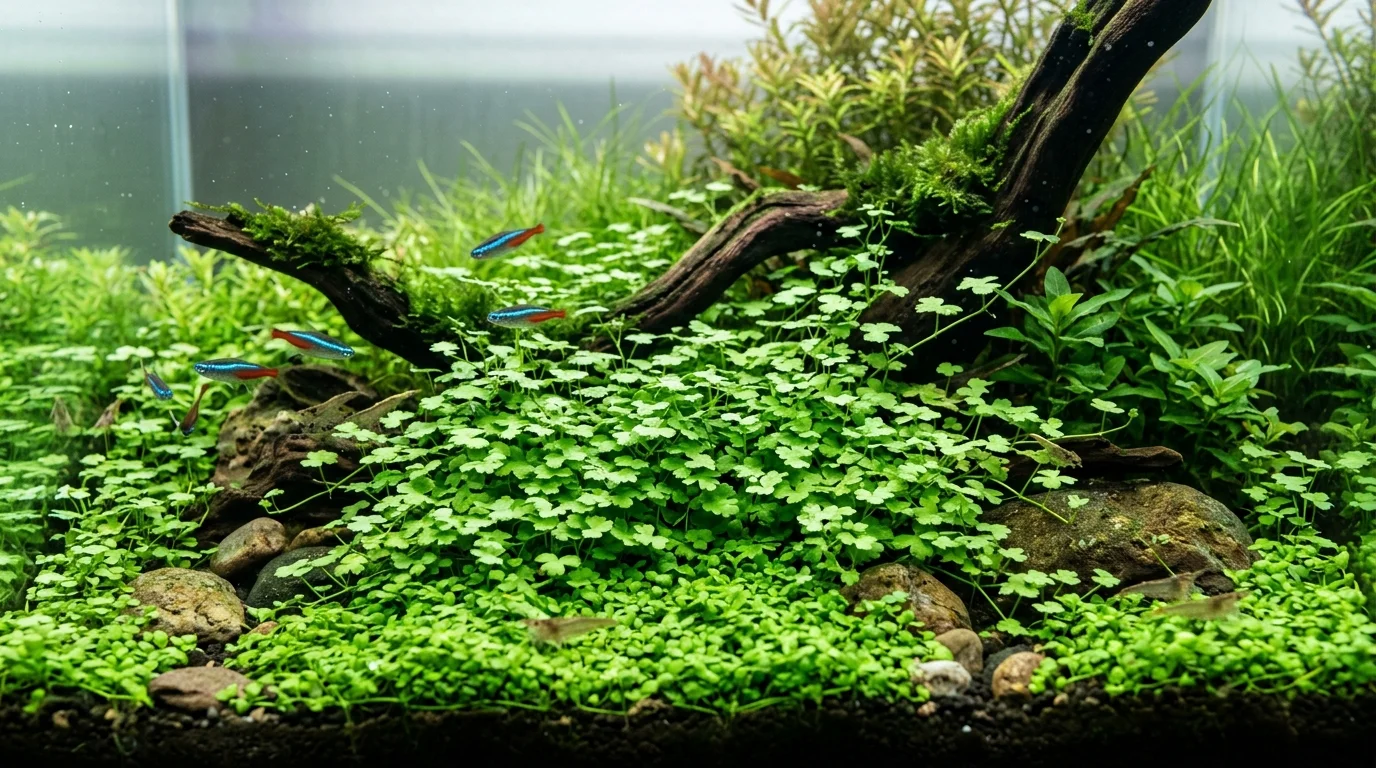
Hydrocotyle tripartita 'Japan' is a fast, creeping pennywort for aquarium carpets and emergent wabi-kusa builds.
-
Difficulty
easy
-
Light
Medium to high light for flat carpeting; low light causes leggy growth.
-
Temperature
20-28°C (68-82°F)
-
Growth
fast
-
Humidity
High for emergent growth
-
pH range
6.0-7.5
-
Biggest Owner Mistake
Letting the carpet grow untrimmed. The top layer shades the lower layers, which turn yellow and detach, and the carpet breaks apart from underneath.
-
What Nobody Tells You
Light decides the shape. The same plant is flat and dense at high light and tall and leggy at low light, so raise light before blaming nutrients.
-
Real Setup Conditions
In wabi-kusa and paludarium builds it grows faster out of the water than in it, so keep emergent runners trimmed and well anchored.
Quick Answer
Hydrocotyle tripartita 'Japan' grows best at 80–200 PPFD, where it stays flat and dense instead of tall and leggy. Trim regularly so the lower layers do not suffocate, yellow and detach. It suits both high-tech aquarium carpets and emergent wabi-kusa balls.
Key Takeaways
- Provide 80–200 PPFD to keep growth flat and dense instead of leggy.
- Trim every 1–2 weeks so lower layers do not suffocate and detach.
- Dose potassium, nitrate and iron; pinholes mean potassium, pale new leaves mean iron or nitrogen.
- Propagate by pressing 2–3 leaf runner sections with nodal roots into damp substrate or moss.
- Use it emergent on wabi-kusa balls and wet rock, or submersed as a foreground carpet.
Hydrocotyle tripartita 'Japan' Care at a Glance
- Light: 80–200 PPFD. Low light makes it tall and leggy; strong light keeps it flat, creeping and densely lobed.
- Water: pH 6.0–7.5, GH 3–8, KH 1–6, TDS 100–220 ppm, 20–28°C (68–82°F).
- Nutrients: Heavy feeder of potassium (K+), nitrate (NO3−) and iron (Fe).
- Maintenance: Trim regularly so the lower layers do not suffocate, yellow and detach.
- Propagation: Snip a runner with 2–3 leaves and nodal roots and press it into damp substrate.
- Best uses: Submersed foreground carpets, trailing midground bushes and emergent wabi-kusa or paludarium cover.
What Is Hydrocotyle tripartita 'Japan'?
Hydrocotyle tripartita, sold in the hobby as Hydrocotyle 'Japan', Mini Pennywort or Three-Part Pennywort, is a fast-growing creeping stoloniferous herb in the family Araliaceae. Its small, delicate, clover-like leaves are deeply lobed into three parts, and it spreads by thin runners that root at the nodes. In the wild it grows on wet riverbanks, muddy stream margins and damp ditches across Southeast Asia and Australia/Oceania, so it handles both submersed and emergent life.
That amphibious habit is its main strength. It makes a soft, airy carpet in a planted tank, and it crosses the waterline without fuss in a wabi-kusa or paludarium, where it drapes over wet rock and covers mud balls.
- Forms compact foreground carpets or trailing midground bushes underwater.
- Runs as an emergent creeper across shorelines, stone and moss.
- Trims easily with curved aquascaping scissors and regrows quickly.
Growth Habit: Submersed vs Emergent
Submersed Culture
Under moderate-to-high light and CO2, Hydrocotyle 'Japan' forms a compact, dense carpet or a trailing midground bush. Each runner roots as it travels, so the carpet knits itself to the substrate within a few weeks once established. Under weaker light the petioles stretch upward and the plant turns leggy rather than flat.
Emergent Culture (Wabi-Kusa and Paludarium)
Emergent growth is where this plant is exceptionally fast. The runner crosses the waterline smoothly, covers wabi-kusa mud balls, drapes over wet dragon stone and forms marginal transition ramps along the shore. For the build itself, see how to make a wabi-kusa and the wabi-kusa substrate recipe. If you are deciding how to lay out the shoreline, compare riparium vs paludarium designs and read about the paludarium water-land barrier.
Water and Environmental Parameters
| Parameter | Recommended Range |
|---|---|
| pH | 6.0–7.5 |
| TDS | 100–220 ppm |
| GH | 3–8 |
| KH | 1–6 |
| Temperature | 20–28°C (68–82°F) |
| Light | 80–200 PPFD |
The plant tolerates soft to moderately hard water. It is not fussy about pH inside this window, but very hard, alkaline water can lock out iron and slow new growth.
Light and CO2 Behavior
Light is the main control over shape. Around 80 PPFD the plant grows taller and leggier, reaching for the surface. Toward 200 PPFD it stays flat, creeping and densely lobed. Injected CO2 speeds up carpeting and gives tighter growth, but the plant can be grown without it if light is kept moderate and nutrients are consistent; expect slower, less dense coverage. Emergent plants get CO2 from the air, which is a large reason they grow so quickly. Humidity and lamp guidance for emergent setups is covered in wabi-kusa lighting and humidity.
Nutrition and Deficiency Signs
Hydrocotyle tripartita is a heavy consumer of potassium, nitrate and iron. Underdosing shows up quickly on new growth.
- Pale yellowish new leaves: iron and/or nitrogen deficiency.
- Pinholes in leaves: potassium starvation.
- Yellow, soft older leaves low in the carpet: usually shading and age rather than a nutrient problem; see trimming below.
Dose a complete liquid fertilizer with extra potassium and chelated iron, or use a nutrient-rich substrate with root tabs under the carpet. Emergent plants on wabi-kusa balls draw nutrients from the substrate and a light misting of dilute fertilizer.
Trimming and Carpet Maintenance
Why Layering Causes Problems
This plant grows in dense horizontal tiers. The top layer shades the one beneath it, and without regular pruning the lower layers suffocate, turn yellow and detach, then float up or rot and feed algae.
How to Trim
- Use curved aquascaping scissors and cut the carpet back to a uniform height.
- Remove the cuttings from the tank so they do not decay on the carpet.
- Thin the thickest patches so light reaches the base.
- Trim every 1–2 weeks in high-growth tanks, or about every 2–3 weeks in slower setups.
- Dose fertilizer after trimming to support regrowth.
Propagation
Propagate by stolon division. Snip any runner section with 2–3 leaves and adventitious nodal roots and press it into damp ADA Amazonia, wabi-kusa substrate or wet moss. Pairing it with paludarium moss helps new runners anchor on rock and wood.
Fauna and Bioactive Integration
The fine mat is an excellent foraging canopy for dwarf shrimp (Neocaridina and Caridina) and a safe nursery for nano-fish fry. In paludariums it provides soft grazing ground and natural egress ramps for semi-aquatic animals such as vampire crabs. Size the water and land areas with the paludarium land-to-water ratio calculator.
Hydrocotyle 'Japan' vs Other Carpeting Plants
Compared with Micranthemum 'Monte Carlo' and Glossostigma, Hydrocotyle 'Japan' is easier to keep and far better for amphibious use, but it grows taller and needs more trimming to stay flat. See the comparison table below.
| Feature | Hydrocotyle 'Japan' | Monte Carlo | Glossostigma | Best Application |
|---|---|---|---|---|
| Difficulty | Easy to moderate | Moderate | Demanding | Hydrocotyle for beginners |
| Emergent growth | Excellent | Good | Fair | Hydrocotyle for wabi-kusa |
| Carpet height | Taller, needs trimming | Low | Very low | Glossostigma for tight lawns |
Companion Plants and Hardscape
Pair Hydrocotyle 'Japan' with epiphytes such as Bucephalandra and Anubias nana on wood or stone. Their slower growth contrasts well with the runner, and the pennywort fills gaps between mounted plants. Keep runners trimmed away from the leaves of slow plants so they are not shaded.
Common Problems
Most issues come from low light, thick unpruned layers or too little potassium and iron. Check the troubleshooting section for symptom-by-symptom fixes.
- Lower layer detaching: trim and thin more often.
- Leggy vertical growth: raise light or reduce shading.
- Pinholes or pale new leaves: increase potassium, nitrate and iron.
Recommended next actions
Next Best Actions
Use calculators and guides to turn this plant profile into a practical care routine.
Plant Guide
Anubias Nana
Anubias Nana is a hardy, slow-growing, low-light epiphyte perfect for beginner aquariums and aquascaping.
Plant Guide
Bucephalandra
A slow-growing Bornean rheophyte that must be attached to rock or wood, never buried, and rewards stable water with metallic, iridescent foliage.
Topic Guide
How to Make a Wabi-Kusa: Step-by-Step Guide
Learn how to make a wabi-kusa with an exact substrate recipe by volume, plant picks, lighting, humidity targets, and mold prevention tips for beginners.
Topic Guide
Paludarium Moss: How to Attach, Hydrate, and Maintain Moss
A technical guide to using moss across terrestrial, splash, transition, and submerged paludarium zones, covering attachment mechanics, hydration, PAR, airflow, algae control, and maintenance.
Topic Guide
Building a Paludarium Land-to-Water Barrier: Drainage, Foam & Mesh
Build a leak-proof paludarium land-to-water barrier: false bottom eggcrate construction, expanding foam waterproofing, geotextile mesh, and soil wicking prevention.
Topic Guide
Riparium vs Paludarium: Structural & Ecosystem Differences Explained
Riparium vs Paludarium comparison: open water volume vs terrestrial land area, hanging planters vs false bottoms, animal stocking, and maintenance differences.
Structured Plant Data
Plant Data Profile
The following data is extracted directly from our botanical knowledge graph for accuracy and transparency.
Growth Characteristics
Growth Rate
fast
Mature Height
1-5 cm
Mature Spread
Spreading
Life Cycle
Perennial
Flowering Season
rare
Container Friendly
yes
Indoor Capable
yes
Environmental Parameters
| Parameter | Recommended | Survivable |
|---|---|---|
| Temperature | 20-28°C (68-82°F) | 18-30°C |
| Humidity | High for emergent growth | Moderate |
| Soil PH | 6.0-7.5 | 5.5-8.0 |
Lighting
Description
Medium to high light for flat carpeting; low light causes leggy growth.
Nutrients
Nitrogen Demand
high
Phosphate Demand
medium
Potassium Demand
high
Micronutrient Notes
Heavy consumer of potassium, nitrate and iron; pale new leaves indicate iron or nitrogen deficiency, pinholes indicate potassium starvation.
Fertilizer Frequency
Regular liquid fertilizer dosing, with root tabs under the carpet if needed.
Organic Options
Nutrient-rich aquasoil or wabi-kusa substrate.
Relationships
-
Light
Requirement | Strength 9
Controls whether growth is flat and dense or tall and leggy.
-
Trimming
Requirement | Strength 9
Regular trimming prevents lower layers from yellowing and detaching.
-
Potassium
Requirement | Strength 8
Potassium starvation causes pinholes in leaves.
Hydrocotyle Species Comparison
| Feature | Hydrocotyle tripartita | Hydrocotyle leucocephala | Hydrocotyle verticillata |
|---|---|---|---|
| Leaf shape | Small, three-lobed, clover-like | Larger, rounded | Round, peltate, on upright stalks |
| Growth habit | Low creeping carpet | Trailing or floating stems | Upright to trailing |
| Best use | Foreground carpet and wabi-kusa | Midground and floating cover | Background and riparium |
| Maintenance | Frequent trimming to stay flat | Moderate | Moderate |
| Light need | Medium to high | Low to high | Low to high |
Troubleshooting & Diagnostics Guide
1 Lower carpet layer detaching and floating
Diagnosis: Dense upper tiers shade the lower layers, which die and release from the substrate.
Treatment: Trim the carpet back, remove loose debris and thin thick patches so light reaches the base.
Prevention: Trim every 1–2 weeks and keep the carpet low and thin.
2 Vertical leggy growth
Diagnosis: Light too low, so petioles stretch toward the surface.
Treatment: Raise light toward 120–200 PPFD, trim tall stems and replant the tops as new runners.
Prevention: Keep PPFD in the 80–200 range and avoid shading by floating plants or hardscape.
3 Yellowing or chlorosis of leaf margins
Diagnosis: Iron, nitrogen or potassium deficiency, or very hard alkaline water limiting iron uptake.
Treatment: Dose chelated iron, nitrate and potassium; check KH and pH are within range.
Prevention: Dose a complete fertilizer on a schedule and test nitrate regularly.
4 Melting after planting tissue culture
Diagnosis: Transition stress from the sealed cup to open water; old leaves die while new growth adapts.
Treatment: Rinse off gel, split into small portions, plant shallowly with good light, nutrients and CO2 if available, and wait for new growth.
Prevention: Provide stable parameters and avoid heavy trimming during the first weeks.
5 Black algae on older foliage
Diagnosis: Poor flow, fluctuating CO2 and decaying old leaves provide a foothold for algae.
Treatment: Trim off affected foliage, improve circulation and stabilise CO2 and nutrients.
Prevention: Prune old leaves regularly and keep nutrients balanced.
6 Runners failing to anchor to rock
Diagnosis: Surface too smooth or dry, or runner moved by flow before roots form.
Treatment: Pin runners with thread, rubber band or moss and keep the surface wet or humid.
Prevention: Use rough rock or moss and keep water movement gentle until anchored.
7 Stunted, curled leaves
Diagnosis: Nutrient shortage, especially potassium or iron, or excessive flow or light shock.
Treatment: Raise fertilizer levels, check water parameters and reduce harsh flow.
Prevention: Dose consistently and adjust light gradually.
8 Dried leaf tips in emergent setups
Diagnosis: Low humidity, drafts or substrate drying out.
Treatment: Increase humidity, mist or cover the container, and keep the substrate wet. See wabi-kusa humidity guidance.
Prevention: Maintain high humidity and consistent moisture.
Authoritative Resources
For additional peer-reviewed information on plant diseases, toxicity, and care, consult these trusted botanical and agricultural extensions:
Glossary of Terms
- Stolon
- A creeping horizontal stem that roots at its nodes to form new plants; Hydrocotyle spreads by stolons.
- Wabi-kusa
- A Japanese style of growing plants in a ball of substrate, often emergently, as a living centerpiece.
- PPFD
- Photosynthetic photon flux density, the amount of usable light reaching the plants, measured in µmol/m²/s.
- Emergent
- Growth with leaves above the waterline, in air with high humidity.
Frequently Asked Questions
How do I plant Hydrocotyle tripartita from tissue culture?
How does Hydrocotyle 'Japan' behave under high light vs low light?
Can Hydrocotyle tripartita grow without injected CO2?
Can I wrap Hydrocotyle around wabi-kusa substrate balls?
Can Hydrocotyle tripartita be used as a floating plant?
How often should I trim Hydrocotyle tripartita?
Why is my Hydrocotyle carpet turning yellow underneath?
What nutrients does Hydrocotyle tripartita need most?
Is Hydrocotyle 'Japan' safe for shrimp and nano fish?
How do I propagate Hydrocotyle tripartita?
Can Hydrocotyle tripartita grow in a paludarium?
What water parameters suit Hydrocotyle tripartita?
Sources & References
-
Source: en.wikipedia.org
Explore More