Building a Paludarium Land-to-Water Barrier: Drainage, Foam & Mesh
The land-to-water barrier is the structural heart of a paludarium. It separates a saturated aquatic zone from a moist but oxygenated terrestrial zone. Without it, porous soils such as ABG mix, peat and coco fiber draw water upward through capillary tension until the root zone is waterlogged, starved of oxygen and producing sulfides. This guide covers the physics of capillary wicking, three proven construction methods (eggcrate false bottom, expanding foam, and stone retaining walls), geotextile selection, hidden drain and pump access, and egress design for semi-aquatic animals such as vampire crabs. Follow the layer specifications and cure times below and the barrier will stay leak-proof and the soil healthy for years.
Quick Answer
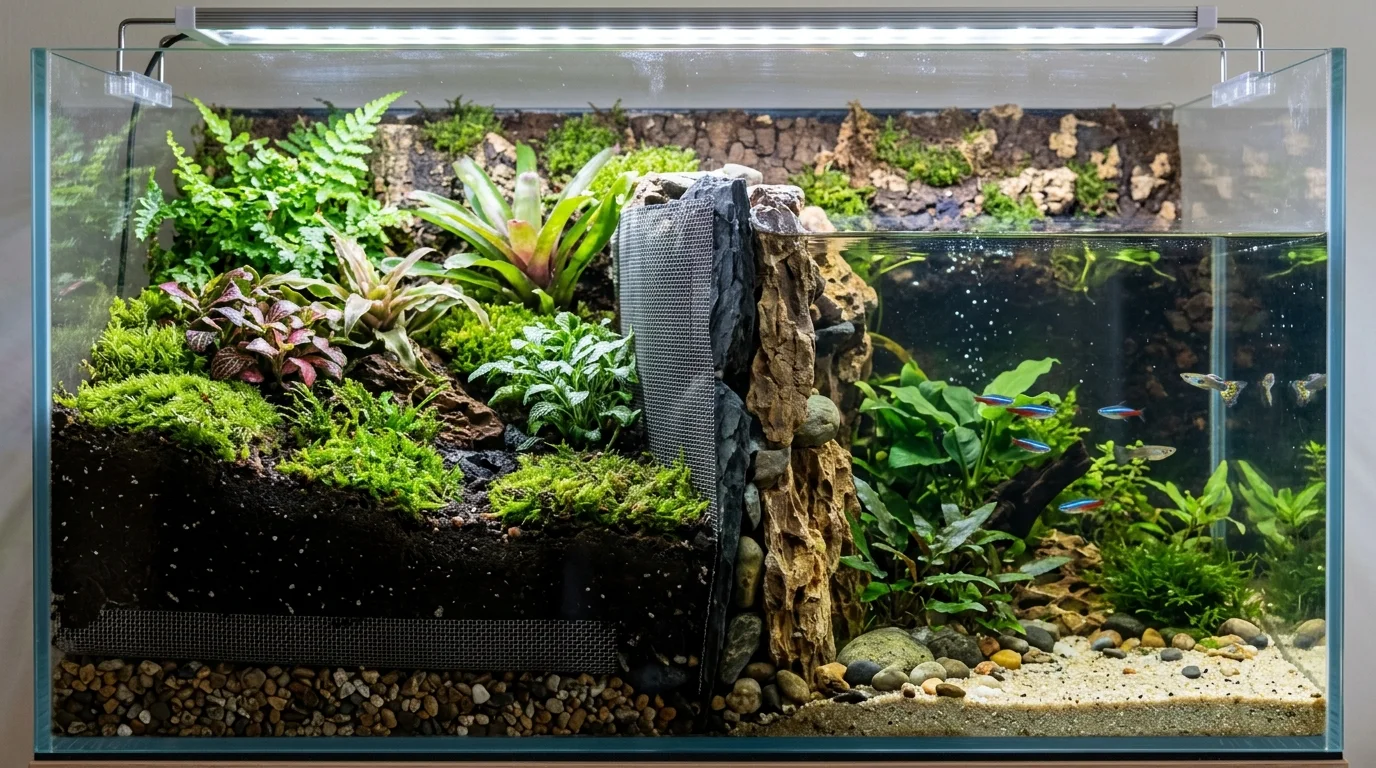
A paludarium land-to-water barrier must stop terrestrial soil from touching standing water, because wet soil wicks water upward by capillary action and turns anaerobic. The reliable fix is a capillary break: an air gap or non-porous wall between the water table and the substrate. Build it with a suspended eggcrate false bottom lined with non-woven geotextile, cured expanding foam sealed with 100% silicone, or silicone-bonded stone walls backfilled with LECA. Add a hidden access pipe to the false bottom so flood water can be drained without dismantling the scape.
Key Takeaways
- Soil touching standing water wicks it upward by capillary action, so every paludarium needs a true capillary break: an air gap or a non-porous wall.
- A suspended eggcrate false bottom lined with non-woven geotextile is the most maintainable design, especially with a hidden 1/2-inch or 3/4-inch access pipe for draining flood water.
- Cured expanding foam sealed with 100% silicone gives the most naturalistic shorelines, but it must be fully cured and ventilated before any water or animals go in.
- Use non-woven needle-punched geotextile, never woven weed barrier, which clogs and frays and fails as a soil separator.
- Build gentle, textured egress ramps and trim moss at the barrier lip so animals can leave the water and moss cannot siphon the pool into the soil.
Why the Land-to-Water Barrier Decides Whether a Paludarium Lives or Dies
A paludarium keeps two incompatible environments in one glass box: a flooded aquatic zone and a terrestrial zone whose roots need both moisture and oxygen. The barrier between them is not decoration. It is the structure that keeps those two zones from merging into one swamp. If you are still deciding on the overall layout, compare the designs in our guide to riparium vs paludarium and size each zone with the paludarium land-to-water ratio calculator before you cut a single piece of eggcrate or squeeze any foam.
Most failed paludariums fail the same way. The builder piles soil against the water, the soil looks fine for three weeks, and then the lower layers turn black and smell like rotten eggs. That is not a plant problem. It is a physics problem, and the barrier is the cure.
The Capillary Wicking Catastrophe
How Soil Wicks Water Upward
Water adheres to soil particles and is held together by cohesion. In the narrow pores between particles it forms a curved surface, and surface tension pulls the water column upward against gravity. This is capillary action, and the finer the pores, the higher the water climbs. Porous terrestrial mixes such as ABG mix, peat and coco fiber are full of fine pores. If the base of that substrate touches standing water, it acts like a wick and keeps drawing water upward for as long as the pool supplies it.
Coarse materials behave differently. Large-grained gravel, lava rock and expanded clay (LECA) have pores too wide to pull water more than a short distance, which is why they are used as drainage layers instead of growing media.
What Saturation Does to the Root Zone
- Hypoxia: Water-filled pores displace air. Roots of terrestrial plants need oxygen to respire, and a saturated substrate cannot supply it.
- Root suffocation: Fine feeder roots die first, turn brown or translucent, and become entry points for rot.
- Anaerobic souring: Without oxygen, anaerobic bacteria take over the substrate and begin to break down organic matter without it.
- Sulfide production: Sulfate-reducing bacteria generate hydrogen sulfide, which causes the rotten-egg smell and blackened soil. It is toxic to roots and to the animals living in the tank.
Designing a True Capillary Break
A capillary break is a physical interruption between the water table and the terrestrial substrate. It takes one of two forms:
- An air gap: A void of at least 1 inch (2.5 cm) between the highest possible water level and the lowest point of the substrate or fine mesh. Capillary water cannot cross open air.
- A non-porous barrier: A sealed wall of cured and siliconed foam, glass, or silicone-bonded stone that stops lateral wicking where soil meets the pool edge.
Most robust builds use both: a non-porous wall to define the shoreline and an air gap or coarse drainage layer beneath the soil so that any water that does get through collects below the root zone instead of rising into it.
Structural Barrier Construction Methods
Method A: Suspended Eggcrate False Bottom
Eggcrate is the plastic fluorescent light diffuser panel sold in hardware stores. Its open grid is rigid and inert, and it creates a void beneath the terrestrial zone for drainage water to collect.
- Cut the eggcrate to fit the land zone with a gap of about 1/4 inch (6 mm) from the glass so it can be lifted out, then seal the gap with silicone-bonded mesh strips.
- Cut PVC pipe into risers or legs and set the eggcrate on them. The void height should give at least 1 inch (2.5 cm) of air above your maximum water level and enough volume to hold a drainage reserve, typically 2 to 3 inches (5 to 7.5 cm).
- Line the top face with non-woven geotextile fabric or fiberglass window screen, wrapped up the glass by 1 inch (2.5 cm) so no soil can fall through the grid.
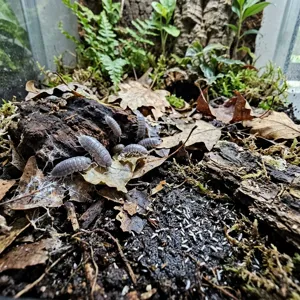
- Add a drainage layer of LECA or lava rock, then a second layer of mesh, then the terrestrial substrate. For terrestrial layers that double as a cleanup-crew habitat, see our isopod substrate recipe.
Use plastic-coated fiberglass screen, not aluminum screen, which can corrode in persistently wet conditions.
Method B: Expanding Foam Shoreline and Waterfall Channels
Closed-cell expanding foam, such as Great Stuff Pond & Stone, can be carved into naturalistic banks, ledges and waterfall channels. It is lightweight and easy to sculpt, but it is not waterproof on its own and must be sealed.
- Apply the foam in thin layers, never one thick bead, because foam keeps expanding as it cures.
- Let it cure until it is fully firm and no longer tacky, then carve it with a serrated knife or hot knife (with ventilation).
- Seal every surface that will touch water or soil with a coat of 100% silicone. Choose a product labeled aquarium-safe, with no mold or mildew inhibitors.
- While the silicone is still wet, press dry peat or coco fiber into it to hide the sealant and give moss and roots a naturalistic anchor.
- Rinse and cure the finished piece as described in the FAQ before introducing water or animals.
Method C: Natural Stone Retaining Walls
Slate, lava rock and dragon stone can be stacked into a retaining wall that holds the soil back from the water. Bond the stones with 100% silicone or cyanoacrylate gel. Cyanoacrylate gel sets in seconds and can be bulked with a piece of tissue to bridge hairline gaps, but silicone is the better choice for the water-facing joints, because it stays flexible and waterproof. Backfill behind the wall with LECA, not soil, so that the layer touching the wall is a non-wicking material, and add the terrestrial substrate on top, separated by mesh.
Barrier Layer Hierarchy and Material Specifications
| Layer Position | Material | Function | Critical Sourcing Requirement |
|---|---|---|---|
| 1 (bottom) | Tank base or standing water void | Holds drainage and flood water | Rated glass and silicone joints with no leaks |
| 2 | PVC risers with eggcrate panel | Structural platform with an air gap above the water table | Rigid light-diffuser eggcrate with a 1/2-inch cell; unpainted PVC |
| 3 | Non-woven geotextile or fiberglass screen | Soil separator that lets water through but retains fines | Needle-punched non-woven polyester or polypropylene; no coatings |
| 4 | LECA or lava rock | Drainage layer that breaks capillary rise | Pre-rinsed, uncoated, pH-neutral |
| 5 | Second mesh layer | Keeps substrate out of the drainage layer | Same non-woven specification as layer 3 |
| 6 (top) | Terrestrial substrate | Root zone for plants and fauna | Fertilizer-free, pesticide-free mix |
Construction Method Comparison
| Method | Structural Durability | Soil Separation Integrity | Aesthetic Naturalism | Difficulty Level | Best Use Case |
|---|---|---|---|---|---|
| A: Eggcrate false bottom | High | High with non-woven geotextile | Low until covered with substrate and moss | Moderate | Large land zones that need full drainage and maintenance access |
| B: Expanding foam | Moderate to high once sealed | High when fully sealed with silicone | Very high | High | Naturalistic shorelines, waterfalls and custom shapes |
| C: Stone retaining wall | High | Moderate; depends on joint quality and backfill | High | Moderate to high | Defined, rocky banks and terraced layouts |
Geotextile Fabric: Why Woven Weed Barrier Fails
Woven landscape fabric is made from flat polypropylene tapes woven into a grid. Its openings are large and uneven, and it frays at cut edges. Fine soil particles pass through the gaps, and the fibers clog with silt, so it fails in both directions. Non-woven, needle-punched geotextile is made from randomly tangled fibers, and its three-dimensional structure filters fines while passing water freely. Choose a non-woven drainage fabric in the range of 3 to 4 oz per square yard (100 to 135 g per square meter), with no herbicide, UV or color coatings.
Siphon and Access Pipe
Flood water will eventually collect in the void under a false bottom, and you need a way to remove it without tearing the scape apart. Install a rigid 1/2-inch or 3/4-inch vinyl or PVC tube that runs from the surface of the substrate down to the floor of the void, with a removable cap at the top. Conceal the opening behind rock, a plant or a moss mat. Cut slots or drill holes in the bottom end and wrap them with mesh, so the tube can pull water but not debris. To drain, insert a thin siphon line or use a turkey baster or small pump. If you use a circulation pump for streams and waterfalls, see paludarium water circulation pumps and plan a removable rock panel or cut-out so you can reach the pump without disturbing the barrier.
Fauna Egress and Bioactive Integration
Semi-aquatic animals can drown if they cannot leave the water. Sheer glass and vertical foam walls are hazards, so build gentle egress ramps with a slope of no more than about 30 to 45 degrees, surfaced with textured stone, cork, or foam pressed with substrate. Provide more than one exit, keep the shoreline water shallow, and avoid smooth steep edges anywhere around the pool. Species such as the ones in our vampire crab paludarium guide spend most of their time out of the water and rely on easy access to land. Moist, textured stone transitions also invite plants. Attach Bucephalandra and Anubias nana to barrier rocks along the shoreline, with the rhizome exposed and not buried, and their roots will grip the stone and soften the edge.
Moss, Wicking and the Barrier Lip
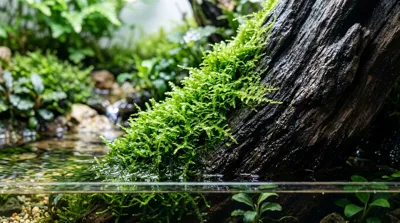
Moss is a living wick. If a strand grows across the barrier from the water into the soil, it can carry water over a capillary break and re-saturate the substrate. Keep a dry strip of coarse gravel or bare stone of about 1/2 inch (1 cm) at the lip and trim any moss that bridges it. For moss selection and placement, see paludarium moss.
Common Mistakes to Avoid
- Skipping the air gap: Soil piled directly against the water will wick no matter how it looks on day one.
- Using woven weed barrier: It clogs and frays, and it lets fines through.
- Rushing the cure: Foam and silicone must be fully cured and rinsed before water and animals go in.
- Burying the access pipe: If you cannot reach the void, you cannot drain it.
- Building vertical walls with no exits: Animals can drown against sheer sides.
Frequently Asked Questions
How long does aquarium-safe silicone take to cure in a paludarium?
Aquarium-safe 100% silicone forms a skin in roughly 15 to 30 minutes and is usually cured through a thin bead within 24 hours. Thick beads and joints that are sealed on both sides take 48 to 72 hours. Wait until the vinegar-like smell is gone before adding water or animals, and always use a product with no mold or mildew inhibitors.
Are the fumes from expanding foam toxic?
Uncured foam releases irritating vapors and its components can irritate skin and lungs, so work in a ventilated area and wear nitrile gloves. Once fully cured, a closed-cell foam labeled for ponds and stone, such as Great Stuff Pond & Stone, is widely used in aquariums. Allow it to cure for at least the time on the can, ideally 48 to 72 hours, then seal it with silicone and rinse before use.
Why does a land-to-water barrier need a capillary break?
Porous soils wick water upward through capillary tension when they touch standing water. This saturates the root zone, displaces oxygen and leads to anaerobic souring. A capillary break, which is an air gap or non-porous wall, stops the water from rising.
How do I prevent geotextile from clogging over time?
Use non-woven needle-punched geotextile, not woven weed barrier, and place a coarse LECA or lava rock layer between the mesh and the soil so fines are not pressed into the fibers. Keep a second mesh layer above the drainage layer, avoid very fine substrates directly against the fabric, and flush the access pipe periodically.
Can moss climb over the barrier and act as a capillary wick?
Yes. Moss strands that bridge the barrier can carry water from the pool into the soil. Keep a dry strip of coarse gravel or bare stone about 1/2 inch (1 cm) wide at the lip, and trim any moss that crosses it.
How do I access a pump hidden behind the barrier?
Plan access before you build. Use a removable rock panel, a cut-out in the false bottom with a lift-out lid, or a pump chamber at the side of the water zone. Leave slack in the pump's cord and tubing so it can be lifted out without disturbing the scape.
What size pipe should I use for a hidden drain or siphon tube?
A rigid 1/2-inch or 3/4-inch vinyl or PVC tube works well. It should reach the floor of the false bottom void, have a removable cap, and be concealed with rock, plants or moss. Wrap the slotted bottom end in mesh so it does not pull in debris.
Why does woven weed barrier fail as a soil separator?
Woven fabric has large, uneven gaps that let fine soil through, it frays at cut edges, and its flat tape fibers clog with silt. Non-woven drainage fabric filters fines while still letting water through.
How should I design egress for vampire crabs and other semi-aquatic animals?
Build gentle ramps of no more than about 30 to 45 degrees from textured stone, cork or foam pressed with substrate. Provide several exits, keep the water near the shore shallow, and avoid sheer glass or vertical foam sides where animals could drown.
Can I use cyanoacrylate gel instead of silicone for the barrier?
Cyanoacrylate gel is fine for bonding stone to stone, and a piece of tissue can help it bridge hairline gaps. For watertight, load-bearing seams at the water line, use 100% silicone, which stays flexible and seals better.
Explore More
Related Articles
Related Plant Guides
No specific plant guides found matching this topic.
Recommended next actions
Continue Exploring
Dive deeper into related plant care tools and profiles.
Calculator
Paludarium Water Volume & Land Ratio Calculator
Calculate net paludarium water volume, land and water surface areas, false bottom void capacity, and minimum pump flow in metric or imperial units.
Plant Guide
Anubias Nana
Anubias Nana is a hardy, slow-growing, low-light epiphyte perfect for beginner aquariums and aquascaping.
Plant Guide
Bucephalandra
A slow-growing Bornean rheophyte that must be attached to rock or wood, never buried, and rewards stable water with metallic, iridescent foliage.
Topic Guide
DIY Isopod Substrate Recipe: Ratios, Ingredients & Preparation
Master DIY isopod substrate recipe by volume: decayed white-rot wood, fermented flake soil, oak leaf compost, worm castings, and calcium carbonate ratios.
Topic Guide
Paludarium Moss: How to Attach, Hydrate, and Maintain Moss
A technical guide to using moss across terrestrial, splash, transition, and submerged paludarium zones, covering attachment mechanics, hydration, PAR, airflow, algae control, and maintenance.
Topic Guide
Paludarium Water Pumps: Sizing, Waterfall Plumbing & Circulation
Size and plumb paludarium pumps: GPH vs head height calculation, hidden pump chambers, drip wall plumbing, avoiding dead zones, and pump maintenance.