Bioactive Cleanup Crew Balance: Isopods and Springtails Cohabitation
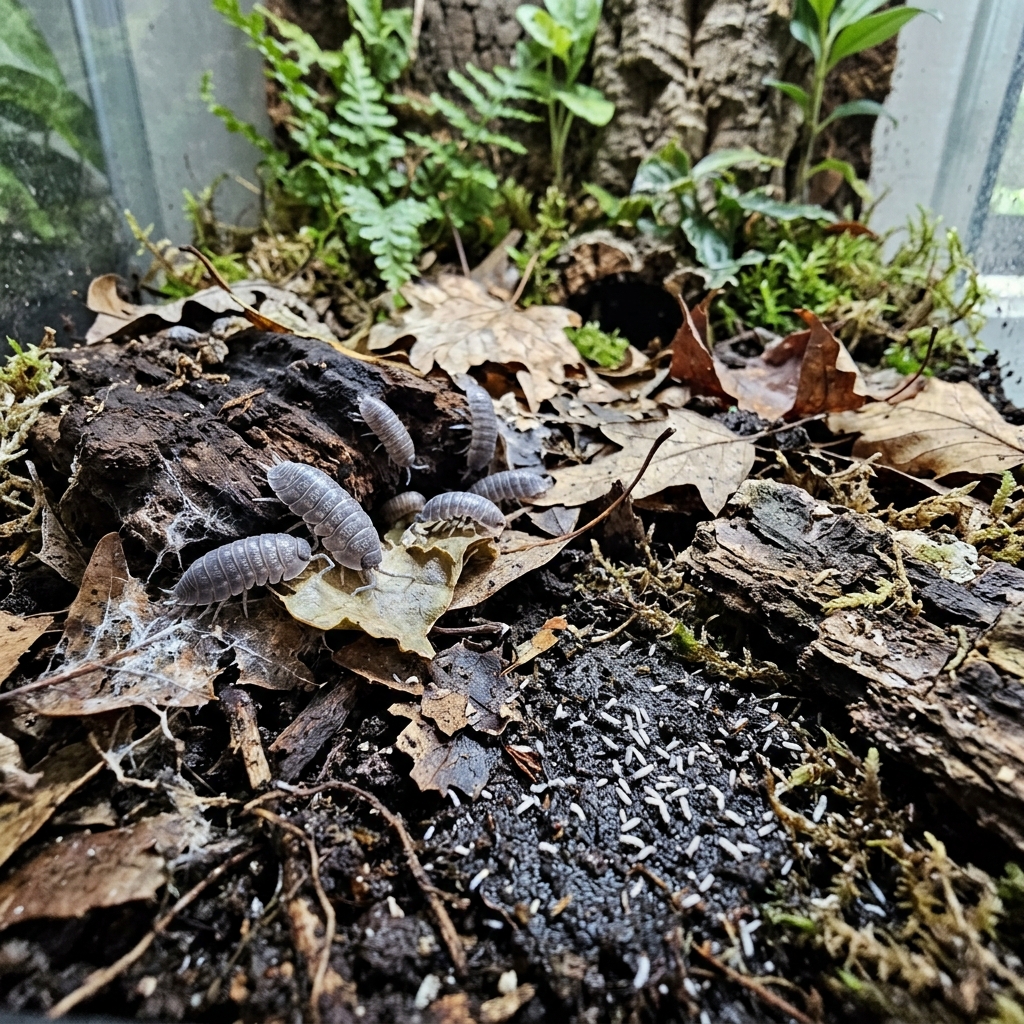
Springtails and isopods occupy different ecological niches, which is why they make a strong team: springtails clean up microscopic fungal and bacterial growth in the substrate pores, while isopods mechanically break down tough lignified matter and leave pre-shredded frass for springtails and plants. Problems begin when fast-breeding isopods outcompete springtails for the same soft food, when feeding is poorly distributed, or when frass accumulates faster than the substrate can process it. This guide covers niche partitioning, competition and population dynamics, seeding ratios and timing, the signs of a crash, and the interventions that restore balance. It also explains how to keep isopods from nibbling live plants and moss, and which genera combine best with springtails.
Quick Answer
Balance a bioactive cleanup crew by pairing springtails (micro-decomposers that graze mold, spores and bacterial film) with isopods (macro-decomposers that shred leaves and decayed wood), and by seeding springtails 2-3 weeks before the isopods. Start with roughly 100-200 springtails and 5-10 isopods for a nano build, 500-1,000 springtails and 10-20 isopods for a 20-40 gallon enclosure, and scale up for larger vivaria. Feed isopods separately from the main substrate with protein and calcium, keep leaf litter and decayed wood permanently stocked, and refresh 20-30% of the substrate every 3-6 months to prevent frass toxicity and food competition.
Key Takeaways
- Springtails and isopods do different jobs: springtails graze microscopic fungi, early mold and bacterial film, while isopods chew fibrous leaves and decayed hardwood, so a stable enclosure needs both.
- Introduce springtails 2-3 weeks before isopods so a fungal grazing barrier is established, and then add isopods in small numbers (5-20 depending on enclosure size) so the substrate is not overwhelmed.
- Fast-breeding isopods such as Porcellionides pruinosus and Porcellio laevis can outcompete springtails for soft food, so scatter supplemental food in several places and keep a backup springtail culture to re-seed after a crash.
- Keep isopods off live plants by always providing decayed white-rot wood, leaf litter, a protein source and a permanent calcium source such as limestone or cuttlebone, since hunger and calcium shortage drive plant nibbling.
- Prevent frass toxicity and substrate exhaustion by refreshing 20-30% of the substrate every 3-6 months, topping up leaf litter monthly and culling or harvesting excess isopods.
Why Cleanup Crews Need Balance
A bioactive terrarium recycles waste through a food web rather than relying on constant manual cleaning. Two groups do most of the work: springtails (Collembola) and terrestrial isopods. Used well, they keep mold, shed leaves and frass under control. Used badly, one group outcompetes the other and the system drifts toward mold blooms, ammonia and exhausted substrate. This guide explains how to build a stable partnership. For the substrate that supports the whole system, read the bioactive substrate guide.
Ecological Niche Partitioning
Springtails and isopods overlap less than most keepers expect, and that is why they coexist.
- Springtails are micro-decomposers. They eat microscopic fungal spores, early mold blooms, bacterial film and soft frass, mostly in surface films and the small pores of the substrate. They clean up what is too small and soft for isopods to bother with.
- Isopods are macro-decomposers. They mechanically chew tough lignified matter: fibrous decaying hardwood, whole leaves and shed exoskeletons. Their frass is a pre-broken, nutrient-rich pellet that feeds microbes, springtails and plant roots.
In practice, isopods turn big pieces into small ones, and springtails and microbes finish the job. The first table above compares the two groups in detail.
Resource Competition and Population Dynamics
The partnership is stable only while both groups have enough food. Isopods are bigger and, in some genera, breed much faster. Porcellionides pruinosus and Porcellio laevis can multiply rapidly and consume soft supplemental foods before springtails reach them. If food is dropped in one spot, a dense isopod crowd can monopolise it, and springtails, which feed on the fungal film that develops on that food, lose their share. Springtails are also sensitive to dryness, so a dry enclosure favours isopods.
Isopods rarely hunt springtails, but they may eat a few weak or dead ones incidentally. The larger effect is indirect: competition for soft food and a drier surface from heavy isopod activity.
Signs of a Population Crash
- Springtails disappear from the surface, and no pale flecks appear when you lift a piece of bark or flood a corner.
- White mold blooms spike on food, wood or the substrate surface, because the grazers that kept fungus in check are gone.
- Dwarf or stunted isopod broods appear, or adults look small and pale, suggesting overcrowding, low calcium or inadequate food.
- Sour smell and dark, wet patches develop as frass builds up faster than it can be processed.
Seeding Ratios and Inoculation Timing
Introduce springtails 2-3 weeks before the isopods. During that time, the springtails establish themselves across the substrate surface and graze the early mold that appears in any new build. They form a fungal grazing barrier that protects the enclosure while the isopods settle in. After 2-3 weeks, add a small starter group of isopods. The seeding table above gives target numbers by enclosure size: roughly 50-200 springtails and 3-10 isopods for a nano, 500-1,000 springtails and 10-25 isopods for a standard 20-40 gallon enclosure, and 1,000-2,000 or more springtails plus 25-50 isopods in several locations for a large vivarium.
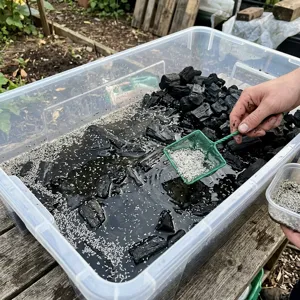
Always start with fewer isopods than you think you need. Populations rise to match the available food, and it is far easier to add animals than to remove them. Culture your springtails ahead of time using the charcoal culturing method, which also gives you a backup population for re-seeding. In wabi-kusa builds, the same principle applies on a small scale; see the wabi-kusa mold prevention guide.
Choosing Compatible Isopods
Match the isopod to the scale and humidity of the build. Slow breeders such as Cubaris are the easiest to balance with springtails, because their small clutches never overwhelm the food supply. See the rubber ducky isopod care guide for a representative tropical species. Fast breeders such as Porcellionides pruinosus and Porcellio laevis are excellent in large, robust builds but need active population management. Keep one isopod species per enclosure whenever possible. Mixed species compete unpredictably and some may interbreed within a genus. The compatibility matrix above summarises the risk by genus.
Feeding Strategy for a Balanced Crew
- Keep the staples permanent. Leaf litter (oak, beech, magnolia) and soft decayed white-rot wood should never run out. A hungry isopod will turn to live plants.
- Distribute supplemental food. Place small portions in three or four spots on flat pieces of bark rather than in one pile, so springtails and smaller isopods get a share.
- Provide protein sparingly. A pinch of freeze-dried shrimp, fish flakes or yeast once or twice a week is enough. Remove leftovers within 24-48 hours.
- Keep calcium available. A limestone chunk, cuttlebone or calcium carbonate in the substrate supports molting and reduces the urge to chew on live tissue.
Protecting Live Plants and Moss
Healthy isopods with plenty of decaying matter rarely damage living plants, but a few conditions push them to graze on tender tissue: low food supply, calcium or protein shortage, overcrowding and a dry surface. Moss rhizoids, seedlings, orchid root tips and soft new growth are the most vulnerable. To protect them, keep the litter and wood stocked, add protein and calcium regularly, thin the isopod population, and use sturdier plants in the same enclosure where possible. Avoid planting delicate seedlings into a dense isopod colony without a barrier such as a layer of leaf litter or bark.
Preventing Frass Toxicity and Substrate Exhaustion
As the colony grows, frass accumulates. In a closed system it releases ammonia and salts, depletes the digestible food in the substrate, and can stress or kill both isopods and springtails. Prevent this by:
- Topping up leaf litter monthly with fresh, aged hardwood leaves.
- Performing a fractional refresh every 3-6 months: remove 20-30% of the old substrate from the dry end, replace it with fresh mix, and leave the rest undisturbed. The mix formulation is covered in the isopod substrate recipe, and you can size a batch with the isopod substrate calculator.
- Maintaining ventilation with low intake and high exhaust vents, as described in the isopod terrarium setup guide.
- Keeping a clear gradient so there is always a dry zone and a damp zone, preventing waterlogged patches.
Signs that the substrate needs refreshing include a persistent sour or ammonia smell, a dark, compacted, wet texture, falling springtail numbers, slow isopod growth and repeated gnat or mite outbreaks.
Population Management and Interventions
Harvesting Excess Isopods
If isopods multiply beyond the food supply, remove some. Lift bark pieces and pick off adults and juveniles with a soft brush or spoon, then move them to a separate colony, share them with other keepers or use them as feeders for other animals. Remove no more than a quarter of the population at once.
Re-Seeding Springtails
Keep at least one backup springtail culture running. If numbers fall in the enclosure, flood-harvest your culture and pour the springtails onto a damp part of the surface. Pair the re-seeding with a fix for the cause (overfeeding, dryness or heavy isopod pressure), or the new population will crash again.
Adjusting Moisture and Food
Because springtails need dampness, a slightly wetter transition zone helps them recover without drowning the isopods. Cut back supplemental feeding when mold appears and distribute food in several spots when springtails seem scarce.
Troubleshooting Summary
| Symptom | Likely cause | Quick fix |
|---|---|---|
| Springtails vanish | Dry surface, heavy isopod pressure or overheating | Dampen the transition zone, spread food, re-seed from a backup culture |
| Sudden mold blooms | Springtail decline or overfeeding | Remove food, improve airflow, re-seed springtails |
| Isopods chewing live plants | Hunger, calcium or protein shortage, overcrowding | Add wood, litter, protein and calcium; thin the colony |
| Sour smell and dark, wet substrate | Frass buildup | Fractional refresh and better ventilation |
| Isopod numbers explode | Excess food and fast-breeding species | Cut feeding, harvest the surplus |
Related Resources
Start with the bioactive substrate guide, build the enclosure with the isopod terrarium setup guide, mix the medium with the isopod substrate recipe, culture springtails with the charcoal method, keep slow-breeding companions with the rubber ducky isopod care guide, and control mold in small builds with the wabi-kusa mold prevention guide.
Frequently Asked Questions
Do isopods eat springtails?
Isopods are not active predators, and springtails are fast and tiny, so they rarely catch live ones. Isopods may eat dead or weakened springtails incidentally, and they compete with springtails for soft food. The real threat to springtails is usually a dry surface or too much competition for fungal food, not direct predation.
Why did my springtails suddenly vanish?
Common causes are a surface that dried out, overheating, heavy isopod competition for soft food, chlorinated water, or a food source that ran out. Check moisture and temperature, spread supplemental food in several places, and re-seed from a backup culture once you have fixed the cause. A flood test in a corner will show whether any survive.
Will isopods eat live moss or orchid roots?
Well-fed isopods mostly leave healthy living plants alone, but they may nibble tender moss rhizoids, seedlings or orchid root tips when hungry, short of calcium or overcrowded. Keep decaying wood and leaf litter stocked, provide protein and a permanent calcium source, and thin the colony if numbers get too high.
Can I keep multiple isopod species together?
It is possible but usually not advisable. Different species have different humidity needs and breeding rates, and a fast breeder such as Porcellionides pruinosus can crowd out a slower one such as a Cubaris. Species in the same genus may also hybridise. One isopod species plus springtails is much easier to balance.
How do I know if my substrate needs refreshing?
Look for a persistent sour or ammonia smell, dark, compacted and wet substrate, falling springtail numbers, slowing isopod growth and repeated mold, gnat or mite problems. Refresh 20-30% of the substrate every 3-6 months by replacing material from the dry end, and top up leaf litter monthly.
How many springtails and isopods should I start with?
For a nano enclosure, start with roughly 50-200 springtails and 3-10 small isopods. For a standard 20-40 gallon enclosure, use about 500-1,000 springtails and 10-25 isopods. Large vivaria can take 1,000-2,000 or more springtails and 25-50 isopods, seeded in several locations. It is better to start low, since populations grow to match the food.
Why should springtails be added before isopods?
Adding springtails 2-3 weeks earlier lets them spread through the surface and substrate and graze the early mold that appears in every new build. This creates a grazing barrier before the isopods arrive and begin adding food waste. It also prevents isopods from monopolising early fungal food.
Which isopods are best with springtails?
Slow breeders such as Cubaris (including Rubber Ducky) and Armadillidium are the easiest, because their populations rarely outgrow the food supply. Fast breeders such as Porcellionides pruinosus and Porcellio laevis work well in large enclosures but need feeding discipline and regular population management.
How do I stop isopods overpopulating my terrarium?
Reduce supplemental feeding, harvest a portion of the colony every few weeks and avoid fast-breeding species in small enclosures. Isopod numbers follow food availability, so a lean food supply keeps the population in check. Excess animals can be moved to another colony or used as feeders.
Does my wabi-kusa or small terrarium need isopods as well as springtails?
Not necessarily. Very small or humid builds such as a wabi-kusa dish often do well with springtails alone, since there is little tough leaf litter to shred. Larger terrariums with leaf litter and wood benefit from a few isopods to process the heavier material.
Sources & References
-
Source: si.edu
Type: horticultural-reference
-
Source: rhs.org.uk
Type: horticultural-reference
-
Source: nhm.ac.uk
Type: horticultural-reference
Explore More
Related Articles
Related Plant Guides
No specific plant guides found matching this topic.
Recommended next actions
Continue Exploring
Dive deeper into related plant care tools and profiles.
Calculator
Isopod Substrate & Leaf Litter Calculator
Calculate exact volumes of decayed white wood, flake soil, leaf litter, worm castings, and calcium for any isopod terrarium volume or container dimensions.
Topic Guide
Bioactive Substrate for Paludariums: ABG Mixes, Ratios & Layering
Learn how bioactive substrate works, the classic ABG mix ratio, ABG-style variants, ingredient roles, drainage layers, moisture management, and microfauna.
Topic Guide
DIY Isopod Substrate Recipe: Ratios, Ingredients & Preparation
Master DIY isopod substrate recipe by volume: decayed white-rot wood, fermented flake soil, oak leaf compost, worm castings, and calcium carbonate ratios.
Topic Guide
How to Set Up an Isopod Terrarium: Ventilation & Moisture Gradients
Step-by-step isopod terrarium setup: enclosure selection, creating a moisture gradient, cross-ventilation, cork bark hides, and leaf litter depth.
Topic Guide
Cubaris sp. 'Rubber Ducky' Isopod Care & Enclosure Guide
Complete Cubaris sp. 'Rubber Ducky' care guide: limestone caves, 80-90% humidity, deep burrowing substrate, white-rot wood diet, and breeding tips.
Topic Guide
How to Culture Springtails on Charcoal: Setup, Feeding & Harvesting
Step-by-step springtail culturing on horticultural lump charcoal: setup, feeding with active dry yeast, flooding harvests, and crash prevention.