Bioactive Terrarium: How the Living Ecosystem Works
A bioactive terrarium functions as a self-regulating micro-habitat. Unlike traditional enclosures that require frequent manual cleaning and periodic substrate replacement, a bioactive system mimics natural soil cycles. Microorganisms and cleanup organisms process organic waste, fallen leaves, and fungal growth into nutrients, while live plant roots absorb those nutrients and help stabilize the substrate. Building a resilient bioactive terrarium requires balancing substrate aeration, drainage, moisture gradients, airflow, lighting, and living organisms.
Quick Answer
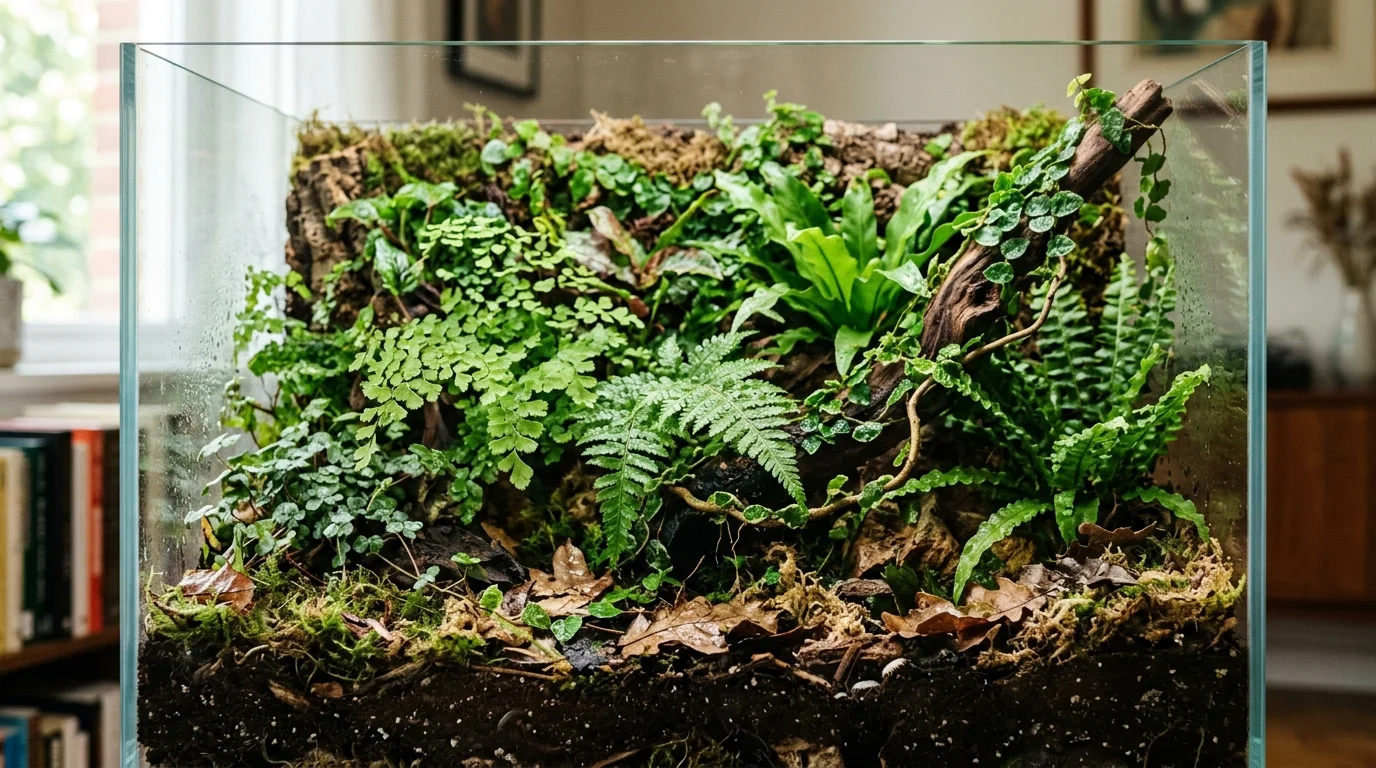
A bioactive terrarium is an enclosed planted habitat that uses living plants, beneficial soil microorganisms, and a decomposer cleanup crew (such as springtails and isopods) to cycle organic waste and maintain a biological micro-ecosystem.
Key Takeaways
- Bioactive terrariums rely on live plants, soil microbiology, and cleanup organisms to recycle organic waste.
- Cleanup crews such as springtails and isopods process decaying leaf litter, mold, and organic debris.
- Proper substrate architecture incorporates a drainage layer (LECA/false bottom), mesh separator, and well-draining soil mix.
- Bioactive systems reduce manual cleaning but still require regular observation, plant pruning, and moisture management.
- Ventilation and lighting are critical to maintain plant health and prevent stagnant, anaerobic conditions.
- Paludariums extend bioactive terrarium mechanics by integrating a functional freshwater aquatic zone.
1. What Is a Bioactive Terrarium?
A bioactive terrarium is a closed or semi-closed glass enclosure that uses living organisms to create a biological waste-cycling system. Rather than relying on synthetic substrate or frequent manual cleaning, a bioactive setup integrates live tropical plants, a structured soil layer, beneficial soil bacteria, fungi, and small decomposer organisms.
The goal is to establish a self-sustaining nutrient cycle: plant leaves fall and decay, decomposers fragment the organic matter, microorganisms convert it into bioavailable inorganic nutrients, and live plant roots absorb those nutrients to fuel new growth.
2. The Science of In-Situ Decomposition
In natural tropical forest floors, organic waste does not accumulate indefinitely because a vast food web of microfauna and fungi breaks down dead matter. In a terrarium, in-situ decomposition reproduces this process on a micro scale.
Fungi and bacteria colonize fallen leaf litter and waste. Primary decomposers such as isopods chew and break down the coarse organic material, while secondary decomposers like springtails feed on fine fungal spores, mold, and micro-debris. This continuous breakdown prevents soil stagnation and keeps the root zone healthy.
3. Conventional Terrariums vs. Bioactive Systems
Traditional terrariums often use simple potting mix or decorative soil. Over time, organic waste builds up, soil compacts, anaerobic bacteria proliferate, and the entire substrate must be dug out and replaced every few months.
By contrast, a bioactive system uses a specialized structural substrate that resists compaction, paired with living organisms that aerate the soil through tunneling and movement. When built correctly, a bioactive substrate can remain functional for years without replacement.
4. Substrate Architecture and Drainage Layers
Moisture management is the foundation of bioactive construction. Without proper drainage, water collects in the root zone, driving out oxygen and creating anaerobic conditions that kill plant roots and beneficial microbes.
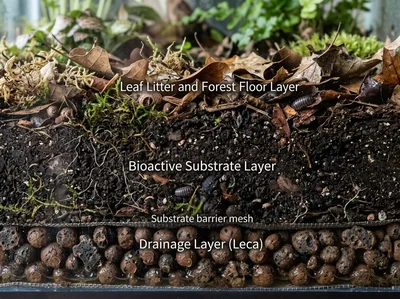
A complete bioactive substrate system uses four distinct layers:
- Drainage Layer (False Bottom): 1–2 inches of expanded clay pebbles (LECA), gravel, or a raised plastic egg-crate grid where excess water collects.
- Substrate Mesh Barrier: A fine non-rotting synthetic mesh placed over the drainage layer to keep soil particles from falling into standing water.
- Bioactive Soil Blend: An ABG-style mix that retains moisture while maintaining high porosity and aeration. For detailed ratios, see Bioactive Substrate for Paludariums, or use our bioactive substrate calculator to determine your mix volume.
- Leaf Litter Layer: A top layer of dried hardwood leaves that shields the soil from drying out and feeds the decomposer population.
5. The Importance of Leaf Litter
Leaf litter is often misunderstood as pure decoration, but it is actually the engine of a bioactive terrarium. Decaying leaves provide the primary carbon source and physical shelter for isopods and springtails.
As the bottom leaves break down into rich humus, new leaf litter should be periodically added to the top. Suitable leaves include oak, magnolia, maple, and beech that have been harvested cleanly and dried.
6. The Cleanup Crew: Springtails and Isopods
The living decomposer community is commonly referred to as the cleanup crew. The two primary groups work in tandem:
- Springtails (Collembola): Tiny (1–2 mm) moisture-loving arthropods that feed on surface mold, fungal hyphae, and fine organic decay.
- Terrestrial Isopods: Larger crustaceans (such as Trichorhina tomentosa or Porcellio species) that fragment tough leaf litter and organic waste.
For a detailed breakdown of species selection and starter culture health, see Springtails vs Isopods.
7. Plant Selection for Bioactive Habitats
Live plants are essential for nutrient uptake and atmospheric balance. Plants absorb nitrates and moisture from the soil, prevent erosion, and create humid microclimates under their foliage.
Select plants adapted to high humidity and warm temperatures, such as tropical ferns, Marcgravia, Ficus villosa, Peperomia, and epiphytic bromeliads. For species placement across different moisture zones, consult Paludarium Plants.
8. Moisture Gradients and Watering
A healthy bioactive terrarium maintains a moisture gradient rather than uniform wetness. The lower substrate layer and drainage zone hold higher moisture, while the upper leaf litter and air space remain humid but aerated.
Avoid overwatering. The substrate should feel like a wrung-out sponge—damp to the touch, but free of pooling water in the soil layer.
9. Ventilation and Air Circulation
Stagnant air encourages uncontrolled fungal outbreaks and weak plant growth. Proper ventilation—using top mesh vents or small circulation fans—helps exchange gases, controls excessive condensation on viewing glass, and strengthens plant stems.
10. What "Bioactive" Does and Does Not Mean
A common misconception is that a bioactive terrarium is completely "self-cleaning" or "maintenance-free." This is false.
- Bioactive DOES mean: Natural processing of plant debris, reduction of routine soil changes, and enhanced habitat stability.
- Bioactive DOES NOT mean: You never have to trim overgrown plants, clean viewing glass, monitor moisture levels, or remove large excess waste.
11. Step-by-Step Bioactive Build Sequence
- Clean and leak-test the glass enclosure.
- Add 1.5–2 inches of LECA clay pebbles for the drainage layer.
- Cut and lay the synthetic mesh barrier flat over the LECA.
- Add 2–4 inches of damp ABG-style bioactive substrate mix.
- Cap the soil with a generous layer of dried leaf litter and botanical items.
- Plant tropical foliage and anchor climbing vines or epiphytes.
- Seed the substrate with active springtail and isopod starter cultures.
- Allow the enclosure to establish for 2–4 weeks before introducing sensitive inhabitants.
12. Relationship to Paludariums
A paludarium is essentially an expanded bioactive terrarium that incorporates a permanent freshwater aquatic section alongside the terrestrial land area. The terrestrial land portion of a paludarium relies on the same bioactive substrate, drainage, and cleanup crew principles explained here. Because the aquatic section may occupy only part of the enclosure and may include displacement from rocks, roots, substrate structures, and other hardscape, its actual water volume should be calculated from the internal aquatic-zone dimensions. Use the Paludarium Water Volume Calculator to estimate the aquatic-zone volume in US gallons and litres before planning the water section. To explore semi-aquatic integration, read the Paludarium Guide.
13. Long-Term Maintenance and Troubleshooting
Routine bioactive maintenance involves simple, regular tasks:
- Pruning: Trim fast-growing vines before they shade lower ground cover.
- Leaf Replenishment: Add fresh dried leaf litter every 2–3 months as lower layers decompose.
- Glass Cleaning: Wipe internal glass with distilled water and a micro-fiber cloth (avoid chemical cleaners).
- Mold Spikes: Early fungal blooms in new setups are normal and usually dissipate as springtails multiply. See Mold in Bioactive Terrariums for troubleshooting.
Frequently Asked Questions
What is a bioactive terrarium?
A bioactive terrarium is an enclosed planted habitat that uses live plants, soil microbes, and decomposer insects (like springtails and isopods) to cycle organic waste naturally.
Does a bioactive terrarium ever need soil changes?
Rarely. Because cleanup organisms aerate the soil and process organic matter, bioactive substrate can remain healthy and structured for years without full replacement.
Are springtails and isopods necessary for a bioactive terrarium?
Yes. Springtails and isopods are the primary decomposers that consume mold, decaying leaves, and organic waste, keeping the soil fresh.
Why do bioactive terrariums need a drainage layer?
A drainage layer (like LECA clay pebbles beneath a mesh barrier) collects excess water runoff, preventing root rot and anaerobic soil conditions.
Is a bioactive terrarium completely maintenance-free?
No. While you do not have to change the soil, you still need to trim plants, mist the enclosure, clean the viewing glass, and replenish leaf litter.
How long does a bioactive terrarium take to establish?
It typically takes 2 to 4 weeks for soil microbes, plants, and cleanup crew populations to stabilize before introducing delicate animals.
What happens if mold appears in a new bioactive terrarium?
Fungal blooms are normal during the first few weeks as fresh organic material breaks down. Springtails will feed on the mold, and it usually subsides as the enclosure matures.
Can I use normal garden soil in a bioactive terrarium?
No. Garden soil packs too tightly, drains poorly in glass containers, and may introduce unwanted pests or lawn chemicals. Use a structured ABG-style mix.
What is the difference between a bioactive terrarium and a paludarium?
A bioactive terrarium is primarily a terrestrial land habitat, whereas a paludarium combines a bioactive land section with a substantial aquatic water feature.
How often should I add leaf litter to a bioactive terrarium?
Replenish leaf litter every 2 to 3 months as isopods and microbes consume the lower layers.
Sources & References
-
Source: neherpetoculture.com
Type: vivarium-reference
-
Source: neherpetoculture.com
Type: vivarium-reference
-
Source: terrariumtribe.com
Type: secondary-vivarium-reference
Explore More
Related Articles
Related Plant Guides
No specific plant guides found matching this topic.
Recommended next actions
Continue Exploring
Dive deeper into related plant care tools and profiles.
Topic Guide
Bioactive Substrate for Paludariums: ABG Mixes, Ratios & Layering
Learn how bioactive substrate works, the classic ABG mix ratio, ABG-style variants, ingredient roles, drainage layers, moisture management, and microfauna.
Topic Guide
Springtails vs Isopods: Which Bioactive Cleanup Crew Do You Need?
Compare springtails and isopods for bioactive enclosures, including their cleanup roles, coexistence, food, moisture, and healthy starter-culture selection.
Topic Guide
Mold in a Bioactive Terrarium: Causes & What to Do
Learn why mold appears in bioactive terrariums, when it is normal, how moisture and organic material affect it, and how to respond safely.
Topic Guide
Humidity
Learn everything about humidity for your indoor and aquarium plants. Expert care tips, troubleshooting, and related guides.
Topic Guide
Misting
Learn everything about misting for your indoor and aquarium plants. Expert care tips, troubleshooting, and related guides.
Topic Guide
Drainage
Learn everything about drainage for your indoor and aquarium plants. Expert care tips, troubleshooting, and related guides.