Springtails vs Isopods: Which Bioactive Cleanup Crew Do You Need?
Springtails and isopods perform overlapping but distinct roles in bioactive enclosures. Springtails are small soil-associated organisms that feed on microorganisms and fine organic material, while terrestrial isopods process larger pieces of decaying plant material and help fragment leaf litter. Many humid planted enclosures can support both. The more useful choice is therefore based on enclosure conditions, animal compatibility, available organic material, and the requirements of the particular cleanup species rather than a universal springtails-versus-isopods winner.
Quick Answer
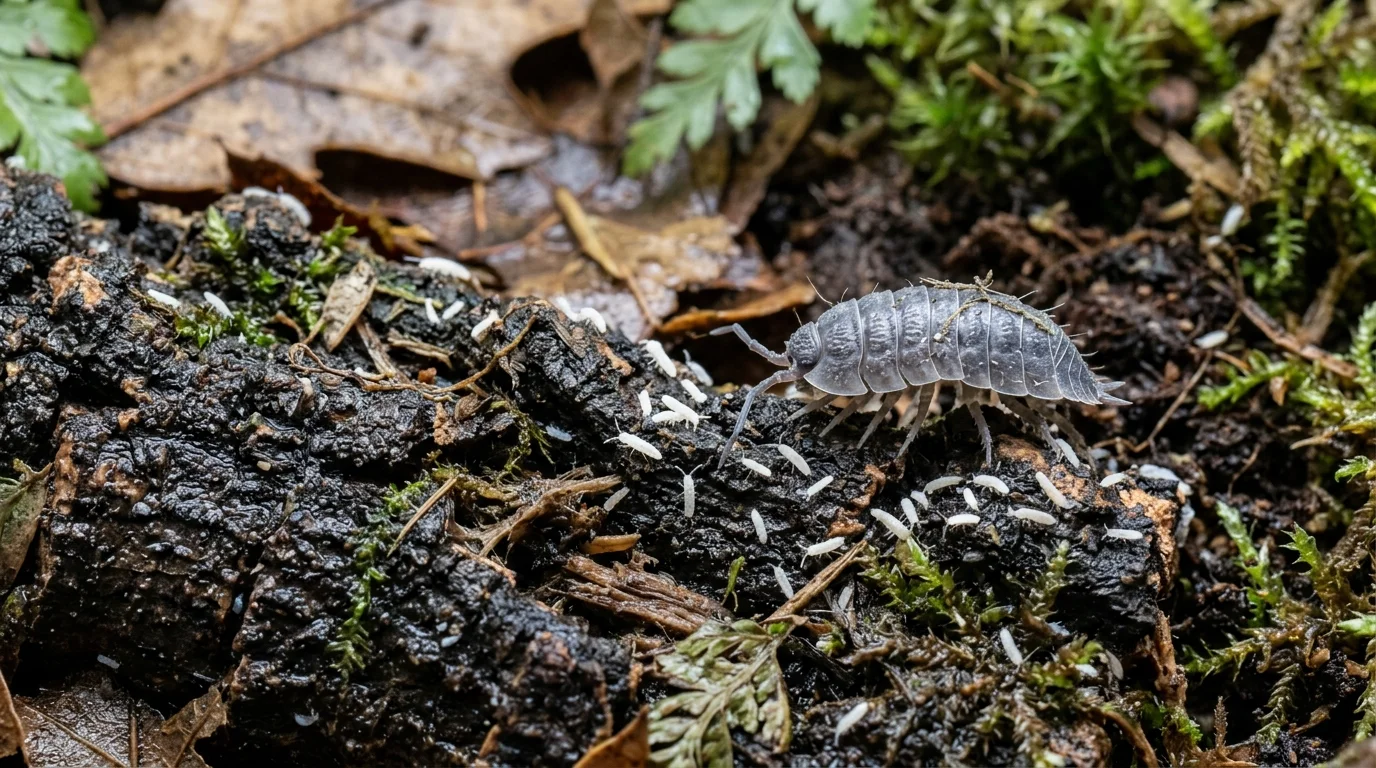
Springtails and isopods are complementary members of a bioactive cleanup crew rather than direct substitutes. Springtails are tiny decomposers associated with moist substrate and fine organic material, while isopods are larger detritivores that process leaf litter and other coarse decaying material. They can coexist when the enclosure provides suitable moisture, food, shelter, and habitat for both.
Key Takeaways
- Springtails and isopods perform different but complementary decomposition roles.
- Springtails are particularly useful in moist substrate and around fine organic material.
- Isopods help process leaf litter and other larger pieces of decaying organic material.
- Springtails and isopods can coexist in many bioactive enclosures.
- A healthy starter culture matters more than an advertised exact number of animals.
- Leaf litter and other suitable organic material help sustain a decomposer community.
- Moisture should be managed through the enclosure rather than simply maximizing humidity or keeping the entire substrate saturated.
- Cleanup organisms support decomposition but do not replace drainage, observation, waste management, or other routine maintenance.
Springtails vs isopods: what is the difference?
Springtails and isopods are both commonly used as cleanup organisms in bioactive enclosures, but they are not interchangeable. They differ in size, feeding behavior, habitat use, and the type of organic material they process.
Springtails are tiny soil-associated organisms that are commonly found in moist environments and feed on microorganisms and fine organic material. Isopods are larger terrestrial detritivores that process decaying plant material such as leaf litter and help physically fragment coarse organic matter.
For many planted terrariums and paludariums, the useful question is not simply which one is better. It is whether the enclosure benefits from one, the other, or both working as complementary parts of its decomposer community.
What do springtails do?
Springtails are very small arthropods associated with moist soil, substrate, leaf litter, and other humid microhabitats. They feed on microorganisms and fine organic material and participate in decomposition within the substrate.
Their small size allows them to occupy spaces that are difficult for larger detritivores to use. In a humid planted enclosure, they can therefore contribute to fine-scale processing of organic material and microbial resources.
Springtails are often discussed in relation to visible fungal growth because fungi and other microorganisms can form part of their food resources. Their presence does not mean that an enclosure will remain completely free of mold, however. Fungal growth is a normal part of decomposition, and persistent mold can also indicate excess organic material, poor airflow, or other environmental imbalance.
What do isopods do?
Terrestrial isopods are larger detritivores that feed on decaying organic material. Leaf litter is particularly important for many species because it provides both food and habitat.
As isopods consume and fragment organic material, they contribute to the physical breakdown of larger pieces of detritus. That creates smaller particles and increases the surface area available to microorganisms and other decomposers.
Isopod species are not interchangeable. Moisture requirements, temperature tolerance, activity patterns, and habitat preferences can differ between species. Choose an isopod based on the actual enclosure and the organisms sharing it rather than assuming every terrestrial isopod has identical care requirements.
Which is better for a bioactive enclosure?
There is no universal winner. Springtails and isopods perform different parts of the decomposition process, so the appropriate choice depends on the enclosure.
Springtails are useful where a moist substrate and fine-scale decomposer activity are desirable. Isopods are useful where there is a continuing supply of leaf litter and other suitable coarse organic material. A humid planted enclosure may support both.
Other factors also matter. Consider enclosure size, substrate structure, drainage, moisture gradient, available food, ventilation, temperature, and the requirements of the plants and animals living in the enclosure.
A cleanup crew should be viewed as one component of a functioning bioactive system. It does not compensate for poor drainage, unsuitable substrate, excessive waste, or inappropriate environmental conditions.
Can springtails and isopods live together?
Yes. Springtails and isopods can coexist in many bioactive enclosures.
Their different sizes and feeding niches mean that they can use different parts of the same decomposer system. Springtails commonly occupy moist substrate and fine organic material, while isopods can process larger pieces of leaf litter and decaying plant matter.
Successful coexistence still depends on the species and enclosure. A habitat that is suitable for one organism is not automatically suitable for another. Provide appropriate moisture, shelter, food, and environmental conditions rather than assuming that adding both cultures will guarantee establishment.
How to choose a healthy starter culture
When selecting a starter culture, prioritize evidence of activity and good condition rather than an advertised exact animal count. Tiny organisms are difficult to count consistently, and the useful measure is whether the culture is established and capable of maintaining itself under suitable conditions.
For springtails, look for active movement through the culture medium or around suitable food. The culture should have appropriate moisture and should not appear completely dried out or severely contaminated.
For isopods, look for active individuals, intact bodies, suitable moisture, and access to shelter and organic food. A culture with widespread unexplained mortality or severe drying is a poor starting point.
There is no universal minimum number that guarantees success. Enclosure size, species, substrate, moisture, available food, temperature, and the condition of the culture all influence establishment.
Food and leaf litter
A cleanup crew still needs resources. Springtails require suitable microbial and fine organic food resources, while isopods depend heavily on decaying plant material and leaf litter.
For isopods, maintain a continuing supply of suitable leaf litter rather than treating the initial layer as a one-time addition. As material breaks down, replenish it so the detritivore community continues to have food and shelter.
Leaf litter should come from suitable plant material and should be free of pesticides or other contaminants. Do not assume that an unidentified outdoor leaf source is safe for a closed animal enclosure.
Springtail cultures may also require an appropriate supplemental food source during establishment. The exact feeding method depends on the culture and enclosure, so avoid treating one feeding schedule as a universal rule.
Moisture and habitat
Moisture is one of the most important environmental factors for cleanup organisms, but maximum moisture is not the goal.
Springtails generally perform well in moist substrate and humid microhabitats. Many terrestrial isopods also require access to moisture, but their exact tolerance differs among species. Providing a moisture gradient can therefore be more useful than keeping the entire enclosure equally wet.
In a paludarium, the distinction between the aquatic and terrestrial zones becomes especially important. The terrestrial substrate should remain appropriate for its plants and decomposers rather than becoming continuously saturated because of uncontrolled water movement from the aquatic section.
Good drainage and suitable substrate structure remain important even when a cleanup crew is present. Biological activity cannot correct a fundamentally waterlogged substrate.
Springtails and isopods in vampire crab paludariums
Vampire crab paludariums can provide suitable habitat for decomposer organisms in their terrestrial zones. The substrate contains organic material, leaf litter, roots, and other resources that can support a small decomposer community.
Springtails are particularly suited to moist terrestrial substrate. Some terrestrial isopods may also be appropriate where the terrestrial zone provides leaf litter, shelter, and a suitable moisture gradient.
Species selection still matters. Not every isopod is suitable for every paludarium, and cleanup organisms should not be selected without considering the animals and plants already living in the enclosure.
For the broader habitat design, see the vampire crab paludarium guide and the paludarium overview.
Common cleanup-crew mistakes
- Choosing by exact animal count: culture health and enclosure suitability are more meaningful than an arbitrary starting number.
- Keeping the substrate permanently saturated: moisture is necessary, but excessive water can create poor root-zone and habitat conditions.
- Providing too little organic material: decomposer populations need appropriate food resources.
- Removing all leaf litter: constant removal can deprive isopods and other decomposers of food and shelter.
- Assuming all isopods have identical requirements: species differ in moisture and habitat preferences.
- Expecting zero mold: fungal growth is part of normal decomposition, although persistent excessive growth can indicate an environmental imbalance.
- Using a cleanup crew instead of maintenance: biological decomposition does not remove the need to monitor the enclosure and correct problems.
- Ignoring compatibility: cleanup organisms must be considered alongside the plants and animals sharing the enclosure.
How springtails and isopods fit into bioactive substrate
Cleanup organisms work best when the substrate provides suitable physical habitat and organic resources. A bioactive substrate should support moisture management, plant roots, decomposition, and protected spaces for the organisms living within it.
For substrate architecture, ABG-style formulations, drainage, and moisture management, see the bioactive substrate guide.
Frequently asked questions
Are springtails or isopods better for a bioactive enclosure?
Neither is universally better. Springtails and isopods perform complementary decomposition roles, so the appropriate choice depends on enclosure conditions, available organic material, and the species being kept.
Can springtails and isopods live together?
Yes. They can coexist in many bioactive enclosures because they occupy different ecological niches and process different types of organic material.
Do springtails eat mold?
Springtails feed on microorganisms and fine organic material, including fungal resources. They can contribute to processing visible fungal growth, but they should not be treated as a guarantee that mold will disappear.
Do isopods need leaf litter?
Leaf litter is an important food and habitat resource for many terrestrial isopods. A continuing supply of suitable, uncontaminated leaf litter helps support the culture.
How many springtails should I add?
There is no single number that applies to every enclosure. Culture health, enclosure size, moisture, available food, and establishment are more useful considerations than an exact starting count.
How many isopods should I add?
A fixed number is not appropriate for every enclosure. The starting culture depends on enclosure size, species, available food, habitat, and the condition of the culture.
Can springtails live in a paludarium?
Yes. Springtails can live in the moist terrestrial substrate of a paludarium when the terrestrial zone provides suitable habitat and is not continuously waterlogged.
Can isopods live in a paludarium?
Some terrestrial isopods can be used in paludarium terrestrial zones, but species requirements and the available moisture gradient must be considered. They should not be treated as aquatic animals.
Do cleanup crews replace cleaning the enclosure?
No. Cleanup organisms contribute to decomposition but do not replace appropriate maintenance, removal of excessive waste, drainage management, or correction of unsuitable environmental conditions.
How do I choose a healthy springtail or isopod culture?
Look for active organisms, appropriate moisture, suitable culture medium or food, and evidence of an established culture. Avoid cultures that appear completely dried out, badly contaminated, or affected by widespread unexplained mortality.
Frequently Asked Questions
Are springtails or isopods better for a bioactive enclosure?
Neither is universally better. Springtails and isopods perform complementary decomposition roles, so the appropriate choice depends on enclosure conditions, available organic material, and the species being kept.
Can springtails and isopods live together?
Yes. They can coexist in many bioactive enclosures because they occupy different ecological niches and process different types of organic material.
Do springtails eat mold?
Springtails feed on microorganisms and fine organic material, including fungal resources. They can contribute to processing visible fungal growth, but they should not be treated as a guarantee that mold will disappear.
Do isopods need leaf litter?
Leaf litter is an important food and habitat resource for many terrestrial isopods. A continuing supply of suitable, uncontaminated leaf litter helps support the culture.
How many springtails should I add?
There is no single number that applies to every enclosure. Culture health, enclosure size, moisture, available food, and establishment are more useful considerations than an exact starting count.
How many isopods should I add?
A fixed number is not appropriate for every enclosure. The starting culture depends on enclosure size, species, available food, habitat, and the condition of the culture.
Can springtails live in a paludarium?
Yes. Springtails can live in the moist terrestrial substrate of a paludarium when the terrestrial zone provides suitable habitat and is not continuously waterlogged.
Can isopods live in a paludarium?
Some terrestrial isopods can be used in paludarium terrestrial zones, but species requirements and the available moisture gradient must be considered. They should not be treated as aquatic animals.
Do cleanup crews replace cleaning the enclosure?
No. Cleanup organisms contribute to decomposition but do not replace appropriate maintenance, removal of excessive waste, drainage management, or correction of unsuitable environmental conditions.
How do I choose a healthy springtail or isopod culture?
Look for active organisms, appropriate moisture, suitable culture medium or food, and evidence of an established culture. Avoid cultures that appear completely dried out, badly contaminated, or affected by widespread unexplained mortality.
Sources & References
-
Source: neherpetoculture.com
Type: vivarium-reference
-
Source: neherpetoculture.com
Type: vivarium-reference
-
Source: terrariumtribe.com
Type: secondary-vivarium-reference
-
Source: terrariumtribe.com
Type: secondary-husbandry-reference
Explore More
Related Articles
Related Plant Guides
No specific plant guides found matching this topic.
Recommended next actions
Continue Exploring
Dive deeper into related plant care tools and profiles.
Topic Guide
Bioactive Terrarium: How the Living Ecosystem Works
Learn how a bioactive terrarium works, including substrate layering, drainage, springtails, isopods, live plants, ventilation, and maintenance.
Topic Guide
Bioactive Substrate for Paludariums: ABG Mixes, Ratios & Layering
Learn how bioactive substrate works, the classic ABG mix ratio, ABG-style variants, ingredient roles, drainage layers, moisture management, and microfauna.
Topic Guide
Mold in a Bioactive Terrarium: Causes & What to Do
Learn why mold appears in bioactive terrariums, when it is normal, how moisture and organic material affect it, and how to respond safely.
Topic Guide
Humidity
Learn everything about humidity for your indoor and aquarium plants. Expert care tips, troubleshooting, and related guides.
Topic Guide
Drainage
Learn everything about drainage for your indoor and aquarium plants. Expert care tips, troubleshooting, and related guides.
Topic Guide
Vampire Crab Paludarium Setup: Habitat, Husbandry & Care
Learn how to design a vampire crab paludarium with usable land, shallow water, suitable substrate, humidity, temperature, hiding places, and compatibility guidance.