Paludarium vs Terrarium: Water Cycle, Drainage, Flora, and Microclimate Compared
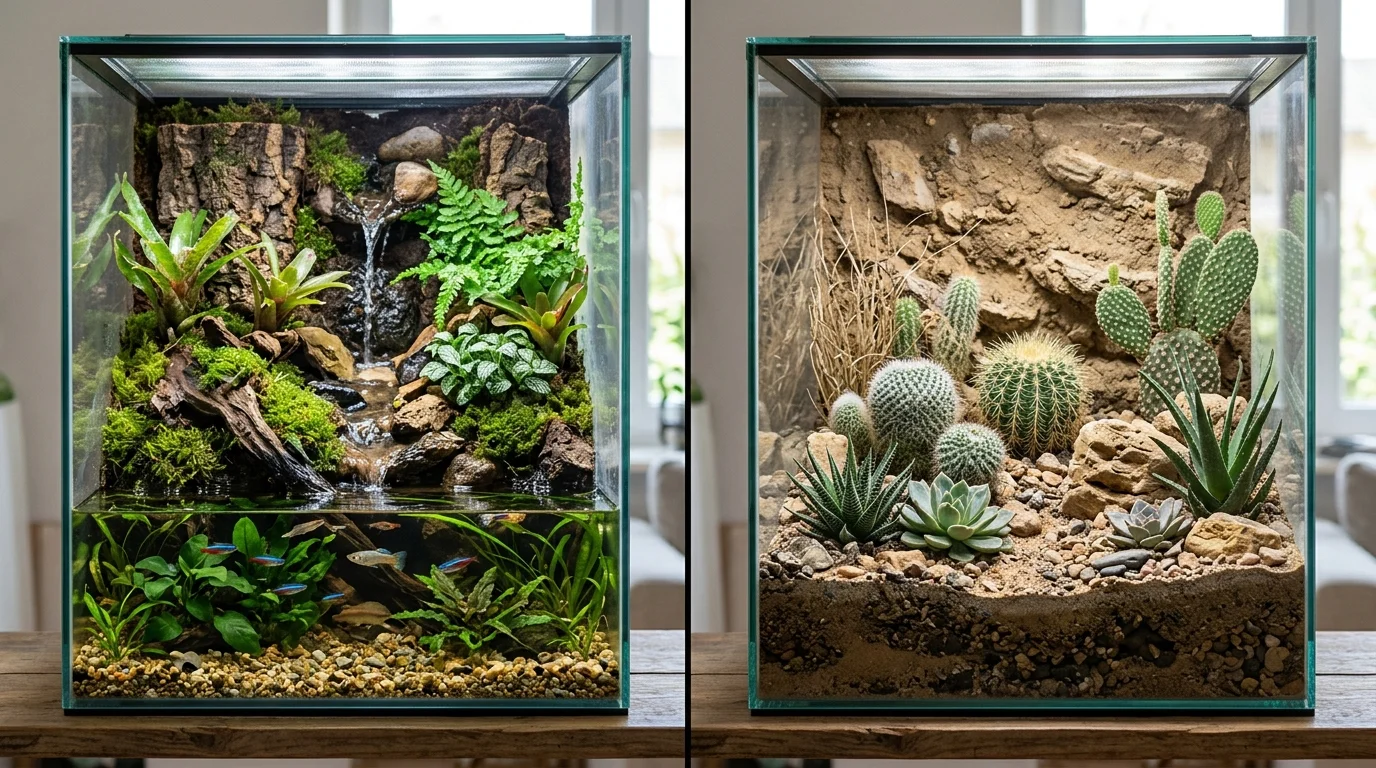
A terrarium is a land-based planted enclosure with no real water body: a closed terrarium recycles moisture through evaporation, condensation, and drip-back in a static loop with no pump or filter, while an open or arid terrarium is watered sparingly by hand. A paludarium is a hybrid with an engineered water body, commonly 30–70% of the footprint, that needs circulation, filtration, or waterfalls to avoid stagnant, anoxic water, plus displacement math, egg-crate support, and pump vaults. A small dish does not make a terrarium a paludarium; whether the water must be engineered does. Terrarium flora keeps its roots in aerated substrate, while paludarium flora spans aquatic, transition, marginal, and terrestrial epiphyte zones with multi-zone lighting gradients. Terrariums fail through waterlogging and mold; paludariums fail through pump burnout, leaks, and stagnation. Beginners should start with a terrarium and move to a paludarium only when they want fish, semi-aquatic animals, or a flowing water feature.
Quick Answer
A terrarium is a land-based planted enclosure with no real water body. A closed terrarium recycles its own moisture through evaporation, condensation, and drip-back in a static loop with no pump or filter, while an open or arid terrarium is watered sparingly by hand. A paludarium is a hybrid with an engineered water body, commonly 30–70% of the footprint, that needs circulation, filtration, or a waterfall to avoid stagnant, oxygen-poor water, plus displacement math for the basin. A small water dish does not turn a terrarium into a paludarium; function does. If the water has to be filtered, circulated, or sized as a habitat, you are building a paludarium. Use the paludarium hub for the overview, the how to build a paludarium guide for construction, and the paludarium plants guide for flora.
Key Takeaways
- The line between the two is function, not volume of water on hand: a terrarium manages moisture as humidity and runoff, while a paludarium manages water as a circulated, filtered body that must stay oxygenated.
- A closed terrarium is a static loop of evaporation, condensation, and drip-back with no equipment, so its failure mode is waterlogging and mold; a paludarium adds pumps and plumbing, so its failure modes are pump burnout, leaks, and stagnant water.
- Plant selection follows the root zone: terrarium plants keep their roots in aerated substrate, while paludarium plants span submerged, transition, marginal, and terrestrial epiphyte zones that each need different conditions.
- Beginners should start with a terrarium; move to a paludarium only when you want fish, semi-aquatic animals, or a flowing water feature and accept the extra engineering, lighting complexity, and upkeep.
Does a Small Pool Make a Terrarium a Paludarium?
This is the question behind most terrarium-versus-paludarium confusion, and the answer is no. A terrarium is a land-based enclosure built around plants. A paludarium is a hybrid built around a functioning water body. Adding a water dish or a shallow puddle to a terrarium does not change what the system is, because the water is not doing hydraulic work: it is not circulated, filtered, or sized as a habitat.
Naming is also loose in the hobby. Some retailers and guides call a paludarium an aquatic terrarium or aqua-terrarium, and "terrarium" is sometimes used as a catch-all for any planted glass enclosure. This guide uses the practical meaning: a terrarium has no real water body, and a paludarium does. The test is whether the water must be engineered. If it needs a pump, filtration, circulation, or displacement math to stay healthy and fit the tank, it belongs to a paludarium. If moisture arrives only as humidity, mist, or occasional watering and leaves as drainage, it belongs to a terrarium.
Paludarium vs Terrarium at a Glance
| Variable | Terrarium | Paludarium |
|---|---|---|
| Water body | None, or a negligible dish or drainage layer | Permanent engineered basin, commonly 30–70% of footprint |
| Water cycle | Closed static loop, or sparse manual watering if open or arid | Open, circulating hydraulic system |
| Equipment | None required | Pump, filtration, often a heater, waterfall or circulation |
| Flora | Humid tropical foliage, micro-ferns, mosses, or arid succulents | Aquatic, transition, marginal, and terrestrial epiphyte plants |
| Humidity control | Sealed or partly sealed lid and airing out | Water surface, splash, and managed ventilation |
| Livestock | Mostly none, or microfauna and some land invertebrates | Fish, shrimp, and semi-aquatic animals |
| Build complexity | Low | High |
For the category definition and the design philosophy behind the hybrid, see the paludarium hub.
Closed Water Cycle vs Active Hydraulic System
A closed terrarium runs on a miniature hydrologic cycle. Water evaporates from the moist substrate and from plant leaves, condenses on the cooler glass or lid, runs down the walls, and returns to the substrate. No pump, filter, or open swimming reserve is involved. The system is static: its only moving parts are vapor and droplets.
That loop depends on the enclosure staying closed. A lid that is closed but not fully sealed lets some vapor escape, and over time the cycle loses water and the soil dries, which is why partly vented terrariums eventually need a little water added. An open or arid terrarium does not recycle moisture at all. It gets small, controlled amounts of water by hand, and the substrate is meant to dry between waterings.
A paludarium runs on mechanics instead. It holds a deep water basin that must be moved and cleaned. A pump drives circulation, a filter handles waste, and a waterfall or flow path returns water to the basin. Without that movement, the deep water can stagnate, lose dissolved oxygen, and turn anoxic, especially when fish or decaying plant matter add load. The system is open in the sense that water, gas, and waste are actively exchanged and managed.
CLOSED TERRARIUM (static loop)
Moist substrate → evaporation
↓
Condensation on glass or lid
↓
Drip-back → substrate

PALUDARIUM (hydraulic system)
Water basin → pump
↓
Filter / waterfall / flow path
↓
Return to basin → gas exchange at surface
Drainage Layer Physics
Both builds can use a drainage layer or false bottom made of LECA, pumice, or pebbles, separated from the soil by a mesh or screen barrier. The material looks the same, but its role and scale are very different.
In a terrarium, the layer is a small passive buffer. It gives occasional over-misting somewhere to go so the roots do not sit in saturated soil, which reduces the risk of root rot. The water volume it holds is negligible and does not circulate. In a closed jar it may also act as a modest moisture reserve feeding the humidity loop, but it is not an aquatic space. In an arid terrarium it should be minimal, because arid plants need fast drainage and dry roots, not a reservoir.
In a paludarium, the false bottom sits inside or beside a deep, permanent basin. It serves as structural support for the land above, as a concealed space for equipment, and as part of the water volume. That requires egg-crate support rated for the load, pump vaults, and displacement calculations, because the land, hardscape, and false bottom take up space that would otherwise be water. The paludarium water volume calculator handles that displacement. For a terrarium, there is no equivalent calculation: you are not sizing a water body, only checking that the drainage layer is deep enough to absorb realistic over-watering.
| Hydraulic Factor | Terrarium | Paludarium |
|---|---|---|
| Water cycle | Closed evaporation-condensation loop, or manual watering | Pumped, filtered, circulating |
| Circulation | None; vapor and droplets only | Required to avoid stagnation |
| False bottom role | Passive buffer against over-misting | Structure, equipment space, and part of the water volume |
| Drainage layer water volume | Negligible and non-circulating | Substantial and part of the basin |
| Support structure | Light, often just a barrier layer | Egg-crate support and pump vaults |
| Volume math | Not needed | True water volume after displacement |
| Water quality management | Not applicable | Filtration, water changes, testing |
Flora and Environmental Boundaries
The plant palette follows from where the roots live. In a terrarium, roots stay in aerated substrate, and the plants are chosen for a humidity regime. A closed terrarium suits high-humidity tropical foliage such as Fittonia, Peperomia, micro-ferns, and terrestrial mosses. An open or arid terrarium suits succulents and cacti that want air, light, and dry roots between waterings.
A paludarium supports a wider and more demanding range because it contains several root environments at once. Submerged and transition species such as Anubias, Bucephalandra, and Java Fern work in or at the edge of the water. Semi-aquatic marginals handle the splash and shoreline, and terrestrial epiphytes grow on hardscape above the water. Each zone has different moisture, light, and nutrient conditions, so the same species rarely thrives everywhere in the tank.
| Plant Group | Terrarium | Paludarium |
|---|---|---|
| Fittonia and Peperomia | Strong fit in closed or humid builds | Possible in the terrestrial zone |
| Micro-ferns | Strong fit in closed builds | Possible on humid land and walls |
| Terrestrial mosses | Strong fit | Strong fit across wall, splash, and transition zones |
| Succulents and cacti | Strong fit in open or arid builds only | Poor fit, humidity and wet air work against them |
| Anubias, Bucephalandra, Java Fern | Poor fit, they need water contact | Strong fit on submerged or transition hardscape |
| Semi-aquatic marginals | Poor fit without a water source | Strong fit at the shoreline |
| Terrestrial epiphytes | Possible | Strong fit on elevated hardscape |
For species selection across the paludarium zones, use the paludarium plants guide.
Gas Exchange, Humidity, and Lighting
The two systems manage air in opposite ways. A closed terrarium holds high humidity by keeping its lid on, and it has no agitated water surface, so gas exchange is slow and the air can become stagnant. Mold is the main risk, and it is managed with springtails, with periodic airing out, and above all by not overwatering. A terrarium that needs opening weekly to deal with mold is usually being watered too heavily.
A paludarium has constant gas exchange across its water surface. Waterfall and surface agitation add oxygen to the water and increase evaporation, which also buffers humidity in the air above. The tradeoff is that humidity, condensation, and airflow all interact, so a sealed canopy can still trap stagnant air over the land zone.
Lighting is where the two diverge most in practice. A terrarium is essentially one light environment: light passes through a lid or glass and strikes foliage, with no water column to cross. A paludarium has multiple PAR zones. Light must reach emersed foliage in the air, pass through the water surface, and penetrate a deep water column, and intensity drops with fixture height, glass or acrylic covers, condensation, and water depth. The result is a gradient, so a fixture that suits the land can be too weak for the deep basin, and one that suits the basin can be too strong for shaded moss.
| Microclimate Factor | Terrarium | Paludarium |
|---|---|---|
| Humidity source | Sealed lid and soil moisture, or ambient air if open | Water surface, splash, waterfall, and managed ventilation |
| Water surface agitation | None | Active, from flow and waterfalls |
| Gas exchange | Slow in closed builds | Continuous across the water surface |
| Mold control | Springtails, airing out, careful watering | Airflow design and splash-zone management |
| Lighting zones | Single foliage zone | Air, surface, and deep water column |
| Lighting complexity | Low | High, with PAR gradients |
Conversion, Cost, and Maintenance Comparison
The cost gap comes from what has to be bought and plumbed. A terrarium can be a simple glass vessel with a lid, drainage material, substrate, and plants. A paludarium is a watertight aquarium-style tank with a pump, filter, false-bottom structure, and often a heater and multi-zone lighting. Maintenance follows the same split: a terrarium is mostly pruning, occasional watering, and mold checks, while a paludarium adds water testing, water changes, and equipment care to the land work.
| Factor | Terrarium | Paludarium |
|---|---|---|
| Vessel | Simple glass container, often with a lid | Watertight, plumbed aquarium-style tank |
| Upfront cost | Lower | Higher, with pump, filter, support, and lighting |
| Routine upkeep | Occasional watering, pruning, airing out | Water quality checks, water changes, filter and pump care, plus land care |
| Main failure modes | Waterlogging and mold | Pump burnout, leaks, stagnant or anoxic water |
| Long-term stability | Can be stable for long periods when moisture balance is right | Depends on equipment reliability and consistent care |
| Conversion to the other | Rebuild as a paludarium if a water body is wanted | Can be simplified toward a terrarium by removing the water body |
Conversion is rarely a small change. Turning a terrarium into a paludarium means replacing the vessel with a watertight one, adding a basin and equipment, and rebuilding the lighting. Going the other way is simpler, but you give up the aquatic capabilities. For the full build sequence, use the how to build a paludarium guide.
How to Choose Between a Terrarium and a Paludarium
- Decide whether you want a real water body. If you only want humid foliage, build a terrarium.
- List the livestock. Fish and semi-aquatic animals require a paludarium; land-only displays do not.
- Choose the plants. Fittonia, Peperomia, micro-ferns, and mosses suit a terrarium; Anubias, Bucephalandra, and Java Fern need water contact.
- Be honest about equipment tolerance. If you do not want pumps, filters, or leak risk, stay with a terrarium.
- Check the lighting plan. A single foliage zone is simple; multiple PAR zones need deliberate design.
- Set budget and weekly time. Compare them against the cost and maintenance table above.
If your interest is a mostly aquatic display with plants growing above the waterline, read the paludarium vs riparium comparison. If your deciding factor is livestock, especially bioactive terrestrial animals, read the paludarium vs vivarium comparison.
Common Mistakes That Blur the Line
- Adding a water dish to a terrarium and calling it a paludarium.
- Sealing a terrarium and then overwatering it, producing condensation, waterlogged substrate, and mold.
- Putting succulents or cacti in a closed, humid build, or humid tropicals in an open arid one.
- Building a deep water basin without circulation or filtration and letting it stagnate.
- Expecting a terrarium to support fish, which need a real, filtered water body.
- Lighting a paludarium as a single zone and ignoring the PAR drop through the water column.
Final Framework
A terrarium treats water as humidity and runoff and succeeds by staying balanced. A paludarium treats water as a living, circulated system and succeeds by staying engineered. Choose by whether you need a real water body, which animals and plants you want, and how much equipment and upkeep you will accept. If the answer to the first question is no, a terrarium is the simpler and more reliable build.
Frequently Asked Questions
Does adding a water bowl make a terrarium a paludarium?
No. A dish or shallow puddle is not an engineered water body. A paludarium has a permanent basin that needs circulation or filtration, is sized with displacement math, and functions as habitat. If the water does not need that engineering, the enclosure is still a terrarium.
Which is easier for beginners, a terrarium or a paludarium?
A terrarium is easier. It has no pump, filter, or leak risk, and routine care is mostly pruning, occasional watering, and mold checks. A paludarium adds water-quality management, equipment maintenance, and more complex lighting.
Can you keep fish or crabs in a terrarium?
Fish cannot live in a terrarium because it has no real, filtered water body. Strictly terrestrial crabs can be kept in a land-based enclosure with suitable water access, but species that need to move between water and land, such as vampire crabs, generally belong in a paludarium.
Why do terrariums not need filters?
A terrarium has no standing water body to hold waste. Moisture cycles as vapor and drip-back or is added by hand, and there are no fish or aquatic life producing nitrogenous waste in the water. A paludarium holds a deep basin, so it needs filtration and circulation to stay clean and oxygenated.
How do lighting requirements differ between a terrarium and a paludarium?
A terrarium usually has one light zone, with light passing through the lid or glass onto foliage. A paludarium has several zones, because light must reach emersed foliage and also penetrate the water surface and a deep water column, creating a gradient that fixture height, covers, condensation, and depth all affect.
Explore More
Related Articles
Related Plant Guides
No specific plant guides found matching this topic.
Recommended next actions
Continue Exploring
Dive deeper into related plant care tools and profiles.
Topic Guide
What Is a Paludarium? Design, Anatomy, and Ecosystem Setup
Learn what a paludarium is, how land and water zones work together, and how to plan drainage, circulation, substrate, planting, and maintenance.
Topic Guide
Bioactive Terrarium: How the Living Ecosystem Works
Learn how a bioactive terrarium works, including substrate layering, drainage, springtails, isopods, live plants, ventilation, and maintenance.
Topic Guide
Paludarium Plants: Choosing Plants for Land & Water Zones
Learn how to choose paludarium plants by land, emergent, humid, and aquatic zones, with guidance on light, moisture, growth, and maintenance.
Topic Guide
Humidity
Learn everything about humidity for your indoor and aquarium plants. Expert care tips, troubleshooting, and related guides.
Topic Guide
Drainage
Learn everything about drainage for your indoor and aquarium plants. Expert care tips, troubleshooting, and related guides.
Topic Guide
How to Build a Paludarium Step by Step
A practical step-by-step construction workflow covering planning, enclosure selection, terrain structure, drainage, substrate, hardscape, water systems, lighting, planting, filling, testing, and stabilization.