Paludarium vs Vivarium: Water Body, Drainage Physics, Bioactive Setup, and Livestock
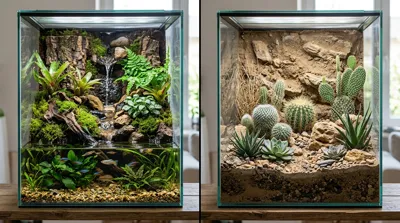
Vivarium is an umbrella term for any enclosure housing living organisms, and a paludarium is one type of vivarium, but in builder usage a vivarium means a terrestrial, often bioactive enclosure for non-swimming species such as poison dart frogs and crested geckos. Its drainage layer or false bottom is a passive, gravity-fed buffer for misting runoff, emptied by siphon or bottom bulkhead, with standing water kept minimal to prevent drowning and root rot. A paludarium has a permanent, functional water body, commonly 30–70% of the footprint or volume, with pumps, filtration, heating, and water-displacement math, and it must balance a terrestrial cleanup crew with aquatic nitrifying biofiltration. It suits semi-aquatic species such as vampire crabs, fire-bellied toads, and certain newts, plus fish and shrimp. Choose by livestock and by whether water is a habitat or a drain; the vivarium is simpler and cheaper, while the paludarium adds capability, plumbing risk, and maintenance.
Quick Answer
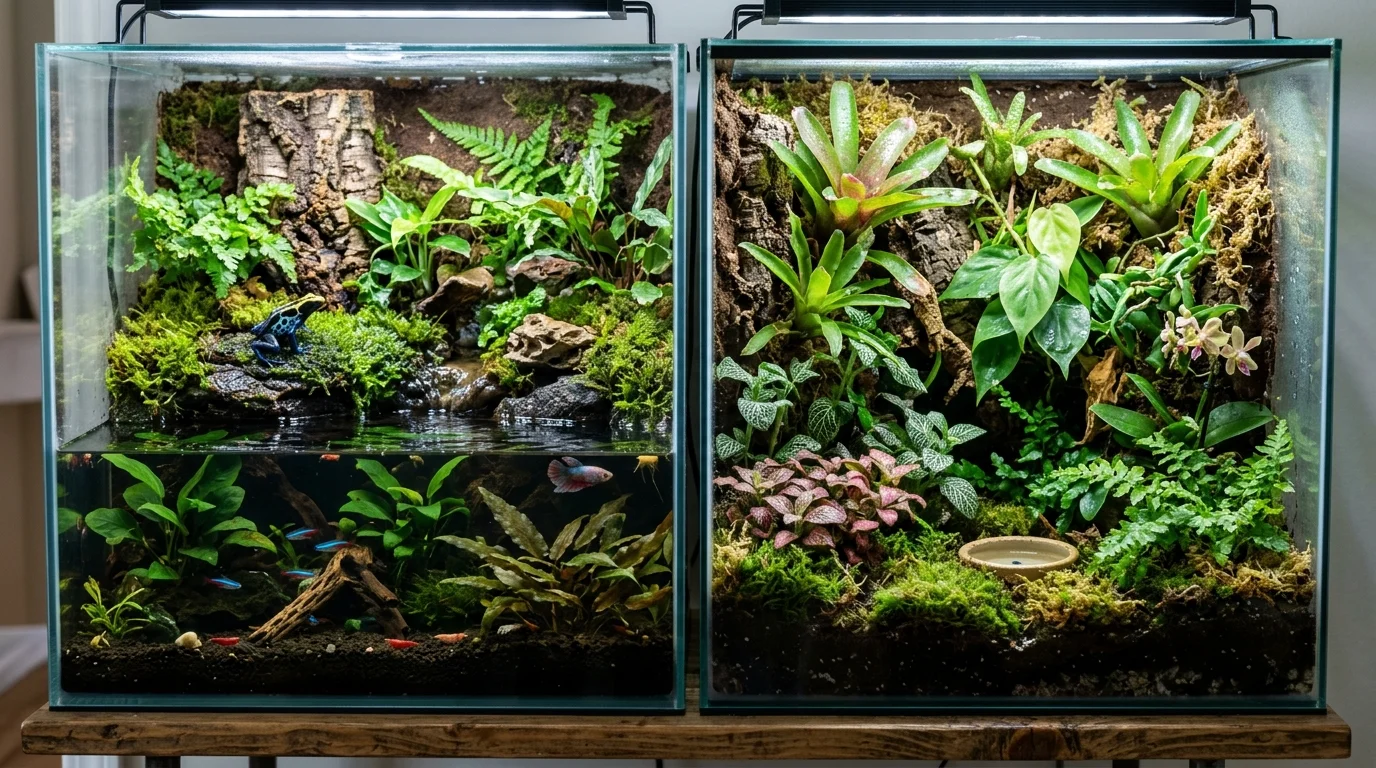
In strict terms, vivarium is an umbrella word for any enclosure that keeps living organisms, and a paludarium is one kind of vivarium. In builder usage, though, a vivarium means a terrestrial enclosure, typically a bioactive setup for non-swimming species such as poison dart frogs and crested geckos. That version has a drainage layer or false bottom that exists only to catch misting runoff, and standing water is kept minimal or removed. A paludarium instead has a permanent, functional water body, commonly 30–70% of the footprint, with pumps, filtration, heating, and water-displacement math, and it supports semi-aquatic livestock plus fish and shrimp. Choose the vivarium for terrestrial animals that can drown, and the paludarium when the animals actually use the water. Use the paludarium hub for the overview, the how to build a paludarium guide for construction, and the paludarium plants guide for flora.
Key Takeaways
- The deciding question is whether the water is a habitat or a drain: a paludarium has a permanent aquatic reservoir with life support, while a terrestrial vivarium only manages runoff and keeps standing water minimal.
- A false bottom looks identical in both builds but does opposite jobs: in a vivarium it is a passive gravity-fed drainage buffer emptied by siphon or bulkhead, and in a paludarium it sits in a circulating, filtered water basin.
- Match livestock to water depth before buying anything: non-swimming species such as dart frogs and crested geckos belong in a vivarium, and a paludarium suits species that actively use both water and land.
- A paludarium runs two waste cycles, terrestrial cleanup crews on land and nitrifying biofiltration in the water, so it carries more failure points, plumbing risk, and maintenance than a vivarium.
Why Paludarium and Vivarium Get Confused
The confusion has a real source. Vivarium literally means a place of life, and the word is used as an umbrella for any enclosure that houses living plants or animals. Under that broad usage, a terrarium with a gecko, an aquarium, and a paludarium can all be called vivaria, and a paludarium is correctly described as a type of vivarium.
In practice, builders and the bioactive community use the word far more narrowly. When someone says they are building a vivarium, they usually mean a terrestrial enclosure, planted and often bioactive, for tropical species such as poison dart frogs, crested geckos, and other animals that live on land. This guide uses that narrower, practical meaning because it is the one that creates the real decision: a terrestrial bioactive vivarium or a paludarium with a functional water body.
Two shortcuts cause most of the mislabeling. The first is assuming any enclosure with dart frogs or bioactive soil is a paludarium. It is not, unless it contains a genuine aquatic zone. The second is calling any wet tank a vivarium regardless of how much open water it holds. A water dish does not make an aquatic section, and a drainage layer full of runoff does not make a water body. The boundary is whether the water is a habitat or a drain.
Paludarium vs Vivarium at a Glance
| Variable | Paludarium | Terrestrial Vivarium |
|---|---|---|
| Water body | Permanent, functional, with real depth, commonly 30–70% of footprint or volume | None; a shallow dish at most, and standing water kept minimal |
| Primary focus | Dual environment, aquatic plus terrestrial | Terrestrial flora and fauna |
| Life support | Pump, filtration, often a heater, water-displacement planning | Misting or fogging, ventilation, heat and light for land species |
| False bottom role | Sits submerged or semi-submerged in a deep, circulating basin | Passive drainage buffer for misting runoff |
| Waste cycles | Two: terrestrial cleanup crew and aquatic nitrifying biofilter | One: terrestrial cleanup crew in the substrate |
| Typical livestock | Semi-aquatic species, plus fish and shrimp | Non-swimming terrestrial species |
| Drowning risk | Designed in, managed through water depth and exits | Minimized by removing standing water |
For the underlying category definition, see the paludarium hub.
Aquatic Integration vs Terrestrial Bioactive Focus
A paludarium is built around its water. The reservoir has enough depth to function as a habitat, whether for swimming, foraging, breeding, or supporting fish and shrimp, and the rest of the enclosure is organized around it. That means the water needs aquatic life support: filtration, circulation, and usually a heater matched to the livestock. It also means the design must account for water displacement, because substrate, hardscape, and the false bottom all take up space that would otherwise hold water.
A vivarium is built around its land. The substrate, leaf litter, plants, and microfauna form the working ecosystem, and moisture comes from misting, fogging, or condensation rather than from a standing reservoir. Where a drainage layer exists, its purpose is to stop runoff from saturating the soil, not to hold a body of water for the animals.
The practical test is simple. If you removed the water and the animals would lose a habitat, it is a paludarium. If you removed the water and the animals would be unaffected beyond humidity and a drinking source, it is a vivarium.
Drainage Physics and Water Management
Both enclosures can contain a false bottom made of LECA or an egg-crate grid, a mesh or screen barrier, and a substrate above it. Because the parts look alike, they are often assumed to work alike. They do not.
In a vivarium, water enters from above as misting or rain-bar runoff, percolates through the substrate, and falls through the barrier into the drainage layer. The layer exists purely as an emergency buffer. Gravity does the work, and the water is removed passively through a siphon tube or a bottom bulkhead and valve. The goal is that the water level never rises to touch the substrate, because saturated soil loses air space and invites root rot and anaerobic conditions.
In a paludarium, the same layer sits in or beside a deliberate water basin. Water is held, circulated by a pump through a waterfall or filter, and cycled continuously. The false bottom is part of an aquatic system, which means it must be engineered for flow, access, and equipment concealment rather than simply for emptying.
| Water Management Factor | Paludarium | Terrestrial Vivarium |
|---|---|---|
| Water behavior | Held and circulated in a closed or recirculating cycle | Drains passively under gravity |
| False bottom state | Submerged or semi-submerged in a deep basin | Mostly dry, filled only by runoff |
| Water movement | Pump, waterfall, or internal filtration | None needed for drainage |
| Water removal | Water changes and top-offs | Siphon tube or bottom bulkhead and valve |
| Key engineering risk | Leaks, pump failure, overflow, substrate wicking | Runoff pooling and soil contact with standing water |
| Sizing math | True water volume after displacement | Runoff capacity of the drainage layer |
PALUDARIUM (water is a habitat)
Terrestrial zone → substrate → barrier
↓
Deep water basin (false bottom submerged or semi-submerged)
↓
Pump → filter / waterfall → return to basin

TERRESTRIAL VIVARIUM (water is a drain)
Misting → substrate → barrier
↓
Drainage layer (LECA / egg-crate buffer)
↓
Siphon tube or bottom bulkhead → removed
The sizing math also differs. In a paludarium you need the usable water volume after the land, hardscape, and false bottom have displaced part of the tank, and the paludarium water volume calculator handles that. In a vivarium you are not calculating a habitat volume at all; you are sizing the drainage layer so it can hold realistic runoff between removals without ever reaching the substrate.
Bioactive Mechanics and Microfauna
Bioactive means the enclosure processes its own waste using living organisms. The difference between the two systems is how many cycles have to balance at once.
A vivarium relies on a terrestrial cleanup crew, commonly springtails and dwarf isopods, working in an airy, moist substrate such as an ABG-style mix topped with leaf litter. They break down feces, uneaten food, and shed plant material, and the substrate bacteria and fungi complete the cycle. Stability depends on moisture, airflow, leaf litter replenishment, and keeping the substrate out of standing water.
A paludarium has to run that terrestrial cycle and a second aquatic one. On land, the same cleanup crew works the substrate. In the water, waste is converted by nitrifying bacteria living in the filter and on surfaces, and aquatic snails or shrimp can add cleanup. High moisture and splash zones create distinct microfauna zones between the two, so the transition area behaves differently from either extreme.
| Bioactive Factor | Paludarium | Terrestrial Vivarium |
|---|---|---|
| Waste cycles | Terrestrial plus aquatic | Terrestrial only |
| Land cleanup crew | Springtails and dwarf isopods on land and splash-adjacent areas | Springtails and dwarf isopods throughout the substrate |
| Water cleanup | Nitrifying biofiltration, plus snails or shrimp where suitable | Not applicable |
| Substrate condition | Moist to wet, with zones prone to saturation | Airy, evenly moist, never waterlogged |
| Main collapse trigger | Filter crash, ammonia spike, or waterlogged land zone | Waterlogged soil, dry-out, or depleted leaf litter |
| Microfauna zoning | Distinct dry land, splash, and aquatic zones | Relatively uniform terrestrial zone |
Cleanup crews do not survive the same way in each system. Springtails and isopods in a paludarium face constant proximity to water and can end up on the surface of the reservoir, so the land zone needs enough elevation and dry refuge for the crew to persist. In a vivarium, the main threat to the crew is substrate that is either soaked or desiccated.
Livestock Suitability and Drowning Hazards
Livestock choice is the most consequential difference between the two builds. Species that are not adapted to swimming can be in real danger in a deep water basin, while species that depend on water cannot thrive in a drained terrestrial enclosure.
The terrestrial vivarium suits non-swimming tropical species such as poison dart frogs and crested geckos. These animals live on land and vegetation, and a deep water body creates a drowning risk with no benefit. That is why vivarium builders work to minimize standing water, keep any water dish shallow, and drain the drainage layer rather than let it fill.
The paludarium suits semi-aquatic species that actively use both water and land, for example vampire crabs, fire-bellied toads, and certain newts, along with fish and shrimp in the water. Because water is part of the habitat, the design must still manage depth, give animals easy exits such as sloped banks, ramps, and roots, and keep equipment from becoming a trap.
| Species Type | Better Fit | Why |
|---|---|---|
| Poison dart frogs | Terrestrial vivarium | Terrestrial, not built for deep water, and drowning is a genuine hazard |
| Crested geckos | Terrestrial vivarium | Arboreal and terrestrial, with no use for a swimming reservoir |
| Fire-bellied toads | Paludarium | Semi-aquatic and use both land and water |
| Vampire crabs | Paludarium | Need access to water and land and use both |
| Certain newts | Paludarium | Spend time in water and on land depending on species and life stage |
| Fish and shrimp | Paludarium | Require a real, filtered water body |
Always confirm the specific species' requirements before building, because many amphibians and invertebrates vary widely in how much water they need and how well they handle it. Species that are not strong swimmers should only ever be given shallow water with easy exits.
Structural and Cost Decision Matrix
Complexity, plumbing risk, lighting, upkeep, and budget all follow from whether the build contains a real water body. A vivarium has fewer systems and therefore fewer ways to fail. A paludarium adds aquatic equipment and plumbing, which raises both the capability and the risk.
| Decision Factor | Paludarium | Terrestrial Vivarium |
|---|---|---|
| Setup complexity | High: watertight enclosure, basin, pump, filter, drainage | Moderate: drainage layer, barrier, substrate, planting |
| Plumbing failure points | Pump, tubing, fittings, waterfall, overflow, leaks | Bulkhead, valve, or siphon line |
| Lighting geometry | Must serve land, splash, and underwater zones with differing depth | Layered for canopy, midstory, and floor, with no underwater zone |
| Heating and filtration | Often needed for the water body | Rarely needed for water |
| Ongoing maintenance | Water changes, filter care, top-offs, plus land care | Misting, pruning, leaf litter, periodic drainage removal |
| Cost | Higher: aquatic equipment and watertight build | Lower: no aquatic life support |
| Livestock range | Semi-aquatic plus fish and shrimp | Terrestrial and arboreal species |
How to Choose Between a Paludarium and a Vivarium
- Name the animals first. If they cannot swim well, choose the vivarium. If they use water as habitat, choose the paludarium.
- Decide whether water is a habitat or a humidity source. If it only needs to keep air moist, a drainage layer and misting are enough.
- List the plants. Humid terrestrial flora suit a vivarium; a mix of aquatic, marginal, and terrestrial plants suits a paludarium, as covered in the paludarium plants guide.
- Honestly assess your appetite for plumbing, pumps, and water chemistry. If it is low, the vivarium is the safer path.
- Check the enclosure. A paludarium needs a watertight build; a vivarium needs ventilation and a way to drain the base layer.
- Set budget and maintenance limits, then compare them against the decision matrix above.
If your real goal is a mostly aquatic display with plants growing above the waterline and no true land, read the paludarium vs riparium comparison. If you are weighing a pure planted display without the livestock question, see the paludarium vs terrarium comparison.
Converting a Vivarium to a Paludarium Later
A vivarium can be converted to a paludarium, but only if it was built with the right bones. A fully watertight enclosure with a deep, accessible drainage layer or false bottom gives you the option to add a water basin, pump, and waterfall later. A build with an unsealed base, thin drainage layer, or no equipment access will need substantial rework.
Plan the conversion as a rebuild of the water side, not an addition. You will need to define the water zone, recalculate displacement, install filtration and circulation, and re-balance the lighting for the new aquatic area. The terrestrial bioactive layer can often stay, but it must be protected from the new water so soil and standing water do not meet. For the full sequence, use the how to build a paludarium guide.
Common Mistakes That Blur the Line
- Calling any enclosure with dart frogs or bioactive soil a paludarium when it has no real aquatic zone.
- Treating a water dish or a flooded drainage layer as an aquatic section.
- Letting standing water in a vivarium drainage layer rise until it touches the substrate.
- Putting non-swimming species into a deep water basin without a shallow, sloped, easily exited design.
- Building a paludarium without planning for both a terrestrial cleanup crew and an aquatic biofilter.
- Buying a deep false-bottom setup for a purely terrestrial animal and then fighting runoff pooling indefinitely.
Final Framework
Vivarium is the umbrella word, and paludarium is the specific build in which water is a functioning habitat. In everyday terms, a terrestrial vivarium manages water as runoff, keeps standing water minimal, and suits animals that can drown. A paludarium manages water as a living system, accepts the engineering that comes with it, and suits animals that need both elements. Pick the system that matches the animals and plants first, then build the drainage and life support that those animals actually require.
Frequently Asked Questions
Can dart frogs live in a paludarium?
Generally a terrestrial vivarium is the better fit, because dart frogs are not strong swimmers and deep water creates a drowning risk. They can be kept in a paludarium only when the design is land-dominant with shallow, gently sloped water and easy exits, and the specific species' requirements have been checked first.
What happens if water pools in a vivarium drainage layer?
Standing water that rises to touch the substrate saturates the soil, removes air space, and promotes root rot and foul, anaerobic conditions. Keep the drainage layer below the barrier, remove excess through a siphon tube or bottom bulkhead, and reduce misting if the layer fills faster than you can empty it.
Which is easier to maintain, a paludarium or a vivarium?
A terrestrial vivarium is easier because it has one waste cycle and no aquatic life support. A paludarium adds filtration, water changes, pump and plumbing checks, and a separate aquatic nitrogen cycle on top of the land care.
Can a vivarium be converted to a paludarium later?
Yes, if it was built watertight with an accessible, adequately deep drainage layer or false bottom. Converting means adding a defined water zone, recalculating displacement, installing filtration and circulation, and rebalancing lighting, so treat it as a rebuild of the water side rather than a small add-on.
How does bioactive cleanup crew survival differ between the two?
In a vivarium, springtails and dwarf isopods mainly need evenly moist, airy substrate and steady leaf litter, and are threatened by waterlogging or drying out. In a paludarium the crew also lives beside open water, so the land zone needs elevation and dry refuge, and a separate aquatic biofilter must handle waste in the water.
Explore More
Related Articles


Related Plant Guides
No specific plant guides found matching this topic.
Recommended next actions
Continue Exploring
Dive deeper into related plant care tools and profiles.
Topic Guide
What Is a Paludarium? Design, Anatomy, and Ecosystem Setup
Learn what a paludarium is, how land and water zones work together, and how to plan drainage, circulation, substrate, planting, and maintenance.
Topic Guide
Bioactive Terrarium: How the Living Ecosystem Works
Learn how a bioactive terrarium works, including substrate layering, drainage, springtails, isopods, live plants, ventilation, and maintenance.
Topic Guide
Paludarium Plants: Choosing Plants for Land & Water Zones
Learn how to choose paludarium plants by land, emergent, humid, and aquatic zones, with guidance on light, moisture, growth, and maintenance.
Topic Guide
Humidity
Learn everything about humidity for your indoor and aquarium plants. Expert care tips, troubleshooting, and related guides.
Topic Guide
Misting
Learn everything about misting for your indoor and aquarium plants. Expert care tips, troubleshooting, and related guides.
Topic Guide
How to Build a Paludarium Step by Step
A practical step-by-step construction workflow covering planning, enclosure selection, terrain structure, drainage, substrate, hardscape, water systems, lighting, planting, filling, testing, and stabilization.