Vampire Crab Paludarium Setup: Habitat, Husbandry & Care
Vampire crabs in the Geosesarma genus are semi-terrestrial crabs associated with land and freshwater-edge environments. A suitable paludarium therefore needs more than an aquarium with a small island: the land area should be usable, the substrate should retain moisture and allow natural behavior, and the aquatic section should remain shallow enough for straightforward access and exit. This guide separates information established by scientific literature from commonly published keeper guidance.
Quick Answer
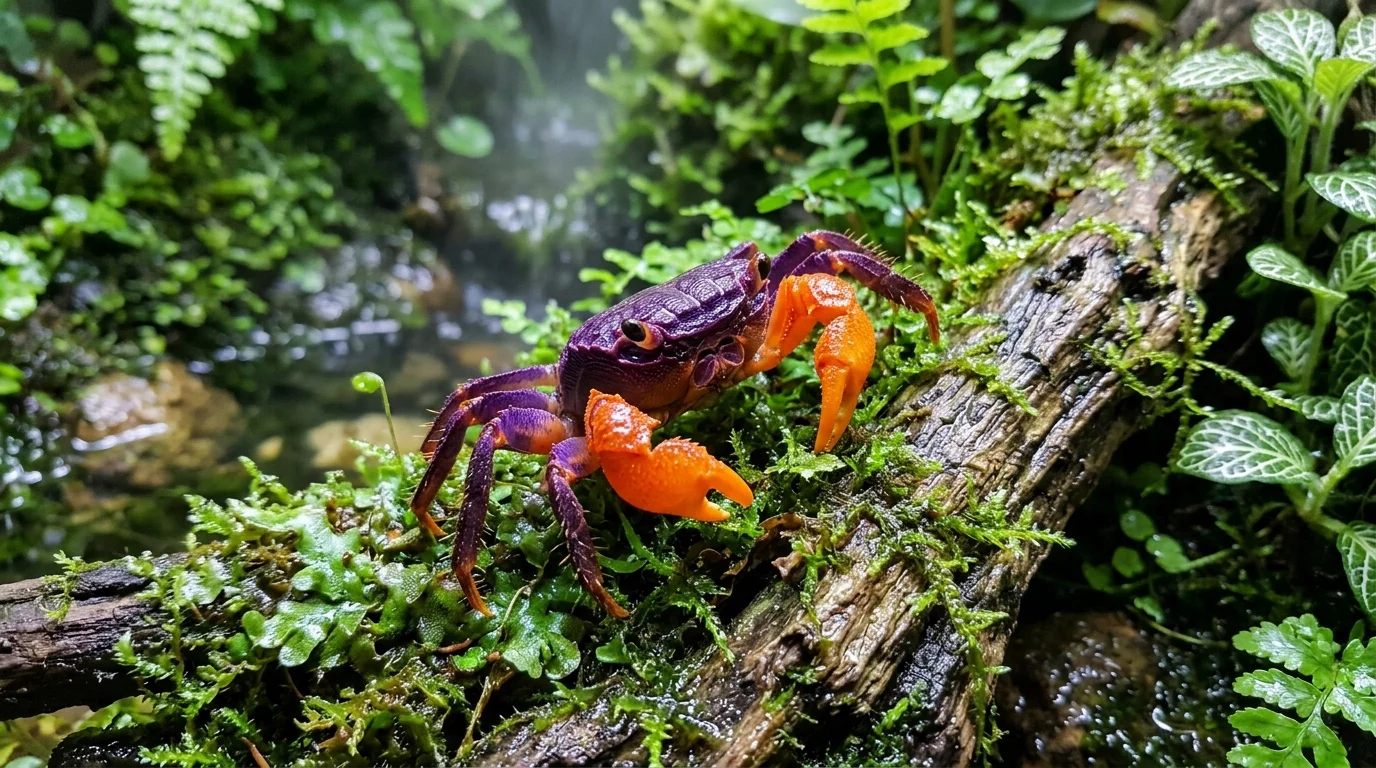
A vampire crab paludarium is a semi-terrestrial enclosure that gives vampire crabs substantial land, a shallow freshwater area with easy exits, moisture-retaining substrate, hiding places, and stable warm, humid conditions. The 2015 scientific description establishes the species' taxonomy and natural association with stream-bank habitats; many of the numerical husbandry ranges used by keepers are practical hobby guidance rather than peer-reviewed requirements.
Key Takeaways
- Vampire crab paludariums should provide substantial usable land as well as a shallow freshwater zone.
- A practical keeper target is roughly 70–80% land and 20–30% water by enclosure area, rather than an aquarium-dominant layout.
- A moisture-retaining soil-based substrate is appropriate; many keepers use roughly 5–10 cm (2–4 inches) or more where burrowing space is needed.
- A shallow aquatic zone of roughly 5–10 cm (2–4 inches) with secure exits is a common husbandry recommendation.
- Common keeper guidance places temperature around 22–28°C (71–82°F) and humidity around 70–85%, but these ranges should be treated as husbandry guidance rather than experimentally established requirements.
- Vampire crabs can be territorial, so hiding places, visual barriers, and adequate usable land are important.
- Fish compatibility should not be assumed; published care guides warn that fish may be a poor match because crabs can injure them.
- ABG-style bioactive substrate is optional rather than a requirement for vampire crabs.
What is a vampire crab paludarium?
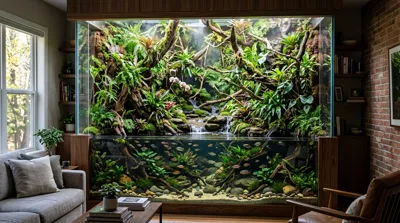
A vampire crab paludarium is a land-dominant enclosure that combines a terrestrial habitat with a smaller freshwater zone. For vampire crabs, the goal is not to recreate a conventional aquarium with a tiny decorative island. The land should be large enough to function as the primary living area, while the aquatic section provides access to freshwater and supports normal interaction with the water.
Vampire crabs sold in the hobby are commonly associated with Geosesarma. The scientific literature is especially useful for understanding their taxonomy and natural setting, while practical enclosure parameters such as humidity, substrate depth, and land-to-water proportions are largely drawn from keeper guidance. Those two evidence levels should not be confused.
For a broader explanation of how the land, water, drainage, planting, and circulation zones fit together, see the paludarium guide. For calculating the aquatic section after the enclosure dimensions are known, use the paludarium water volume calculator.
What the scientific literature establishes
Ng, Schubart, and Lukhaup described Geosesarma dennerle and Geosesarma hagen in a 2015 paper in the Raffles Bulletin of Zoology. The paper describes the animals from stream-bank habitats near Cilacap in Central Java, Indonesia. This is important because it provides a primary scientific reference for the taxonomy and locality rather than relying on hobby descriptions that may repeat one another.
The paper should not, however, be treated as a complete modern husbandry manual. Exact enclosure proportions, humidity targets, substrate recipes, and other practical numbers commonly used by keepers are generally recommendations from the aquarium and terrarium hobby rather than controlled husbandry requirements demonstrated by the species description.
Land should be the primary habitat
A useful starting point is a land-dominant layout, with roughly 70–80% of the enclosure devoted to usable land and roughly 20–30% to water. This is a practical keeper guideline, not a universal biological rule.
Usable land matters more than the percentage printed on a plan. A large decorative ledge that is difficult for the crabs to reach does not provide the same habitat value as continuous ground with cover, texture, and hiding places.
Build the transition between land and water so that crabs can move between zones without climbing a smooth vertical wall. Sloped banks, textured hardscape, roots, stones, and other secure structures can create several routes between the two zones.
Substrate and burrowing space
Vampire crabs benefit from a moisture-retaining terrestrial substrate rather than a thin decorative soil layer. A common keeper recommendation is at least about 5–10 cm (2–4 inches), with many setups using roughly 8–10 cm (3–4 inches) where enclosure height permits.
The substrate should hold moisture without remaining saturated. A soil-based mix can provide the combination of structure, moisture retention, and rooting space needed in a planted paludarium. Avoid treating fertilizer-rich potting mixes or products containing perlite or fertilizer pellets as automatically suitable for an animal enclosure.
An ABG-style bioactive substrate can be used, but it is not a requirement for keeping vampire crabs. The important design objective is a stable, moisture-retaining terrestrial zone rather than adherence to one particular substrate recipe. The separate bioactive substrate guide covers ABG-style formulations and drainage architecture in more detail.
Keep the aquatic zone shallow and accessible
A common keeper target is roughly 5–10 cm (2–4 inches) of water. The exact depth should be determined by the enclosure geometry and the animals' ability to leave the water easily rather than by a single universal number.
Provide multiple secure exits. A crab should not need to swim across open water or climb a smooth wall to reach land. Textured slopes, roots, rocks, branches, or other stable structures can create escape routes from the aquatic zone.
Water volume also depends heavily on the actual internal dimensions and the space displaced by hardscape and land structures. If the aquatic section is a rectangular zone, its geometric volume can be calculated separately from its estimated usable volume with the paludarium water volume calculator.
Temperature and humidity
Published vampire crab care guides commonly recommend temperatures around 22–28°C (71–82°F) and humidity around 70–85%, with many hobby guides emphasizing humidity of roughly 75% or higher. These figures are best understood as practical husbandry guidance, not as experimentally established physiological boundaries.
Stable conditions are generally more useful than repeatedly chasing a single target number. Measure temperature and humidity with appropriate instruments, and consider how ventilation, enclosure size, substrate moisture, lighting, and room conditions interact.
A humid enclosure should not mean a permanently waterlogged substrate. The terrestrial zone needs moisture while still retaining air-filled pore spaces. Good drainage and controlled watering help separate high ambient humidity from saturated soil.
Hiding places, territoriality, and molting
Vampire crabs can be territorial, particularly when space and hiding opportunities are limited. Provide several retreats rather than one central hiding place. Cork, roots, leaf litter, planted areas, textured hardscape, and other stable structures can create visual barriers and separate territories.
Hiding opportunities are also important when a crab is vulnerable around a molt. The enclosure should offer sheltered areas where an individual can remain out of direct contact with other crabs.
Designing several separated microhabitats is generally more useful than filling the enclosure with a single dense pile of decoration. The crabs should be able to move between open feeding areas, cover, and the water zone without being forced through one narrow bottleneck.
Size: do not confuse carapace measurements with hobby figures
Size information about vampire crabs is frequently repeated without specifying what part of the animal was measured. The 2015 scientific paper reports male holotype carapace widths of roughly 14 mm, which is considerably smaller than the frequently repeated hobby figure of 1.5–2 inches.
Those numbers should not be treated as equivalent measurements. A hobby figure in that range may refer to overall span or another informal measurement rather than carapace width. Do not use 1.5–2 inches as a claimed carapace width for these crabs.
Compatibility and cohabitation
Do not assume that a paludarium is automatically suitable for mixed-species stocking. Vampire crabs have claws and can be territorial, and published care guides warn that fish may be a poor match because crabs can injure fish.
For that reason, this guide does not prescribe a list of fish or other animals to keep with vampire crabs. Compatibility depends on enclosure structure, available refuges, animal behavior, size differences, and the particular species involved. A visually attractive mixed-species setup is not necessarily a low-risk setup.
When planning a community enclosure, evaluate whether every animal has an appropriate habitat zone and whether one animal can interfere with another during feeding, resting, or molting. If those requirements cannot be met independently, a species-specific enclosure is the simpler design.
Planning the terrestrial zone
Start by deciding where the continuous terrestrial habitat will be before adding decorative hardscape. The land should include enough depth for substrate, planting, hiding places, and maintenance access.
- Establish the land footprint. Keep the terrestrial zone continuous where possible rather than dividing it into isolated decorative islands.
- Build a stable substrate profile. Allow roughly 5–10 cm (2–4 inches) or more where burrowing and planting require additional depth.
- Create several shelters. Use stable structures to create separate retreats and visual barriers.
- Construct the water transition. Make several routes between land and water rather than one steep access point.
- Add planting and leaf litter. Use plants and organic cover as habitat structure rather than only as decoration.
- Check access before filling the enclosure. Make sure the animals can reach the water and return to land without relying on smooth vertical surfaces.
Maintenance priorities
Maintenance is mainly about keeping the terrestrial and aquatic zones functioning as separate but connected environments. Monitor temperature and humidity, maintain appropriate substrate moisture, remove decomposing material that is accumulating excessively, and keep the aquatic area clean enough for the intended inhabitants.
Inspect the land-water boundary after routine maintenance. Substrate can migrate into the aquatic zone, plants can shift, and hardscape can settle. Any change that creates a steep drop, blocks an exit, or removes a hiding place should be corrected before it becomes a husbandry problem.
Do not rely on a bioactive cleanup crew as a substitute for maintenance. Springtails, isopods, microbes, and decomposers can participate in nutrient cycling, but they do not eliminate the need to monitor the enclosure.
Common setup mistakes
- Making the enclosure mostly water: this leaves too little usable terrestrial habitat.
- Using a very thin substrate: shallow substrate limits planting, moisture buffering, and natural digging behavior.
- Creating only one water exit: a single access point can become blocked or difficult to use.
- Using smooth vertical water walls: these can make escape from the aquatic zone unnecessarily difficult.
- Confusing humidity with saturated soil: high ambient humidity does not require permanently waterlogged terrestrial substrate.
- Using one hiding place: limited refuge can increase competition between territorial animals.
- Treating hobby ranges as scientific limits: practical temperature, humidity, and ratio recommendations should not be presented as experimentally proven requirements.
- Assuming mixed-species compatibility: fish and other animals should not be added simply because they can physically occupy the same water volume.
Frequently asked questions
What is a vampire crab paludarium?
It is a land-dominant enclosure combining terrestrial habitat with a smaller freshwater zone for vampire crabs. The terrestrial area should function as the primary living space rather than as a small island in an aquarium.
How much land should a vampire crab paludarium have?
A common keeper starting point is roughly 70–80% land and 20–30% water. This is practical husbandry guidance, not a universal scientific requirement.
How deep should the water be?
Many keeper guides recommend roughly 5–10 cm (2–4 inches). More important than a precise number is providing shallow, accessible water with several secure exits.
How deep should the substrate be?
About 5–10 cm (2–4 inches) is a practical starting range, with additional depth where the enclosure allows useful burrowing and planting space.
What temperature do vampire crabs need?
Common husbandry guides recommend about 22–28°C (71–82°F). Treat this as practical keeper guidance rather than a precisely established physiological range.
What humidity do vampire crabs need?
Common guides recommend roughly 70–85% humidity, with many recommending about 75% or higher. Stable humidity and appropriate substrate moisture are more useful than chasing a single exact reading.
Can vampire crabs live fully underwater?
No. Their semi-terrestrial ecology is central to the enclosure design, so the paludarium should provide substantial accessible land as well as freshwater.
Can vampire crabs live with fish?
Do not assume compatibility. Published care guides warn that fish can be a poor match because vampire crabs may injure them. Evaluate compatibility for the specific animals and enclosure rather than relying on a generic community list.
Do vampire crabs need an ABG substrate?
No. ABG-style bioactive substrate is one possible approach, not a mandatory requirement. A suitable moisture-retaining terrestrial substrate is the underlying requirement.
How many vampire crabs can I keep together?
There is no single stocking number that applies safely to every enclosure. Usable land area, hiding places, enclosure geometry, sex ratio, individual behavior, and access to resources all affect social pressure. Prioritize sufficient space and multiple refuges rather than applying a universal crab-per-gallon rule.
Frequently Asked Questions
What is a vampire crab paludarium?
A vampire crab paludarium is a land-dominant enclosure combining terrestrial habitat with a smaller freshwater zone. The terrestrial area should function as the primary living space.
How much land should a vampire crab paludarium have?
A common keeper starting point is roughly 70–80% land and 20–30% water. This is practical husbandry guidance rather than a universal scientific requirement.
How deep should the water be for vampire crabs?
Many keeper guides recommend roughly 5–10 cm (2–4 inches). The water should have multiple secure exits so the crabs can easily return to land.
How deep should vampire crab substrate be?
About 5–10 cm (2–4 inches) is a practical starting range, with additional depth where useful burrowing and planting space is available.
What temperature do vampire crabs need?
Common husbandry guidance recommends about 22–28°C (71–82°F). These values should be treated as keeper guidance rather than precisely established physiological limits.
What humidity do vampire crabs need?
Common care guides recommend roughly 70–85% humidity, with many recommending about 75% or higher. Stable humidity and appropriate substrate moisture are more important than chasing one exact reading.
Can vampire crabs live fully underwater?
No. They are semi-terrestrial animals, so a suitable enclosure needs substantial accessible land as well as freshwater.
Can vampire crabs live with fish?
Do not assume compatibility. Published care guides warn that fish may be a poor match because vampire crabs can injure them.
Do vampire crabs need ABG substrate?
No. ABG-style substrate is optional. The important requirement is a suitable moisture-retaining terrestrial substrate that supports the intended enclosure design.
How many vampire crabs can I keep together?
There is no universal stocking number for every enclosure. Usable land, hiding places, enclosure geometry, sex ratio, and individual behavior all affect how many animals can be housed responsibly.
Sources & References
-
Source: lkcnhm.nus.edu.sg
Type: primary-literature
-
Source: terrariumtribe.com
Type: secondary-husbandry
-
Source: aquaticarts.com
Type: secondary-husbandry
-
Source: en.wikipedia.org
Type: background-reference
Explore More
Related Articles
Related Plant Guides
No specific plant guides found matching this topic.
Recommended next actions
Continue Exploring
Dive deeper into related plant care tools and profiles.
Topic Guide
What Is a Paludarium? Design, Anatomy, and Ecosystem Setup
Learn what a paludarium is, how land and water zones work together, and how to plan drainage, circulation, substrate, planting, and maintenance.
Topic Guide
Paludarium Plants: Choosing Plants for Land & Water Zones
Learn how to choose paludarium plants by land, emergent, humid, and aquatic zones, with guidance on light, moisture, growth, and maintenance.
Topic Guide
Bioactive Terrarium: How the Living Ecosystem Works
Learn how a bioactive terrarium works, including substrate layering, drainage, springtails, isopods, live plants, ventilation, and maintenance.
Topic Guide
Paludarium Waterfall Guide
A practical construction guide for paludarium waterfalls covering cascading flow paths, expanding-foam baffles, slate tiers, structural support, splash mitigation, acoustic dampening, mold prevention and hidden plumbing service access.
Topic Guide
Humidity
Learn everything about humidity for your indoor and aquarium plants. Expert care tips, troubleshooting, and related guides.
Topic Guide
Misting
Learn everything about misting for your indoor and aquarium plants. Expert care tips, troubleshooting, and related guides.