Bioactive Substrate for Paludariums: ABG Mixes, Ratios & Layering
A successful bioactive substrate is more than a recipe. It combines an appropriate organic substrate, moisture management, drainage architecture, plant roots, and decomposer organisms into a functioning terrestrial layer. ABG-style mixtures are commonly used in vivariums and paludariums because their ingredients provide different physical roles. The classic benchmark is best treated as a documented reference formulation rather than the only valid recipe, and project variants should be described as ABG-style rather than incorrectly presented as the original Atlanta Botanical Garden formula.
Quick Answer
Bioactive substrate is a living-capable terrestrial substrate system designed to support plants, moisture management, decomposition, and beneficial microfauna. For paludariums, ABG-style mixes are one established approach, but there is no single universally authoritative ABG recipe. A commonly documented classic benchmark uses 2 parts tree fern fiber, 2 parts bark, 1 part sphagnum moss, 1 part peat, and 1 part horticultural charcoal, measured by volume.
Key Takeaways
- Bioactive substrate is a system, not simply a bagged soil mix or a single recipe.
- A commonly documented classic ABG benchmark is 2 parts tree fern fiber, 2 parts bark, 1 part sphagnum, 1 part peat, and 1 part horticultural charcoal by volume.
- ABG-style formulations can be modified for availability and enclosure needs; project-approved variants should not be called the original Atlanta Botanical Garden formula.
- Horticultural charcoal is used as a substrate ingredient and should not be treated as interchangeable with aquarium activated carbon or barbecue briquettes.
- A drainage layer can provide a collection zone beneath the terrestrial substrate, but it does not automatically solve every moisture or oxygen problem.
- The terrestrial substrate should be moist enough for the intended plants and decomposers without becoming permanently saturated.
- Springtails and isopods can contribute to decomposition and nutrient cycling, but exact seeding numbers are not universal requirements.
- ABG-style substrate is optional for vampire crab paludariums; the underlying requirement is an appropriate stable terrestrial substrate.
What is bioactive substrate?
Bioactive substrate is the terrestrial growing medium within a living enclosure that supports plants, moisture management, decomposition, and interactions among microorganisms and larger decomposer organisms. It is part of an ecosystem rather than simply a decorative soil layer.
In a paludarium, the substrate also has to coexist with a nearby aquatic zone. That makes moisture control especially important: the terrestrial layer should retain enough moisture for the intended plants and organisms without becoming permanently saturated because water is continuously moving into it.
For vampire crab paludariums, an ABG-style substrate can be useful, but it is not mandatory. The appropriate substrate depends on enclosure structure, planting, drainage, moisture requirements, and the animals being kept.
What is ABG mix?
ABG refers to a family of vivarium substrate formulations associated with planted, bioactive enclosure construction. There is not one universally documented recipe that should be treated as the only legitimate ABG formula.
A commonly documented classic benchmark uses 2 parts tree fern fiber, 2 parts bark, 1 part sphagnum moss, 1 part peat, and 1 part horticultural charcoal, measured by volume. This ratio is useful as a reference point because the ingredients provide different physical properties rather than because the exact numbers are biologically mandatory.
Published vivarium construction resources describe comparable ingredient combinations and explain how the components contribute to substrate structure. A modern enclosure can reasonably adapt the formulation when ingredients are unavailable or when a different physical balance is better suited to the intended plants.
Classic ABG benchmark versus project variants
The classic benchmark used in this guide is:
- 2 parts tree fern fiber
- 2 parts bark
- 1 part sphagnum moss
- 1 part peat
- 1 part horticultural charcoal
Measure all parts by volume rather than weight. A cup, scoop, or other consistent container can be used for every ingredient.
For this project, three ABG-style variants are also useful reference formulations:
- Variant A: 2 tree fern fiber : 2 bark : 1 sphagnum : 1 peat : 1 charcoal.
- Variant B: 2 tree fern fiber : 2 bark : 2 sphagnum : 1 peat : 1 charcoal.
- Variant C: 2 tree fern fiber : 1 bark : 1 sphagnum : 1 peat : 1 charcoal.
These project variants should be described as ABG-style formulations, not as three official historical Atlanta Botanical Garden recipes. Variant A matches the classic benchmark above; Variants B and C deliberately change the relative proportions of moisture-retaining or coarse structural components.
Why the ingredients are combined
Tree fern fiber
Tree fern fiber provides coarse organic structure and contributes to moisture retention. Its availability varies by region, so a substrate should not be designed around the assumption that every keeper can source the same material.
Bark
Bark provides coarse organic material and helps maintain physical structure. Appropriately sized horticultural bark can create larger spaces within the substrate than a fine, highly compacting material.
Sphagnum moss
Sphagnum contributes moisture retention and organic structure. It is useful in moderation; increasing the proportion of fine moisture-holding material also changes how quickly the substrate dries.
Peat
Peat contributes fine organic material and moisture retention. It can be reduced or substituted when sourcing, sustainability, or enclosure requirements make that preferable.
Horticultural charcoal
Horticultural charcoal is a coarse carbon-rich component used in many vivarium substrate formulations. It should not be confused with aquarium activated carbon used for water filtration, and barbecue briquettes are not an appropriate substitute because they may contain binders or other additives.
Charcoal should not be marketed as a universal detoxifier or as proof that a substrate will remove toxins. Its role in an ABG-style substrate is primarily as a structural component within the overall mix.
How to think about drainage layers
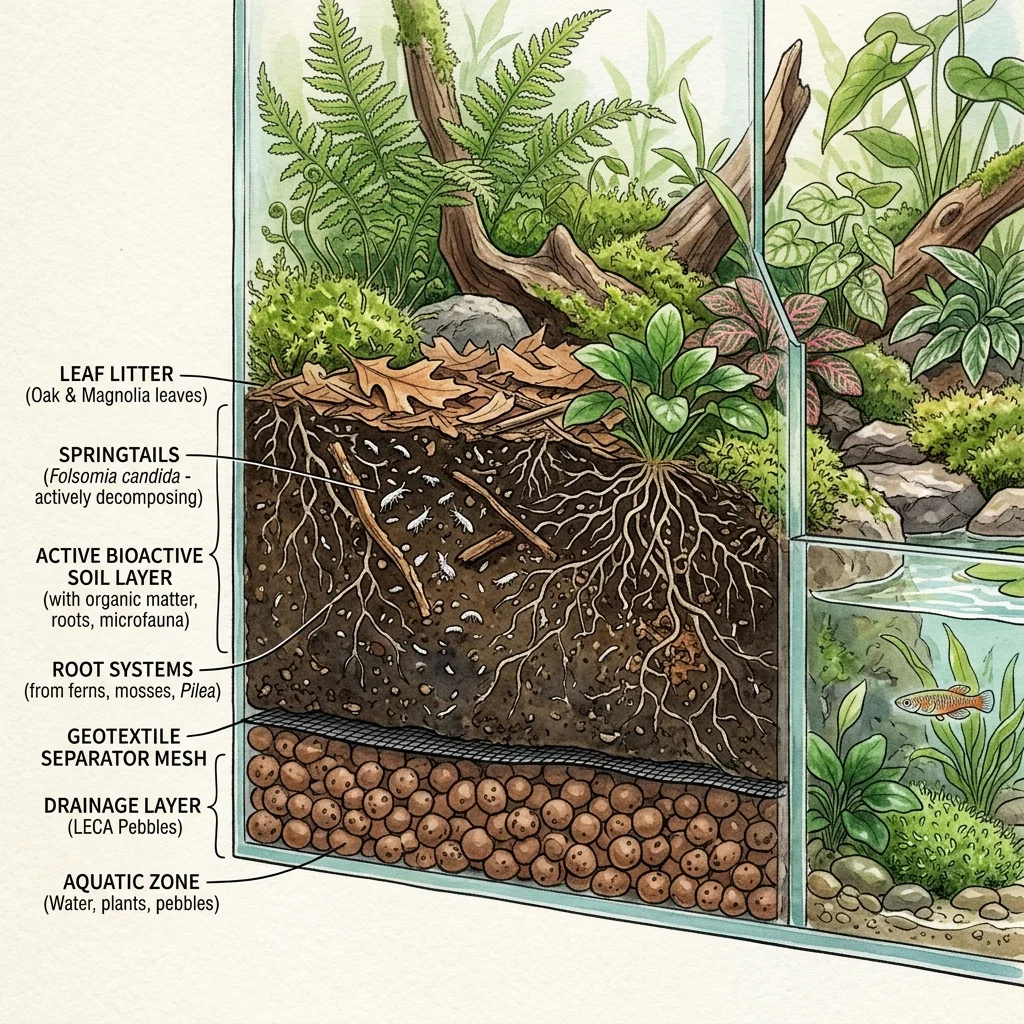
A drainage layer creates a separate collection zone beneath the terrestrial substrate. In a paludarium, this can be useful because watering, condensation, and nearby aquatic structures can introduce excess water into the terrestrial section.
A typical architecture may include a lower drainage or collection zone, a permeable separator, the terrestrial substrate, and a surface layer of leaf litter. The separator reduces migration of fine substrate into the drainage area while still allowing the intended water movement.
A drainage layer is not a guarantee that the root zone will remain healthy. If the substrate above it is continuously saturated, simply adding more empty space underneath does not automatically restore appropriate air-filled pore space. Water input, substrate composition, enclosure geometry, and drainage pathways all matter.
Moisture: damp is not the same as waterlogged
Bioactive substrate generally needs enough moisture to support its intended plants and decomposer community. The correct moisture level depends on the enclosure and organisms, so there is no single moisture percentage that applies to every paludarium.
Use the substrate's physical behavior as one practical indicator. It should retain moisture without behaving like a container of standing water. If water is continuously pooling through the entire terrestrial layer, investigate the source rather than assuming the drainage layer will solve it.
In a paludarium, keep the aquatic boundary and terrestrial root zone conceptually separate. Water should not be allowed to migrate uncontrolled through the entire soil profile simply because the two habitats touch.
Microfauna and decomposition
Springtails and isopods are commonly used in bioactive enclosures as part of the decomposer community. They consume and process organic material and can contribute to nutrient cycling within the enclosure.
There is no universal scientific seeding number that can be applied to every enclosure. Starter-culture size depends on enclosure volume, substrate, leaf litter, moisture, temperature, and the organisms being maintained.
Start with a healthy culture appropriate to the enclosure rather than chasing an arbitrary number of individuals. Provide suitable habitat and organic material, then monitor whether the population persists and the substrate system remains balanced.
A decomposer community does not make an enclosure maintenance-free. Remove excessive waste, dead material, or contaminated substrate when necessary and continue monitoring the physical environment.
Bioactive substrate for vampire crab paludariums
Vampire crabs do not require one particular branded or named substrate. A stable moisture-retaining terrestrial substrate is the fundamental requirement.
An ABG-style formulation can work well when the enclosure includes plants, leaf litter, decomposers, and an appropriate drainage architecture. It can also be unnecessary if a simpler terrestrial substrate better matches the enclosure design.
For vampire crab setups, substrate depth should be planned around the actual enclosure and desired behavior. A common keeper recommendation is roughly 5–10 cm (2–4 inches), with additional depth where useful burrowing and planting space is available.
The vampire crab paludarium guide covers the animal-specific habitat requirements separately, including land-water layout, water access, humidity, temperature, hiding places, and compatibility.
Ingredient substitutions and sourcing
Ingredient availability varies substantially by country. A useful substitution should preserve the intended physical role of the original ingredient rather than merely matching its appearance.
For example, a substitute for tree fern fiber should contribute suitable coarse organic structure and moisture behavior. Coir or coco fiber can be considered in some mixes, but changing ingredients changes the physical properties of the finished substrate, so the result should be evaluated rather than assumed to be identical to the reference recipe.
The same principle applies to peat. Reducing or replacing peat may be appropriate, but the replacement should be evaluated for moisture retention, structure, acidity, and decomposition behavior in the actual enclosure.
How to mix an ABG-style substrate
- Choose one formulation. Start with the classic benchmark or an appropriate ABG-style variant rather than mixing several recipes without recording the proportions. You can calculate your bioactive substrate mix to determine the exact component volumes.
- Measure by volume. Use the same container for every ingredient so the ratios remain consistent.
- Break up compacted materials. Remove large unwanted pieces while retaining the coarse structure appropriate to the formulation.
- Combine the dry components thoroughly. This helps distribute the coarse and fine materials through the mixture.
- Add moisture gradually. Moisten the mixture without turning the entire batch into saturated mud.
- Test the texture. The finished substrate should hold together enough to retain structure while still containing coarse material and air spaces.
- Install it over the intended drainage architecture. Keep the separator functional so fine substrate does not migrate freely into the collection zone.
Common mistakes
- Calling every ABG-style recipe the original formula: different formulations exist, and project variants should be labeled accurately.
- Measuring by weight: the published ratios are normally expressed by volume, so weight changes the intended proportions.
- Using barbecue charcoal: briquettes can contain binders and additives that are inappropriate for a planted animal enclosure.
- Confusing horticultural charcoal with activated carbon: these products have different intended uses and physical properties.
- Adding excessive fine material: a substrate can become dense and hold too much water if its coarse structural components are reduced too far.
- Relying on drainage alone: a drainage layer does not make permanently saturated substrate automatically suitable.
- Using exact microfauna seeding numbers as universal rules: population needs depend on enclosure conditions and the culture being introduced.
- Treating bioactive as maintenance-free: decomposition is part of the system, not a replacement for observation and intervention.
Frequently Asked Questions
What is ABG mix?
ABG refers to a family of vivarium substrate formulations. A commonly documented classic benchmark uses 2 parts tree fern fiber, 2 parts bark, 1 part sphagnum, 1 part peat, and 1 part horticultural charcoal by volume.
What is the classic ABG ratio?
The commonly documented benchmark is 2:2:1:1:1 by volume for tree fern fiber, bark, sphagnum, peat, and horticultural charcoal respectively.
Are the project ABG variants official Atlanta Botanical Garden formulas?
No. Variant A matches the classic benchmark used here, while Variants B and C are project-approved ABG-style modifications. They should not be presented as historical official formulas.
Can I use activated charcoal instead of horticultural charcoal?
Do not treat aquarium activated carbon and horticultural charcoal as interchangeable products. The ABG-style formulation calls for horticultural charcoal as a substrate component.
Can I use barbecue charcoal?
No. Barbecue briquettes can contain binders, ignition aids, or other additives. Use an appropriate horticultural charcoal product instead.
Why does a bioactive substrate need a drainage layer?
A drainage layer can provide a collection zone beneath the terrestrial substrate and help separate excess water from the root zone. It does not by itself prevent saturation or guarantee healthy root-zone conditions.
Is ABG substrate required for vampire crabs?
No. ABG-style substrate is optional. Vampire crab enclosures need an appropriate stable terrestrial substrate; the exact recipe can vary with enclosure design and planting.
Can coco coir replace tree fern fiber or peat?
It can be considered as a substitute in some formulations, but it will change the physical behavior of the mixture. Evaluate moisture retention, structure, and drainage rather than assuming the replacement is identical.
How deep should bioactive substrate be?
Depth depends on the enclosure and the plants or animals being kept. For vampire crab paludariums, roughly 5–10 cm (2–4 inches) is a common practical starting point, with more depth where useful burrowing and planting space is needed.
Do I need an exact number of springtails or isopods?
No universal seeding number applies to every enclosure. Start with a healthy culture appropriate to the enclosure and monitor whether the population establishes and the decomposition system remains balanced.
Sources & References
-
Source: neherpetoculture.com
Type: vivarium-reference
-
Source: neherpetoculture.com
Type: vivarium-reference
-
Source: terrariumtribe.com
Type: secondary-vivarium-reference
Explore More
Related Articles
Related Plant Guides
No specific plant guides found matching this topic.
Recommended next actions
Continue Exploring
Dive deeper into related plant care tools and profiles.
Topic Guide
Bioactive Terrarium: How the Living Ecosystem Works
Learn how a bioactive terrarium works, including substrate layering, drainage, springtails, isopods, live plants, ventilation, and maintenance.
Topic Guide
Springtails vs Isopods: Which Bioactive Cleanup Crew Do You Need?
Compare springtails and isopods for bioactive enclosures, including their cleanup roles, coexistence, food, moisture, and healthy starter-culture selection.
Topic Guide
Mold in a Bioactive Terrarium: Causes & What to Do
Learn why mold appears in bioactive terrariums, when it is normal, how moisture and organic material affect it, and how to respond safely.
Topic Guide
Drainage
Learn everything about drainage for your indoor and aquarium plants. Expert care tips, troubleshooting, and related guides.
Topic Guide
Coco Coir
Learn everything about coco coir for your indoor and aquarium plants. Expert care tips, troubleshooting, and related guides.
Topic Guide
Perlite
Learn how perlite improves drainage, how long it lasts in soil, when to replace it, and how to use it in potting mixes.