Mold in a Bioactive Terrarium: Causes & What to Do
Fungal growth is a natural component of decomposition and does not automatically mean that a bioactive terrarium is failing. Newly introduced wood, leaf litter, and other organic materials can develop visible fungal growth as microorganisms colonize them. A healthy response is usually to improve environmental balance rather than attempt to sterilize the enclosure. Persistent or rapidly expanding growth should prompt checks of moisture, airflow, organic loading, drainage, and animal welfare. If a growth cannot be identified confidently, avoid assuming that it is harmless.
Quick Answer
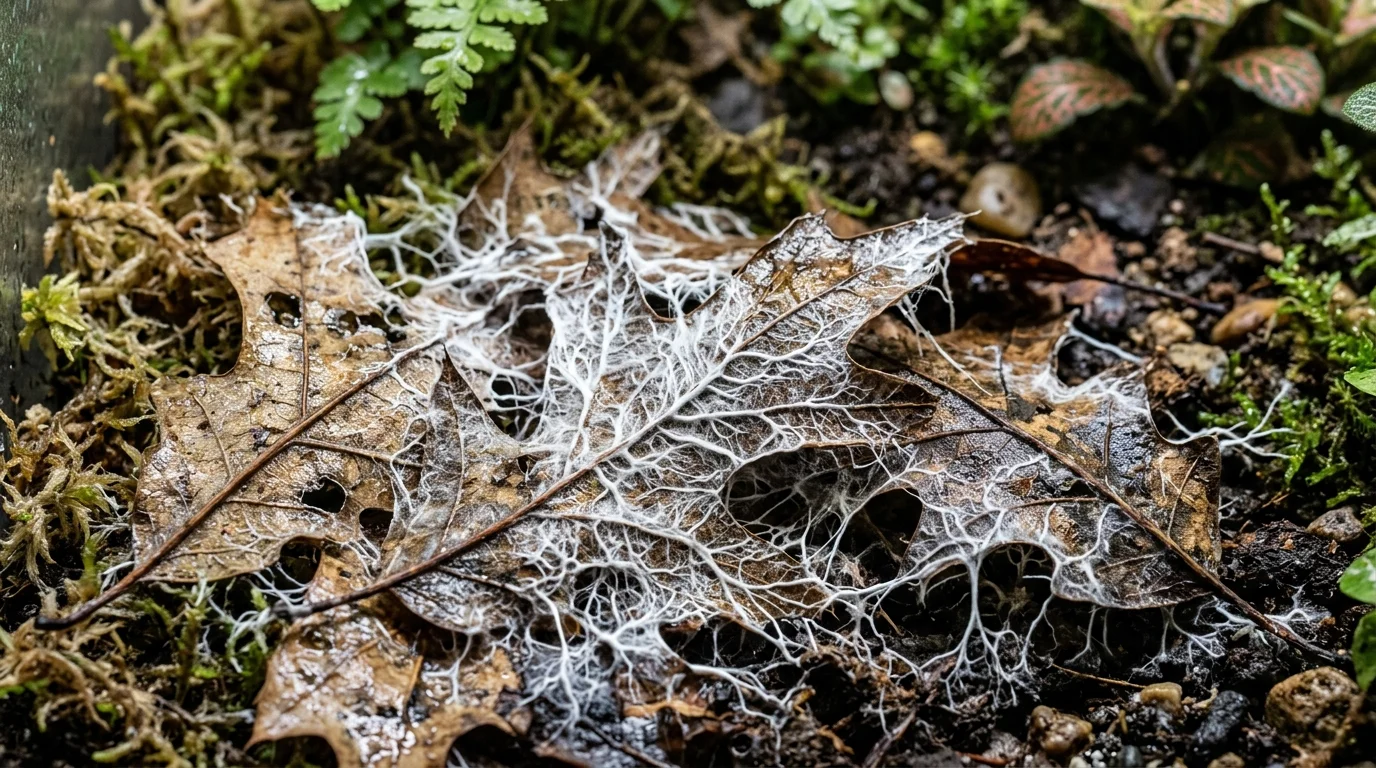
Mold in a bioactive terrarium is often a normal part of decomposition, especially in a newly established enclosure with abundant fresh organic material. The important question is whether the growth is transient and being processed by the decomposer community or whether persistent, excessive growth is signaling conditions such as excess organic material, poor airflow, excessive moisture, or inadequate decomposition capacity.
Key Takeaways
- Some visible mold and fungal growth can be normal during decomposition.
- Fresh wood, leaf litter, and other organic materials commonly provide substrates for fungal colonization.
- Springtails can consume fungal resources, but they do not guarantee a mold-free enclosure.
- Persistent excessive growth can indicate too much organic material, excessive moisture, poor airflow, or another imbalance.
- Removing the underlying excess material is usually more useful than repeatedly wiping visible growth.
- Good drainage and appropriate substrate moisture remain important even in humid bioactive systems.
- Avoid pesticides, fungicides, or household cleaning chemicals inside an inhabited bioactive enclosure unless their safety for the specific animals and plants is established.
- If an unidentified growth may be harmful or an animal appears unwell, seek appropriate expert or veterinary advice.
Is mold normal in a bioactive terrarium?
Some mold and other fungal growth can be completely normal in a bioactive terrarium. Fungi are decomposers, and fresh wood, leaf litter, food residues, and other organic material provide resources for fungal colonization.
This is especially common when a new enclosure is first established. Newly introduced organic materials have not yet developed the microbial community that will eventually use them, so visible fungal growth can temporarily appear faster than it is consumed or decomposed.
The presence of mold alone therefore does not prove that an enclosure is unhealthy. The more useful question is whether the amount and persistence of growth fit the enclosure's overall conditions.
Why does mold grow in a terrarium?
Fungal growth depends on available organic material and environmental conditions. A humid enclosure naturally provides conditions in which fungi can grow, while fresh wood, leaf litter, dead plant material, and supplemental food provide potential resources.
Problems are more likely when the amount of available organic material or moisture substantially exceeds what the enclosure's biological community can process.
Persistent condensation, poor airflow, saturated substrate, excessive food, and large amounts of newly introduced organic material can all contribute to visible fungal growth. These factors should be considered together rather than assuming that humidity alone is the cause.
White mold on terrarium wood
White fungal growth on newly introduced wood is a common observation in humid planted enclosures. Wood contains organic compounds that can support fungal colonization, particularly while the material is relatively fresh.
When the growth is limited to new wood and the rest of the enclosure appears healthy, it may decline as the available resources change and the microbial community becomes established.
There is no need to sterilize every piece of wood simply because a temporary fungal bloom appears. Instead, monitor the growth and inspect the enclosure's moisture, airflow, and organic loading.
Mold on leaf litter and substrate
Leaf litter is intentionally retained in many bioactive systems because it provides food and habitat for decomposer organisms. As leaves begin to break down, fungi and microorganisms colonize them.
A small amount of fungal growth on decomposing leaves can therefore be part of normal biological activity. Removing every leaf as soon as fungal growth appears can also remove an important food resource from the decomposer community.
However, large quantities of rotting material should not simply be left indefinitely. If organic material is accumulating faster than the enclosure can process it, reduce the excess and investigate why.
Do springtails get rid of mold?
Springtails feed on microorganisms and fungal resources and can contribute to the processing of visible fungal growth. They are one reason springtails are commonly included in bioactive cleanup communities.
They are not a guaranteed mold-control system. If the enclosure continues receiving excessive organic material or remains poorly drained and poorly ventilated, fungal growth can continue despite the presence of springtails.
A cleanup community works within the limits of the habitat provided to it. Improving those habitat conditions is more reliable than expecting a larger population of cleanup organisms to solve every fungal problem.
For more on the different roles of springtails and isopods, see springtails vs isopods.
When mold becomes a problem
Visible fungal growth deserves closer attention when it is rapidly increasing, covering large amounts of unrelated material, accompanied by persistent foul odors, or associated with obviously excessive moisture or organic accumulation.
These signs do not identify one specific cause. They indicate that the enclosure should be inspected as a system.
Check the substrate, drainage, ventilation, condensation, food inputs, leaf litter, dead plant material, and overall waste load. Look for the underlying condition rather than treating the visible mold as an isolated problem.
How to reduce excessive mold
Remove excess organic material
If a large amount of food, dead vegetation, or decomposing material has accumulated, remove the excess. A bioactive enclosure needs organic resources, but it also has a finite processing capacity.
Review substrate moisture
Check the actual substrate rather than judging conditions solely from the humidity reading. A humid atmosphere can coexist with a properly drained substrate, while a high humidity reading does not tell you whether roots and decomposers are sitting in stagnant water.
If the substrate is persistently saturated, investigate drainage and water movement before simply increasing ventilation or reducing misting.
Review airflow and condensation
Persistent condensation and stagnant air can create conditions favorable to fungal growth. Review the enclosure's ventilation and whether watering or misting is introducing more moisture than the system can lose.
Do not increase airflow blindly. Excessive ventilation can dry plants and decomposers, so changes should be made in conjunction with actual observations of moisture and plant condition.
Reduce unnecessary food inputs
Supplemental food should match the needs of the animals and cleanup community. Excess food can become an additional fungal substrate instead of improving the biological balance.
Allow the system to mature
New bioactive enclosures often go through a period of microbial change. If the plants, substrate, decomposers, and animals are otherwise healthy, a temporary fungal bloom may diminish as the system matures.
Should you remove mold?
There is no universal requirement to remove every visible patch. Small amounts associated with normal decomposition can be left for the biological community to process.
Manual removal becomes more useful when growth is excessive, when a large piece of organic material is visibly deteriorating, or when the growth is interfering with the enclosure's intended use.
If removing material, address the source at the same time. Repeatedly wiping the same surface without correcting excess moisture or organic loading often produces only temporary improvement.
What not to use against terrarium mold
Do not treat an inhabited bioactive terrarium like an empty household surface. Household disinfectants, fungicides, pesticides, bleach solutions, and other chemicals can create risks for plants, microorganisms, and animals.
Before introducing any chemical treatment into an enclosure, verify that it is specifically appropriate for the organisms present and follow authoritative directions. In many cases, environmental correction and physical removal of excessive material are safer approaches.
Mold, drainage, and bioactive substrate
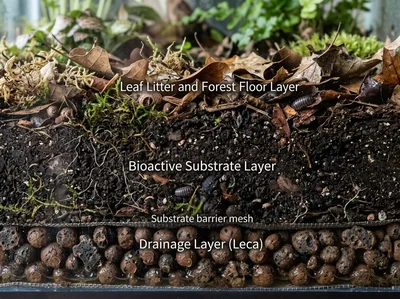
Substrate architecture strongly affects moisture distribution. A properly designed drainage zone can help keep excess water away from the main root-zone substrate.
The goal is not to create a dry terrarium. The goal is to maintain moisture conditions that support plants and decomposers without creating persistent saturation and low-oxygen zones where they are not appropriate.
For drainage architecture, substrate structure, and ABG-style formulations, see the bioactive substrate guide.
Mold in a paludarium
Paludariums add another potential source of moisture because they combine terrestrial and aquatic zones. Water movement from the aquatic section can keep terrestrial substrate wetter than intended if the transition is not properly designed.
If mold is persistent in a paludarium's terrestrial section, inspect the land-water boundary, substrate drainage, condensation, airflow, and organic material separately. High humidity alone is not enough to explain every fungal problem.
For broader land-and-water enclosure design, see the paludarium guide.
When an unidentified growth should be treated cautiously
Not every fuzzy or discolored growth in an enclosure can be confidently identified from appearance alone. Some organisms may be harmless decomposers, while others may warrant caution.
If you cannot confidently identify a growth, avoid assuming that it is harmless simply because it appeared in a bioactive enclosure. Keep animals from unnecessary exposure where practical and seek appropriate expert advice.
If an animal looks unwell, behaves abnormally, or has unexplained lesions or other concerning signs, contact an exotics veterinarian rather than attempting to diagnose the cause from the appearance of enclosure growth alone.
Common mistakes when dealing with terrarium mold
- Trying to eliminate every fungus: fungi are normal decomposers in a biological system.
- Adding excessive cleanup organisms: more organisms do not automatically correct poor environmental conditions.
- Keeping the enclosure permanently wet: moisture should match the needs of the plants and animals rather than being maximized.
- Removing all leaf litter: this can remove an important food and habitat resource for decomposers.
- Adding household chemicals: products safe for household surfaces may be hazardous to enclosed animals and microorganisms.
- Ignoring drainage: persistent saturation can create broader substrate and root-zone problems.
- Ignoring organic loading: excessive food and dead material can overwhelm the system's processing capacity.
- Changing several variables at once: make measured changes so the effect of each intervention can be understood.
Frequently asked questions
Is white mold in a bioactive terrarium normal?
It can be. White fungal growth commonly appears on fresh organic material such as wood during decomposition. Monitor the enclosure rather than assuming that every temporary fungal bloom indicates a serious problem.
How do I get rid of mold in a bioactive terrarium?
First identify whether the growth is excessive. Remove unusually large accumulations or spoiled organic material, then review moisture, drainage, airflow, condensation, and food inputs. Small amounts associated with normal decomposition may not require removal.
Will springtails eliminate mold?
No. Springtails consume microorganisms and fungal resources and may help process visible growth, but they cannot guarantee a mold-free enclosure. Environmental conditions still determine how quickly fungal resources accumulate.
Should I remove moldy wood from my terrarium?
Not necessarily. Fungal growth on newly introduced wood can be a temporary part of decomposition. If the wood is otherwise appropriate and the enclosure is healthy, observation may be sufficient. Remove material when the growth is excessive or the material is contributing to a broader enclosure problem.
Does mold mean my bioactive terrarium is failing?
No. Some fungal growth is expected in a biological enclosure. Persistent excessive growth, foul odors, saturated substrate, or other signs of environmental imbalance deserve investigation.
Does high humidity cause mold?
Humidity can contribute to fungal growth, but it is only one factor. Available organic material, surface moisture, airflow, temperature, drainage, and decomposition activity also affect fungal growth.
Can I use fungicide in a bioactive terrarium?
Do not use a fungicide simply because it is intended for household or garden use. Chemicals can affect plants, microorganisms, and animals in an enclosed system. Verify product safety for the specific organisms present before considering chemical treatment.
Why does my new terrarium have mold?
New enclosures contain fresh organic materials and are undergoing microbial establishment. Wood, leaf litter, and other materials can develop temporary fungal growth while the decomposer community develops.
Can mold hurt terrarium animals?
The presence of visible mold does not by itself establish that an animal is being harmed. If an animal appears unwell or an unidentified growth raises a safety concern, seek appropriate expert or veterinary advice rather than assuming the cause.
Should I add more springtails when I see mold?
Not automatically. First check whether the enclosure has excessive moisture, poor airflow, excess food, or too much decomposing material. Cleanup organisms cannot compensate indefinitely for an environmental imbalance.
Frequently Asked Questions
Is white mold in a bioactive terrarium normal?
It can be. White fungal growth commonly appears on fresh organic material such as wood during decomposition. Monitor the enclosure rather than assuming that every temporary fungal bloom indicates a serious problem.
How do I get rid of mold in a bioactive terrarium?
First identify whether the growth is excessive. Remove unusually large accumulations or spoiled organic material, then review moisture, drainage, airflow, condensation, and food inputs. Small amounts associated with normal decomposition may not require removal.
Will springtails eliminate mold?
No. Springtails consume microorganisms and fungal resources and may help process visible growth, but they cannot guarantee a mold-free enclosure. Environmental conditions still determine how quickly fungal resources accumulate.
Should I remove moldy wood from my terrarium?
Not necessarily. Fungal growth on newly introduced wood can be a temporary part of decomposition. If the wood is otherwise appropriate and the enclosure is healthy, observation may be sufficient.
Does mold mean my bioactive terrarium is failing?
No. Some fungal growth is expected in a biological enclosure. Persistent excessive growth, foul odors, saturated substrate, or other signs of environmental imbalance deserve investigation.
Does high humidity cause mold?
Humidity can contribute to fungal growth, but it is only one factor. Available organic material, surface moisture, airflow, temperature, drainage, and decomposition activity also affect fungal growth.
Can I use fungicide in a bioactive terrarium?
Do not use a fungicide simply because it is intended for household or garden use. Chemicals can affect plants, microorganisms, and animals in an enclosed system. Verify product safety for the specific organisms present before considering chemical treatment.
Why does my new terrarium have mold?
New enclosures contain fresh organic materials and are undergoing microbial establishment. Wood, leaf litter, and other materials can develop temporary fungal growth while the decomposer community develops.
Can mold hurt terrarium animals?
The presence of visible mold does not by itself establish that an animal is being harmed. If an animal appears unwell or an unidentified growth raises a safety concern, seek appropriate expert or veterinary advice rather than assuming the cause.
Should I add more springtails when I see mold?
Not automatically. First check whether the enclosure has excessive moisture, poor airflow, excess food, or too much decomposing material. Cleanup organisms cannot compensate indefinitely for an environmental imbalance.
Sources & References
-
Source: neherpetoculture.com
Type: vivarium-reference
-
Source: neherpetoculture.com
Type: vivarium-reference
-
Source: terrariumtribe.com
Type: secondary-vivarium-reference
Explore More
Related Articles
Related Plant Guides
No specific plant guides found matching this topic.
Recommended next actions
Continue Exploring
Dive deeper into related plant care tools and profiles.
Topic Guide
Bioactive Terrarium: How the Living Ecosystem Works
Learn how a bioactive terrarium works, including substrate layering, drainage, springtails, isopods, live plants, ventilation, and maintenance.
Topic Guide
Bioactive Substrate for Paludariums: ABG Mixes, Ratios & Layering
Learn how bioactive substrate works, the classic ABG mix ratio, ABG-style variants, ingredient roles, drainage layers, moisture management, and microfauna.
Topic Guide
Springtails vs Isopods: Which Bioactive Cleanup Crew Do You Need?
Compare springtails and isopods for bioactive enclosures, including their cleanup roles, coexistence, food, moisture, and healthy starter-culture selection.
Topic Guide
Humidity
Learn everything about humidity for your indoor and aquarium plants. Expert care tips, troubleshooting, and related guides.
Topic Guide
Misting
Learn everything about misting for your indoor and aquarium plants. Expert care tips, troubleshooting, and related guides.
Topic Guide
Drainage
Learn everything about drainage for your indoor and aquarium plants. Expert care tips, troubleshooting, and related guides.