Paludarium Plants Melting: Causes, Diagnosis & Recovery
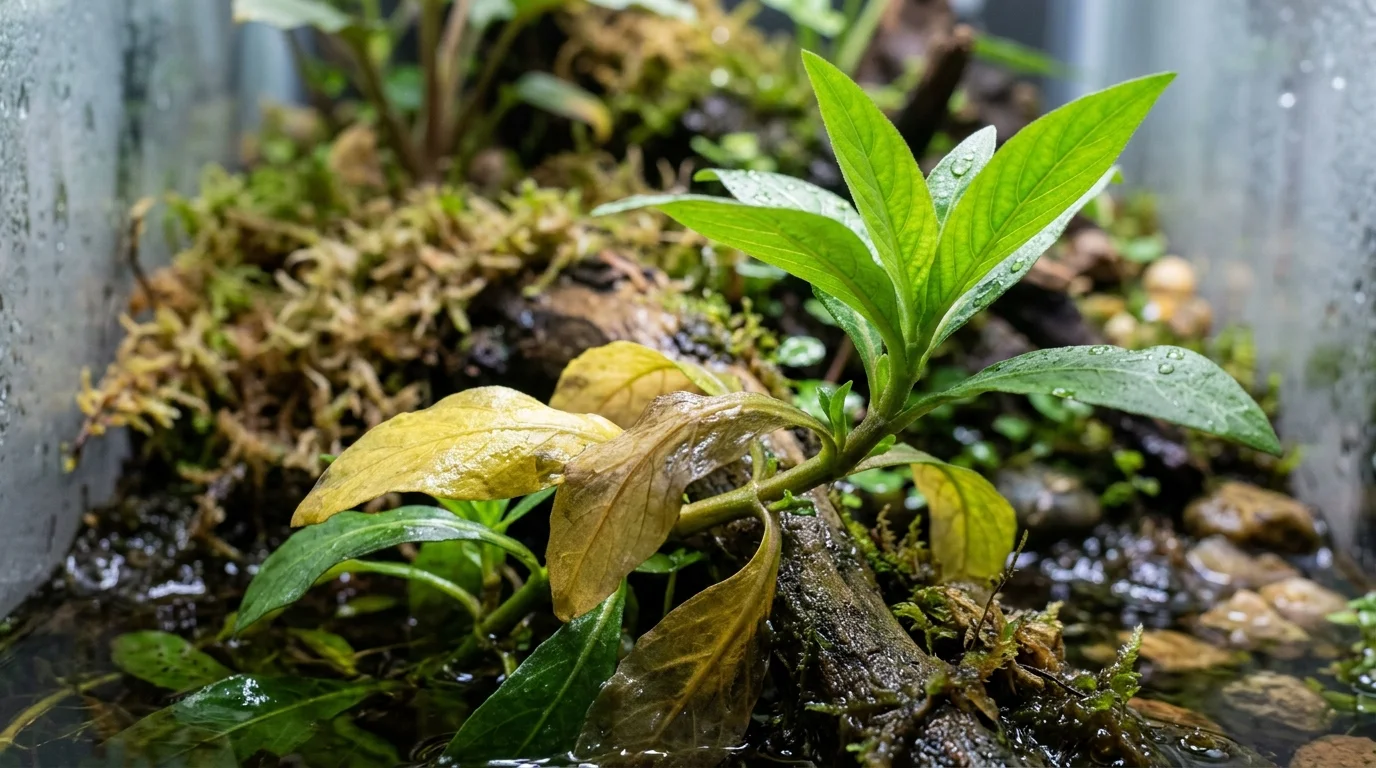
Paludarium plant melt is a symptom with multiple possible causes. Normal transition shock can cause old emersed or submerged leaves to deteriorate while firm roots, crowns, rhizomes, and new growth remain viable. Active soft rot, fungal blight, root-zone hypoxia, crown rot, parameter shock, ammonia spikes, severe nutrient or carbon limitation, and heat stress require different interventions. The core recovery process is to identify the pattern, remove clearly decomposed tissue, correct water and root-zone conditions, stabilize environmental parameters, and use gradual humidity acclimation where appropriate. Hydrogen peroxide should remain a cautious, localized adjunct rather than a substitute for sanitation and environmental correction.
Quick Answer
Paludarium plant melting can be normal transition shock, but rapid tissue collapse, foul odors, soft crowns, or deteriorating roots and rhizomes indicate a more serious problem. First separate normal leaf replacement from bacterial soft rot, fungal blight, and root-zone hypoxia. Then remove visibly rotted tissue, correct stagnant or waterlogged conditions, stabilize environmental parameters, and re-acclimate sensitive foliage gradually. For the physiological difference between emersed and submerged growth, see the emersed vs submerged plants guide. For general plant selection, use the paludarium plants guide.
Key Takeaways
- Do not treat every melting leaf as transition shock: firm roots, crowns, rhizomes, and active new growth can indicate adaptation, while soft, foul-smelling, rapidly collapsing tissue points toward decay.
- Remove rotted tissue promptly and correct the cause at the same time; cutting away decay without fixing stagnant water, poor drainage, heat, or parameter instability only delays recurrence.
- A waterlogged terrestrial substrate and a stagnant false bottom can both create root-zone hypoxia, so drainage, oxygen exchange, and actual water movement must be checked separately.
- Use gradual humidity re-tenting for dry-canopy stress, cautious 3% hydrogen peroxide treatment only as a targeted adjunct when appropriate, and the dedicated emersed vs submerged guide when transition physiology is the main issue.
What Does Plant Melting Mean in a Paludarium?
Plant melting describes rapid deterioration of leaves, stems, crowns, rhizomes, or other soft tissues. The tissue may become translucent, water-soaked, pale, brown, slimy, or structurally weak before breaking down. Melting is a symptom rather than a diagnosis.
The first diagnostic question is whether the plant is replacing foliage that was developed for a different environment or whether living tissue is actively decaying. A submerged plant moved into emersed growth can lose its old aquatic leaves while producing aerial foliage. An emersed plant moved underwater can similarly lose aerial leaves while producing submerged growth.
That transition response is different from bacterial soft rot, fungal disease, root-zone hypoxia, severe environmental stress, or crown and rhizome decay. The emersed vs submerged plants guide explains the physiological basis of leaf-form replacement. This page focuses on diagnosing active failure and recovering affected plants.
Normal Transition Shock vs Active Decay
| Observation | More Consistent With Transition | More Consistent With Decay or Severe Stress |
|---|---|---|
| Old leaves | Gradual yellowing, transparency, or melting after a change in growth environment | Rapid collapse of multiple leaves or newly produced tissue |
| New growth | New leaves or shoots continue developing | New growth also collapses or stops completely |
| Roots | Firm and structurally intact | Soft, mushy, darkening, or foul-smelling |
| Crown or rhizome | Firm despite loss of older foliage | Soft, slimy, hollow, or progressively disintegrating |
| Odor | Usually no abnormal decomposition odor | Foul or sulfurous odor can indicate stagnant, decomposing material |
| Rate of decline | Often follows the environmental transition | Can progress rapidly once soft rot or severe tissue damage is established |
When the plant is changing between emersed and submerged growth, avoid removing the entire specimen simply because older leaves deteriorate. Inspect the crown, rhizome, stem base, and roots first.
How to Recognize Bacterial Soft Rot
Bacterial soft rot can cause plant tissues to become water-soaked, translucent, soft, and rapidly decomposing. Genera such as Pectobacterium and Erwinia are associated with soft-rot diseases in plants. The exact organism cannot be reliably identified from appearance alone, so diagnosis should focus on the pattern of tissue breakdown and the environmental conditions supporting it.
Soft rot is especially concerning when a crown, rhizome, stem base, or marginal growth point becomes soft while deterioration progresses into adjacent tissue. Foul odor and a wet, collapsing texture strengthen the case for active decomposition rather than ordinary transition shock.
- Isolate or physically separate heavily affected plant material where practical.
- Remove soft, slimy, or clearly dead tissue using a clean cutting tool.
- Cut back to firm, structurally intact tissue rather than leaving visibly infected tissue attached.
- Clean and disinfect tools between affected plants.
- Correct stagnant water, excessive saturation, poor drainage, or persistent heat that may be maintaining favorable decay conditions.
Do not assume that a chemical treatment alone will stop soft rot. Removing damaged tissue and correcting the environment are the primary recovery steps.
What About Fungal Blight?
Fungal and fungus-like pathogens can produce leaf spots, expanding lesions, damping-off-like symptoms, or tissue collapse. Appearance alone is not enough to identify a particular pathogen, and a wet paludarium can also produce non-pathogenic tissue damage that resembles disease.
Persistent leaf wetness, poor airflow, damaged tissue, and overcrowding can increase the likelihood of disease problems. Keep affected leaves from remaining continuously wet when the plant is adapted to aerial growth, and remove heavily damaged foliage when it is no longer contributing to the plant.
Fungal blight should be considered especially when lesions expand across otherwise established aerial leaves without a corresponding change in water level or growth form. If the problem is confined to older submerged leaves during an emersed transition, normal morphological replacement remains a competing explanation.
Root-Zone Hypoxia: The Hidden Cause of Melt
Roots need oxygen for respiration. A terrestrial substrate that stays saturated without effective drainage can develop poorly oxygenated zones, while a false bottom containing stagnant water can create a separate low-oxygen reservoir around roots that reach into it.
These two problems can look similar from above but require different corrections. A terrestrial substrate may need improved drainage or reduced saturation. A false bottom may need functioning drainage pathways, access to the reservoir, and sufficient water movement or exchange where the system design requires it.
Waterlogged terrestrial substrate
Excess water ↓ pore air ↓ oxygen diffusion ↓ root respiration stress → root decline

Stagnant false bottom
Standing water + organic debris → oxygen depletion → anoxic dead zone → root/crown stress| Root-Zone Condition | Likely Risk | Diagnostic Check |
|---|---|---|
| Terrestrial substrate remains saturated | Root hypoxia and decay | Check drainage, pore structure, and persistent water level |
| False bottom contains stagnant water | Low-oxygen or anoxic zone | Inspect reservoir, drainage paths, and accumulated debris |
| Roots are above the intended water line | Drying or intermittent stress | Check actual moisture around the root zone |
| Water continuously pools around crown | Crown rot risk | Check marginal ledge geometry and splash pattern |
| Strong circulation but poor root drainage | Root-zone problem can persist despite visible water movement | Inspect substrate and false-bottom structure directly |
For pump placement, circulation, stagnant zones, and mechanical water movement, use the paludarium filter and pump guide. This troubleshooting page does not replace that mechanical design guidance.
Waterlogged Soil vs a Stagnant False Bottom
A false bottom is not automatically a biological filter. If water is merely stored beneath an elevated substrate without purposeful flow or oxygenation, it can become a stagnant reservoir. Likewise, a terrestrial substrate can remain hypoxic even when the visible aquatic zone has strong circulation.
- Identify exactly where the roots are located.
- Determine whether that zone is continuously submerged, intermittently flooded, or merely moist.
- Check whether excess water has a functioning path to drain or return.
- Inspect for accumulated organic debris and decomposing material.
- Look for roots entering stagnant reservoir water that was not intended to be part of the root zone.
- Correct the physical cause before adding further treatments.
Chemical and Environmental Triggers
Not all melt begins with pathogens. Sudden environmental changes can damage foliage or roots and create secondary opportunities for decay. The most useful diagnostic approach is to look for a recent change that coincides with the onset of symptoms.
| Trigger | Potential Plant Response | First Diagnostic Action |
|---|---|---|
| Large pH shift | Physiological stress, nutrient-availability changes, impaired growth | Compare current conditions with the established baseline and stabilize gradually |
| Large TDS change | Osmotic stress or sudden environmental shock | Review recent water changes, additives, and concentration changes |
| Ammonia spike | Stress to sensitive aquatic and marginal tissues | Test the water and identify the source of the spike |
| Severe nutrient starvation | Slow growth, chlorosis, weakened new tissue | Review available nutrients rather than adding concentrated fertilizer blindly |
| Severe carbon limitation | Reduced submerged growth and photosynthetic performance | Review dissolved-carbon conditions and water movement |
| Heat stress | Wilting, leaf damage, accelerated water loss, tissue stress | Check canopy and water temperatures and fixture heat load |
When water volume is changing through evaporation, splash, or water changes, maintaining a stable reserve can make parameter management easier. Use the paludarium water volume calculator for aquatic-zone volume and reserve calculations rather than estimating water stability from external tank dimensions alone.
pH and TDS Shock
Plants can acclimate to a range of chemical conditions, but abrupt changes can be more stressful than a stable value outside an idealized target. Large changes in pH or total dissolved solids can alter osmotic conditions and nutrient availability.
When a parameter shift is suspected, avoid repeatedly making large corrective changes unless an immediate safety problem requires intervention. Establish the current condition, identify what changed, and move the system toward a stable target progressively.
Ammonia Spikes and Aquatic Plant Melt
An ammonia spike can accompany a new or destabilized aquatic system, decomposing organic material, dead livestock, overfeeding, or filtration problems. Plant damage should therefore trigger a water-quality check when aquatic foliage deteriorates unexpectedly.
Do not interpret an ammonia reading in isolation. Determine whether the system has recently experienced a biological disturbance, dead material, a filter interruption, or another event that explains the change. Correct the source and restore stable biological processing.
Severe Nutrient or Carbon Starvation
Plants require mineral nutrients and carbon for sustained growth. Severe deficiency can weaken new growth and reduce recovery capacity, but nutrient deficiency should not be used as a catch-all explanation for translucent, foul-smelling, rapidly decomposing tissue.
Submerged plants can also experience carbon limitation when dissolved CO2 availability is low and the species has limited ability to use bicarbonate. Water movement can affect the boundary layer around submerged leaves, but it does not make every species capable of using bicarbonate.
Before adding concentrated fertilizer or carbon products, establish whether the observed symptom actually matches a deficiency and whether another stressor such as hypoxia, heat, or decay is present.
Heat Stress and Canopy Failure
High temperatures can increase metabolic demand and water loss while reducing the margin for plants already experiencing root or humidity stress. A strong light fixture positioned close to a sealed canopy can also create a hot microclimate even when the room itself feels comfortable.
Inspect the actual leaf-zone temperature rather than relying only on room temperature. The paludarium lighting guide covers PAR distribution, fixture elevation, optical losses, and the interaction between lighting and heat or evaporation.
Zone-Specific Failure: Dry Canopy Air
Plants that have recently moved into an emersed canopy can lose water faster than their existing leaves can tolerate when atmospheric humidity falls sharply. Leaf edges may dry, leaves may wilt, and older foliage may drop.
This pattern is different from a waterlogged crown. Dry-canopy stress is primarily a foliage water-balance problem, whereas crown rot is commonly associated with persistent wetness, poor oxygen availability, or damaged tissue at the plant base.
| Canopy Pattern | Likely Direction | Check |
|---|---|---|
| Leaf edges become dry and crisp | Atmospheric water-loss stress | Humidity, airflow, temperature, and root moisture |
| Whole leaves wilt but remain structurally intact | Water-balance or root-uptake stress | Root condition and substrate moisture |
| Leaves become translucent and slimy | Wet-tissue decay or transition melt | Growth form, tissue firmness, crown and root condition |
| Plant repeatedly dries after ventilation | Acclimation is incomplete | Reduce the rate of humidity change and reassess airflow |
Gradual Humidity Re-Tenting
If a newly emersed plant is losing water faster than it can replace it, a temporary humidity tent or clear dome can reduce atmospheric stress. The objective is acclimation, not permanent sealing.
- Place the plant in a stable, humid microclimate with appropriate light.
- Keep the root zone correctly moist without converting the substrate into a permanently saturated mass.
- Observe condensation and leaf wetness rather than maximizing humidity indefinitely.
- Begin short ventilation periods once the plant shows stable turgor and new aerial growth.
- Increase ventilation gradually while monitoring the newest leaves.
- Remove the tent when the plant can maintain new growth under the paludarium's normal canopy conditions.
Retenting does not cure root rot or crown rot. If the plant remains soft at the base or the roots are deteriorating, correct the root-zone problem instead.
Zone-Specific Failure: Waterlogged Marginal Crowns
Marginal plants often tolerate wet roots while keeping their crowns or growing points above water. A common failure occurs when splash, rising water, substrate settling, or poor ledge geometry keeps the crown continuously wet.
The result can resemble normal transition melt at first, but persistent crown softness is a major warning sign. Keep the growing point appropriately positioned and prevent uncontrolled water from pooling around sensitive tissue.
How to Sanitize and Remove Rotted Tissue
Physical removal is the first-line response when tissue is clearly dead or decomposing. Use a sharp, clean tool and work from visibly damaged tissue toward firm tissue. Do not drag a contaminated blade repeatedly through healthy tissue.
- Remove the plant from the wet environment when practical.
- Rinse away loose debris so the boundary between healthy and damaged tissue is visible.
- Cut away soft, slimy, translucent, or clearly decomposed tissue.
- Continue until the remaining tissue is firm and structurally intact.
- Discard heavily decomposed material rather than returning it to the system.
- Clean and disinfect the cutting tool before using it on another plant.
- Replant only after the environmental cause has been corrected.
For rhizomatous plants, preserving a firm healthy rhizome or crown is more important than preserving every leaf. Never bury a healthy rhizome simply to stabilize a plant if the species requires an exposed rhizome.
Should You Cut Away a Rotting Rhizome?
Yes, visibly soft and decomposing rhizome tissue should generally be removed rather than left attached to firm healthy tissue. The cut should be made back into tissue that is clearly firm and intact.
Do not remove a firm rhizome simply because leaves are melting. Leaf loss can occur during environmental transition while the rhizome remains viable. The distinction is tissue condition: soft, slimy rhizome tissue is different from firm rhizome tissue supporting declining leaves.
Using 3% Hydrogen Peroxide as a Targeted Adjunct
Hydrogen peroxide can damage plant tissue as well as unwanted organisms, so it should not be treated as a universal cure for plant melt. A 3% household solution is relatively concentrated for direct plant exposure and should be used cautiously, only as a targeted adjunct after visibly damaged tissue has been removed.
For a small isolated plant that tolerates treatment, a conservative approach is to apply 3% H2O2 briefly to the affected external area rather than soaking the entire plant. Keep exposure short, avoid sensitive growing points whenever possible, and rinse thoroughly with clean water afterward. If the species is known to be sensitive, skip the treatment rather than risking additional tissue damage.
- Do not use peroxide to compensate for poor drainage or stagnant water.
- Do not repeatedly soak healthy roots or crowns as a routine preventative treatment.
- Do not combine peroxide treatment with other oxidizing chemicals.
- Do not return heavily contaminated or decomposing plant material to the display.
- Test any treatment on a small area or expendable specimen when species sensitivity is uncertain.
The safest role for peroxide is limited and local: physical sanitation and environmental correction remain the core recovery strategy.
Hydrogen Peroxide Spot-Treatment Safety
| Situation | Recommended Approach | Reason |
|---|---|---|
| Small isolated surface lesion | Consider cautious localized treatment after tissue removal | Limits chemical exposure to healthy tissue |
| Large area of healthy foliage | Avoid blanket spraying or soaking | Oxidation can damage viable tissue |
| Soft crown or rhizome | Prioritize cutting away decay and correcting the environment | Peroxide cannot replace removal of decomposing tissue |
| Unknown sensitive species | Use a small test area or skip peroxide | Species tolerance varies |
| Repeated recurrence | Stop relying on chemical treatment and find the environmental cause | Recurring melt usually indicates an unresolved stressor |
Saving Newly Placed Moss
Newly placed moss can appear to melt after being moved between growing environments, especially when its previous humidity, moisture, light, and airflow differed substantially from the paludarium. Some browning or loss of old tissue can be transitional.
Do not immediately bury or flood the moss to compensate for dry-looking foliage. First determine whether the moss is receiving the correct moisture, humidity, light, and airflow for its intended zone. Remove slimy or decomposing sections and preserve clean, viable growth where possible.
If the moss was intended for an aquatic position, distinguish normal adaptation from persistent decay. If it was placed in an aerial splash zone, check whether repeated water impact is keeping the growth saturated while airflow remains too low.
Diagnosing a Foul-Smelling Substrate
A foul-smelling substrate is a warning to inspect the root zone rather than simply adding fresh water or fertilizer. Decomposition can consume oxygen and create reduced compounds associated with stagnant conditions.
- Check whether water is trapped below or inside the substrate.
- Inspect drainage pathways for blockage.
- Look for accumulated dead leaves, roots, or other organic debris.
- Inspect roots and crowns for soft or dark tissue.
- Determine whether a false-bottom reservoir is stagnant.
- Remove decomposing material and correct the water path.
- Reassess the plant after environmental conditions stabilize.
A foul smell alone does not identify a specific pathogen, but it is sufficient reason to investigate stagnant organic material and oxygen availability.
Recovery Decision Tree
Plant is melting
↓
Are only older leaves declining after a growth-form change?
↓
YES → Check firm roots/crown + new growth → continue gradual acclimation
NO ↓
Is tissue soft, slimy, foul-smelling, or rapidly collapsing?
↓
YES → Remove decay → inspect roots/crown → correct environment
NO ↓
Check pH/TDS/ammonia + light + temperature + humidity + nutrients/carbon
↓
Identify and correct the dominant stressor
↓
Monitor new growth rather than old damaged leaves
When to Replant After Tissue Removal
Replant a recovered specimen only after the physical conditions that caused the damage have been corrected. A clean cut placed back into the same stagnant, waterlogged, overheated, or unstable environment can result in renewed decay.
For terrestrial plants, provide the appropriate moisture level and functioning drainage. For marginal plants, keep sensitive crowns above persistent water exposure where required. For submerged plants, maintain suitable water quality and circulation without assuming that stronger flow alone will solve root-zone problems.
Preventing Repeat Melt
- Keep terrestrial substrates appropriately moist rather than continuously waterlogged.
- Ensure false-bottom drainage and access points remain functional.
- Prevent stagnant pockets around roots, crowns, and rhizomes.
- Keep decaying leaves and organic debris from accumulating in wet hidden areas.
- Make major pH and TDS changes gradually where practical.
- Investigate unexplained ammonia spikes immediately.
- Match light intensity and fixture position to the plant's actual growth zone.
- Control canopy heat and excessive evaporation.
- Use gradual humidity acclimation when changing growth form.
- Inspect newly planted specimens frequently during the establishment period.
Plant Melt Diagnostic Matrix
| Symptom | Primary Suspects | Immediate Focus |
|---|---|---|
| Old submerged leaves melt after emergence | Normal transition shock | Check crown, roots, and new aerial growth |
| Emersed leaves collapse after submergence | Growth-form transition | Check for new submerged growth |
| Soft foul-smelling crown | Bacterial soft rot or crown decay | Remove rotted tissue and correct persistent wetness |
| Soft dark roots | Root-zone hypoxia or decay | Inspect drainage, saturation, and stagnant reservoirs |
| Dry crisp canopy leaves | Low humidity, heat, or insufficient root uptake | Check humidity, temperature, roots, and airflow |
| Expanding leaf lesions | Possible fungal or pathogen-associated blight | Remove severely affected tissue and improve environmental conditions |
| Sudden aquatic decline after water change | Parameter shock or contamination | Check pH, TDS, ammonia, temperature, and recent inputs |
| Slow pale new growth | Nutrient or carbon limitation | Assess available nutrients, light, and dissolved-carbon conditions |
Final Paludarium Plant Recovery Checklist
- Identify whether the plant is undergoing a normal emersed/submerged transition.
- Inspect roots, rhizomes, crowns, and stem bases before removing the entire plant.
- Separate firm living tissue from soft or decomposing tissue.
- Remove clearly rotted tissue with clean tools.
- Inspect terrestrial drainage and false-bottom water movement.
- Check recent pH, TDS, ammonia, temperature, light, humidity, nutrient, and carbon changes.
- Correct the environmental cause before relying on chemical treatments.
- Use cautious localized 3% H2O2 treatment only as an optional adjunct when appropriate.
- Re-tent sensitive aerial plants gradually rather than maintaining a sealed dome indefinitely.
- Monitor new growth, crown condition, and roots as the primary recovery indicators.
For plant selection and zone placement, return to the paludarium plants guide. For the physiological mechanisms behind emersed and submerged leaf replacement, use the emersed vs submerged plants guide. For stagnant flow and mechanical circulation problems, see the paludarium filter and pump guide. For light-related stress and canopy heat, see the paludarium lighting guide. For aquatic-zone volume and dilution-buffer calculations, use the paludarium water volume calculator.
Frequently Asked Questions
How do I save a Cryptocoryne that is melting?
Do not immediately discard a melting Cryptocoryne. Remove badly decomposed leaves, keep the crown and roots stable, and check whether the plant recently changed water conditions or growth form. If the crown and roots remain firm, allow new growth to emerge under stable conditions. Soft or foul-smelling crown tissue requires removal of decay and correction of the root-zone environment.
Should I cut away a rotting rhizome on a paludarium plant?
Yes, visibly soft or decomposing rhizome tissue should generally be removed back to firm, intact tissue using a clean sharp tool. Do not cut healthy firm rhizome simply because older leaves are melting during a normal transition.
What should I do if my paludarium substrate smells foul?
Inspect for stagnant water, blocked drainage, decomposing organic material, and soft roots. Remove decomposing material, restore drainage or appropriate water movement, and correct persistent saturation. A foul odor is a reason to investigate the root zone rather than simply adding fertilizer or fresh water.
How can I save newly placed moss that is melting?
First determine whether the moss is adapting from a different humidity, moisture, light, or growth environment. Remove slimy or decomposing sections, keep viable growth appropriately moist, and provide stable humidity and airflow. Avoid permanently flooding or drying the moss just because older growth is declining.
Is 3% hydrogen peroxide safe for paludarium plants?
A 3% solution can damage plant tissue, so it should not be used as a routine whole-plant treatment. If used, keep it localized and brief, avoid sensitive growing points, rinse afterward, and treat it only as an adjunct after removing decay and correcting the environmental cause.
Explore More
Related Articles
Related Plant Guides
No specific plant guides found matching this topic.
Recommended next actions
Continue Exploring
Dive deeper into related plant care tools and profiles.
Topic Guide
Paludarium Plants: Choosing Plants for Land & Water Zones
Learn how to choose paludarium plants by land, emergent, humid, and aquatic zones, with guidance on light, moisture, growth, and maintenance.
Topic Guide
Emersed vs Submerged Plants in a Paludarium
A practical guide to the physiological and morphological differences between emersed and submerged aquatic plants, including cuticles, stomata, leaf structure, gas exchange, transition shock, and humidity acclimation.
Topic Guide
How to Convert an Aquarium into a Paludarium
A comprehensive guide to transitioning a standard aquarium into a dual-zone paludarium, with fish stocking, terrarium conversion, and maintenance advice.
Topic Guide
Water Quality for Houseplants
Compare tap, filtered, distilled, and rainwater for houseplants. Learn which water is best for sensitive plants and how to prevent mineral buildup.
Topic Guide
Humidity
Learn everything about humidity for your indoor and aquarium plants. Expert care tips, troubleshooting, and related guides.
Topic Guide
Misting
Learn everything about misting for your indoor and aquarium plants. Expert care tips, troubleshooting, and related guides.