Emersed vs Submerged Plants in a Paludarium
Emersed and submerged plant growth represent different physiological and morphological adaptations to air and water. Emersed leaves generally rely on cuticles and functional stomata to regulate water loss and atmospheric CO2 exchange, while submerged leaves often have modified surface structures and reduced stomatal function and instead exchange dissolved gases through the leaf surface. Water also provides buoyant mechanical support, allowing many submerged leaves to remain thinner and more flexible. During paludarium transitions, older leaves may melt as the plant replaces them with leaves suited to the new environment. Stable roots, appropriate light, gradual humidity acclimation, and careful monitoring of crown and root condition help distinguish normal transition from plant failure.
Quick Answer
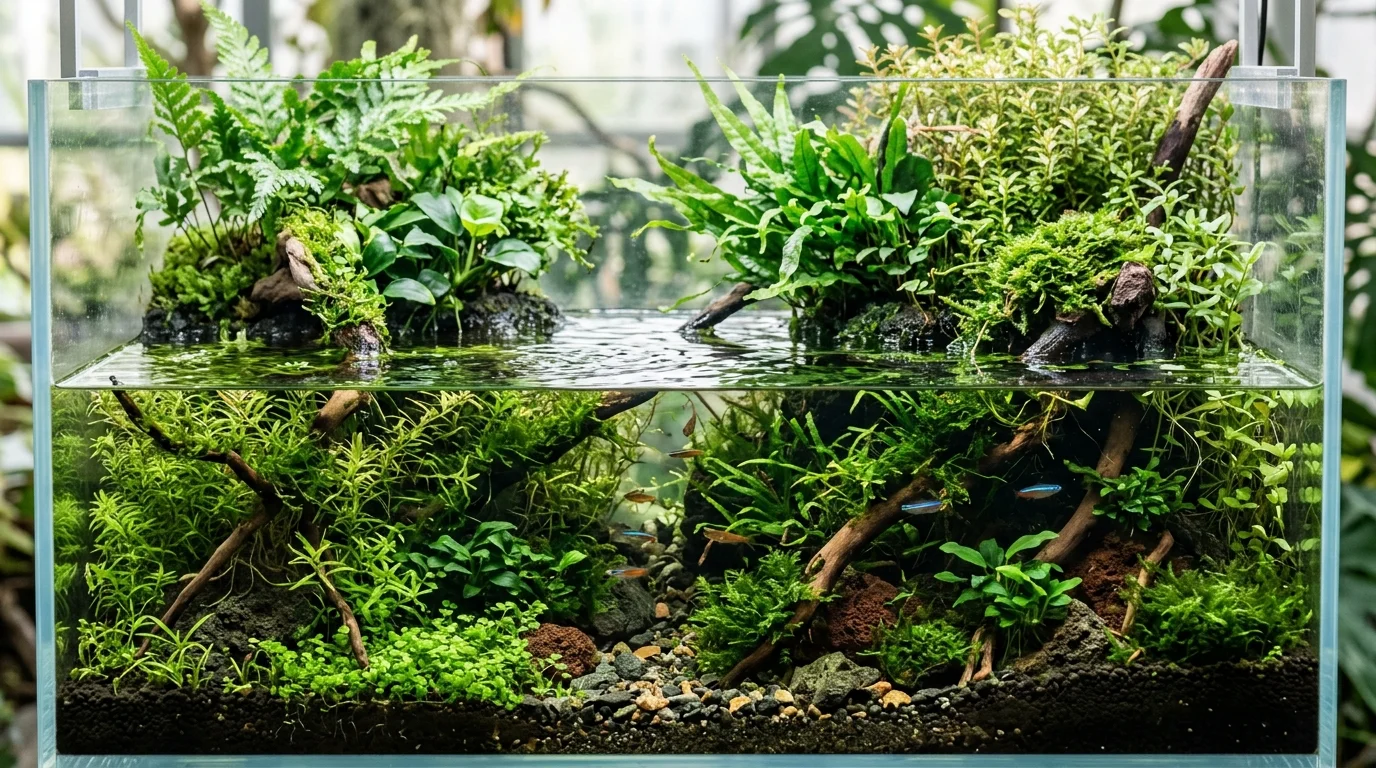
Emersed and submerged plants can be the same species but develop different functional leaves and tissues because air and water impose different constraints on gas exchange, water retention, mechanical support, and light capture. Emersed leaves generally develop stronger cuticles and functional stomata for atmospheric gas exchange, while submerged leaves rely on dissolved carbon and the surrounding water for gas exchange and receive mechanical support from buoyancy. When a plant changes form, older leaves may melt or deteriorate while new leaves develop for the new environment. In a paludarium, gradual humidity acclimation and stable light, water, and root conditions can reduce transition shock. For general plant selection, see the paludarium plants guide, and for transition failures or root rot, see paludarium plants melting.
Key Takeaways
- Emersed leaves are adapted to air: stronger cuticles, functional stomata, greater structural support, and gas exchange with atmospheric CO2.
- Submerged leaves operate in water: thinner or differently structured surfaces, reduced reliance on functional stomata, and greater dependence on dissolved CO2 and bicarbonate availability.
- Transition shock is often a leaf-form replacement process rather than proof that the entire plant is dying; stable roots, appropriate light, and gradual humidity changes help the plant produce its next adapted growth form.
- If leaves repeatedly melt, stems collapse, or roots become soft and dark, move from transition guidance to the dedicated paludarium plants melting guide rather than treating every failure as normal acclimation.
What Is the Difference Between Emersed and Submerged Plants?
Emersed growth means a plant's leaves and shoots develop in contact with air while the roots may remain in water or saturated substrate. Submerged growth means the foliage develops beneath the water surface. The same aquatic or marginal species can therefore produce noticeably different leaves depending on whether its tissues develop in air or underwater.
The difference is not simply whether a leaf is wet or dry. Development in air changes how a plant controls water loss, exchanges gases, supports its tissues, captures light, and transports water and nutrients. Development underwater changes those constraints because surrounding water provides mechanical support and creates a very different pathway for carbon dioxide and oxygen movement.
In a paludarium, these differences matter most when plants are moved between aquatic and terrestrial zones or when newly purchased plants were grown in one form and introduced into another. A plant can remain alive while its existing leaves become poorly adapted to the new environment and are replaced by new growth.
For general species selection and placement across terrestrial, transition, and aquatic zones, use the paludarium plants guide. This page focuses specifically on what happens physiologically when growth form changes.
Emersed vs Submerged Growth at a Glance
| Trait | Emersed Growth | Submerged Growth |
|---|---|---|
| Leaf environment | Air | Water |
| Cuticle | Usually more developed to reduce water loss | Often thinner or less restrictive because surrounding water reduces direct desiccation risk |
| Stomata | Typically functional and important for gas exchange | Often reduced, absent, or functionally limited in submerged leaves |
| CO2 source | Atmospheric CO2 | Dissolved CO2 and, for some species, bicarbonate-derived carbon |
| Mechanical support | Structural tissues carry more of the load | Buoyancy provides substantial support |
| Leaf shape | Often thicker, firmer, and adapted to air | Often thinner, softer, narrower, divided, or otherwise adapted to water |
| Gas movement | Primarily through atmospheric boundary layers and stomata | Limited by slower diffusion through water and leaf boundary layers |
| Transition response | May shed submerged-form leaves after emergence | May melt or replace emersed-form leaves after submergence |
How the Cuticle Changes Between Emersed and Submerged Leaves
The cuticle is a hydrophobic layer covering the outer surface of most terrestrial and emersed aerial leaves. One of its major functions is limiting uncontrolled water loss from the leaf surface. An emersed leaf exposed to moving or relatively dry air can lose water rapidly, so cuticle development becomes an important part of aerial adaptation.
Submerged leaves face a different problem. The surrounding water greatly reduces the gradient driving direct evaporation from the leaf surface. A thick terrestrial-style cuticle can also interfere with movement of gases and dissolved substances between the leaf and surrounding water. Consequently, submerged leaves of many aquatic plants develop thinner or otherwise modified surface barriers.
This does not mean that every submerged leaf lacks a cuticle or that every emersed leaf has the same thickness. Cuticle structure varies by species, age, light environment, humidity, and developmental history. The useful distinction is functional: emersed leaves must strongly regulate water loss to air, while submerged leaves operate in a medium where evaporation is not the primary surface-water problem.
What Happens to Stomata Underwater?
Stomata are microscopic pores that regulate gas exchange between internal leaf tissues and the atmosphere. In an emersed leaf, stomata can open and close to balance carbon dioxide uptake against water loss. This regulation is central to aerial photosynthesis.
Once a leaf develops underwater, conventional stomatal gas exchange becomes much less useful because the leaf is no longer exchanging gases with a free atmospheric surface. In many aquatic species, submerged leaves therefore have fewer stomata, poorly functioning stomata, or no functional stomata on the submerged surface.
Submerged carbon acquisition instead depends heavily on diffusion of dissolved inorganic carbon through the water surrounding the leaf. Depending on species and water chemistry, this carbon can include dissolved CO2 and bicarbonate-derived carbon. The ability to use bicarbonate is species-specific and should not be assumed for every aquatic plant.
Atmospheric CO2 vs Dissolved CO2 and Bicarbonate
Atmospheric CO2 is readily available around an emersed leaf because air provides rapid gas movement compared with water. A stomatal pore can regulate entry of CO2 into the leaf while controlling water loss.
Underwater, CO2 must first exist in dissolved form and then move through the water boundary layer to the photosynthetic tissues. Diffusion in water is substantially slower than diffusion in air. The effective carbon supply can therefore depend on water movement, boundary-layer thickness, pH, temperature, dissolved inorganic carbon concentration, and the species' carbon-acquisition mechanisms.
Bicarbonate (HCO3-) is an important component of dissolved inorganic carbon in many natural and aquarium systems. Some aquatic plants have biochemical or surface adaptations that allow them to use bicarbonate as a carbon source. Others depend more strongly on dissolved CO2. A general statement that all aquatic plants can use bicarbonate is therefore incorrect.
Emersed leaf:
Atmospheric CO2 → stomatal pore → internal leaf air spaces → photosynthetic tissue

Submerged leaf:
Dissolved CO2 / usable HCO3- → water boundary layer → leaf surface → photosynthetic tissue
Water movement can reduce the thickness of the boundary layer around submerged leaves, potentially improving exchange. This is one reason circulation and local flow can influence submerged plant performance without changing the plant's basic physiology.
Lignin, Turgor, and Mechanical Support
Plants growing in air cannot rely on buoyancy to hold leaves and stems upright. Emersed tissues therefore need sufficient structural reinforcement and internal water pressure to maintain form. Cell-wall strengthening, including lignified tissues in many mature supporting structures, can contribute to rigidity.
Submerged foliage receives physical support from the surrounding water. A leaf that would need to remain rigid in air can be thinner or more flexible underwater because buoyancy reduces the gravitational load on the tissue. Internal turgor pressure still contributes to cell shape and firmness, but it operates alongside external mechanical support from water.
This is why a submerged leaf can appear delicate or floppy when removed from water. Its appearance outside the water does not necessarily indicate that the tissue was unhealthy while submerged; it was developed for a different mechanical environment.
| Structural Factor | Emersed Growth | Submerged Growth |
|---|---|---|
| Buoyancy | Unavailable as structural support | Provides external support |
| Turgor pressure | Important for maintaining leaf firmness | Important but supplemented by water support |
| Cell-wall reinforcement | Often more important for aerial rigidity | Can be reduced in flexible aquatic foliage |
| Lignified support tissues | Useful for stems and persistent aerial structures | Species-dependent and often less dominant in delicate submerged leaves |
Why Do Leaf Shape and Texture Change?
Leaf shape is a developmental response, not merely a cosmetic difference. Aerial and submerged leaves experience different requirements for gas diffusion, water retention, structural support, light interception, and boundary-layer movement.
Submerged leaves may become thinner, more flexible, narrower, ribbon-like, finely divided, or otherwise shaped to increase effective exchange with surrounding water. Emersed leaves may become thicker, firmer, broader, and more protective against water loss.
The direction and magnitude of change are species-specific. Some plants show dramatic heterophylly, where aquatic and aerial leaves look substantially different. Others retain similar shapes but change thickness, surface properties, petiole structure, or tissue organization.
Why Can Leaf Color Change During Transition?
Leaf color can change as a plant moves between growth environments because chloroplast development, pigment concentration, leaf thickness, light exposure, and tissue age can all change. A submerged leaf and a newly produced emersed leaf may therefore have different shades of green even when they belong to the same plant.
Light also changes with depth. Water, suspended particles, dissolved compounds, surface agitation, and shading can reduce or alter the light reaching submerged foliage. In a paludarium, compare the actual light environment of each zone rather than assuming that one fixture produces the same usable intensity everywhere. The paludarium lighting guide covers PAR differences between terrestrial and submerged zones.
What Is Transition Shock?
Transition shock occurs when a plant must adjust from one developmental environment to another. The existing leaves were built under the previous conditions and may not function efficiently after the environmental change.
For example, an aquatic plant moved from submerged growth to an emersed shelf may lose older submerged leaves while producing thicker aerial leaves. Conversely, a plant grown emersed and then submerged may lose its aerial leaves while producing a submerged form.
A temporary loss of older leaves can therefore be part of normal morphological transition. The more important question is whether the plant is maintaining viable stems, crowns, rhizomes, or roots and producing appropriately adapted new growth.
| Observation After Transition | Possible Interpretation | What to Check |
|---|---|---|
| Older leaves yellow or melt while new growth appears | Possible normal form replacement | Roots, crown, stem base, and new growth |
| Leaves remain firm but new growth is slow | Acclimation or environmental limitation | Light, temperature, humidity, nutrients, and water conditions |
| New leaves emerge but old submerged leaves deteriorate | Common during aquatic-to-aerial transition | Whether aerial growth is expanding normally |
| Stem base becomes soft or foul-smelling | Possible tissue or root-zone failure | Drainage, oxygen availability, substrate saturation, and root condition |
If transition problems progress to widespread melting, collapsing tissue, or root deterioration, use the paludarium plants melting guide rather than assuming that continued leaf loss is normal transition shock.
How Humidity Acclimation Tents and Domes Work
A humidity tent or clear acclimation dome can reduce the immediate atmospheric water-loss demand placed on newly emersed foliage. This can be useful when a plant has developed underwater or in very humid conditions and is suddenly exposed to drier air.
The principle is simple: high relative humidity reduces the vapor-pressure gradient between moist internal leaf tissues and the surrounding air. Lower transpiration demand can give the plant more time to develop aerial cuticles, functional stomata, stronger supporting tissues, and other adaptations required for sustained emersed growth.
A dome should not be treated as a permanent high-humidity enclosure by default. As new aerial growth develops, gradual ventilation can help the plant adapt to the final paludarium atmosphere. Condensation should also be monitored because continuously wet foliage and stagnant air can create conditions favorable to fungal or bacterial problems.
- Start with high humidity when the plant is highly sensitive to rapid atmospheric drying.
- Provide appropriate light without creating excessive heat inside the enclosure.
- Keep the root zone stable and avoid confusing high humidity with waterlogged substrate.
- Open or vent the dome progressively as new aerial growth develops.
- Increase air exchange while watching for persistent wilting, leaf-edge damage, or excessive condensation.
- Continue acclimation until the plant can maintain new leaves under the paludarium's normal humidity rather than relying on a sealed microclimate.
Humidity Is Not the Same as Water Availability
A plant can experience high atmospheric humidity while its roots remain poorly oxygenated or excessively saturated. Conversely, a plant can have adequate root moisture but lose water rapidly from leaves when surrounding air is dry.
For transition management, separate three conditions: atmospheric humidity around the foliage, water availability at the roots, and oxygen availability in the root zone. A humidity dome addresses primarily the first. It does not repair damaged roots, stagnant substrate, blocked drainage, or an unsuitable water level.
How Splash and Waterfall Zones Affect Emersed Foliage
Plants positioned close to a waterfall or splash zone can experience much higher surface wetting and humidity than plants elsewhere in the terrestrial zone. This can be useful for species adapted to consistently humid conditions, but repeated mechanical splash can also keep leaves wet for long periods and increase local moisture stress if airflow is poor.
The paludarium waterfall guide covers splash control, water-path design, acoustic dampening, and service access. Use that guide for the physical water feature rather than changing plant physiology into a waterfall-construction topic.
How to Manage an Emersed-to-Submerged Transition
- Identify which part of the plant is changing environment: leaf, stem, crown, rhizome, or root system.
- Determine whether the existing foliage was developed emersed or submerged.
- Expect some old foliage to decline if its structure is poorly suited to the new environment.
- Keep the root or rhizome zone stable rather than repeatedly changing water level.
- Match lighting to the new growth zone and avoid assuming that the same PAR reaches foliage above and below the waterline.
- For aerial acclimation, use a humidity tent or dome when appropriate, then increase ventilation progressively.
- Watch new growth for evidence that the plant is producing a form suited to the new environment.
- If the crown, stem base, or roots deteriorate rather than simply replacing old leaves, investigate the problem as a plant-melting or root-zone issue.
How to Manage a Submerged-to-Emersed Transition
- Move the plant into a consistently humid terrestrial or marginal position rather than exposing it immediately to dry air.
- Keep the root zone moist according to the species while preserving adequate oxygen and drainage.
- Use a transparent acclimation dome when rapid moisture loss is likely.
- Provide stable light and avoid placing the plant directly under a high-intensity fixture until its aerial growth is established.
- Vent the enclosure progressively as new emersed leaves develop.
- Do not judge the transition solely by the condition of old submerged leaves.
- Evaluate the new growth, root condition, and crown health together.
How to Tell Normal Transition From a Failing Plant
| Pattern | More Consistent With Transition | More Concerning for Failure |
|---|---|---|
| Old leaves | Gradual yellowing, transparency, or melting after environmental change | Rapid widespread collapse across new and old growth |
| New growth | New leaves or shoots continue developing | No viable new growth and progressive crown decline |
| Roots/rhizomes | Firm and structurally intact | Soft, mushy, darkening, or foul-smelling tissue |
| Stem base | Firm | Softening or collapse |
| Humidity response | Plant stabilizes as humidity is moderated gradually | Persistent decline despite appropriate humidity and root conditions |
Transition is a developmental process, while root rot and tissue collapse are failures of plant health. They can occur together, but they should not be treated as interchangeable explanations.
Practical Emersed vs Submerged Transition Checklist
- Confirm whether the existing leaves were developed emersed or submerged.
- Check the crown, stem base, rhizome, and roots before discarding a plant because of leaf loss.
- Maintain stable root-zone moisture and oxygen availability.
- Use gradual humidity acclimation for sensitive aerial transitions.
- Vent humidity domes progressively rather than removing them abruptly.
- Match light to the actual terrestrial or submerged position.
- Expect species-specific differences in leaf shape, thickness, and color.
- Use the paludarium plants guide for general species and placement decisions.
- Use the paludarium plants melting guide when leaf loss is accompanied by crown, stem, or root deterioration.
Emersed vs Submerged Plant Reference Framework
| Question | Emersed Growth | Submerged Growth |
|---|---|---|
| Where is the leaf adapted to function? | Atmosphere | Water column |
| Primary water-loss challenge | Transpiration to air | Much lower direct evaporative loss |
| Primary carbon environment | Atmospheric CO2 | Dissolved inorganic carbon |
| Stomatal role | Central to regulated atmospheric gas exchange | Often reduced or functionally limited |
| Mechanical environment | Gravity and air movement | Buoyancy and water movement |
| Typical adaptation during transition | More aerialized leaf structure | More aquatic leaf structure |
Final Takeaway
Emersed and submerged growth are two different developmental solutions to two different physical environments. The major changes involve water-loss control through the cuticle and stomata, mechanical support through cell structure and buoyancy, carbon acquisition through atmospheric or dissolved inorganic carbon, and leaf morphology suited to air or water.
In a paludarium, transition success is best judged by the plant's new growth and the condition of its roots, crown, stems, or rhizome rather than by the appearance of every old leaf. Stable environmental conditions, appropriate light, gradual humidity acclimation, and good root-zone oxygenation provide the foundation for that transition.
Frequently Asked Questions
Why do submerged plants melt when moved into emersed growth?
Submerged leaves are developed for underwater conditions and may lack the cuticle, stomatal function, structural reinforcement, and gas-exchange characteristics needed in air. Those leaves can deteriorate while the plant produces new aerial leaves adapted to the paludarium's terrestrial conditions.
How do I stop a paludarium plant from getting transition shock?
Reduce abrupt environmental changes, keep the root zone stable, provide appropriate light, and use gradual humidity acclimation when moving a plant into emersed growth. A humidity tent or dome can temporarily reduce water-loss stress, but it should be vented progressively as new aerial growth develops.
Do submerged plants have stomata?
Some aquatic plants have stomata on leaves that develop above water, while submerged leaves often have reduced, nonfunctional, or absent stomata. Underwater gas exchange relies more heavily on diffusion of dissolved gases through the leaf surface.
Can aquatic plants use bicarbonate instead of CO2?
Some aquatic plant species can use bicarbonate as a carbon source, while others depend more strongly on dissolved CO2. Bicarbonate use is species-specific and should not be assumed for every submerged plant.
How can I tell normal plant transition from root rot?
Normal transition can involve older leaves melting while the crown, stems, rhizomes, or roots remain firm and new growth develops. Soft, mushy, darkening, foul-smelling roots or crown tissue, progressive stem collapse, and failure of new growth are more concerning signs of root-zone or tissue failure. Use the paludarium plants melting guide when those symptoms appear.
Explore More
Related Articles
Related Plant Guides
No specific plant guides found matching this topic.
Recommended next actions
Continue Exploring
Dive deeper into related plant care tools and profiles.
Topic Guide
What Is a Paludarium? Design, Anatomy, and Ecosystem Setup
Learn what a paludarium is, how land and water zones work together, and how to plan drainage, circulation, substrate, planting, and maintenance.
Topic Guide
Paludarium Plants: Choosing Plants for Land & Water Zones
Learn how to choose paludarium plants by land, emergent, humid, and aquatic zones, with guidance on light, moisture, growth, and maintenance.
Topic Guide
How to Convert an Aquarium into a Paludarium
A comprehensive guide to transitioning a standard aquarium into a dual-zone paludarium, with fish stocking, terrarium conversion, and maintenance advice.
Topic Guide
Paludarium Plants Melting: Causes, Diagnosis & Recovery
A troubleshooting guide for diagnosing and stopping plant melt, tissue lysis, soft rot, root decay, rhizome damage, and environmental stress in terrestrial, marginal, and submerged paludarium zones.
Topic Guide
Water Quality for Houseplants
Compare tap, filtered, distilled, and rainwater for houseplants. Learn which water is best for sensitive plants and how to prevent mineral buildup.
Topic Guide
Paludarium Lighting Guide
A practical engineering guide to paludarium lighting covering plant-level PAR targets, terrestrial and submerged gradients, photoperiod, spectrum, fixture elevation, optical losses, heat and evaporation.