Cubaris sp. 'Rubber Ducky' Isopod Care & Enclosure Guide
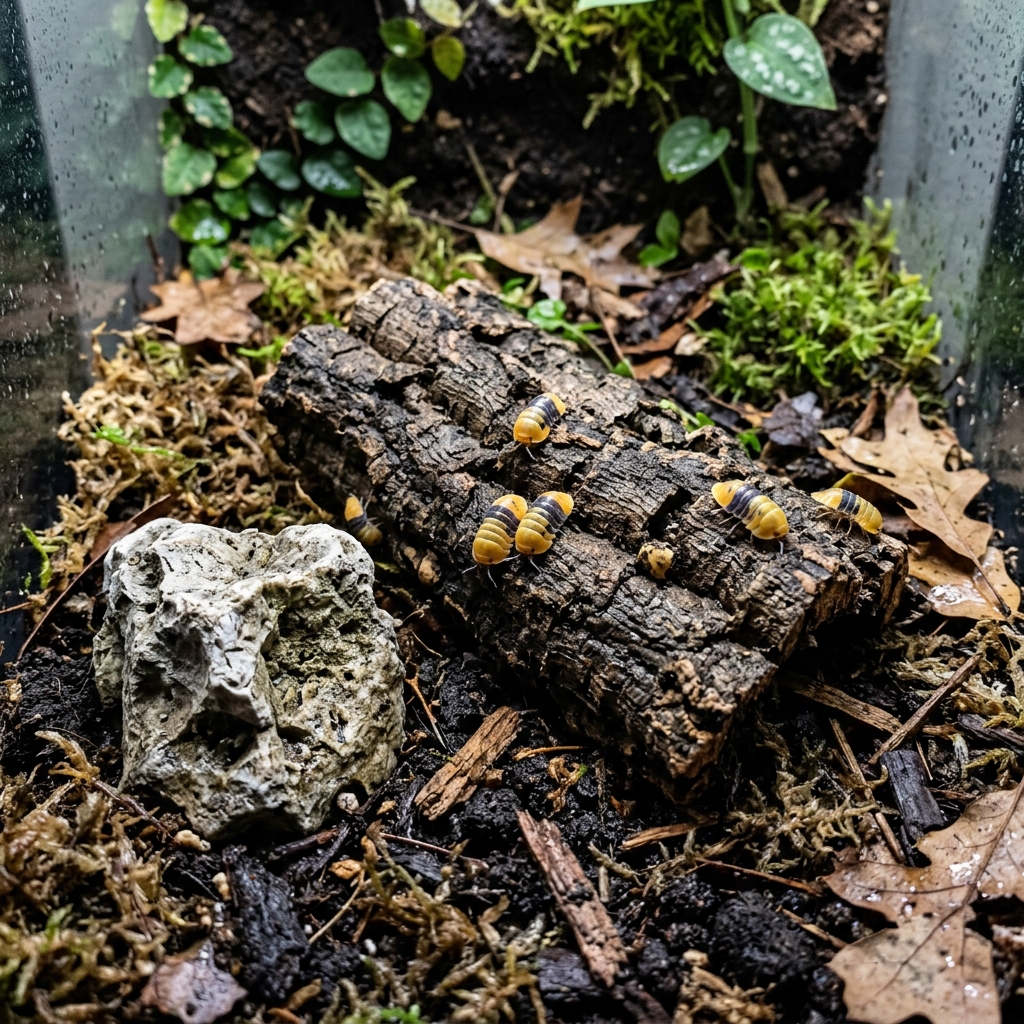
Cubaris sp. 'Rubber Ducky' is a tropical, conglobating isopod of the family Armadillidae. It is an undescribed species in the trade, widely reported to come from limestone (karst) regions of Thailand, with Kanchanaburi often cited. Compared with drier-tolerant Armadillidium, it needs warmer, steadier humidity, deeper substrate for burrowing and a constant calcium source to calcify its exoskeleton after each molt. This guide covers origin, the limestone requirement, environmental parameters with critical thresholds, enclosure and substrate depth, diet, slow breeding, handling and troubleshooting. Use it with the general isopod terrarium setup and substrate recipe guides to build a stable, long-lived colony.
Quick Answer
Keep Cubaris sp. 'Rubber Ducky' isopods at 22-26 °C (72-78 °F) in 8-10 cm of deep, organic-rich substrate with a stable, humid burrow zone of 80-90% and a slightly drier surface layer. Give them permanent calcium (limestone chunks, powdered limestone or crushed oyster shell), soft decayed white-rot wood, hardwood leaf litter and occasional protein. Avoid temperatures above 28 °C (82 °F), and leave the colony undisturbed, because they breed slowly and spend long periods underground.
Key Takeaways
- Provide a permanent calcium source: limestone chunks in the enclosure plus powdered limestone or crushed oyster shell mixed into the substrate, because calcification after molting depends on it.
- Hold the burrow zone at a stable 80-90% humidity and 22-26 °C (72-78 °F), and treat anything above 28 °C (82 °F) as a danger zone.
- Use at least 8-10 cm (3-4 in) of substrate so the isopods can burrow and choose their own moisture and temperature layer; do not dig them up when they disappear for weeks.
- Feed a staple of soft, decayed white-rot hardwood and aged oak or magnolia leaf litter, with small amounts of protein (freeze-dried shrimp, spirulina, yeast flakes) one to two times a week.
- Expect slow growth and small clutches; leave the colony undisturbed, avoid handling, and add springtails as the cleanup crew rather than competing isopod species.
What Is the Rubber Ducky Isopod?
Cubaris sp. 'Rubber Ducky' is a small tropical isopod in the family Armadillidae, prized for its yellow-orange markings on a glossy dark body and its ability to roll into a tight ball (conglobation). The name refers to a trade or hobby designation: it is an undescribed species, so the 'sp.' and the quoted common name are used until a formal description is published. In the hobby it is widely reported to come from the limestone (karst) regions of Thailand, with the Kanchanaburi area often cited. Because exact collection details are rarely documented, treat the origin as trade-reported. Karst habitats offer a clue to its needs: cool, humid, stable caves and crevices with abundant calcium. If you are new to isopods, read the general isopod terrarium setup guide first, and then use this guide to adjust the parameters for this species.
Why Limestone Is Non-Negotiable
Isopods shed their exoskeleton in two halves, and they must rebuild a hard, calcified shell afterwards. A large part of that shell is calcium carbonate, which they absorb from food, from their own reabsorbed old cuticle and from the substrate. A karst habitat is rich in calcium carbonate, so Rubber Duckies in captivity depend on a constant supply. Without it, expect soft or deformed shells, stuck molts, poor breeding and unexplained deaths.
- Limestone chunks: place two or three small pieces of untreated limestone on the substrate surface and partially buried, so the isopods can graze and shelter on them.
- Powdered limestone (calcium carbonate): mix a modest amount into the substrate; a common starting point is about 1-2% of the dry substrate volume, adjusted by feel. Use pure, additive-free ground limestone, not quicklime or hydrated lime, which are caustic.
- Crushed oyster shell or cuttlebone: useful secondary sources, particularly in a feeding dish, but they should supplement rather than replace limestone in the substrate.
- Sourcing: choose rocks sold for aquaria or terraria, or clean quarry limestone; avoid anything treated, dyed or exposed to fertilizers and chemicals. Rinse with plain water.
For the full substrate build and how calcium fits into the mix, see the isopod substrate recipe.
Environmental Parameters
The first table above gives the ideal ranges, critical thresholds and monitoring methods. The key numbers are:
- Humidity: aim for a stable 80-90% RH in the burrow zone. Unlike semi-arid or temperate Armadillidium, Rubber Duckies suffer when the substrate dries out repeatedly. They still need a gradient, so keep a damp end packed with long-fibre sphagnum, a slightly drier surface and fine-mesh ventilation, as described in the terrarium setup guide. A wet zone covering roughly 30-40% of the floor works well for this species.
- Temperature: 22-26 °C (72-78 °F) is ideal. They are sensitive to heat; above 28 °C (82 °F) they become stressed, and they may stop breeding or die. Do not place a heat source under the substrate. A low-wattage heat mat on one side wall with a thermostat is safer. Cooler rooms below about 20 °C (68 °F) slow activity and breeding.
- Substrate depth: provide 8-10 cm (3-4 in) or more, so they can burrow and select the temperature and moisture they need. Use the isopod substrate calculator to convert your enclosure dimensions into the volume of mix required.
- Ventilation: modest but not absent. Use fine mesh over small vents with low intake on the moist side and a small exhaust on the dry side, so that stale air leaves without drying out the enclosure.
Enclosure and Substrate Build
Use a footprint of at least 30 × 20 cm (12 × 8 in) for a starter colony, with a lid and mesh vents. Fill with 8-10 cm of a moisture-retentive, organic-rich mix of sifted topsoil or coir, decomposed hardwood, leaf litter, and powdered limestone. Compress lightly, so that tunnels do not collapse. Add cork bark rounds over the damp end, white-rot wood chunks half-buried in the middle, and limestone chunks on the surface, then top with 2-3 cm of aged leaf litter. Moisten the wet end rather than the entire surface. Let the setup settle for 24-48 hours before adding the animals.
Diet and Feeding
Rubber Duckies are detritivores that feed mostly on decaying wood and leaves. The feeding table above lists each food, how often to offer it and why. In practice:
- Keep the staples always present. Soft, decayed white-rot hardwood and aged oak or magnolia leaves should never run out.
- Maintain calcium at all times. Limestone and powdered limestone are available continuously.
- Offer protein sparingly. A pinch of freeze-dried shrimp, spirulina or yeast flakes once or twice a week on a flat piece of bark is enough.
- Remove leftovers. Take out uneaten protein or vegetables within 24-48 hours, because in a humid enclosure they mold and attract mites and gnats.
Burrowing Behaviour: Why They Disappear
Rubber Duckies are shy, subterranean animals. After being introduced to a new enclosure, or after a molt, they may disappear for days or even weeks. This is normal: they are burrowing to a stable layer to molt and to avoid light, heat and disturbance. Resist the urge to dig them up. A healthy colony shows activity at night or under bark, fresh frass, and chewed leaves and wood. If you are worried, lift a cork bark piece gently rather than disturbing the substrate, and check moisture and temperature, which are far more likely causes of trouble than the animals simply being hidden.
Slow Breeding and Colony Growth
This species is a slow breeder. Hobbyists report small clutches, a gestation period of roughly 1-2 months (in the marsupium, shortened by warmth), and slow maturation over many months. Large numbers will not appear quickly. To support breeding:
- Start with at least 10-20 adults to keep genetic diversity and social activity.
- Keep temperature and humidity stable within the ideal range.
- Maintain calcium and protein, which breeding females use heavily.
- Avoid disturbing the enclosure: do not rearrange the decor, dig through the substrate or constantly remove animals for counting.
- Do not overcrowd; slow growth means a dense colony can run short of food and cover.
Handling Sensitivity
Handle them as little as possible. Dry, warm hands cause dehydration and stress, and rough handling can injure freshly molted animals, whose shells are still soft. If you must move one, use a soft brush or a damp spoon, avoid squeezing, and never handle animals that are pale and freshly molted. Wash your hands before and after handling, and avoid lotions, sanitizers and insect repellents.
Cleanup Crew and Tankmates
Springtails are the best companions. They graze on mold and fungal film, and they compete little with isopods. They do need a damp surface, which suits the humidity needs of this species. Learn how to culture them in the springtail culturing guide, and how to balance populations in the bioactive cleanup crew guide. Avoid adding other isopod species: they have different humidity needs and may outcompete the slower Rubber Duckies, or in some cases interbreed.
Troubleshooting Summary
| Symptom | Likely cause | Quick fix |
|---|---|---|
| Soft, pale or deformed shells; stuck molts | Low calcium or low humidity | Add limestone chunks and powdered limestone; raise humidity in the burrow zone |
| No animals visible for weeks | Normal burrowing or molting | Check parameters; do not dig; look under bark at night |
| Animals climbing the walls or lid | Too dry, too hot or too wet | Check temperature and moisture; re-wet the damp end; add bark |
| Mold on food | Overfeeding or fresh produce | Remove it, reduce portions and add springtails |
| No juveniles after many months | Cool, dry, low-protein or disturbed setup | Stabilize parameters, add protein, avoid disturbance |
Related Resources
Start with the isopod terrarium setup guide, mix the right medium with the isopod substrate recipe, scale volumes with the isopod substrate calculator, culture companions with the springtail guide and balance the ecosystem using the cleanup crew balance guide.
Frequently Asked Questions
Do Rubber Ducky isopods really need limestone, or is cuttlebone enough?
Cuttlebone is a useful supplement, but limestone is the better primary source for this species. Limestone chunks last for months, double as hides and grazing surfaces, and powdered limestone in the substrate supplies calcium continuously. Cuttlebone and crushed oyster shell are good additions in a feeding dish. The key is that calcium is always available, not just offered occasionally.
Why did my Rubber Ducky isopods disappear for weeks?
They are burrowing animals. After introduction, after a disturbance or before molting, they go deep into the substrate, particularly if it is at least 8-10 cm deep. This is normal and usually temporary. Check that temperature is 22-26 °C and the burrow zone is damp, but do not dig through the substrate to find them. Check under bark pieces at night instead.
What humidity do Rubber Ducky isopods need?
Aim for a stable 80-90% in the burrow zone, using damp lower substrate layers and a sphagnum-packed wet end, while keeping a slightly drier surface and fine-mesh ventilation. They tolerate less humidity than they prefer for short periods, but repeated drying causes failed molts and deaths. Avoid saturating the enclosure, because stagnant, waterlogged substrate rots.
What temperature is best, and how hot is too hot?
The ideal range is 22-26 °C (72-78 °F). Above about 28 °C (82 °F) they become stressed and may die, particularly in sealed containers that trap heat. Below about 20 °C (68 °F) they slow down and breed less. Measure at substrate level and keep containers away from windows, lamps and heat sources.
How fast do Rubber Ducky isopods breed?
Slowly. Hobbyists report small clutches, roughly 4-8 weeks of gestation depending on temperature and months of growth before maturity. A starter group of 10-20 adults can take a year or more to build a large colony. Stable conditions, calcium, protein and minimal disturbance help most.
Can I handle Rubber Ducky isopods?
Avoid it where possible. They dehydrate easily and are fragile just after molting, and handling stresses them and can cause them to stop breeding. If you must move one, use a soft brush or a clean damp spoon, and never handle pale, freshly molted animals.
Can Rubber Ducky isopods live with springtails?
Yes, and it is recommended. Springtails graze on mold and fungal films without competing with the isopods for wood or leaves. They need a damp surface to survive, which fits this species' humidity needs. Add them once the enclosure has settled. See the springtail culturing and cleanup crew guides for details.
What should I feed Rubber Ducky isopods?
The staples are soft decayed white-rot hardwood and aged hardwood leaf litter such as oak or magnolia, with calcium available at all times. Add a small pinch of protein, such as freeze-dried shrimp, spirulina or yeast flakes, once or twice a week, and remove leftovers within 24-48 hours.
How deep should the substrate be for Rubber Duckies?
Use at least 8-10 cm (3-4 in). Depth lets them burrow, molt out of sight and move between moisture and temperature layers. Shallow substrate under about 5 cm dries quickly, leaves them exposed and often leads to molting problems.
Can I keep Rubber Ducky isopods with other isopod species?
It is best not to. Faster, hardier species such as Porcellio may outcompete them for food and cover, and different species need different humidity levels. Keeping Rubber Duckies alone, with only springtails as companions, gives the best chance of a stable colony.
Sources & References
-
Source: si.edu
Type: horticultural-reference
-
Source: nhm.ac.uk
Type: horticultural-reference
-
Source: rhs.org.uk
Type: horticultural-reference
Explore More
Related Articles
Related Plant Guides
No specific plant guides found matching this topic.
Recommended next actions
Continue Exploring
Dive deeper into related plant care tools and profiles.
Calculator
Isopod Substrate & Leaf Litter Calculator
Calculate exact volumes of decayed white wood, flake soil, leaf litter, worm castings, and calcium for any isopod terrarium volume or container dimensions.
Topic Guide
Bioactive Cleanup Crew Balance: Isopods and Springtails Cohabitation
Maintain the ideal isopod-to-springtail balance in bioactive terrariums: niche partitioning, crash prevention, food competition, and population control.
Topic Guide
DIY Isopod Substrate Recipe: Ratios, Ingredients & Preparation
Master DIY isopod substrate recipe by volume: decayed white-rot wood, fermented flake soil, oak leaf compost, worm castings, and calcium carbonate ratios.
Topic Guide
How to Set Up an Isopod Terrarium: Ventilation & Moisture Gradients
Step-by-step isopod terrarium setup: enclosure selection, creating a moisture gradient, cross-ventilation, cork bark hides, and leaf litter depth.
Topic Guide
How to Culture Springtails on Charcoal: Setup, Feeding & Harvesting
Step-by-step springtail culturing on horticultural lump charcoal: setup, feeding with active dry yeast, flooding harvests, and crash prevention.