Wabi-Kusa Mold Prevention: Ventilation, Treatment and Springtails
Mold is the most common failure in a new wabi-kusa because the build combines three things fungi thrive on: a moist organic substrate, high humidity, and decaying leaf tissue from the submerged-to-emersed transition. Risk peaks between days 3 and 28, when plants melt back and air inside the dome is stagnant. This guide gives a week-by-week risk timeline, the three root causes, and a staged response. The response runs from daily ventilation and cotton-swab peroxide treatment, through weak chamomile misting, to living springtail cleanup crews. It also covers how to tell harmless mycelium from true mold, and when a build should be discarded.
Quick Answer
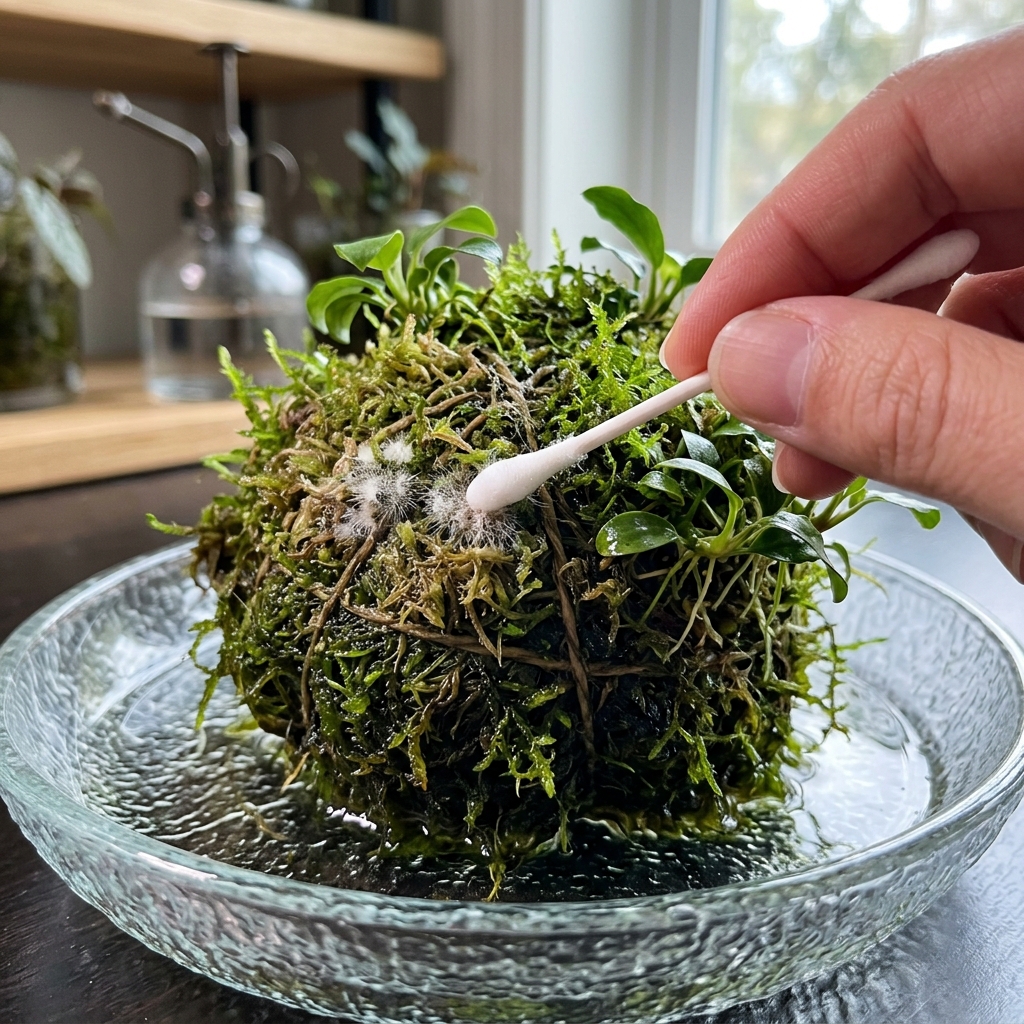
Prevent wabi-kusa mold by venting the dome or lid for 5-10 minutes once or twice a day, keeping the ball damp but not waterlogged, and removing melting leaves within 24 hours. This matters most in weeks 1-4. If white fuzz appears, dab it with a cotton swab dipped in 3% hydrogen peroxide, increase airflow, and consider adding tropical white springtails (Collembola) to graze the surface.
Key Takeaways
- Mold risk peaks in weeks 1-4 after the build, when melting submerged-grown leaves and 85-95% humidity coincide, so prevention must start on day one.
- The three root causes are stagnant air inside the dome, decaying melt-back tissue left on the ball, and an oversaturated ball sitting in too much water.
- Vent for 5-10 minutes once or twice daily, remove dead leaves within 24 hours, and keep the reservoir at 1-2 cm so the ball wicks water rather than soaks in it.
- Spot-treat white fuzz by dabbing 3% hydrogen peroxide with a cotton swab (diluted 1:1 with water on moss), and use a weak, cooled chamomile mist as a mild, low-evidence supplement.
- Tropical white springtails (Folsomia candida) graze mold and fungal film on a damp substrate, but they supplement good ventilation and sanitation rather than replace them.
Why Mold Appears on a Wabi-Kusa
A new wabi-kusa is close to an ideal environment for fungi: a damp, organic-rich substrate, sphagnum or moss wrapped around the outside, humidity of 85-95%, and temperatures of 22-26 °C (72-79 °F). That setup is deliberate, because the plants need it to convert from submerged to emersed growth. The goal of mold prevention is not to dry the build out, but to remove the other two ingredients fungi need, which are dead tissue to feed on and still air. For the full build process, see how to make a wabi-kusa.
The Mold Bloom Timeline: Weeks 1 to 4
Most outbreaks follow a predictable pattern. In the first three days the substrate is freshly hydrated and mold is uncommon. The highest-risk period is days 4-14, when submerged-grown and tissue-culture leaves turn translucent and melt. That tissue is a ready food source resting against warm, wet sphagnum. Risk remains high through week 3 as new growth crowds the surface and traps moisture, then declines in week 4 as roots anchor and you begin lowering humidity. Use the stage checklist in the first table above to schedule inspections, and plan to check the ball every day during the first two weeks.
Root Cause 1: Stagnant Microclimate
Fungal spores are everywhere, but they colonize surfaces most readily where air does not move and moisture film persists. A sealed lid or cloche creates a still, saturated layer right at the substrate surface. Fix this with scheduled venting: lift the lid for 5-10 minutes once or twice daily in weeks 1-2, and extend it to 10-15 minutes in weeks 3-4. Venting does not undo the humidity target, because the dome re-humidifies within minutes from the reservoir and the ball. A low-speed fan near the dish helps in still rooms. Environmental targets are covered in the wabi-kusa lighting and humidity guide.
Root Cause 2: Decaying Melt-Back Tissue
Many aquatic plants shed their submerged leaves within 1-3 weeks of moving to emersed conditions. This melt-back is normal, but each dead leaf is a fungal food source. Inspect daily with tweezers and remove anything translucent, brown, or slimy within 24 hours. Rinse tissue-culture gel completely before planting, because leftover agar is a rich food source. Choosing emersed-grown stock also reduces melt-back dramatically. Plant-by-plant guidance is in the wabi-kusa plants guide, and fast-converting species such as Hydrocotyle tripartita recover quickly and generate less debris.
Root Cause 3: Waterlogged or Oversaturated Balls
A ball that is wet all the way through has no air pockets, so roots are stressed, the surface stays glossy and fungi thrive. Keep only the bottom portion of the ball in a 1-2 cm reservoir so it wicks moisture upward. Do not mist until the surface drips. Aim for a substrate that passes the squeeze test: it should hold together and release no more than a few drops. If your ball stays soggy, the mix is likely too fine or too high in coir or bentonite, so review the wabi-kusa substrate recipe, in particular the aerated low-mold variant, which uses less organic matter and adds fine pumice or perlite for extra pore space.
Identifying What You Are Seeing
- White cottony fuzz: dense, fluffy, raised growth on sphagnum, moss or soil. This is typical mold and should be treated.
- Fine cobweb-like threads: thin, wispy white strands that spread across the surface. This is often saprophytic fungal mycelium feeding on decaying organics. It is usually harmless to healthy plants and fades once the food source is used up, but it signals excess organic matter and stagnant air, so remove the dead material and increase ventilation.
- Green, black or dark grey mold: usually indicates a more advanced or aggressive outbreak, especially if it spreads quickly or smells sour. Remove the affected material and consider rebuilding if it covers more than a small area.
- Slimy, sour-smelling ball: typically waterlogging and bacterial rot rather than just surface mold. Reduce the reservoir, improve airflow and be prepared to rebuild.
It can be hard to tell mold from mycelium by eye. If the growth is spreading across the ball within a day or two, treat it as mold.
Intervention Protocol
- Remove physically. Lift out visible fuzz and the dead leaf or moss underneath with clean tweezers. Do not shake or blow on the ball.
- Spot-treat with 3% hydrogen peroxide. Dampen a cotton swab with standard 3% hydrogen peroxide and dab it only on the fuzz until it fizzes. Repeat every 2-3 days for up to 1-2 weeks while the patch recedes. On moss or delicate new shoots, dilute 1:1 with dechlorinated water to avoid bleaching.
- Increase airflow. Lengthen daily venting and add a small fan if needed.
- Reduce moisture. Mist less and confirm the reservoir is 1-2 cm, not more.
- Optional mild chamomile mist. A weak, cooled, unsweetened chamomile brew diluted 1:1 with dechlorinated water can be misted lightly on the surface. Evidence for this folk remedy is weak, so treat it as a supplement and not a replacement for steps 1-4.
- Reassess in a week. If fuzz keeps returning, consider switching to a lower-organic substrate for the next build.
Hydrogen peroxide is mildly irritating, so keep it off your eyes and wash your hands afterwards. Use fresh product, because old bottles lose strength. The table above summarizes treatment options and cautions.
Seeding Springtails as Living Mold Grazers
Tropical white springtails (Folsomia candida, class Collembola) are tiny soil arthropods that eat fungal hyphae, mold films and decaying plant matter. In a semi-enclosed wabi-kusa dome they work as a slow, continuous cleanup crew. To use them:
- Introduce a small starter group, from a few dozen to about 100 individuals, onto the damp surface of the ball or the dish rim after the first outbreak has been treated.
- Provide a few small hides, such as a piece of charcoal or a thin layer of leaf litter, so they have shelter near moisture.
- Keep at least part of the surface damp. Springtails dehydrate and die in dry, open dishes, so they suit domes and lidded containers best.
- Feed lightly, if needed, with a tiny pinch of yeast or fish flake placed away from the ball, never on it, since extra food can itself promote mold.
Springtails do not harm healthy plant roots and cannot rescue a poorly ventilated or waterlogged build, so use them alongside the other measures. Culturing methods are covered in our springtail culturing guide, and population balance in the bioactive cleanup crew guide.
Prevention Checklist
- Use clean tools, dishes and hands; rinse the dish with hot water before building.
- Rinse peat-free coir until the runoff is clear, and avoid raw compost or leaf mold in the mix.
- Use dechlorinated or RO water; replace the reservoir every 1-2 weeks.
- Do not bury or pack moss or sphagnum so tightly that the surface stays soaked.
- Thin and trim plants so air can move between stems.
- Inspect daily in weeks 1-2, and every few days after that.
- Keep the ball out of cold drafts and direct sun, which cause condensation and heat spikes.
Troubleshooting Summary
| Symptom | Likely cause | Quick fix |
|---|---|---|
| White cottony fuzz on sphagnum | Stagnant air and decaying leaves | Remove tissue, dab with 3% H2O2, vent twice daily |
| Fine wispy threads on soil | Mycelium feeding on organics | Remove debris, increase airflow, add springtails |
| Slimy, sour-smelling ball | Waterlogging | Reduce reservoir, improve aeration, rebuild if needed |
| Fuzz returns after treatment | Source of food or moisture not removed | Find and remove dead matter; mist less; consider a low-mold substrate |
| Moss bleached after treatment | Undiluted peroxide on moss | Dilute 1:1 next time and use only a light dab |
Related Resources
Return to the wabi-kusa tutorial, choose a low-mold mix in the substrate recipe guide, dial in conditions with the lighting and humidity guide, and pick resilient species from the plants guide.
Frequently Asked Questions
Why is there white fuzz on my wabi-kusa?
White fuzz is usually mold or fungal mycelium feeding on decaying leaf tissue or the organic parts of the substrate, helped by humid, still air. Remove dead material with tweezers, dab the fuzz with a cotton swab dampened with 3% hydrogen peroxide, vent the dome 5-10 minutes twice daily and reduce misting.
What is the difference between white fuzzy mold and cobweb-like mycelium?
Fuzzy mold is dense, cottony and raised, and it should be treated. Cobweb-like mycelium is thin and wispy, and it is often saprophytic fungal growth that feeds on dead organic matter. It is usually harmless to healthy plants and fades as the food source is used up. If either spreads quickly across the ball over a day or two, treat it as mold.
Is hydrogen peroxide safe on moss and plants?
A light dab of 3% hydrogen peroxide on a small patch is generally tolerated by sphagnum and plants, but it can bleach or burn moss, new shoots and fine roots. Dilute it 1:1 with dechlorinated water for moss, apply it only to the fuzz with a cotton swab, and never pour it into the reservoir or soak the ball. Keep it away from your eyes and never mix it with vinegar or other cleaners.
How long should I ventilate my wabi-kusa each day?
Open the lid or dome for 5-10 minutes once or twice daily in weeks 1-2, and 10-15 minutes twice daily in weeks 3-4. From week 5, crack the lid for longer periods as part of the 2-3 week hardening-off process, and eventually leave it open or ajar. Humidity recovers within minutes, so venting does not harm the establishment phase.
Can springtails survive in a wabi-kusa dish?
Yes, as long as part of the surface stays damp. Tropical white springtails (Folsomia candida) do well in a lidded or semi-closed dome with a 1-2 cm reservoir and a few hides, such as charcoal or leaf litter. They dry out and die in open, low-humidity dishes. They graze mold films but do not replace ventilation or removal of decaying tissue.
Does chamomile tea prevent mold on wabi-kusa?
Chamomile tea is a popular folk remedy, but there is little reliable evidence that it controls mold on plant substrates. If you try it, use a weak, plain, unsweetened brew, cool it, dilute it 1:1 with dechlorinated water, and mist lightly. Treat it as a supplement to ventilation, sanitation and peroxide spot treatment, not a substitute.
When is mold on a wabi-kusa too serious to save?
Consider rebuilding if the ball is slimy or sour-smelling, if black or green mold covers more than a small area, or if fuzz keeps returning in spite of good ventilation and spot treatment. Wear gloves when handling, avoid inhaling spores if you have asthma or allergies, and do not reuse the affected sphagnum.
How can I stop mold before it starts?
Use clean tools and rinsed coir, keep the reservoir at 1-2 cm, vent twice daily, remove melting leaves within 24 hours, trim crowded stems, and use a substrate with lower organic content in humid climates. Buying emersed-grown plants also cuts down on melt-back debris.
Will mold kill my wabi-kusa plants?
Surface mold on sphagnum or dead leaves rarely kills healthy plants on its own, but heavy growth can smother moss and shoots, and the waterlogging that often accompanies it causes root rot. Early removal, better airflow and a drier surface typically stop it. Persistent sour-smelling rot is the more serious warning sign.
Should I use a fan or a fully open container to avoid mold?
Not during weeks 1-4, when plants need high humidity to convert to emersed growth. A better approach is scheduled venting, with a low-speed fan only if the room air is very still. Once plants are established, you can gradually move to a partially open or open display, which lowers mold risk naturally.
Sources & References
-
Source: rhs.org.uk
Type: horticultural-reference
-
Source: adana.co.jp
Type: horticultural-reference
-
Source: missouribotanicalgarden.org
Type: horticultural-reference
Explore More
Related Articles

Related Plant Guides
Recommended next actions
Continue Exploring
Dive deeper into related plant care tools and profiles.
Topic Guide
Bioactive Cleanup Crew Balance: Isopods and Springtails Cohabitation
Maintain the ideal isopod-to-springtail balance in bioactive terrariums: niche partitioning, crash prevention, food competition, and population control.
Topic Guide
How to Make a Wabi-Kusa: Step-by-Step Guide
Learn how to make a wabi-kusa with an exact substrate recipe by volume, plant picks, lighting, humidity targets, and mold prevention tips for beginners.
Topic Guide
How to Culture Springtails on Charcoal: Setup, Feeding & Harvesting
Step-by-step springtail culturing on horticultural lump charcoal: setup, feeding with active dry yeast, flooding harvests, and crash prevention.
Topic Guide
Wabi-Kusa Lighting and Humidity: PPFD, Phases and Vessels
Wabi-kusa lighting and humidity: 6500K LED at 80-150 PPFD, 8-10 hours, three-phase humidity hardening, vessel comparison and misting rules.
Topic Guide
Best Wabi-Kusa Plants: Carpets, Stems, Epiphytes and Mosses
Best wabi-kusa plants by role: carpets, stems, epiphytes and mosses, with emersed growth needs, transition speed, planting tips and troubleshooting.
Topic Guide
Wabi-Kusa Substrate Recipe: Ratios, Binders and Keto Soil Substitutes
Wabi-kusa substrate recipe by volume: akadama, peat-free coir, bentonite binder, and keto soil substitutes, with ratios, prep steps and troubleshooting.