Wabi-Kusa Substrate Recipe: Ratios, Binders and Keto Soil Substitutes
A wabi-kusa substrate has to retain water, wick it upward, release nutrients slowly and stay porous enough for root respiration, and no single material does all four. This guide compares the main components (aquasoil, akadama, peat-free coir, keto soil, bentonite clay and sphagnum) and gives four tested recipes, all expressed by volume. It also covers keto soil substitutes, bentonite dosing limits, mixing and hydration steps, volumes by ball size, and fixes for crumbling, waterlogging and mold. Use it alongside the full build tutorial and the substrate calculator to scale any recipe to your ball size.
Quick Answer
The best all-round wabi-kusa substrate is 60% aquasoil, 30% fine akadama and 10% peat-free coir by volume, hydrated to a damp-clay consistency. If you cannot source keto soil, use 45% coir, 30% fine akadama, 20% aquasoil fines and 5% bentonite clay by volume, so the ball holds its shape without sealing off oxygen to the roots.
Key Takeaways
- All ratios in this guide are by volume, measured with the same scoop and with each component pre-moistened and lightly packed, never by weight.
- A reliable beginner mix is 60% aquasoil, 30% fine akadama and 10% peat-free coir; a keto-free binder mix is 45% coir, 30% akadama, 20% aquasoil fines and 5% bentonite.
- Keto soil is a sticky, organic-rich Japanese clay soil that can be replaced by a blend of rinsed coir fines and a small dose of bentonite clay.
- Keep dry bentonite at 5-8% of total volume; above about 10% it swells, seals pore space and causes waterlogging and root rot.
- Substrate that is high in organic matter (coir, keto soil) raises mold risk, so rinse coir, avoid over-wetting and ventilate during establishment.
What Makes a Good Wabi-Kusa Substrate?
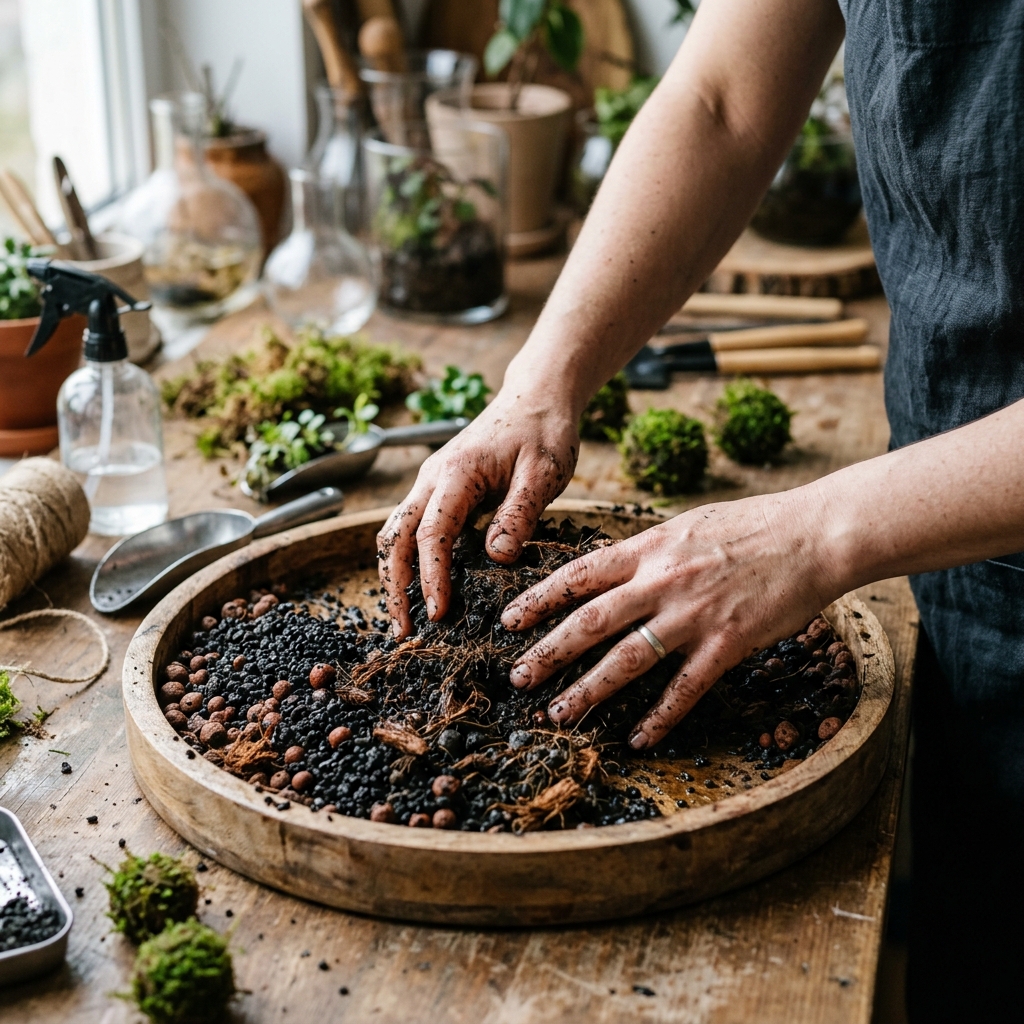
A wabi-kusa substrate has to do four jobs at once: hold water, wick it upward from a shallow reservoir, release nutrients slowly, and stay porous enough for root respiration. No single material achieves all four, which is why successful recipes blend a nutrient-rich component, a structural granular component, a water-holding fibre and, if needed, a binder. This guide gives tested recipes where every ratio is by volume, not by weight. Measure each component in its pre-moistened, lightly packed state using the same scoop, because dry bulk densities of coir, akadama and aquasoil differ widely and cannot be converted reliably. For the complete build process, follow our guide on how to make a wabi-kusa.
Core Substrate Components
- Aquasoil: a nutrient-rich, slightly acidic, granular soil with high cation exchange capacity. It feeds the plants for roughly 2-3 months. Crush or choose small-grain product so it packs into a ball.
- Akadama (fine grade, 1-3 mm): a fired volcanic clay from Japan that retains water while keeping air spaces. It is the main structural and moisture buffer in most recipes, but it slowly breaks down into fines over 12-24 months.
- Peat-free coir fines: coconut fibre that holds water and adds flexibility to the mix. Rinse it until runoff is clear, because raw coir can carry sodium and potassium salts.
- Keto soil (ketotsuchi): a sticky, fine-textured Japanese soil rich in clay and decomposed plant matter, used traditionally to shape wabi-kusa and kokedama balls. It binds exceptionally well but is hard to find outside Japan.
- Bentonite clay: a swelling smectite clay used here as a binder substitute. Choose additive-free, unscented powder only.
- Long-fibre sphagnum: not part of the mix itself but wrapped around the outside to hold the ball together and slow surface drying.
Four Recipes by Volume
Recipe 1: Baseline Starter (60 / 30 / 10)
Combine 60% aquasoil, 30% fine akadama and 10% peat-free coir fines by volume. This is the mix used in our main tutorial and works for most beginners. For a 6 cm ball (130 mL of mix), use about 78 mL aquasoil, 39 mL akadama and 13 mL coir.
Recipe 2: Traditional Keto (50 / 30 / 20)
Combine 50% keto soil, 30% fine akadama and 20% aquasoil fines by volume. Knead with dechlorinated water until the mix feels like modelling clay. The keto soil provides most of the binding, so a sphagnum wrap is optional but still helpful for reducing surface drying.
Recipe 3: Keto-Free Bentonite Binder (45 / 30 / 20 / 5)
Combine 45% peat-free coir fines, 30% fine akadama, 20% aquasoil fines and 5% bentonite clay by volume. For a 6 cm ball (130 mL), this equals about 58 mL coir, 39 mL akadama, 26 mL aquasoil fines and 6-7 mL (roughly 1.3 teaspoons) bentonite powder. This is the most practical substitute for traditional builds when keto soil is not available.
Recipe 4: Aerated Low-Mold (40 / 40 / 10 / 10)
Combine 40% fine akadama, 40% aquasoil, 10% coir fines and 10% fine pumice or perlite by volume. The lower organic fraction and extra pore space reduce mold pressure in humid rooms and enclosed domes. The ball is less cohesive, so rely on a firmer sphagnum and thread wrap. See our wabi-kusa mold prevention guide for more environmental controls.
Keto Soil Substitutes
Because keto soil is rarely stocked outside Japan, most hobbyists replace it with a combination that mimics its two key properties: stickiness and moisture retention. A rinsed peat-free coir base supplies the organic, water-holding fraction, while a small dose of bentonite clay supplies the clay stickiness. Blending in aquasoil fines adds the nutrient and CEC contribution that keto soil would otherwise provide. Other workable substitutes include fine, additive-free kneading clay mixed into coir at a low percentage, though bentonite is the easiest to dose accurately. Always test a small handful first: the substitute is working if the mix rolls into a ball that survives gentle handling without cracking.
Using Bentonite Clay as a Binder
Bentonite swells many times its dry volume when wetted and forms a gel-like film between particles. A small amount (5-8% of total volume) increases cohesion without sacrificing airflow. Above about 10% it seals pore spaces, reduces oxygen to roots and leads to waterlogging and rot. To dose correctly:
- Measure the bentonite as a dry powder with a teaspoon or small measuring spoon.
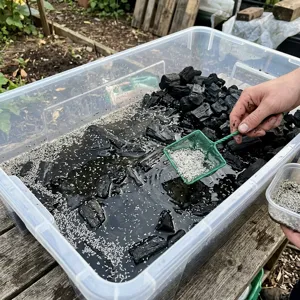
- Mix it thoroughly into the dry or only slightly damp akadama and aquasoil fines first, so it distributes evenly.
- Add the hydrated coir and then add water gradually while kneading.
- Let the mix rest 20-30 minutes so the clay fully hydrates before shaping.
Use only pure, additive-free bentonite. Fragranced, deodorizing or clumping products with additives are unsuitable for plant roots.
Preparing the Substrate Step by Step
- Pre-treat each component. Soak fresh aquasoil for 24 hours and drain. Soak akadama for 10-15 minutes and drain. Hydrate coir fully and rinse until runoff is clear.
- Measure by volume. Use one scoop for all components and keep every component field-moist and lightly packed, with coir squeezed out before measuring.
- Combine dry binders first. If using bentonite, blend it with the akadama and aquasoil fines before adding coir or water.
- Add water gradually. Use dechlorinated or RO water and knead until you reach a damp-clay consistency.
- Rest the mix. Wait 20-30 minutes, then perform the squeeze test: the clump should hold its shape and release only a few drops.
- Shape and wrap. Form the ball using the volumes listed in the table above, wrap with damp sphagnum and plant it as described in our step-by-step tutorial.
To avoid arithmetic errors, enter your ball diameter and chosen recipe into the Wabi-Kusa Substrate Calculator, which converts the totals into millilitres, cups and teaspoons for each component.
Tuning the Recipe for Your Plants
Plant choice can justify small adjustments. Fine ground covers such as Glossostigma and Marsilea root best near the surface of a finer, nutrient-rich mix, so keep aquasoil fines at 20-30% and avoid coarse chunks in the top layer. Stem plants and creepers such as Rotala rotundifolia and Hydrocotyle tripartita anchor well in the standard 1-3 mm granular blend and tolerate slightly coarser mixes. Heavy feeders benefit from the baseline recipe, while species that dislike constant wetness do better in the aerated low-mold recipe. For a full list of suitable species, see our wabi-kusa plants guide.
Substrate Hygiene and Mold Risk
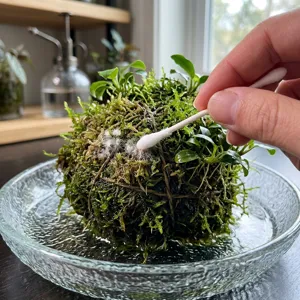
Organic-rich mixes, especially those with coir or keto soil, provide food for mold and fungus gnats when kept wet and stagnant. Rinse coir thoroughly, prepare the mix with clean hands and tools, and avoid saturating the ball: it should draw water from a 1-2 cm reservoir rather than sit in a puddle. During the first weeks, vent enclosed containers daily and remove dead leaves promptly. If white fuzz appears, increase airflow and spot-treat as described in our mold prevention guide. Avoid general-purpose potting mixes, which often contain slow-release fertilizer, bark fines and pathogens that favor mold and cause algae blooms.
Troubleshooting Substrate Problems
| Symptom | Likely Cause | Solution |
|---|---|---|
| Ball crumbles when handled | Too little binder or too dry a mix | Add water gradually; in Recipe 3 confirm 5-8% bentonite by volume; rewrap with sphagnum |
| Ball feels slimy or smells sour | Waterlogged substrate or excess bentonite | Reduce reservoir to 1 cm, lower bentonite below 8% in the next build, improve airflow |
| Surface dries out within a day | Mix too coarse or too much akadama or pumice | Increase coir fraction by 5-10% and add a thicker sphagnum wrap |
| White fuzzy mold | High organic fraction with stagnant air | Ventilate, reduce misting, switch to Recipe 4 for the next build |
| Plants yellow after 2-3 months | Aquasoil nutrients depleted | Add a very dilute liquid aquatic fertilizer (about 1/4 of the labeled dose) to the reservoir every 2 weeks |
| White crust on the surface | Hard or high-TDS water | Switch to RO or dechlorinated low-TDS water and lightly rinse the surface |
Related Resources
Put your recipe into practice with the full wabi-kusa tutorial, choose your species in the plant selection guide, protect your build with mold prevention strategies, and calculate exact quantities with the substrate calculator.
Frequently Asked Questions
What is the best wabi-kusa substrate recipe by volume?
For most beginners, the best recipe is 60% aquasoil, 30% fine akadama and 10% peat-free coir fines by volume. It balances nutrients, moisture retention and aeration. If you want a traditional, more cohesive ball, use 50% keto soil, 30% akadama and 20% aquasoil fines, or the keto-free version with bentonite.
What is keto soil and can I substitute it?
Keto soil (ketotsuchi) is a sticky, fine-textured Japanese soil rich in clay and decomposed plant matter, traditionally used to bind wabi-kusa and kokedama balls. You can substitute it with 45% rinsed peat-free coir fines, 30% fine akadama, 20% aquasoil fines and 5% bentonite clay by volume, which replicates its stickiness and moisture retention.
How much bentonite clay should I add to a wabi-kusa substrate?
Use 5-8% of total volume as dry, additive-free powder. For a 130 mL mix that is roughly 6-10 mL (about 1.3 to 2 teaspoons). Going above about 10% makes the substrate swell and seal, which restricts oxygen and encourages waterlogging and root rot.
Can I make a wabi-kusa using only akadama?
You can, but it is not ideal. Akadama alone lacks nutrients and tends to crumble when shaped, so you will need a binder and a regular dilute fertilizer. Blending it at about 30% by volume with aquasoil and coir gives a firmer ball and a built-in nutrient supply.
Do I need to rinse peat-free coir before using it?
Yes. Rinse hydrated coir until the runoff is clear to remove excess salts such as sodium and potassium, which can burn sensitive roots. Squeeze out the excess water before measuring so that your volume ratios stay accurate.
How much substrate do I need for a 6 cm wabi-kusa ball?
A 6 cm sphere has a volume of about 113 mL, so prepare roughly 130 mL of mix to allow for compaction and trimming losses. In the baseline recipe that is about 78 mL aquasoil, 39 mL akadama and 13 mL coir. Use the substrate calculator to scale other sizes.
Can I use regular potting soil for wabi-kusa?
It is not recommended. Standard potting mixes often contain slow-release fertilizer, bark fines and perlite that float or leach, and they stay wet in a way that encourages mold, fungus gnats and algae. A purpose-built blend of aquasoil, akadama and coir gives much more predictable results.
Why does my wabi-kusa ball keep falling apart?
Common causes are too little binder, a mix that is too dry or too coarse, or no outer wrap. Add water gradually until the mix reaches a damp-clay consistency, ensure bentonite is 5-8% by volume in keto-free recipes, let the mix rest 20-30 minutes, and secure the ball with damp sphagnum and thread.
Which wabi-kusa substrate is least likely to grow mold?
The aerated low-mold recipe (40% akadama, 40% aquasoil, 10% coir and 10% pumice or perlite by volume) is the safest option, because the lower organic fraction and higher porosity reduce the conditions mold needs. Pair it with daily ventilation and a thin water reservoir.
Sources & References
-
Source: rhs.org.uk
Type: horticultural-reference
-
Source: adana.co.jp
Type: horticultural-reference
-
Source: britannica.com
Type: horticultural-reference
Explore More
Related Articles
Related Plant Guides
Recommended next actions
Continue Exploring
Dive deeper into related plant care tools and profiles.
Calculator
Wabi-Kusa Substrate Calculator: Ball Volume & Soil Ratios
Calculate exact volume ratios of aquasoil, akadama, coir, and bentonite clay for any wabi-kusa ball diameter, plus sphagnum wrap surface area.
Plant Guide
Rotala rotundifolia
Rotala rotundifolia care guide: emersed and submerged forms, light, CO2, red coloration, wabi-kusa use, propagation, and troubleshooting for stems.
Topic Guide
Best Wabi-Kusa Plants: Carpets, Stems, Epiphytes and Mosses
Best wabi-kusa plants by role: carpets, stems, epiphytes and mosses, with emersed growth needs, transition speed, planting tips and troubleshooting.
Topic Guide
How to Make a Wabi-Kusa: Step-by-Step Guide
Learn how to make a wabi-kusa with an exact substrate recipe by volume, plant picks, lighting, humidity targets, and mold prevention tips for beginners.
Topic Guide
Wabi-Kusa Mold Prevention: Ventilation, Treatment and Springtails
Wabi-kusa mold prevention: stop white fuzz in weeks 1-4 with ventilation, 3% hydrogen peroxide spot treatment, chamomile mist and springtails.
Topic Guide
Wabi-Kusa Lighting and Humidity: PPFD, Phases and Vessels
Wabi-kusa lighting and humidity: 6500K LED at 80-150 PPFD, 8-10 hours, three-phase humidity hardening, vessel comparison and misting rules.