Best Wabi-Kusa Plants: Carpets, Stems, Epiphytes and Mosses
Wabi-kusa works because many aquatic plants are amphibious and produce tougher, more compact leaves when grown above the waterline. Choosing species by functional role (creeping filler, vertical stem, epiphytic accent or moss) gives a balanced composition and limits competition on a small substrate ball. This guide compares the most reliable species across four tiers, explains submerged-to-emersed conversion and leaf melt-back, and covers placement, planting technique, light and humidity needs, and pruning. Use it with the build tutorial, substrate recipe, lighting guide and mold prevention guide to design a stable, long-lived wabi-kusa.
Quick Answer
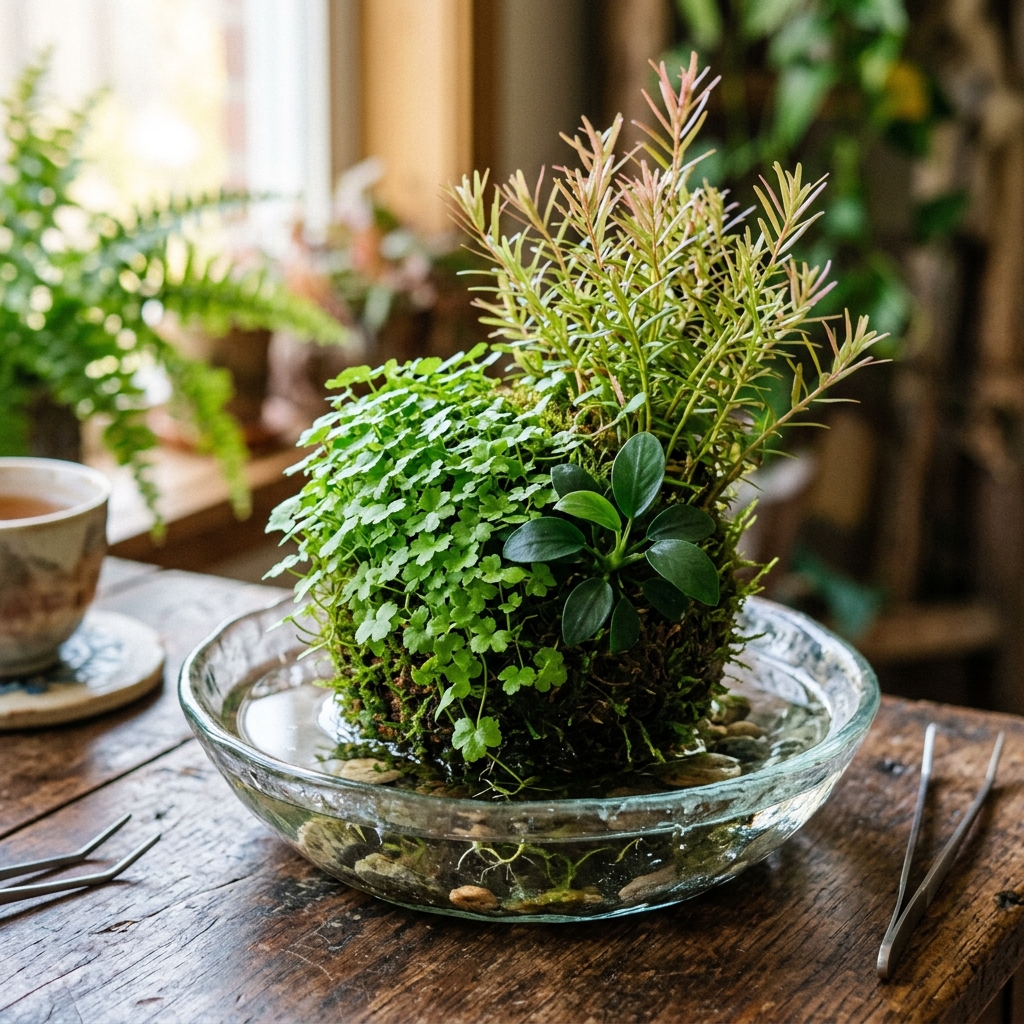
The best wabi-kusa plants are amphibious aquatic species that grow well emersed (leaves above water). Use Hydrocotyle tripartita, Glossostigma elatinoides, Marsilea hirsuta or Micranthemum 'Monte Carlo' for carpets; Rotala rotundifolia, Ludwigia or Hygrophila pinnatifida for vertical stems; Anubias nana, Bucephalandra or Java Fern for epiphytic accents; and Taxiphyllum barbieri or Christmas Moss for texture. Combine 2-4 species in different roles and keep humidity at 85-95% for the first 3-4 weeks.
Key Takeaways
- Choose amphibious species with proven emersed performance, and build the palette from four functional tiers: carpeting fillers, vertical stems, epiphytic accents and mosses.
- Use 2-4 species in distinct roles rather than many similar plants, which compete for light and moisture and look cluttered.
- Leaf melt-back during the first 1-3 weeks is normal for submerged-grown stock; emersed-grown or tissue-culture plants convert fastest.
- Never bury the rhizome of Anubias, Bucephalandra or Java Fern; attach epiphytes to the sphagnum wrap, a stone or wood so the rhizome stays above the substrate.
- Keep humidity at 85-95% for 3-4 weeks, then harden off to 60-80% over 2-3 weeks, with 6500K light at roughly 80-150 PPFD for 8-10 hours daily.
Why Aquatic Plants Work in Wabi-Kusa
Many aquatic plants are amphibious: in the wild they live through seasonal flooding and dry periods and switch between submerged and emersed leaf forms (a trait called heterophylly). Wabi-kusa takes advantage of this by growing them above water in a moist ball of substrate. Emersed leaves are usually thicker, more compact and more colorful than submerged ones, and the plants grow faster with access to atmospheric CO2. Not every aquatic plant adapts, so the species below are grouped into four functional tiers that cover a complete composition. For the full construction process, see how to make a wabi-kusa.
How to Choose Plants
- Pick by role, not by quantity. One carpeter, one stem plant and one accent (epiphyte or moss) is usually enough. A palette of 2-4 species looks cohesive and reduces competition.
- Match the substrate. Carpeting and stem plants root in the substrate and benefit from a nutrient-rich mix; see the wabi-kusa substrate recipe.
- Match the environment. Fine carpeters need higher humidity than Anubias or Java Fern. Check targets in the lighting and humidity guide.
- Buy emersed or tissue-culture stock. Emersed-grown plants skip most of the melt-back; tissue culture must be rinsed free of gel.
Tier 1: Carpeting and Creeping Fillers
These plants cover the substrate surface, hold the ball together with their roots and hide the sphagnum wrap.
Hydrocotyle tripartita
The best beginner choice. Fast creeping stolons root at every node, and the emersed form produces rounded, glossy leaves 5-10 cm tall. It tolerates a wide temperature range (15-30 °C survivable) and recovers quickly from melt-back. Trim regularly, because it will overgrow slower companions. Full care details are on the Hydrocotyle tripartita profile.
Glossostigma elatinoides
A very fine, low carpet with small spoon-shaped leaves that looks excellent emersed. It demands consistently high humidity (85-95%) and medium to high light, and it dislikes drying out. Plant tiny portions into the surface layer of a fine, nutrient-rich mix. It is best for experienced growers.
Marsilea hirsuta
A clover-like fern ally with four-leaflet leaves that stays compact, especially under strong light. Emersed leaves are smaller and tougher than submerged ones. It is moderately easy and spreads by runners across the surface.
Micranthemum 'Monte Carlo'
A dense, bright green creeping carpet with rounded leaves. Emersed growth is lush but needs high humidity during establishment. Divide it into small tufts and press them onto the damp surface so the stems make contact with the substrate.
Tier 2: Background and Vertical Stems
Stem plants provide height, color and a focal point. Place them off-centre on the top or rear of the ball and keep them trimmed so they do not shade the carpet.
Rotala rotundifolia
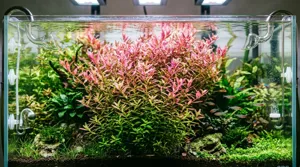
An easy, fast-growing stem plant that develops pink to red tones under strong light and root-feeding substrate. Emersed leaves are rounder and thicker than the fine, narrow submerged leaves. Pinch the tips every 2-3 weeks and replant the cuttings. See the Rotala rotundifolia profile for details.
Ludwigia (for example Ludwigia repens)
A hardy stem plant with oval leaves that turn red to bronze under high light. Emersed growth is vigorous and can sprawl, so prune hard to keep it in proportion on a small ball. Choose smaller cultivars for wabi-kusa.
Hygrophila pinnatifida
A rhizomatous plant with deeply lobed, textured leaves that make a striking background accent. It is slower than Rotala and Ludwigia and can also be attached to wood or stone. Keep the rhizome above the surface of the substrate to prevent rot.
Tier 3: Epiphytes and Hardscape Accents
Epiphytes grow on rock, wood or other plants rather than in soil. They grow slowly, rarely need trimming and add structure, but their rhizomes rot if buried. Attach them to the sphagnum wrap with cotton thread or to small stones and driftwood placed on the ball.
Anubias nana
A tough, slow-growing rhizomatous plant with thick, dark green leaves that adapts easily to emersed growth, often with little melt-back. It tolerates low to medium light, which makes it a good partner for fast carpeters. Tie it to the ball with the rhizome fully exposed. See the Anubias nana profile.
Bucephalandra
A small, slow-growing epiphyte with iridescent, textured leaves available in many varieties. It likes high humidity (80-90%) and stable conditions. Convert it gradually, and expect slower regrowth than Anubias.
Java Fern (Microsorum pteropus)
A durable fern that grows well emersed in humid conditions, producing broader, thicker fronds. Attach it to the sphagnum wrap or a stone. Small plantlets can form on the leaves and can be removed and reattached to propagate.
Tier 4: Mosses
Mosses soften the surface, hide the sphagnum and buffer humidity. In emersed culture they must not dry out, so use them where the substrate is consistently moist.
Taxiphyllum barbieri (Java Moss)
A fast-growing, forgiving moss that forms irregular mats. Press small pieces onto the damp surface or secure them with thread. Emersed growth is slower and denser than submerged growth, and the moss needs 85-100% humidity. Trim it regularly to prevent smothering of neighbouring plants.
Christmas Moss (Vesicularia montagnei)
A moss with layered, drooping fronds that resemble tiny fir branches. It grows slower than Java Moss, giving a neater look, but it also traps debris and needs gentle cleaning. Attach it to the upper part of the wabi-kusa where it receives light but does not dry out.
Species Comparison
Use the species comparison table above to match plants to the humidity and light you can provide. As a rule, fast-transitioning plants (Hydrocotyle, Rotala, Ludwigia, Anubias, Java Fern and Java Moss) are best for a first wabi-kusa, while Glossostigma, Marsilea, Monte Carlo and Bucephalandra suit growers who can maintain stable high humidity.
Planting Technique
- Prepare the plants. Rinse tissue-culture gel completely; trim damaged roots and divide into small portions of 3-5 stems.
- Plant stems and carpeters. Use fine tweezers to push roots 1-2 cm into the substrate through the moss layer, and lay creeping stems flat so the nodes touch damp substrate.
- Attach epiphytes. Tie the rhizome to the sphagnum wrap, a stone or wood with cotton thread, leaving it above the surface of the substrate.
- Add moss last. Press thin layers of moss onto exposed areas and secure them lightly.
- Cover the dish. Add 1-2 cm of dechlorinated or RO water to the dish and keep humidity at 85-95% with a lid or cloche.
Submerged-to-Emersed Conversion
Plants grown submerged usually lose their old leaves in the first 1-3 weeks and then produce new emersed leaves from the nodes or the rhizome. This melt-back is normal. Keep humidity high, trim dead tissue promptly (decaying leaves are a mold risk, see the mold prevention guide) and avoid moving the plants once they begin rooting. After 3-4 weeks, harden off the plants over 2-3 weeks by opening the lid for progressively longer periods.
Light, Humidity and Pruning
Provide 6500K full-spectrum light at about 80-150 PPFD for 8-10 hours daily. Higher intensity accelerates growth and red coloration in stem plants but also dries the substrate faster. Prune stems and carpets every 1-3 weeks, replant healthy cuttings, and keep the highest growth from shading the epiphytes and mosses. Fertilize with a very dilute aquatic fertilizer (about 1/4 of the labelled dose) every 2 weeks once the aquasoil is depleted, usually after 2-3 months.
Troubleshooting
| Symptom | Likely Cause | Solution |
|---|---|---|
| Leaves melt or turn translucent in the first weeks | Normal submerged-to-emersed conversion | Maintain 85-95% humidity, trim dead leaves and wait for new growth |
| Crispy, brown edges on carpet plants or moss | Humidity too low or substrate drying | Mist more often, close the lid partially and check the reservoir level |
| Anubias or fern rhizome turns brown and soft | Rhizome buried or kept too wet | Reattach with the rhizome fully exposed and remove rotted tissue |
| Leggy, pale stems | Insufficient light | Raise intensity toward 120-150 PPFD or lower the light |
| One species overwhelms the rest | Aggressive grower such as Hydrocotyle or Ludwigia | Trim every 1-2 weeks and replant cuttings elsewhere |
| White fuzzy mold on moss or sphagnum | Stagnant air and decaying plant matter | Remove dead tissue, ventilate and spot-treat with 3% hydrogen peroxide |
Related Resources
Build your ball with the wabi-kusa tutorial, mix the right medium with the substrate recipe, dial in conditions with the lighting and humidity guide, and avoid problems with mold prevention. Plant profiles: Hydrocotyle tripartita, Rotala rotundifolia and Anubias nana.
Frequently Asked Questions
What are the best plants for a beginner wabi-kusa?
Hydrocotyle tripartita, Rotala rotundifolia, Anubias nana, Java Fern and Java Moss are the most forgiving. They convert quickly to emersed growth, tolerate small humidity swings and root or attach easily. Add one of them from each of the carpet, stem and accent roles for a balanced composition.
How many plant species should I use in one wabi-kusa?
Use 2-4 species. A typical combination is one carpeting filler, one vertical stem plant and one epiphyte or moss. More species compete for light and moisture and make a small ball look cluttered.
Can I use submerged aquarium plants in a wabi-kusa?
Yes, many amphibious species convert, but expect 1-3 weeks of leaf melt-back as the plant replaces submerged leaves with emersed ones. Emersed-grown or tissue-culture stock converts fastest. Keep humidity at 85-95% during this period and trim dead leaves to prevent mold.
Which carpeting plants work best for wabi-kusa?
Hydrocotyle tripartita is the easiest and fastest. Marsilea hirsuta and Micranthemum 'Monte Carlo' are moderately easy, while Glossostigma elatinoides forms the finest carpet but needs consistently high humidity and strong light.
Can I grow Anubias nana in a wabi-kusa?
Yes. Anubias nana tolerates emersed growth very well and often shows little melt-back. Attach the rhizome to the sphagnum wrap, a stone or wood with cotton thread and keep it above the substrate surface, since a buried rhizome rots.
Do Bucephalandra and Java Fern grow emersed?
Both do. Java Fern adapts quickly in humid conditions, while Bucephalandra is slower and wants stable humidity of roughly 80-90%. Treat both as epiphytes: attach them to the ball or hardscape and never bury the rhizome.
Can I use moss in a wabi-kusa?
Yes. Java Moss (Taxiphyllum barbieri) and Christmas Moss (Vesicularia montagnei) soften the surface and cover the sphagnum wrap. They need 85-100% humidity and a consistently damp surface, so place them on the lower or shaded parts of the ball where they will not dry out.
Why are my wabi-kusa plants melting after I planted them?
Plants grown submerged or in tissue culture shed their old leaves when moved to emersed conditions. This is normal. Keep humidity at 85-95%, remove dead tissue and wait 1-3 weeks for new emersed leaves to appear.
How much light do wabi-kusa plants need?
Aim for a 6500K full-spectrum LED delivering roughly 80-150 PPFD at the plant surface for 8-10 hours a day. Epiphytes and mosses tolerate lower light, while stem plants and fine carpeters need medium to high intensity for compact, colorful growth.
How do I stop one plant from taking over my wabi-kusa?
Trim fast growers such as Hydrocotyle tripartita and Ludwigia every 1-2 weeks, replant the cuttings elsewhere and avoid over-fertilizing. Choose slower accent plants such as Anubias nana or Bucephalandra for a composition that stays stable.
Sources & References
-
Source: missouribotanicalgarden.org
Type: horticultural-reference
-
Source: adana.co.jp
Type: horticultural-reference
-
Source: powo.science.kew.org
Type: horticultural-reference
-
Source: tropica.com
Type: horticultural-reference
Explore More
Related Articles

Related Plant Guides
Recommended next actions
Continue Exploring
Dive deeper into related plant care tools and profiles.
Plant Guide
Anubias Nana
Anubias Nana is a hardy, slow-growing, low-light epiphyte perfect for beginner aquariums and aquascaping.
Plant Guide
Rotala rotundifolia
Rotala rotundifolia care guide: emersed and submerged forms, light, CO2, red coloration, wabi-kusa use, propagation, and troubleshooting for stems.
Topic Guide
How to Make a Wabi-Kusa: Step-by-Step Guide
Learn how to make a wabi-kusa with an exact substrate recipe by volume, plant picks, lighting, humidity targets, and mold prevention tips for beginners.
Topic Guide
Wabi-Kusa Lighting and Humidity: PPFD, Phases and Vessels
Wabi-kusa lighting and humidity: 6500K LED at 80-150 PPFD, 8-10 hours, three-phase humidity hardening, vessel comparison and misting rules.
Topic Guide
Wabi-Kusa Mold Prevention: Ventilation, Treatment and Springtails
Wabi-kusa mold prevention: stop white fuzz in weeks 1-4 with ventilation, 3% hydrogen peroxide spot treatment, chamomile mist and springtails.
Topic Guide
Wabi-Kusa Substrate Recipe: Ratios, Binders and Keto Soil Substitutes
Wabi-kusa substrate recipe by volume: akadama, peat-free coir, bentonite binder, and keto soil substitutes, with ratios, prep steps and troubleshooting.