Wabi-Kusa Lighting and Humidity: PPFD, Phases and Vessels
Light and humidity decide whether emersed conversion succeeds, because plants transitioning from submerged to emersed growth cannot control water loss until they build new, waxier leaves and roots. This guide sets out a three-phase acclimatization protocol, with exact relative humidity, ventilation and misting targets, paired with photoperiod, spectrum and PPFD values for establishment and for red pigmentation. It compares sealed glass cloches, vented acrylic domes and open dishes, explains how to convert lux and foot-candles to PPFD, and covers lens-effect scorch, algae film, window sunlight, winter radiator air and reservoir depth. Use it with the build tutorial and the mold prevention guide to keep conditions humid enough for the plants but airy enough to stay clean.
Quick Answer
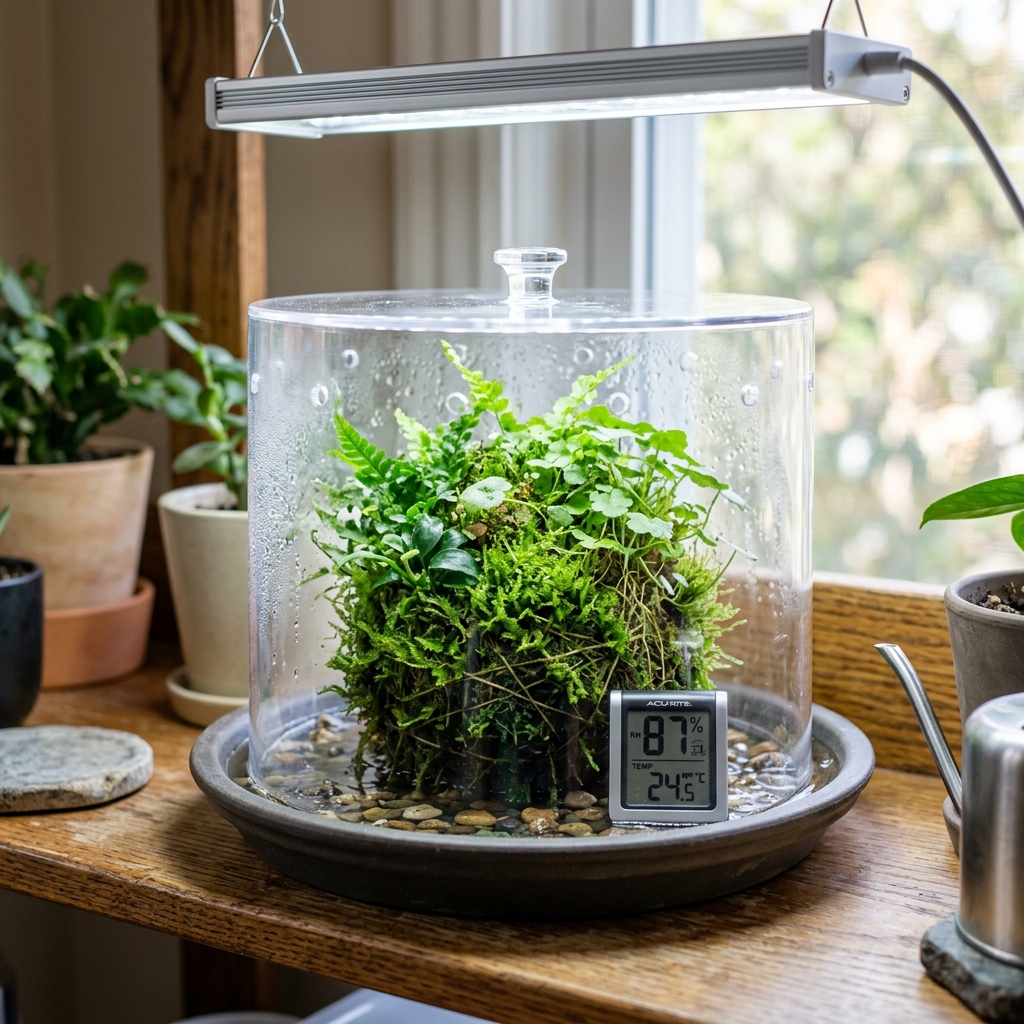
Light a wabi-kusa with a 6500K full-spectrum white LED for 8-10 hours daily at 80-120 PPFD during establishment, rising to 120-150 PPFD only if you want red pigmentation in stems such as Rotala. Keep humidity at 85-95% in a sealed dome for weeks 1-3, harden off by cracking the lid 2-5 mm in weeks 4-5 (70-80% RH), then move to an open shallow bowl at 50-70% room humidity from week 6 with a constant 1-2 cm base water reservoir.
Key Takeaways
- Run a 6500K full-spectrum white LED for 8-10 hours daily at 80-120 PPFD for establishment and mosses, and 120-150 PPFD only for red stem pigmentation such as Rotala rotundifolia.
- Acclimatize in three phases: sealed dome at 85-95% RH with a 15-minute daily air exchange (weeks 1-3), lid cracked 2-5 mm at 70-80% RH (weeks 4-5), then an open shallow bowl at 50-70% RH from week 6.
- Keep a continuous 1-2 cm water reservoir under the ball in every phase so it wicks moisture upward instead of sitting saturated.
- Mist with dechlorinated or RO water and never leave standing droplets under bright LEDs, because drops act as lenses and scorch leaves.
- Measure light in PPFD with a PAR meter or phone-based estimate, not lux alone; lux and foot-candles describe human-visible brightness and convert to PPFD only roughly, and the factor depends on the light source.
Why Light and Humidity Matter for Emersed Conversion
Plants grown submerged or in tissue culture have thin cuticles and few functional stomata controls, so they lose water quickly when moved into air. A wabi-kusa solves this by holding humidity high while the plants build new emersed leaves, then lowering it step by step. Light drives that rebuilding, but too much light dries the surface, scorches leaves and feeds algae. For the full build, see how to make a wabi-kusa.
Photoperiod and Spectrum
Use a 6500K full-spectrum white LED for 8-10 hours daily on a timer. This daylight-balanced spectrum gives compact growth and natural leaf colour. Avoid strongly pink or purple grow lights, which distort colour and make algae and mold hard to spot. Long photoperiods above 10 hours add heat and evaporation without improving growth, and they encourage algae film on the glass and substrate.
Light Intensity: PPFD and PAR
PPFD (photosynthetic photon flux density, measured in µmol/m²/s) is the usable light reaching the leaf surface. Measure at the height of the plant tops, not at the lamp.
- 80-120 PPFD: general establishment, tissue-culture stock and mosses.
- 100-130 PPFD: established mixed plantings.
- 120-150 PPFD: red pigmentation in stems such as Rotala rotundifolia, once plants are rooted and humidity is stable.
Above roughly 150 PPFD, evaporation rises sharply, the ball dries faster than the reservoir can wick, and leaves bleach or scorch. Raise the lamp or dim it if you see pale patches, crisping, or green algae film on the substrate. Plant-specific needs are in the wabi-kusa plants guide.
The Three Humidity Acclimatization Phases
Phase 1: Establishment (Weeks 1-3)
Seal the ball under a glass cloche or tight dome to hold 85-95% RH. Open it for a 15-minute air exchange once daily, and remove any melting leaves at the same time. Humidity returns within minutes from the reservoir and the wet ball, so venting does not undo establishment. Run 80-120 PPFD for 8-10 hours.
Phase 2: Hardening Off (Weeks 4-5)
Once new emersed leaves have formed and the stems resist gentle tugging, begin cracking the lid 2-5 mm, which lowers humidity to about 70-80% RH. Start with a few hours and extend through the two weeks. If leaf edges crisp or the plants wilt in the afternoon, close the gap slightly for a few days before trying again.
Phase 3: Mature (Week 6 Onward)
Move the plants to an open shallow bowl at ambient room humidity, typically 50-70% RH, with a continuous 1-2 cm base water reservoir. Fine carpeters and mosses may need a partial cover or a daily mist if your room is drier than 50%. The protocol is summarised in the first table above.
Enclosure Vessel Comparison
The vessel controls humidity more than any other variable. A completely sealed glass cloche gives the highest, most stable humidity and is best for phase 1, but it needs daily venting because still, saturated air favours mold. A perforated or vented acrylic dome holds moderate to high humidity while letting air move, which makes it a good compromise for most phases and lets you tune airflow by taping holes. An open shallow dish has the lowest mold risk and the lowest humidity, so it suits only established, tolerant plants. The second table above compares them in detail, and the mold prevention guide covers ventilation schedules and treatments.
Misting Mechanics
Mist with dechlorinated or RO water to avoid mineral crusts on leaves and substrate.
- Phase 1: 1-2 light mists daily. Use a fine spray held 20-30 cm away, and stop once the surface looks damp rather than glossy.
- Phase 2: once daily, or whenever the surface feels dry.
- Phase 3: every 2-3 days as needed. The reservoir does most of the work.
Avoid the lens effect. Water drops on leaves can focus strong LED light into small hot spots that burn tissue. Mist when the light is off, or at least after the drops have time to run off or evaporate, and do not leave beads of water on leaves under lamps above about 120 PPFD. Never mist until the ball drips, since an oversaturated ball is the main driver of mold and root rot.
Water Reservoir Depth
Keep 1-2 cm of water in the dish in every phase. The lower third of the ball should sit in the water, which wicks upward through the substrate. Less than 1 cm often leaves the ball dry within a day or two under a strong light, and more than 2 cm saturates the lower ball and starves roots of oxygen. Replace the reservoir every 1-2 weeks. Substrate that wicks too fast or too slowly is usually a recipe problem, so review the wabi-kusa substrate recipe.
Plant-Specific Notes
Hydrocotyle tripartita tolerates lower humidity than most carpeters once rooted and is the easiest to harden off. Rotala colours best at the upper end of the PPFD range but only with stable humidity, so delay the 120-150 PPFD step until phase 2 or later. Mosses and fine carpeters are the last to move out of the dome and often stay under a partial lid permanently in dry rooms.
Troubleshooting Summary
| Symptom | Likely cause | Quick fix |
|---|---|---|
| Pale, bleached patches | Light too intense or too close | Raise the lamp or dim toward 100-120 PPFD |
| Crispy brown edges | Humidity too low or ball drying | Close the lid gap; check reservoir; mist |
| Brown spots with a clear centre | Droplet lens effect | Mist with lights off; avoid pooled drops |
| Green film on substrate or glass | Excess light or duration | Cut to 8 hours; lower intensity; wipe surfaces |
| Leggy, pale stems | Too little light | Lower the lamp toward 120 PPFD |
Related Resources
Return to the wabi-kusa tutorial, choose a suitable mix in the substrate recipe guide, pick species in the plants guide, and prevent outbreaks with mold prevention.
Frequently Asked Questions
How do I convert lux or foot-candles to PPFD for a wabi-kusa?
There is no exact conversion, because lux and foot-candles weight light by human eye sensitivity while PPFD counts photons plants can use. For a 6500K white LED, a rough rule is PPFD ≈ lux ÷ 70 to 80 (so 100 PPFD is about 7,000-8,000 lux, or about 650-750 foot-candles). Sunlight and other spectra differ, so use a PAR meter for accuracy, and treat phone apps as rough estimates.
How can I tell light bleaching from drying out?
Bleaching shows as pale, whitish or yellow patches on the leaves facing the lamp, often with clear, papery spots, and it improves when you raise the light. Drying out shows as crispy brown edges, wilting, and a dry or light-coloured ball, and it improves when you raise humidity or the reservoir. Check the ball's moisture and the lamp distance first to tell which one it is.
Can a wabi-kusa survive winter radiator or heater air?
Yes, with precautions. Heated air can drop room humidity below 30-40% and dry the ball rapidly. Keep the wabi-kusa away from radiators and vents, use a partial lid or vented dome, keep the reservoir at 1-2 cm and check it daily, and mist more often. Moss and fine carpeters may need to return to a sealed cloche during the heating season.
Does direct window sunlight work for a wabi-kusa?
Usually not. Direct sun through glass can exceed 1,000 PPFD, overheating a closed dome and scorching leaves, and it drives algae and mold. Bright indirect light from a north or east window can supplement, but an LED on a timer gives much more stable results. Never place a sealed cloche in direct sun.
How deep should the water reservoir be?
Keep 1-2 cm in every phase so the bottom third of the ball sits in water and wicks moisture upward. Less than 1 cm dries the ball quickly under strong light, and more than 2 cm saturates it and reduces oxygen to the roots. Replace the water every 1-2 weeks with dechlorinated or RO water.
How long should I keep my wabi-kusa in a sealed dome?
Keep it sealed, with a daily 15-minute air exchange, for about 3 weeks (phase 1). Then crack the lid 2-5 mm for weeks 4-5, and move to an open bowl from week 6 if the plants stay turgid. Slow species such as Bucephalandra, fine carpeters and mosses may need longer.
What humidity should an established wabi-kusa have?
Most established plantings tolerate ambient room humidity of 50-70% in an open shallow bowl with a 1-2 cm reservoir. Tolerant species such as Hydrocotyle tripartita and Anubias do well, while mosses and fine carpeters may prefer 70-80% under a partial cover.
Why do I get brown spots after misting under the light?
Water drops on leaves can focus LED light like tiny lenses and burn spots into the tissue, especially above about 120 PPFD. Mist when the light is off or wait for droplets to run off before turning it on, and use a fine spray rather than large drops.
Can I use a regular desk lamp or a plant grow light?
A neutral-to-cool white LED (around 6500K) with a known output works well. Incandescent bulbs and some cheap lamps run hot and dry the ball. Purple grow lights make colour and mold harder to judge. Use a timer and an adjustable height so you can tune PPFD.
Do I need a fan for a wabi-kusa?
Not during phase 1, when plants need still, humid air, and scheduled venting is enough. A low-speed fan in the room can help in phase 2 and 3 if air is very still, but aim it near the dish rather than directly onto it, since strong airflow dries the surface.
Sources & References
-
Source: rhs.org.uk
Type: horticultural-reference
-
Source: adana.co.jp
Type: horticultural-reference
-
Source: missouribotanicalgarden.org
Type: horticultural-reference
Explore More
Related Articles
Related Plant Guides
Recommended next actions
Continue Exploring
Dive deeper into related plant care tools and profiles.
Plant Guide
Rotala rotundifolia
Rotala rotundifolia care guide: emersed and submerged forms, light, CO2, red coloration, wabi-kusa use, propagation, and troubleshooting for stems.
Topic Guide
Best Wabi-Kusa Plants: Carpets, Stems, Epiphytes and Mosses
Best wabi-kusa plants by role: carpets, stems, epiphytes and mosses, with emersed growth needs, transition speed, planting tips and troubleshooting.
Topic Guide
How to Make a Wabi-Kusa: Step-by-Step Guide
Learn how to make a wabi-kusa with an exact substrate recipe by volume, plant picks, lighting, humidity targets, and mold prevention tips for beginners.
Topic Guide
Wabi-Kusa Mold Prevention: Ventilation, Treatment and Springtails
Wabi-kusa mold prevention: stop white fuzz in weeks 1-4 with ventilation, 3% hydrogen peroxide spot treatment, chamomile mist and springtails.
Topic Guide
Wabi-Kusa Substrate Recipe: Ratios, Binders and Keto Soil Substitutes
Wabi-kusa substrate recipe by volume: akadama, peat-free coir, bentonite binder, and keto soil substitutes, with ratios, prep steps and troubleshooting.
Plant Guide
Hydrocotyle 'Japan'
Hydrocotyle tripartita 'Japan' is a fast, creeping pennywort for aquarium carpets and emergent wabi-kusa builds.