How to Culture Springtails on Charcoal: Setup, Feeding & Harvesting
Charcoal culturing gives springtail keepers a clean, low-maintenance system because lump charcoal is highly porous, buffers moisture, never decomposes into sludge and lets springtails be harvested by simple flotation. This guide covers why charcoal works, how to source safe untreated material, the step-by-step culture build, micro-dosed feeding with yeast or rice, ventilation to prevent oxygen depletion and CO2 buildup, and the flooding-and-pour harvest. It also provides a maintenance schedule, a comparison with soil and clay-slab cultures, and a troubleshooting table covering grain mites, yeast mold, crashes and water quality. Use it alongside the cleanup crew balance, isopod and wabi-kusa guides to put your cultures to work.
Quick Answer
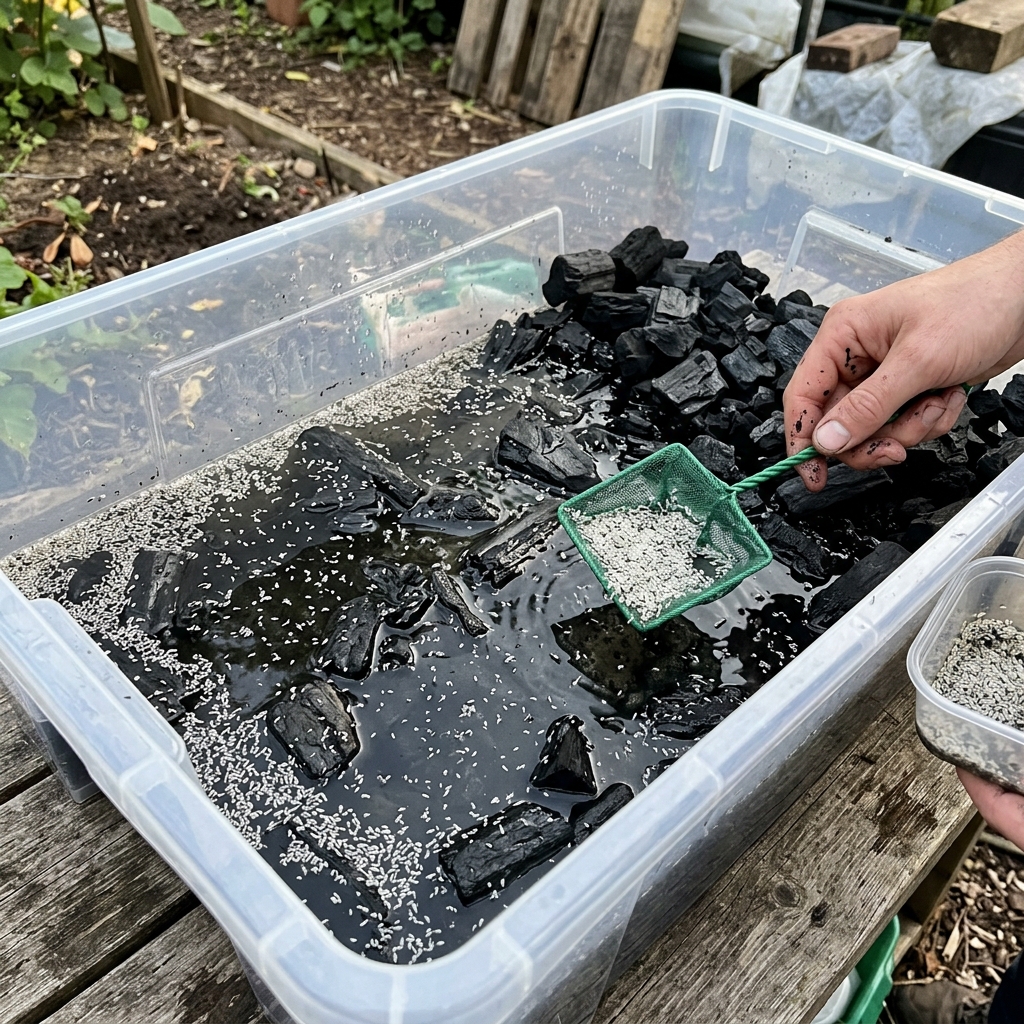
Culture tropical white springtails (Folsomia candida or Sinella curviseta) in an airtight plastic tub filled with rinsed, untreated hardwood lump charcoal broken into 1-3 cm pieces, with 1-2 cm of dechlorinated or RO water pooled at the base. Feed a micro-dose of active dry yeast or a few uncooked rice grains only when the last feeding has been eaten (about every 2-3 days), open the lid briefly twice a week for gas exchange, and harvest by flooding the tub so the hydrophobic springtails float and can be poured straight into a vivarium or wabi-kusa dish.
Key Takeaways
- Use untreated natural hardwood lump charcoal or horticultural charcoal, rinsed free of dust and broken into 1-3 cm pieces; never use briquettes or self-lighting charcoal, which contain binders and accelerants.
- Keep a shallow 1-2 cm pool of dechlorinated or RO water at the base so the charcoal wicks moisture upward while the surface stays damp but not flooded.
- Micro-dose food: add only as much active dry yeast or rice as the colony consumes within 48-72 hours, because leftovers cause bacterial blooms, mold, mites and oxygen depletion.
- Open airtight culture tubs briefly (about 1-2 minutes) twice a week to refresh oxygen and vent CO2, and do a deep flush every 1-3 months to remove frass and stale water.
- Harvest by flooding: springtails float on the water surface because of their hydrophobic cuticle, so you can pour them directly into a vivarium, isopod enclosure or wabi-kusa dish without moving substrate.
Why Culture Springtails on Charcoal?
Springtails (Collembola) are tiny, wingless hexapods that graze on mold, fungal hyphae, algae and decaying organic matter. In bioactive terrariums, isopod enclosures and wabi-kusa domes they act as a living cleanup crew. The two most common culturing species are the tropical white springtail (Folsomia candida) and Sinella curviseta, both of which tolerate room temperature and reproduce quickly. Many hobbyists start cultures in soil or peat, but those mixes break down, harbour pests and are hard to harvest cleanly. Horticultural lump charcoal avoids these problems, and it is the method this guide teaches. For how springtails fit into a balanced ecosystem, see the bioactive cleanup crew balance guide.
Why Lump Charcoal Works
- High surface microporosity. Charcoal is full of microscopic pores that offer a large surface area for biofilm and give springtails countless crevices to shelter in.
- Moisture buffering. Porous charcoal wicks water from the base pool and holds a damp surface without becoming waterlogged.
- No decomposition. Unlike soil, peat or wood, charcoal does not rot into sludge, so the culture stays clean for months and the material can be rinsed and reused.
- Clean flotation harvest. Springtails have a hydrophobic cuticle, so when the tub is flooded they float on the meniscus and can be poured off with the water, leaving the charcoal behind.
Sourcing Charcoal Safely
Choose untreated natural hardwood lump charcoal or horticultural-grade charcoal sold for gardening or orchid mixes. Avoid briquettes, instant-light or self-lighting charcoal, and any product with lighter fluid, binders, starch, borax or chemical ignition aids, because these leach into the water and can poison the culture. Check the label for 100% hardwood and no additives. Pieces labelled as biochar are suitable if they are unfertilized and untreated.
Culture Setup, Step by Step
- Choose a container. Use a food-safe plastic tub with a tight-fitting lid, roughly 1-4 litres for a first culture. Wash it with hot water only, with no soap or bleach residue.
- Rinse the charcoal. Charcoal dust clogs pores and clouds the water. Rinse the pieces in a bucket or colander until the water runs mostly clear, and drain.
- Break it into 1-3 cm pieces. Wrap chunks in a towel and break them with a hammer, or choose pre-sized lump. Wear eye protection. Keep a range of sizes so the pieces interlock and leave open gaps.
- Fill the container. Pack charcoal loosely to a depth of 5-8 cm, leaving air space above.
- Add a shallow water pool. Pour in 1-2 cm of dechlorinated or RO water so only the bottom of the charcoal sits in water. The upper pieces should stay damp but not flooded.
- Seed the culture. Tip in a starter culture of at least a few hundred springtails, or a tablespoon or more of an existing culture with its substrate. Larger starter groups establish faster.
- Feed lightly and close the lid. Add a first micro-dose of yeast (see below), then seal the tub and keep it at a steady temperature in indirect light.
Feeding and Nutrition
Springtails graze on yeast and the microbial film it supports. Offer active dry baker's yeast, brewer's yeast, or a few uncooked rice grains, placed on a dry, flat piece of charcoal so the food does not fall into the water.
Micro-dosing rules:
- Feed only what is consumed within 48-72 hours. A pinch of about 1/8 teaspoon is enough for a small tub.
- If food from the last feeding is still visible, do not add more. Skip a feeding instead.
- Remove any food that has turned slimy, fuzzy or foul-smelling with tweezers.
- Do not use meat, dairy, sugary foods or large quantities of fish flake. They spoil quickly and feed bacteria and mites.
Overfeeding is the most common cause of culture failure. Uneaten food ferments, depletes oxygen and builds up CO2 and bacterial slime, which in a sealed container can suffocate the colony within days.
Ventilation and Burping
An airtight tub holds moisture well, but living springtails and microbes consume oxygen and release carbon dioxide. Without any gas exchange, the air becomes stale and the colony shrinks. Open the lid for 1-2 minutes twice a week and fan the air gently, so that fresh oxygen replaces CO2. If the tub shows heavy condensation, sour smells or animals crowding at the lid, burp it more often or add a small, fine-mesh vent. Never leave a culture open for long periods, as it will dry out and invite fungus gnats and mites.
Environment: Temperature, Light and Water
Springtails do best at a steady 20-25 °C (68-77 °F). Cultures grow slower below about 18 °C (64 °F) and can crash above about 28 °C (82 °F), especially in a sealed tub. Keep the tub out of direct sun and away from radiators and heating vents. Use dechlorinated tap, rainwater or RO water; chlorine and chloramine can harm them, and extremely hard water leaves mineral crusts over time. Distilled and RO water are fine because the yeast and charcoal supply what the colony needs. Change the base water every 1-2 weeks if it turns cloudy.
Harvesting: The Flood-and-Pour Method
Springtails have a hydrophobic cuticle that makes them float on the water surface. You can use this to harvest large numbers cleanly.
- Pour dechlorinated water gently into the culture until it covers the lower charcoal and rises to just below the rim.
- Wait 1-2 minutes. Springtails climb up and float as a white film on the surface.
- Swirl gently if needed to concentrate them against one side.
- Pour the surface water, with the floating springtails, directly into the target enclosure. Aim at a damp, shaded spot in an isopod enclosure or a bioactive terrarium, or onto the damp surface of a wabi-kusa ball, avoiding pooling.
- Drain the culture back to its 1-2 cm base water level and reseal it.
You can also pour the harvest into a small cup and add a spoonful at a time. Harvest no more than half the culture at once so it can recover.
Using Your Springtails
Add springtails to a new enclosure only after it has settled for several days, and keep part of the surface damp so they can survive. In isopod setups, they graze fungal film and mold without competing for wood and leaves; see the isopod terrarium setup guide and the isopod substrate recipe, which includes charcoal as a springtail habitat. Humidity-loving species such as those in the rubber ducky isopod care guide pair well with springtails. In wabi-kusa builds, springtails graze mold on sphagnum and substrate; see the wabi-kusa mold prevention guide. To plan the volume of substrate for a new enclosure, use the isopod substrate calculator.
Common Problems
Grain Mites
Tiny white or tan specks crawling on the food usually indicate grain mites. They arrive on yeast, rice or dirty charcoal and bloom when food is left to rot. Remove all food, let the surface dry for a day, flood the culture to float springtails into a clean container, discard the old charcoal and water, and restart with fresh, rinsed material.
White Fuzz on Yeast
A thin white fuzz on leftover yeast or rice is usually harmless mold growing on the food itself, and springtails often graze it. A heavy, spreading or coloured mold, or a sour smell, signals overfeeding. Remove the food with tweezers and withhold feeding for several days.
Culture Crashes
A sudden loss of springtails is typically caused by CO2 and oxygen depletion from a sealed tub with decaying food, overheating, chlorinated water or contaminated charcoal. Open the tub, remove spoiled food, refresh the water, move the culture somewhere cooler and consider starting a backup culture. Always keep at least two cultures going, in separate containers, so that one failure does not wipe out your colony.
Troubleshooting Summary
| Symptom | Likely cause | Quick fix |
|---|---|---|
| Few animals and a sour smell | Overfeeding and stale air | Remove food, burp the lid, flush the water |
| Moving specks on food | Grain mites | Remove food, dry the surface, flood-harvest into a clean tub |
| Charcoal is dry and animals are sparse | Water level too low | Add water to restore 1-2 cm |
| Population stalls | Cold room or too little food | Move to 20-25 °C and add a micro-dose of yeast |
| Slimy or cloudy base water | Frass and bacterial growth | Perform a deep flush with fresh water |
Related Resources
Learn how springtails balance with other cleanup organisms in the cleanup crew guide, add them to an isopod terrarium built with the isopod substrate recipe, support tropical species with the rubber ducky isopod care guide, and use them against mold with the wabi-kusa mold prevention guide. Size your enclosure substrate with the isopod substrate calculator.
Frequently Asked Questions
How do I get rid of grain mites in my springtail culture?
Remove all food, let the surface dry for a day and reduce feeding. Flood the culture to float the springtails into a clean container, since mites do not float as readily, then discard the old charcoal and water and restart with rinsed, fresh charcoal. Prevent mites by feeding tiny amounts and removing uneaten yeast or rice promptly.
Does white fuzz on the yeast hurt springtails?
A thin white fuzz on leftover yeast or rice is usually harmless mold on the food itself, and springtails commonly graze it. If the mold spreads thickly, turns green, black or pink, or the culture smells sour, you are overfeeding. Remove the food with tweezers and skip feeding for several days.
Why did my springtail culture crash?
The usual causes are oxygen depletion and CO2 buildup in a sealed tub with decaying food, overheating above about 28 °C (82 °F), chlorinated water, or contaminated or treated charcoal. Burp the tub twice a week, feed only what is eaten in 48-72 hours, keep it at 20-25 °C and run a backup culture.
Can I use tap water, or do I need distilled or RO water?
Dechlorinated tap water, rainwater, distilled water and RO water all work. Let tap water sit for 24 hours or use a dechlorinator, and check with your water provider about chloramine, which does not evaporate. Very hard water can leave mineral crusts over time, so RO or rainwater is a good choice in hard-water areas.
What is the best room temperature for springtails?
Aim for 20-25 °C (68-77 °F). Below about 18 °C (64 °F) reproduction slows down, and above about 28 °C (82 °F) cultures can crash, especially in sealed containers. Keep the tub away from direct sun, heaters and electronics that give off warmth.
Why does the culture have to be opened if it is airtight?
Springtails and the microbes on the food use oxygen and release carbon dioxide. In a sealed tub the air becomes stale, which slows reproduction and can suffocate the colony. Opening the lid for 1-2 minutes twice a week refreshes the air without drying out the culture.
How much yeast should I feed?
A pinch of about 1/8 teaspoon on a dry piece of charcoal is enough for a small tub. Feed again only when the previous dose has been eaten, which is usually every 2-3 days. If food is still visible after 72 hours, skip feeding. Too much yeast sours the culture and attracts mites.
Can I use charcoal briquettes or barbecue charcoal?
No. Briquettes and self-lighting charcoal contain binders, starch, accelerants or other chemicals that leach into the water and can kill springtails. Use untreated 100% hardwood lump charcoal or horticultural-grade charcoal or biochar that is unfertilized.
How long does it take for a charcoal culture to be ready to harvest?
A healthy culture started with a few hundred animals typically takes about 3-6 weeks to build up to a harvestable population at 20-25 °C. Harvest no more than half at once, and keep a backup culture. Larger starter groups and steady feeding speed up growth.
How many springtails should I add to a terrarium or wabi-kusa?
A tablespoon-sized portion or a few dozen to a few hundred animals is plenty for a small enclosure, because they breed to match the available food. Add them only to enclosures with a damp surface or part of the surface kept damp, and avoid overfeeding the terrarium, since this drives population explosions.
Sources & References
-
Source: si.edu
Type: horticultural-reference
-
Source: rhs.org.uk
Type: horticultural-reference
-
Source: nhm.ac.uk
Type: horticultural-reference
Explore More
Related Articles
Related Plant Guides
No specific plant guides found matching this topic.
Recommended next actions
Continue Exploring
Dive deeper into related plant care tools and profiles.
Calculator
Isopod Substrate & Leaf Litter Calculator
Calculate exact volumes of decayed white wood, flake soil, leaf litter, worm castings, and calcium for any isopod terrarium volume or container dimensions.
Topic Guide
Bioactive Cleanup Crew Balance: Isopods and Springtails Cohabitation
Maintain the ideal isopod-to-springtail balance in bioactive terrariums: niche partitioning, crash prevention, food competition, and population control.
Topic Guide
DIY Isopod Substrate Recipe: Ratios, Ingredients & Preparation
Master DIY isopod substrate recipe by volume: decayed white-rot wood, fermented flake soil, oak leaf compost, worm castings, and calcium carbonate ratios.
Topic Guide
How to Set Up an Isopod Terrarium: Ventilation & Moisture Gradients
Step-by-step isopod terrarium setup: enclosure selection, creating a moisture gradient, cross-ventilation, cork bark hides, and leaf litter depth.
Topic Guide
Cubaris sp. 'Rubber Ducky' Isopod Care & Enclosure Guide
Complete Cubaris sp. 'Rubber Ducky' care guide: limestone caves, 80-90% humidity, deep burrowing substrate, white-rot wood diet, and breeding tips.
Topic Guide
Wabi-Kusa Mold Prevention: Ventilation, Treatment and Springtails
Wabi-kusa mold prevention: stop white fuzz in weeks 1-4 with ventilation, 3% hydrogen peroxide spot treatment, chamomile mist and springtails.