Paludarium Water Pumps: Sizing, Waterfall Plumbing & Circulation
A paludarium pump does three jobs: it filters and aerates the water, it feeds streams, waterfalls and drip walls, and it keeps shallow basins from stagnating. Most pump problems come from sizing by nominal flow rate and ignoring head height, or from burying the pump where it cannot be serviced. This guide covers turnover rules, head-loss sizing, hidden pump chamber design, tubing and valve selection, splash and noise control, dead-zone elimination, and pump maintenance. It also covers practical details such as dry-running during water changes, vibration noise, tubing leaching, calcified impellers and siphon breakers.
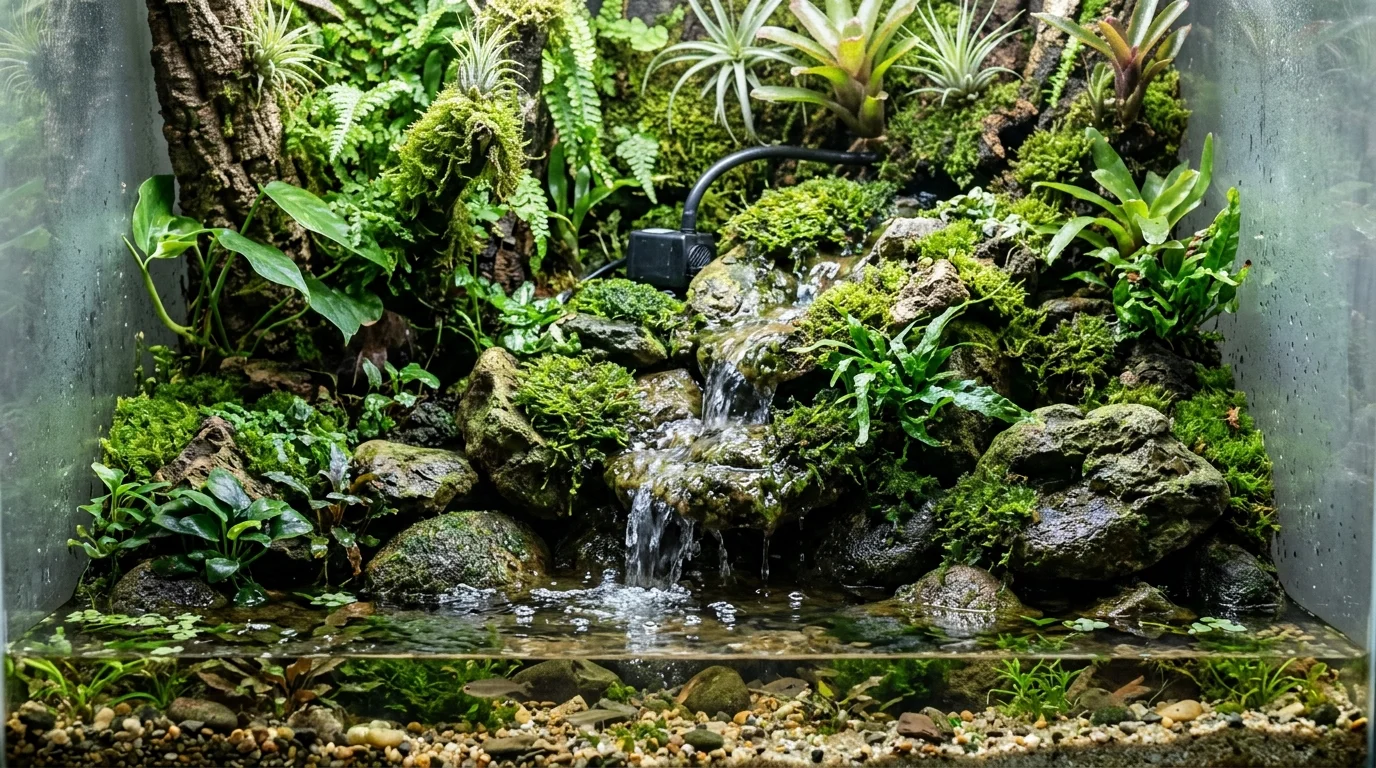
Quick Answer
Size a paludarium pump by true water volume and actual lift, not by the number on the box. Aim for 4 to 6 times the water volume per hour for basic circulation and 8 to 10 times for streams and waterfalls, then check the manufacturer's flow curve at your real head height, because a pump rated at 100 GPH can deliver only 30 to 40 GPH at 60 cm (24 in) of lift. Hide the pump in an accessible chamber with a coarse 10 to 20 PPI foam pre-filter, use black tubing to resist algae, regulate flow with a valve, build stepped ledges to cut splash, and aim the return flow to create a circular current so no dead zones form.
Key Takeaways
- Use 4 to 6 times the true water volume per hour for general circulation and 8 to 10 times for streams and waterfalls, then size from the pump's flow curve at your actual head height.
- Vertical lift cuts delivered flow sharply: a pump rated at 100 GPH can drop to 30 to 40 GPH at 60 cm (24 in), so always measure from the water line to the outlet.
- Build a hidden pump chamber with a removable lid, spare cord and tubing slack, and wrap the intake in coarse 10 to 20 PPI reticulated foam so you can service the impeller without demolishing the hardscape.
- Use black flexible vinyl or silicone tubing, an in-line valve and stepped slate drop ledges to control flow, algae, splash and noise.
- Aim the return flow along a wall to create a circular current loop and break the surface gently, which prevents dead zones and biofilm scum and aerates the water without a noisy air stone.
Why Paludarium Pumps Are Different From Aquarium Pumps
A standard aquarium pump moves water in a loop inside a tank. A paludarium pump has to lift water out of a small pool, up through tubing, over rock or foam, and back down in a controlled stream, often against a real vertical climb. It also lives in a build that is mostly hidden behind hardscape, so a poor choice is hard to fix later. Start by deciding how much water you actually have: a build with a large land zone has far less water than its glass volume suggests. If you have not sized the zones yet, use the paludarium land-to-water ratio calculator, then size the pump from the water volume it gives you. If your build has no land at all, you are closer to a riparium, and the guide to riparium vs paludarium explains how circulation needs differ.
Pump Sizing and Head Height Calculations
The Turnover Rule
Turnover is the number of times per hour the pump moves the full water volume. Two working ranges cover most builds:
- 4x to 6x per hour: Enough for basic biological filtration and circulation in a still pool.
- 8x to 10x per hour: Needed when the pump also feeds an active stream or waterfall, because part of the flow is spent on the feature.
Use the true water volume, measured after substrate, rock, foam and the false bottom void are in place. A 10 US gallon (38 L) water zone with a waterfall needs roughly 80 to 100 GPH (300 to 380 L/h) delivered, not 80 to 100 GPH printed on the box.
Head Height and Flow Loss
Head height is the vertical distance from the water surface to the highest point the water must reach. Every pump has a flow curve: flow is highest at zero head and falls as lift increases, reaching zero at the pump's maximum head. The loss is not small. A 100 GPH submersible pump can drop to 30 to 40 GPH at 60 cm (24 in) of vertical head. Tubing length, tight bends, narrow fittings and a partly closed valve add friction loss on top of that.
- Measure the vertical distance from the normal water line to the waterfall outlet, not from the tank base.
- Calculate the target flow using the 8x to 10x turnover rule for the water volume.
- Open the manufacturer's flow curve and read the delivered flow at your head height.
- Add a margin of 20 to 30% for friction in tubing and fittings, and for flow that you will throttle with a valve.
- Pick the smallest pump whose curve meets that number, and use a valve to turn it down, rather than buying an oversized pump you cannot control.
The matrix below shows illustrative values. Delivered flow varies by model, so treat it as a planning guide and always check the curve for the pump you are buying.
| Feature Height | Tank Water Volume | Recommended Nominal GPH | Actual Delivered Flow | Recommended Tubing ID |
|---|---|---|---|---|
| 15 cm (6 in) | 10 gal (38 L) | 150 GPH (570 L/h) | About 100 to 120 GPH | 3/8 in |
| 30 cm (12 in) | 15 gal (57 L) | 200 GPH (760 L/h) | About 120 to 140 GPH | 1/2 in |
| 45 cm (18 in) | 20 gal (76 L) | 300 GPH (1,135 L/h) | About 160 to 190 GPH | 1/2 in |
| 60 cm (24 in) | 30 gal (114 L) | 450 GPH (1,700 L/h) | About 240 to 270 GPH | 1/2 to 3/4 in |
| 90 cm (36 in) | 40 gal (151 L) | 600 GPH (2,270 L/h) | About 320 to 360 GPH | 3/4 in |
Hidden Pump Chamber Design
Where to Put the Pump
There are two reliable locations. The first is beneath the false bottom, in the void that also catches drainage water. The second is a vertical PVC or acrylic shaft built behind the foam or stone, open at the top and perforated near the base. Both keep the pump submerged and invisible. For how the false bottom and access pipes are built, see our guide to the paludarium land-to-water barrier. A pump chamber must be separated from the substrate by the same capillary break and geotextile as the rest of the barrier, or soil will work into the pump.
Maintenance Access
Every pump needs cleaning, so build the access before the hardscape goes in:
- Removable lid: A slate slab, a faux-rock lid made from foam and silicone, or a cork panel that lifts straight out.
- Cord and tubing slack: Leave enough slack that the pump can be lifted to the rim without disconnecting the tubing or pulling the outlet out of the waterfall.
- Unions or quick-connects: Use a union on the tubing so you can remove the pump without cutting anything.
- Drip loop in the cord: Run the power cord down in a loop so water cannot travel along it to the plug.
Pre-Filtration
Wrap the intake in a block of coarse reticulated foam rated at 10 to 20 PPI. The open cells pass water but stop plant debris, moss strands and small animals such as shrimp or crab larvae before they reach the impeller. Moss fragments are a common culprit, so if you grow carpets or walls, see our paludarium moss guide and keep the intake well away from them. Rinse the foam in tank water, never tap water, during routine maintenance.
Water Feature Plumbing: Streams, Waterfalls and Drip Ledges
Tubing Selection
Use black flexible vinyl or silicone tubing, in 3/8 in or 1/2 in inside diameter for most builds. Black tubing blocks light, which stops algae from growing inside the line and restricting flow. Clear tubing in a lit tank turns green within weeks. Choose tubing labeled aquarium-safe or food-grade, and avoid brass fittings, because copper leaching can harm crustaceans and shrimp.
Flow Regulation
Too much flow erodes soil and blasts plants. Too little leaves a waterfall trickling and a pool stagnant. Use two controls together: an in-line ball valve made of PVC or nylon, and the adjustable intake dial on the pump itself. Set the valve so plants and moss near the feature are watered gently but substrate is not washed away. Leave the valve at least partly open, because a pump run nearly closed will overheat and wear faster.
Splash Prevention and Noise Reduction
A sheer drop onto water is the loudest and splashiest arrangement. Use stepped drop ledges instead. Break the fall into two or three small steps with slate shims or flat stones angled slightly toward the pool, and let the water slide over a textured surface rather than fall through air. This cuts noise, keeps water off the terrestrial glass and prevents droplets from drying into mineral spots. For a drip wall, feed a perforated line along the top of a textured background so water films down the surface evenly, and aim the lowest outlet at a rock rather than directly at open water.
Water Circulation Methods Compared
| Feature Type | Hydraulic Setup | Best Flora/Fauna | Primary Maintenance Risk |
|---|---|---|---|
| Waterfall | Pump lifts water to an upper outlet and falls over stepped ledges | Bucephalandra and Anubias on splash-zone rock; frogs and crabs that like moving water | Splash, noise and evaporation; clogged outlet |
| Stream | Gentle sloped channel returning to the pool | Moss, ferns and marginal plants along the banks; crabs | Channel leaks and algae in slow stretches |
| Drip wall or ledge | Perforated line along the top of a textured background | Epiphytes and mosses; dart frogs and other humidity-loving species | Blocked holes and uneven flow |
| Return loop only | Pump aims flow along a wall to circulate a shallow basin | Fish, shrimp and snails in the water zone | Dead zones and surface scum if aimed poorly |
Eliminating Aquatic Dead Zones
Circular Current Loops
Water that does not move grows biofilm, collects dust and loses oxygen. In a shallow basin, place the pump outlet in one corner, aimed along the far wall instead of across the pool, and put the intake in the opposite corner. The flow then travels around the perimeter and returns to the intake in a circular loop that sweeps the entire basin. Check by dropping a pinch of fish food or a few drops of dye in each corner and watching where it drifts. Any corner where it sits is a dead zone, so redirect the outlet or add a small second outlet.
Aeration Without a Noisy Air Stone
Oxygen enters water at the surface, so surface movement matters more than bubbles. Aim the return so it ripples the surface without splashing, let waterfalls and stream steps tumble through air, or add a venturi on the outlet if the pump supports one. A gentle surface ripple prevents the oily film that forms in still water and keeps the exchange of gases working. A smooth, quiet surface that is slowly moving beats a hissing air stone in a living room.
Plants, Animals and Pump Placement
Flow affects what thrives where. Bucephalandra and Anubias nana grow well on rock in the splash zone, where moving water brings oxygen and nutrients, but they resent heavy direct force on the leaves. Semi-aquatic animals need a calm area to rest. For crabs especially, keep a quiet, shallow, easy-exit section of the pool away from the outlet. The vampire crab paludarium guide covers the land and water layout those animals need.
Pump Maintenance Schedule
- Every 2 to 4 weeks: Rinse the pre-filter foam in removed tank water and check the outlet for debris.
- Every 2 to 3 months: Remove the pump, take off the cover, and clean the impeller and shaft.
- Every 6 to 12 months: Inspect the impeller and shaft for wear, replace worn parts, and replace tubing that has gone brittle or discolored.
- During every water change: Unplug the pump before water drops below its intake.
Common Mistakes to Avoid
- Sizing by the box: Ignoring head height leaves a waterfall that trickles.
- Burying the pump: A pump you cannot reach is a pump you will have to demolish the scape to replace.
- Running the pump dry: Even a few minutes can overheat the motor and damage the bearing.
- Using clear tubing: It fills with algae and cuts flow.
- Dropping water from a height onto open water: It is loud, splashy and a source of mineral spots on the glass.
Frequently Asked Questions
Can I run a pump dry during a water change?
No. Unplug the pump before the water level falls below its intake. Running dry, even for a few minutes, can overheat the motor and damage the bearing because the water is what cools and lubricates it. Plug it back in only after the water is above the intake.
How do I stop a pump from vibrating against the glass?
Rest the pump on a foam pad or on silicone suction cups so it is not touching the glass, make sure tubing is not pressed against the pane, and check that the impeller is seated and not worn. A pump hidden in a foam-lined chamber is usually quieter than one mounted on the glass.
Can tubing leach chemicals into a paludarium?
Low-quality vinyl can release plasticizers, and some fittings can release metals. Use tubing labeled aquarium-safe or food-grade, flush it with warm water before use, and avoid brass fittings, because copper is toxic to crabs, shrimp and other invertebrates. Silicone tubing is a good choice for sensitive animals.
How do I clean a calcified impeller?
Unplug the pump and remove the cover and impeller. Soak the parts in a 1:1 mix of white vinegar and water for 15 to 30 minutes, then scrub off the loosened scale with a soft brush. Rinse thoroughly in clean water before reassembling and returning the pump to the tank. Replace the impeller or shaft if it is worn.
What is a siphon breaker and do I need one?
A siphon breaker is a small hole, about 1 to 2 mm, in the tubing just above the water line. It lets air in when the pump stops, so the tubing cannot siphon the pool down through the outlet. Use one whenever the outlet or a drain line could end up below the water level.
How do I size a pump for a waterfall?
Take the true water volume and multiply it by 8 to 10 for the hourly flow you need. Measure the vertical distance from the water line to the outlet, then read the delivered flow at that head on the manufacturer's flow curve. Add a 20 to 30% margin for friction and valve restriction, and pick a pump that meets the number. A rated 100 GPH pump can deliver only 30 to 40 GPH at 60 cm (24 in) of lift.
What size tubing should I use for a paludarium pump?
Most builds use 3/8 in or 1/2 in inside-diameter tubing. Use 3/8 in for small pumps and short features, 1/2 in for mid-size pumps, and 3/4 in for larger pumps or long runs. Tubing that is too narrow adds friction and reduces delivered flow.
Why use black tubing instead of clear?
Black tubing blocks light, so algae cannot grow inside the line. Clear tubing in a lit paludarium grows a green film that narrows the bore and reduces flow.
How do I protect animals from the pump intake?
Wrap the intake in a block of coarse reticulated foam rated at 10 to 20 PPI. It stops moss, plant debris and small animals such as shrimp or crab larvae from reaching the impeller. Rinse the foam in tank water every few weeks.
How do I reach a hidden pump without tearing the scape apart?
Build access in from the start. Put the pump under the false bottom or in a vertical PVC or acrylic shaft behind the foam, with a removable slate or faux-rock lid, spare cord, and a union on the tubing. See the guide to the paludarium land-to-water barrier for how the false bottom and access pipes are built.
How do I keep a waterfall from splashing the glass?
Replace sheer drops with stepped ledges made from slate shims, lower the outlet closer to the water, and reduce flow with an in-line valve. Angle the landing rock toward the pool so water slides instead of splashing.
Explore More
Related Articles


Related Plant Guides
No specific plant guides found matching this topic.
Recommended next actions
Continue Exploring
Dive deeper into related plant care tools and profiles.
Calculator
Paludarium Water Volume & Land Ratio Calculator
Calculate net paludarium water volume, land and water surface areas, false bottom void capacity, and minimum pump flow in metric or imperial units.
Plant Guide
Anubias Nana
Anubias Nana is a hardy, slow-growing, low-light epiphyte perfect for beginner aquariums and aquascaping.
Plant Guide
Bucephalandra
A slow-growing Bornean rheophyte that must be attached to rock or wood, never buried, and rewards stable water with metallic, iridescent foliage.
Topic Guide
Paludarium Moss: How to Attach, Hydrate, and Maintain Moss
A technical guide to using moss across terrestrial, splash, transition, and submerged paludarium zones, covering attachment mechanics, hydration, PAR, airflow, algae control, and maintenance.
Topic Guide
Building a Paludarium Land-to-Water Barrier: Drainage, Foam & Mesh
Build a leak-proof paludarium land-to-water barrier: false bottom eggcrate construction, expanding foam waterproofing, geotextile mesh, and soil wicking prevention.
Topic Guide
Riparium vs Paludarium: Structural & Ecosystem Differences Explained
Riparium vs Paludarium comparison: open water volume vs terrestrial land area, hanging planters vs false bottoms, animal stocking, and maintenance differences.