Paludarium Water Volume & Land-to-Water Ratio Calculator
Calculate net paludarium water volume, land and water surface areas, false bottom void capacity, and minimum pump flow in metric or imperial units.
Quick Answer
The calculator estimates paludarium land and water volumes from the enclosure dimensions, land-to-water ratio, substrate depth, and selected false-bottom setup. For an eggcrate false bottom, it models the hidden void at about 95% usable water-filled space, while other drainage-layer setups use their specified assumptions. The result helps estimate how much land and water volume your paludarium provides before accounting for irregular hardscape, plants, or other displacement.
Enter your details
Enter your details below to generate a custom recommendation.
Recommended Output
Actual water available for filtration, dosing, and aquatic life after subtracting land footprint, substrate void, and hardscape displacement.
Required delivered turnover flow for water features and filtration.
Land Footprint Area
False Bottom Void Volume
Water Surface Area
Open Water Basin Volume
Total internal glass volume (L × W × H).
The Problem
A paludarium's glass volume says very little about its real water volume, because land, hardscape and the false bottom void all change it. Keepers need a net water figure to size pumps, dose treatments, plan water changes and choose livestock.
When to Use This Tool
When planning a new paludarium and deciding how much of the footprint should be land versus water.,When sizing a pump or filter from the true water volume instead of the glass volume.,When estimating how much water an eggcrate or LECA false bottom void adds to the system.,When working out how much water to prepare for a first fill or a large water change.,When comparing eggcrate, LECA and solid-bank builds for the same tank.
Who is this for?
- Paludarium and riparium builders
- Keepers planning vampire crab or other semi-aquatic setups
- Aquascapers adding waterfalls, streams and hidden pump chambers
Why Glass Volume Misleads in a Paludarium
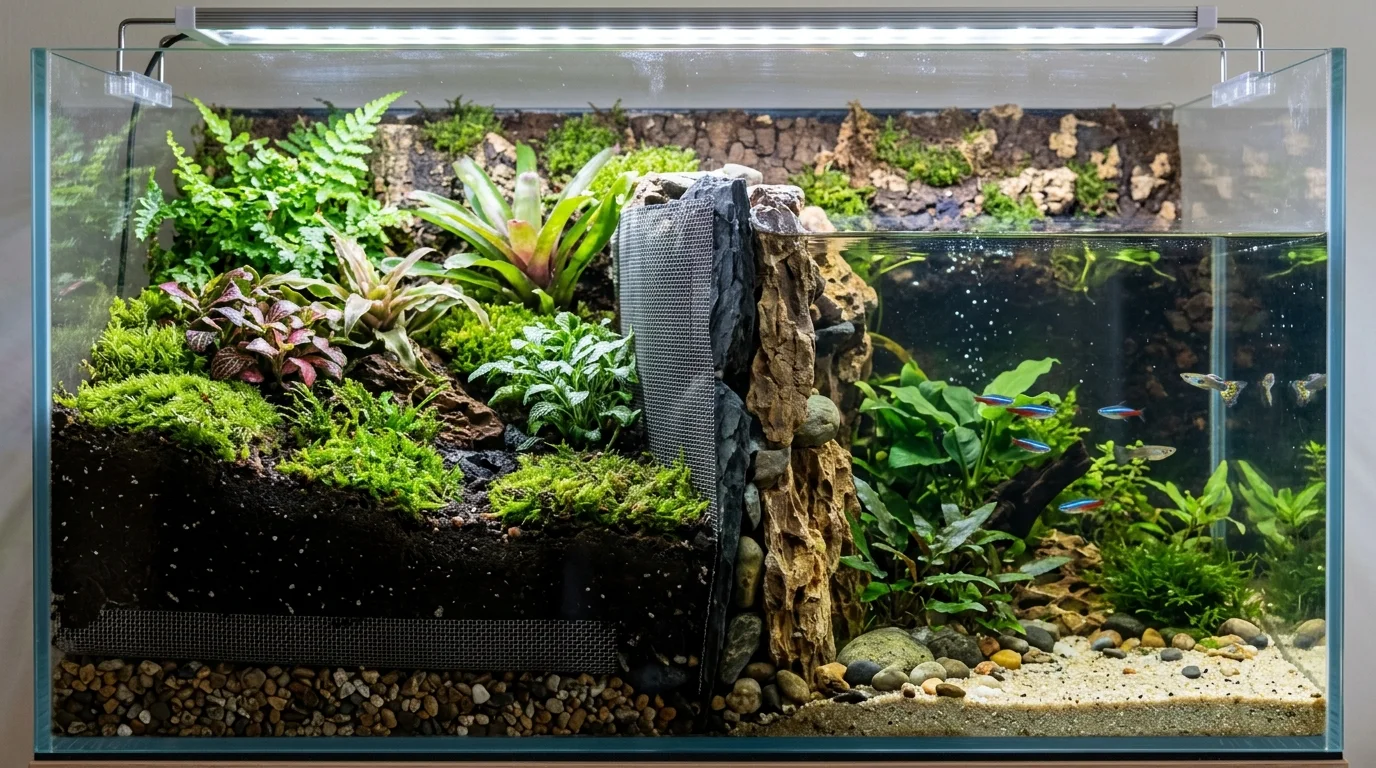
A paludarium's glass volume overstates its water. Part of the footprint is land, part of the height is air, and rock, wood and foam take up room. This calculator turns your dimensions into a net water figure you can use for pump sizing, dosing and water changes. If you are still deciding how much of the tank should be land, the riparium vs paludarium comparison explains how the land-to-water split changes what the build can support.
How to Use the Calculator
- Enter the internal tank dimensions: length, width (front to back) and height, measured inside the glass.
- Set the water depth: the depth of standing water. With a false bottom, this is also the height of the water-filled void under the land.
- Choose the land footprint: the share of the floor that is land, from 10% to 90%.
- Pick the false bottom type: an eggcrate void holds the most hidden water, LECA or gravel holds less, and a solid bank holds none.
- Estimate hardscape displacement: rock-heavy and foam-heavy builds hold less water than sparse ones.
- Select the turnover rate: 5x for circulation only, 8x for a stream or waterfall, 10x for a heavy waterfall.
What Each Result Means
- Total tank volume: gross glass volume, useful for stand weight and glass planning, not for dosing.
- Water zone and land zone area: the footprint split in cm² and sq in.
- Open water volume: the exposed pool before displacement.
- False bottom void volume: hidden water under the land before displacement.
- Net water volume: the figure to use for dosing and water changes.
- Minimum delivered pump flow: the flow you need at the outlet after head loss. The paludarium water circulation pumps guide explains how to convert it into a nominal pump rating that accounts for vertical lift.
Choosing a False Bottom Type
An eggcrate void gives the most hidden water and the easiest maintenance access. A LECA or gravel layer is simpler to build and holds less water because it only fills the gaps between particles. A solid bank holds no water under the land, so all water sits in the open pool. Construction details for each approach are in the paludarium land-to-water barrier guide.
Sizing Water Volume for Plants and Animals
Semi-aquatic animals such as the species in our vampire crab paludarium guide care more about land area, humidity and easy exits than about a large water volume. Fish need real net volume and filtration. Shoreline plants such as Bucephalandra and Anubias nana grow on rock at the water margin and are not limited by net volume, but they need that margin to exist, so keep some shallow water and exposed rock in your layout.
Presets and Worked Examples
The three presets show how land share, void type and displacement change the result across tank sizes. Each worked example lists every step, so you can audit the numbers by hand.
Preset names are labels for the tank footprint class. The actual net water volumes are much smaller than the nominal gallon figures, which is normal for a land-heavy build.
Recommended next actions
Next Best Actions
Use the result in a real care workflow with plant profiles, guides, and personalized quizzes.
Calculator
Paludarium Water Volume Calculator
Calculate the gross aquatic zone volume and estimate net usable water volume of a paludarium in gallons and liters. Deduct foundation and hardscape displacement.
Topic Guide
Building a Paludarium Land-to-Water Barrier: Drainage, Foam & Mesh
Build a leak-proof paludarium land-to-water barrier: false bottom eggcrate construction, expanding foam waterproofing, geotextile mesh, and soil wicking prevention.
Topic Guide
Riparium vs Paludarium: Structural & Ecosystem Differences Explained
Riparium vs Paludarium comparison: open water volume vs terrestrial land area, hanging planters vs false bottoms, animal stocking, and maintenance differences.
Topic Guide
Paludarium Water Pumps: Sizing, Waterfall Plumbing & Circulation
Size and plumb paludarium pumps: GPH vs head height calculation, hidden pump chambers, drip wall plumbing, avoiding dead zones, and pump maintenance.
Topic Guide
Vampire Crab Paludarium Setup: Habitat, Husbandry & Care
Learn how to design a vampire crab paludarium with usable land, shallow water, suitable substrate, humidity, temperature, hiding places, and compatibility guidance.
Troubleshooting & Diagnostics Guide
1 Net water volume is far lower than the tank's gross volume
Diagnosis: Gross volume includes land, the air above the waterline and hardscape. In land-heavy builds the net figure is often 15% to 30% of gross.
Treatment: This is expected. Use net volume for pump sizing, dosing and water changes, and use gross volume only for glass and stand planning.
2 A warning says there is too little height above the waterline
Diagnosis: Tank height minus water depth is under 10 cm (4 in), leaving little room for land, plants and an air gap above the water table.
Treatment: Lower the water depth or choose a taller tank. A land surface that sits too close to the water invites capillary wicking.
3 Calculated pump flow seems too small for the waterfall
Diagnosis: The result is a delivered-flow target at the outlet, and a pump's nominal rating drops sharply with vertical lift.
Treatment: Measure the vertical distance from the waterline to the outlet and check the pump's flow curve at that head. See the circulation pumps guide for a sizing procedure.
4 Real water volume is lower than the calculator result
Diagnosis: More hardscape than estimated, an eggcrate void partly blocked by substrate or mesh, or a waterline below the assumed depth.
Treatment: Raise the hardscape displacement percentage, confirm the void is open, and re-measure the water depth.
Glossary of Terms
- False Bottom
- A supported panel, often eggcrate, that holds the land substrate above a water-filled void so soil does not touch standing water.
- Capillary Break
- An air gap or non-porous barrier that stops soil from wicking water upward from the water table.
- Net Water Volume
- The volume of standing water in the system after accounting for land, the false bottom void and hardscape displacement.
- Turnover Rate
- The number of times per hour a pump moves the full water volume.
- LECA
- Lightweight expanded clay aggregate, a porous drainage material with open space between particles.