Carnivorous Plant Water TDS & Dilution Calculator
Rate your water's TDS for carnivorous plants, calculate how much tap water can be blended with RO or distilled water to reach a safe target, and estimate how fast minerals build up in a pot.
Quick Answer
Enter your measured tap TDS, the TDS of your RO, distilled or rain water, the batch size and a target (30 ppm by default, never above 50 ppm). The calculator applies a mass-balance equation, V_tap = V_total × (TDS_target − TDS_pure) / (TDS_tap − TDS_pure), to give the most tap water you can blend and the pure water needed. For example, 180 ppm tap water and 5 ppm RO water make a 5-litre batch at 30 ppm with about 0.71 L of tap and 4.29 L of RO, a 6.0 : 1 pure-to-tap ratio. It also rates your raw water (Optimal, Safe, Marginal or Lethal / Toxic) and estimates how many weeks minerals take to reach a toxic level in an unflushed pot. Boiling or letting tap water stand does not lower TDS.
Enter your details
Enter your details below to generate a custom recommendation.
Recommended Output
RO, Distilled, or Clean Rainwater
Tap or Well Water Allowance
The Problem
Knowing whether tap, well or rain barrel water can be used on carnivorous plants, and working out exactly how much pure water to blend with it, without guessing ratios or ignoring the mineral build-up caused by evaporation.
When to Use This Tool
When you have measured your tap or well water with a TDS pen and need to know whether it is safe for carnivorous plants.,When you want to stretch RO or distilled water by blending in a measured amount of tap water.,When you need a target TDS for sensitive plants, seedlings, terrariums or wicking rock mounts.,When you want to plan how often a pot or bottom-watering tray should be flushed.,When you want to verify that an RO unit, DI resin or rain barrel is still producing usable water.
Who is this for?
- Carnivorous plant growers using tap water, well water or rainwater
- Keepers of Nepenthes, sundews, butterworts, Venus flytraps and Sarracenia
- Terrarium and greenhouse hobbyists building low-mineral water systems
What this calculator does
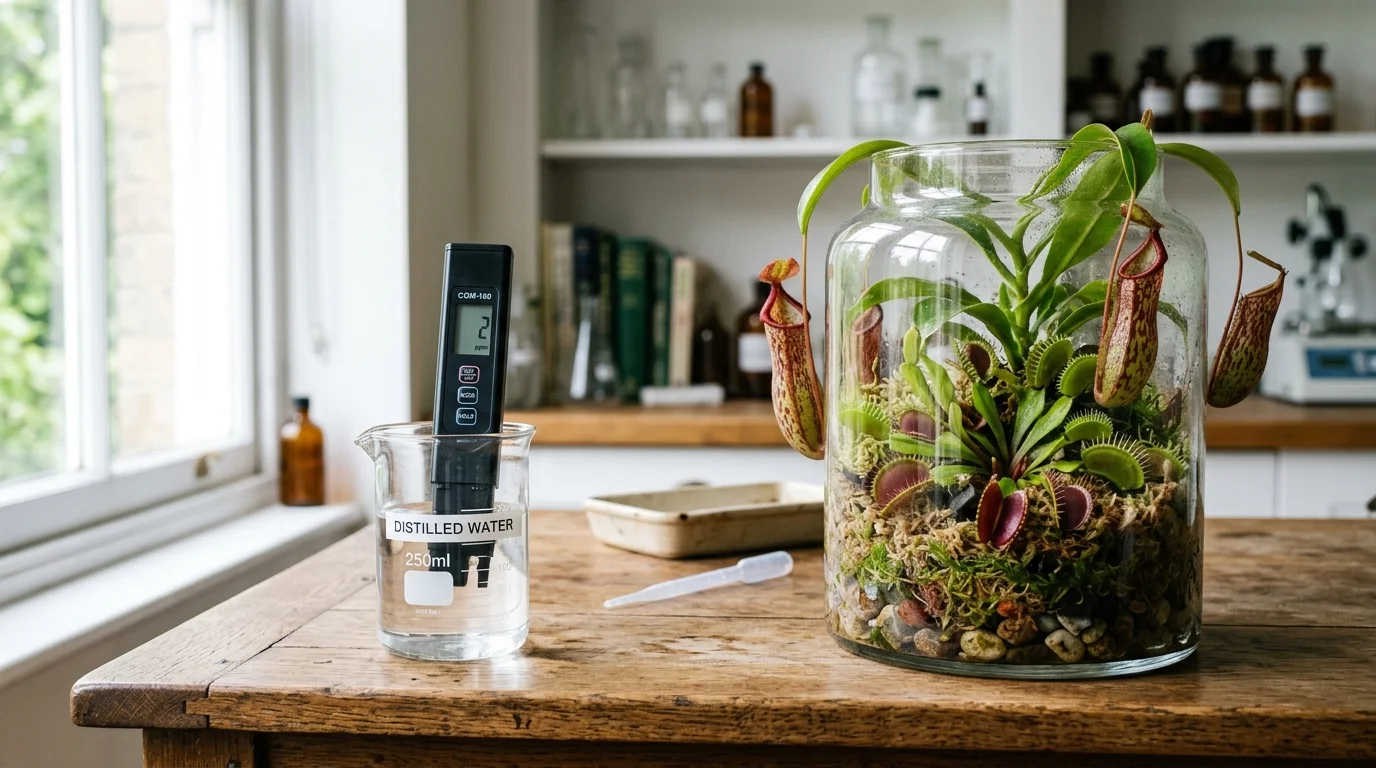
Tap water that looks clean can still kill carnivorous plants slowly. This calculator turns a handheld TDS reading into three practical answers: how safe your water is, how much tap water you can blend into pure RO, distilled or rain water to reach a safe target, and how quickly minerals will build up in a pot if you never flush it.
Why TDS matters for carnivorous plants
Carnivorous plants evolved in nutrient-poor bogs, where rain is the main water source and the soil holds almost no dissolved salts. Their roots cope poorly with dissolved calcium, magnesium, sodium and bicarbonate, which accumulate in the substrate and damage root tissue. Sensitive plants include Nepenthes ventrata, Mexican butterworts such as Pinguicula moranensis, and sundews such as Drosera capensis, although tolerance varies by species. As a rule, the lower the TDS, the safer the plant.
The four safety tiers
- Optimal (under 20 ppm): ideal for any species, including seedlings and sensitive plants.
- Safe (under 50 ppm): acceptable for most species, with occasional flushing of the substrate.
- Marginal (50-100 ppm): risky, because evaporation concentrates minerals quickly. Dilute it or use it only with frequent flushing.
- Lethal / Toxic (over 100 ppm): do not use undiluted. Plants usually decline over weeks to months.
The tier describes your raw source water. After blending to your target, the mixture should fall in the optimal or safe tier.
How the dilution works
The calculator uses a mass-balance equation:
$$V_{\text{tap}} = V_{\text{total}} \times \frac{\text{TDS}_{\text{target}} - \text{TDS}_{\text{pure}}}{\text{TDS}_{\text{tap}} - \text{TDS}_{\text{pure}}}$$
With 180 ppm tap water, 5 ppm RO water and a 30 ppm target, only about 14% of a batch can be tap water. A 5 L batch uses about 0.71 L of tap and 4.29 L of RO, a 6.0 : 1 ratio. Harder water leaves even less room: a 420 ppm well supply contributes only about 6% of a batch at 30 ppm. At that point, ask whether the tap water is worth using at all, because the saving is small and a small meter error shifts the result noticeably.
Why evaporation turns low-TDS water toxic
Water evaporates from the substrate surface, the pot walls, the tray and the plant, but dissolved minerals do not evaporate with it. Each time you top up with the same water, you add another dose of minerals to a pot that already holds the earlier ones. The concentration in the substrate climbs well above the number on your meter.
Water that reads 60-80 ppm can therefore turn toxic within weeks, and how long depends on the volume of water the system holds. A small pot with 0.75 L of pore water and 250 ml of weekly evaporation can cross 100 ppm in one to two weeks at 70 ppm. A bottom-watering tray system holding about 4 L of water takes around six to seven weeks at the same reading. Bottom-watering trays are especially unforgiving because the reservoir loses water continuously and never rinses minerals out.
Treat the accumulation estimate as a flushing schedule: slowly pour pure water through the substrate from the top, well before the estimated number of weeks, and let it drain from the base.
Myths: boiling, standing and filter jugs
- Boiling does not lower TDS. Boiling removes water as steam and leaves the minerals behind, so the remaining water is more concentrated. Some carbonate may precipitate as limescale, but the water that remains is still far from safe.
- Letting tap water stand overnight does not lower TDS. Chlorine gas escapes, but calcium, magnesium and sodium stay, and evaporation slightly raises the concentration.
- Carbon pitcher filters do not remove dissolved ions. Activated carbon removes chlorine and some organics, so filtered tap water usually reads about the same as the unfiltered supply. Only RO, distillation, DI resin or clean rainwater reliably give low-TDS water.
Commercial Water Filter Reality-Check: Standard carbon pitchers (like Brita or PUR) remove chlorine and taste compounds but do NOT reduce dissolved mineral ions (TDS). Only Reverse Osmosis (RO) or deionization (ZeroWater) purifies water to safe carnivorous thresholds.
Measuring accurately
A TDS pen measures electrical conductivity and converts it to ppm with a fixed factor, so readings are estimates and brands can disagree. What matters is using the same meter consistently. Test your pure water first: if it reads above about 10-15 ppm, your RO membrane or DI resin may need replacing. Rinse the probe in pure water between samples and measure at room temperature.
Using the result in your setup
- Terrariums and enclosed displays: little water leaves an enclosure, so salts accumulate fast. See the carnivorous plant terrarium build guide for drainage and flushing layouts.
- Substrate choice: the peat and perlite or sand mixes in the carnivorous plant substrate guide add no minerals. Garden soil and houseplant mixes do.
- Rock mounts: a wicking rock concentrates salts in its pores, so Mexican butterworts need very low-TDS water. See the Pinguicula rock setup guide.
- Winter dormancy: pots stay barely damp in winter, which makes mineral crust easy to miss. Flush before the spring wake-up described in the dormancy requirements guide.
- Plants used as gnat traps: living traps watered with tap water decline and stop making sticky leaves. See carnivorous plants for fungus gnats.
A simple routine
- Measure your pure water and your tap water.
- Choose a target of 30 ppm or lower. If your tap TDS is several hundred ppm, consider using pure water alone.
- Enter the values and mix the batch using the volumes shown.
- Check the final blend with the meter before use.
- Flush each pot with pure water on the schedule suggested by the accumulation estimate.
Recommended next actions
Next Best Actions
Use the result in a real care workflow with plant profiles, guides, and personalized quizzes.
Plant Guide
Cape Sundew
Drosera capensis, the Cape sundew, is a fast-growing, forgiving carnivorous plant with long sticky red-tipped leaves that curl around prey, grows all year without dormancy and doubles as a living flypaper.
Plant Guide
Ventrata Pitcher Plant
Nepenthes ventrata is a hardy tropical pitcher plant hybrid that produces fluid-filled pitfall traps on its leaf tendrils, grows year-round without dormancy and tolerates household humidity better than most Nepenthes.
Plant Guide
Mexican Butterwort
Pinguicula moranensis is a compact Mexican butterwort that switches between sticky carnivorous leaves in summer and a tight succulent rosette in winter, and thrives in pumice or on wicking rock.
Topic Guide
Carnivorous Plant Substrate Guide: Ingredients, Ratios & Zero Fertilizer
Master carnivorous plant substrate recipes: 50/50 peat-perlite/silica sand ratios, zero-fertilizer rules, rinsing minerals, and live sphagnum moss.
Topic Guide
How to Build a Carnivorous Plant Terrarium: Bog Layering & Drainage
Build a carnivorous bog terrarium with LECA drainage, mineral-free peat mix, RO water, species zoning, ventilation, and strong LED lighting.
Topic Guide
Carnivorous Plants for Fungus Gnats: Living Sticky Traps
Control houseplant fungus gnats naturally with carnivorous plants: Drosera sundews and Pinguicula butterworts as living flypaper, placement, and limits.
Troubleshooting & Diagnostics Guide
1 White crust forms on the substrate surface or pot rim
Diagnosis: Evaporation is leaving dissolved minerals behind, usually from tap water or marginal-tier water.
Treatment: Flush the pot slowly from the top with pure water until it drains freely, scrape off the crust and repot if the substrate is heavily encrusted. Keep blended water under 30 ppm afterwards.
2 Sundew dew drops dry up and tentacle tips blacken
Diagnosis: Mineral build-up in the substrate, or water above 100 ppm.
Treatment: Flush with RO or distilled water, switch to pure water immediately and trim only leaves that are fully dead.
3 Pitcher lids and rims brown, with new pitchers staying small
Diagnosis: Salt stress from hard water or accumulated minerals in the pot.
Treatment: Flush the pot thoroughly, switch to low-TDS water and keep humidity high while the plant recovers.
4 The calculator reports that the target cannot be reached
Diagnosis: The pure water reading is higher than the chosen target.
Treatment: Retest your pure water, replace an exhausted RO membrane or DI resin, or raise the target slightly if it is still under 50 ppm.
5 TDS pen reads above zero in distilled water or gives inconsistent readings
Diagnosis: Meter out of calibration, dirty probe or temperature effects.
Treatment: Rinse the probe in pure water, recalibrate with the standard solution recommended by the manufacturer and compare against a second meter.
6 Plants decline even though blended water reads under 30 ppm
Diagnosis: Salts have already accumulated in the substrate, or the substrate or a fertilizer is adding minerals.
Treatment: Flush the pot with several times its volume of pure water, check the medium for fertilizer and repot in a peat and perlite mix if needed.
7 Rain barrel water kills plants despite being soft
Diagnosis: Metal leachate such as zinc or copper from gutters or roofing, or organic contamination.
Treatment: Stop using the barrel water, flush the pots and switch to RO or distilled water. Collect from non-metal roofs and test before use.
Glossary of Terms
- TDS (Total Dissolved Solids)
- The total concentration of dissolved minerals and salts in water, usually estimated by a handheld meter that measures electrical conductivity and reports parts per million (ppm).
- Reverse Osmosis (RO)
- A filtration process that forces water through a semipermeable membrane to remove most dissolved ions, typically producing water below 15 ppm TDS.
- Deionised (DI) Water
- Water treated with ion-exchange resin to remove dissolved ions. Output is near 0 ppm until the resin is exhausted.
- Evaporative Concentration
- The build-up of dissolved minerals in a pot or tray as water evaporates and leaves its solutes behind, raising the concentration over time.
- Flushing
- Slowly pouring pure water through a substrate from the top and letting it drain from the base to wash accumulated minerals out of the pores.
Frequently Asked Questions
Is a Brita or other carbon pitcher filter good enough for carnivorous plants?
How do zero-water style filters compare with RO?
Does boiling tap water or leaving it overnight make it safe?
Is rain barrel water safe for carnivorous plants?
How do I calibrate a handheld TDS pen meter?
What are the signs of mineral toxicity on sundews?
What are the signs of mineral toxicity on pitcher plants and their lids?
What target TDS should I use?
How often should I flush my pots?
Can I use tap water if my meter reads under 50 ppm?
Scientific References
-
Source: carnivorousplants.org
Type: horticultural-reference
-
Source: extension.umn.edu
Type: horticultural-reference
-
Source: rhs.org.uk
Type: horticultural-reference