Carnivorous Plant Substrate Guide: Ingredients, Ratios & Zero Fertilizer
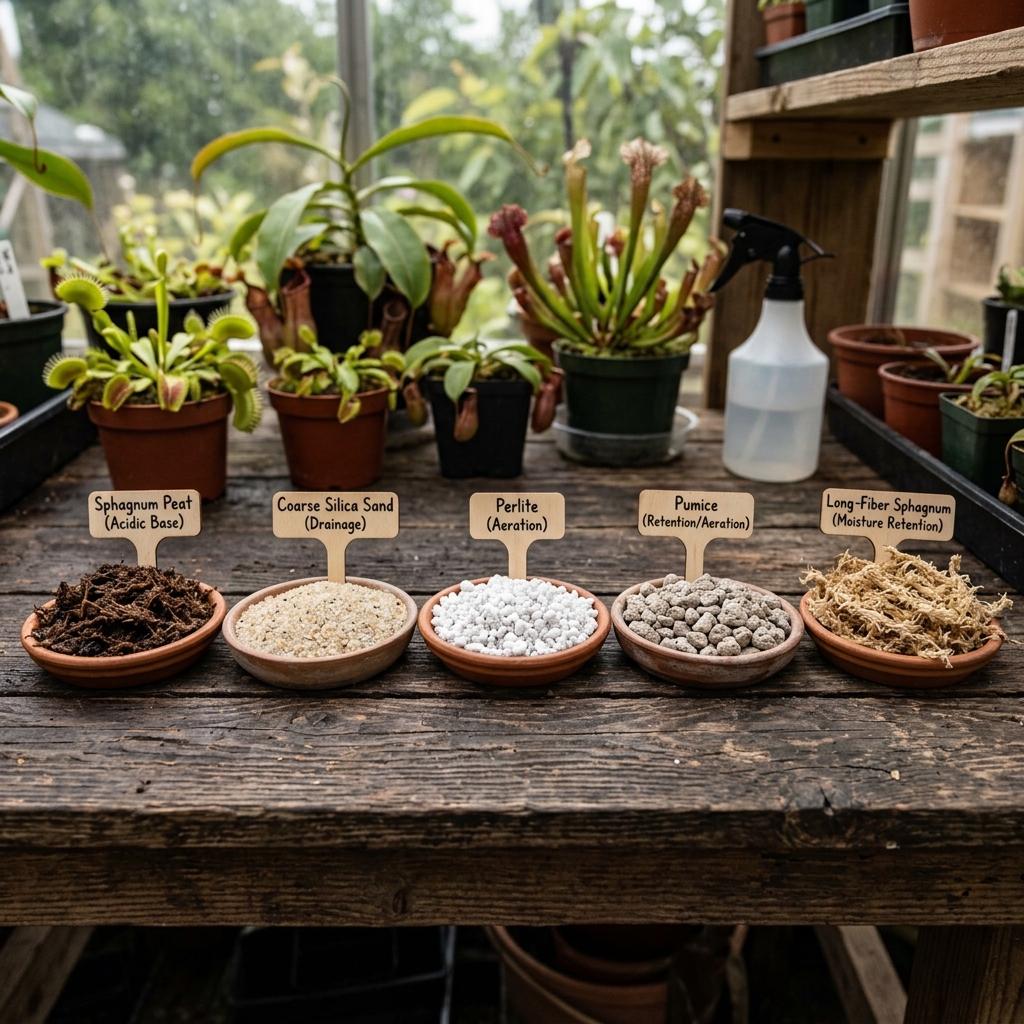
A reliable carnivorous plant substrate is built from clean, nutrient-free ingredients rather than conventional potting soil. The standard bog formulation uses 50% unfertilized Canadian sphagnum peat moss and 50% coarse washed silica sand or suitable horticultural perlite by volume. Nepenthes require a more airy epiphytic medium based on long-fiber sphagnum and perlite or pumice, while Mexican Pinguicula such as Pinguicula moranensis can be grown in a porous mineral-oriented mixture. Ingredient purity matters because fertilizers, compost, limestone, calcium-rich sand, and dissolved minerals can accumulate in the root zone. Pre-rinse mineral components with RO or distilled water, hydrate dry peat thoroughly, and verify rinse-water TDS when ingredient quality is uncertain.
Quick Answer
Carnivorous plant substrate must remain nutrient-poor, acidic, and free of fertilizer and mineral contamination. For most bog-type species, use unfertilized Canadian sphagnum peat with coarse washed silica sand or horticultural perlite at 50/50 by volume. Nepenthes generally need a more open long-fiber sphagnum and perlite/pumice mix, while Mexican Pinguicula can use a predominantly mineral, porous mix.
Key Takeaways
- Never use fertilizer-enriched peat, compost, manure, garden soil, or standard potting soil for carnivorous plant root zones.
- For a standard bog mix, combine 50% unfertilized Canadian sphagnum peat moss with 50% coarse washed silica sand or suitable horticultural perlite strictly by volume.
- Use pure #12–#20 coarse quartz/silica sand rather than builder's sand or beach sand that may contain limestone or calcium carbonate.
- Pre-rinse perlite and other mineral components with RO or distilled water, hydrate peat thoroughly, and test rinse runoff when ingredient purity is uncertain.
- Match the substrate to the plant group: bog-style peat mixes for many Drosera, airy long-fiber sphagnum mixes for Nepenthes, and porous mineral mixes for Mexican Pinguicula.
What Makes a Safe Carnivorous Plant Substrate?
Carnivorous plants evolved in environments where available soil nutrients are limited, so their growing medium should provide physical support, moisture, and air-filled pore space without functioning as a fertilizer reservoir. A suitable substrate is therefore deliberately low in nutrients and soluble minerals.
The most important rule is simple: use only clean, untreated ingredients and measure all recipes by volume unless a recipe explicitly specifies mass. Conventional houseplant soil, compost, manure, fertilizer-enriched peat, and enriched potting mixes are not substitutes for a carnivorous plant substrate.
The substrate is only one part of the growing system. Water quality, container drainage, light, temperature, and species-specific moisture requirements must also be matched. For a complete enclosure architecture, see the carnivorous plant terrarium build guide.
The Absolute Zero-Fertilizer Rule
Carnivorous plant roots are adapted to nutrient-poor conditions. Fertilizer-enriched peat, compost, manure, and standard potting soil can expose sensitive root systems to concentrations of soluble nutrients that are inappropriate for these plants. In severe cases, fertilizer salts can damage root tissues rapidly, with visible decline appearing within days.
Do not use products simply because the packaging says they are peat moss or sphagnum-based. Check the ingredient label for added fertilizer, controlled-release fertilizer, compost, lime, wetting agents, or other soil amendments.
Products such as enriched Miracle-Gro potting mixes or fertilizer-treated peat should not be used as the base of a carnivorous plant substrate. When in doubt, choose a product whose ingredient list clearly identifies untreated sphagnum peat moss without added fertilizer.
Standard Bog Mix: 50/50 by Volume
The standard starting recipe for many bog-type carnivorous plants is 50% unfertilized Canadian sphagnum peat moss and 50% coarse washed silica sand or horticultural perlite by volume.
The ratio is volumetric, not a weight ratio. For a 10-liter batch, combine 5 liters of suitable peat with 5 liters of suitable coarse silica sand or perlite. A 20-liter batch would contain 10 liters of each component.
Do not attempt to reproduce a 50/50 recipe by weighing the ingredients. Peat, silica sand, and perlite have very different bulk densities, so equal weights do not represent equal volumes.
Why the 50/50 Structure Works
Peat supplies moisture retention and acidic organic structure, while coarse silica sand or perlite increases pore space and reduces the tendency of the organic component to form a dense, oxygen-poor mass. The exact physical behavior varies with particle size, peat decomposition, and watering method.
For plants such as Drosera capensis, a moist bog-style substrate can provide the consistently hydrated root environment the species tolerates well. The same substrate should not automatically be imposed on every carnivorous genus.
Aerial Epiphytic Pitcher Mix for Nepenthes
Nepenthes generally benefit from a more open, airy substrate than a compact bog mix. A practical starting formulation is 60–70% long-fiber sphagnum moss and 30–40% horticultural perlite or pumice by volume.
For example, a 10-liter batch can contain 6 liters of long-fiber sphagnum and 4 liters of perlite for a 60/40 mix. A more open 70/30 formulation contains 7 liters of sphagnum and 3 liters of perlite.
Hydrate the long-fiber sphagnum thoroughly before planting, but do not compress it into a dense plug. The finished root zone should retain moisture while preserving abundant air-filled pore space.
For Nepenthes ventrata, use an elevated or otherwise well-drained planting position rather than allowing the pot or root mass to remain submerged in a standing reservoir.
Mexican Pinguicula Mineral Mix
Mexican Pinguicula can require a substantially different root-zone architecture from classic bog carnivores. A mineral-oriented starting recipe is 60% porous volcanic pumice, 20% coarse silica sand, and 20% horticultural perlite by volume, with minimal organic matter.
For a 10-liter batch, use 6 liters of pumice, 2 liters of coarse silica sand, and 2 liters of perlite. Again, these quantities are measured by volume rather than weight.
The objective is a porous, fast-draining medium rather than a waterlogged peat bed. Pinguicula moranensis is an example of a Mexican Pinguicula for which a mineral-oriented planting niche can be useful.
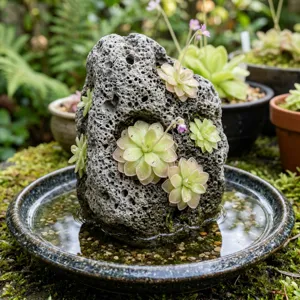
For species-specific placement and mineral architecture, see the Pinguicula rock setup guide. Species and seasonal differences should be considered before applying one mineral recipe universally.
Canadian Sphagnum Peat: What to Buy
Canadian sphagnum peat is the principal organic component of many carnivorous bog mixes, but the word “peat” on a package does not guarantee suitability. Select material that is identified as 100% pure sphagnum peat moss and contains no added fertilizer or enriched soil components.
Avoid products containing controlled-release fertilizer, starter fertilizer, compost, manure, lime, or unexplained soil amendments. Surfactants and wetting agents should also be avoided when the product formulation is not clearly documented for carnivorous plant use.
Testing Peat for Hidden Fertilizer
Start with the product label and manufacturer specification. If the ingredients are unclear, do not assume the peat is safe because the package uses the words “sphagnum peat moss.” A rinse test can provide additional evidence about soluble material but cannot prove that a product is free of every additive.
Place a measured sample of hydrated peat in a clean container, rinse it with low-TDS RO or distilled water, and measure the runoff TDS. A persistent elevated reading can indicate soluble salts or other dissolved material, although TDS alone cannot identify which compounds are present. For a conservative carnivorous setup, aim for rinse runoff below 20 ppm TDS after thorough preparation.
Silica Sand: Use Quartz, Not Generic Sand
Use coarse #12–#20 grit pure quartz or silica sand when a sand component is required. Coarse particles maintain drainage pathways and provide physical structure without contributing the carbonate minerals that can alter a deliberately acidic root zone.
Do not substitute builder's sand simply because it is inexpensive. Construction sands can contain variable mineral fractions, limestone, fines, clay, and other materials that are difficult to control in a sensitive carnivorous substrate.
Beach sand is also a poor default because it may contain salt residues, shell fragments, calcium carbonate, and other marine-derived minerals. A controlled horticultural substrate should use a known mineral composition instead.
Perlite: Rinse Before Use
Coarse horticultural perlite is useful because it increases aeration without adding substantial weight. However, perlite is often dusty and can carry soluble contamination from handling or processing.
Place the required quantity in a clean container and rinse it thoroughly with RO or distilled water. Allow the rinse water to drain away rather than incorporating the first dusty rinse into the final substrate.
Do not aggressively pulverize perlite during preparation. Preserve the coarse particle structure because the objective is to create durable air-filled spaces throughout the root zone.
Pumice and Lava for Mineral-Oriented Mixes
Porous volcanic pumice can provide durable pore structure in mineral-oriented Pinguicula substrates. Small lava granules can also contribute physical anchoring and drainage. Both materials should be treated as variable natural minerals rather than automatically pure inert substances.
Inspect the source material and remove visible dust. Rinse thoroughly with RO or distilled water before incorporation. Avoid material contaminated with fertilizer, mortar, lime, soil, or obvious soluble mineral deposits.
What About Coco Coir?
Coco coir is sometimes proposed as a peat substitute because it is renewable and moisture-retentive, but it should not be treated as a drop-in replacement for carnivorous plant peat. Coir products vary substantially in potassium, salts, buffering, processing residues, and pre-treatment.
For a conservative carnivorous substrate, untreated high-quality sphagnum peat remains the simpler baseline for bog species. If coir is considered for a species-specific formulation, use only a documented low-salt, thoroughly buffered product and verify that its chemistry is appropriate for the intended plant.
Do not assume that rinsing any generic coir product once makes it equivalent to pure sphagnum peat. Coir chemistry and physical behavior remain different from peat.
Measuring Substrate Components Correctly
Prepare recipes using calibrated volume containers rather than kitchen scales when the recipe is expressed as a percentage by volume. Fluff peat and long-fiber sphagnum before measuring so that compressed packaging does not create an artificially dense volume.
- Loosen and inspect each dry ingredient.
- Measure each component separately by volume.
- Wash mineral components before final mixing.
- Hydrate peat or long-fiber sphagnum with RO or distilled water.
- Combine the components gently until the distribution is uniform.
Do not compact the finished mixture more than necessary for planting stability. For example, a 50/50 bog mix is 5 liters peat plus 5 liters silica sand or perlite for a 10-liter total batch. It is not 5 kilograms plus 5 kilograms.
Pre-Soaking and Re-Wetting Dried-Out Peat
Dry peat can become hydrophobic after prolonged storage or complete desiccation. If dry peat is placed directly into a container and watered from above, water can initially run around the outside of dry clumps while leaving the interior poorly hydrated.
Break large compressed pieces apart and place the peat in a clean container. Add RO or distilled water gradually, mix gently, and allow the material to absorb water before adding more. After hydration, check for dry pockets and repeat mixing until the peat is evenly moist.
Do not compensate for hydrophobic peat by flooding the finished container. The objective is to hydrate the substrate uniformly before planting so that the final root zone has predictable moisture distribution.
Rinsing and TDS Testing
Rinsing is particularly important when the source material has uncertain soluble-mineral content. Use RO or distilled water for preparation so the rinse itself does not introduce a substantial mineral load.
Collect runoff from a representative sample after thorough rinsing and measure it with a calibrated TDS meter. A practical conservative target is below 20 ppm TDS for the final rinse water from substrate components. TDS is a screening measurement rather than a complete chemical analysis, so a low reading does not prove that every possible contaminant is absent.
For irrigation-water assessment, use the Carnivorous Water TDS Calculator. Keeping source water low in dissolved minerals reduces the amount of soluble material introduced to the substrate over time.
Substrate and Water Quality Work Together
Even a perfectly prepared peat-and-sand mixture can accumulate minerals if it is repeatedly irrigated with unsuitable water. As water evaporates, dissolved material remains behind and can gradually increase the root-zone concentration.
Use low-TDS RO, distilled, or appropriately clean rainwater and monitor the actual water source. Do not rely solely on the fact that water is clear or has passed through a household filter.
A substrate that is clean when installed can become chemically unsuitable if repeated irrigation introduces significant dissolved minerals. Water quality should therefore be treated as part of the substrate-management system rather than as a separate concern.
Match the Mix to the Genus
Bog-Adapted Drosera
Many bog-adapted Drosera can be grown in a moist acidic peat-based substrate. Drosera capensis is a useful example of a species that tolerates consistently moist conditions. Avoid allowing the substrate to become chemically enriched through fertilizer or mineral accumulation.
Nepenthes
Nepenthes should generally receive a more open, airy substrate. The 60/40 or 70/30 long-fiber sphagnum-to-perlite/pumice formulations provide more air-filled pore space than a dense bog mix. The exact formulation can be adjusted according to pot size, environmental humidity, watering frequency, and species.
Mexican Pinguicula
Mexican Pinguicula often benefit from porous mineral-oriented conditions rather than a permanently saturated peat bed. The 60/20/20 pumice, silica sand, and perlite recipe is a practical starting formulation for this type of setup, but species-specific requirements should take precedence.
When Substrate Problems Appear
Substrate failure often presents as a combination of symptoms rather than one definitive sign. Persistent sour odor can indicate excessive saturation or poor aeration. Mineral residue can indicate unsuitable water or contaminated ingredients. Rapid decline immediately after potting can indicate fertilizer exposure, root disturbance, or a mismatch between the plant and the moisture regime.
Do not solve every substrate problem by adding another ingredient. First identify whether the issue is nutrient contamination, mineral contamination, particle structure, moisture, drainage, or species mismatch.
Related Carnivorous Plant Guidance
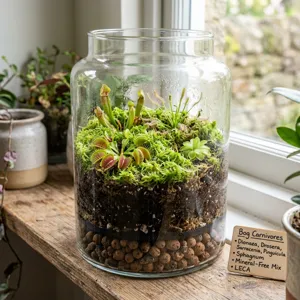
Use the carnivorous plant terrarium build guide for complete enclosure layering and drainage architecture. For Pinguicula moranensis, review the Pinguicula rock setup guide before using a bog-style mix. For seasonal requirements, consult dormancy requirements for carnivorous plants. For fungus-gnat management, see carnivorous plants for fungus gnats.
Frequently Asked Questions
Can I use coco coir instead of peat moss for carnivorous plants?
Coco coir is not a direct drop-in replacement for sphagnum peat. Its potassium, salt, buffering, and processing characteristics vary substantially between products. For a conservative bog substrate, use clean unfertilized Canadian sphagnum peat. If coir is tested as an alternative, use only a documented low-salt, properly buffered product and validate its chemistry before use.
Should I rinse perlite before using it for carnivorous plants?
Yes. Rinsing coarse horticultural perlite with RO or distilled water removes loose dust and helps reduce soluble contamination. Drain the first rinse away and use the cleaned coarse particles in the final substrate.
How can I tell if peat contains hidden fertilizer?
Start by checking the complete product label and manufacturer specification for fertilizer, controlled-release nutrients, compost, lime, wetting agents, or enriched-soil additives. If the formulation is unclear, do not assume it is safe. A rinse-water TDS test can screen for soluble material but cannot prove that the peat is chemically pure.
Can I use play sand instead of silica sand for carnivorous plants?
Do not use play sand as an automatic substitute. Play sand can vary in mineral composition and particle size, and the label does not necessarily establish that it is pure quartz or free of carbonate minerals. Use known coarse #12–#20 quartz or silica sand when a controlled sand component is required.
Can I use builder's sand in a carnivorous plant substrate?
Builder's sand is not recommended as the default because its mineral composition, fines, clay content, and carbonate contamination can vary. A controlled carnivorous substrate should use a known coarse silica or quartz product instead.
How do I re-wet peat that has completely dried out?
Break apart compressed dry peat, place it in a clean container, and add RO or distilled water gradually while mixing gently. Allow the material to absorb water before adding more. Continue until there are no dry hydrophobic pockets. Do not simply flood the final container to compensate for poorly hydrated peat.
What is the standard carnivorous plant peat-to-perlite ratio?
A practical standard starting point is 50% unfertilized Canadian sphagnum peat moss and 50% coarse horticultural perlite by volume. The ratio is volumetric, not a weight ratio, and should be adjusted when the species requires a different root-zone structure.
What is the standard peat-to-silica-sand ratio for carnivorous plants?
A common bog-style starting formulation is 50% unfertilized Canadian sphagnum peat and 50% coarse washed silica sand by volume. Use pure quartz or silica sand and avoid limestone-rich, builder's, or beach sand.
Can I use regular potting soil for carnivorous plants?
No. Standard potting soil commonly contains fertilizer, compost, lime, or other amendments that are inappropriate for a nutrient-poor carnivorous root zone. Use a species-appropriate substrate made from clean, untreated ingredients.
Can I use Miracle-Gro peat moss for carnivorous plants?
Do not use a peat or potting product that contains added fertilizer or enriched soil ingredients. Select a product specifically identified as untreated, unfertilized sphagnum peat moss and verify its ingredient list.
What TDS should carnivorous plant substrate rinse water have?
For a conservative preparation target, aim for final rinse runoff below 20 ppm TDS after thorough washing with RO or distilled water. TDS is a screening measurement and cannot identify every dissolved substance, so ingredient sourcing and labeling remain important.
Do Nepenthes use the same substrate as Drosera?
Not necessarily. Many Drosera tolerate a moist bog-style peat-based mix, while Nepenthes generally benefit from a more open and highly aerated medium. A practical Nepenthes starting mix is 60–70% long-fiber sphagnum with 30–40% horticultural perlite or pumice by volume.
What substrate should I use for Pinguicula moranensis?
A porous mineral-oriented mix can be appropriate, with a practical starting recipe of 60% pumice, 20% coarse silica sand, and 20% perlite by volume. Keep the root zone fast draining and avoid treating the plant as a permanently saturated bog species.
Does rinsing substrate prove that it contains no fertilizer?
No. Rinsing and TDS testing can reduce and screen for soluble material, but they cannot prove that a substrate contains no fertilizer or other chemical additives. Product labeling and ingredient documentation remain the primary safeguards.
Sources & References
-
Source: carnivorousplants.org
Type: horticultural-reference
-
Source: rhs.org.uk
Type: horticultural-reference
-
Source: missouribotanicalgarden.org
Type: horticultural-reference
Explore More
Related Articles
Related Plant Guides
No specific plant guides found matching this topic.
Recommended next actions
Continue Exploring
Dive deeper into related plant care tools and profiles.
Calculator
Carnivorous Plant Water TDS Calculator: Safety & Dilution
Rate your water's TDS for carnivorous plants, calculate how much tap water can be blended with RO or distilled water to reach a safe target, and estimate how fast minerals build up in a pot.
Plant Guide
Cape Sundew
Drosera capensis, the Cape sundew, is a fast-growing, forgiving carnivorous plant with long sticky red-tipped leaves that curl around prey, grows all year without dormancy and doubles as a living flypaper.
Plant Guide
Ventrata Pitcher Plant
Nepenthes ventrata is a hardy tropical pitcher plant hybrid that produces fluid-filled pitfall traps on its leaf tendrils, grows year-round without dormancy and tolerates household humidity better than most Nepenthes.
Plant Guide
Mexican Butterwort
Pinguicula moranensis is a compact Mexican butterwort that switches between sticky carnivorous leaves in summer and a tight succulent rosette in winter, and thrives in pumice or on wicking rock.
Topic Guide
How to Build a Carnivorous Plant Terrarium: Bog Layering & Drainage
Build a carnivorous bog terrarium with LECA drainage, mineral-free peat mix, RO water, species zoning, ventilation, and strong LED lighting.
Topic Guide
Carnivorous Plants for Fungus Gnats: Living Sticky Traps
Control houseplant fungus gnats naturally with carnivorous plants: Drosera sundews and Pinguicula butterworts as living flypaper, placement, and limits.