How to Build a Pinguicula Rock: Mounting Mexican Butterworts
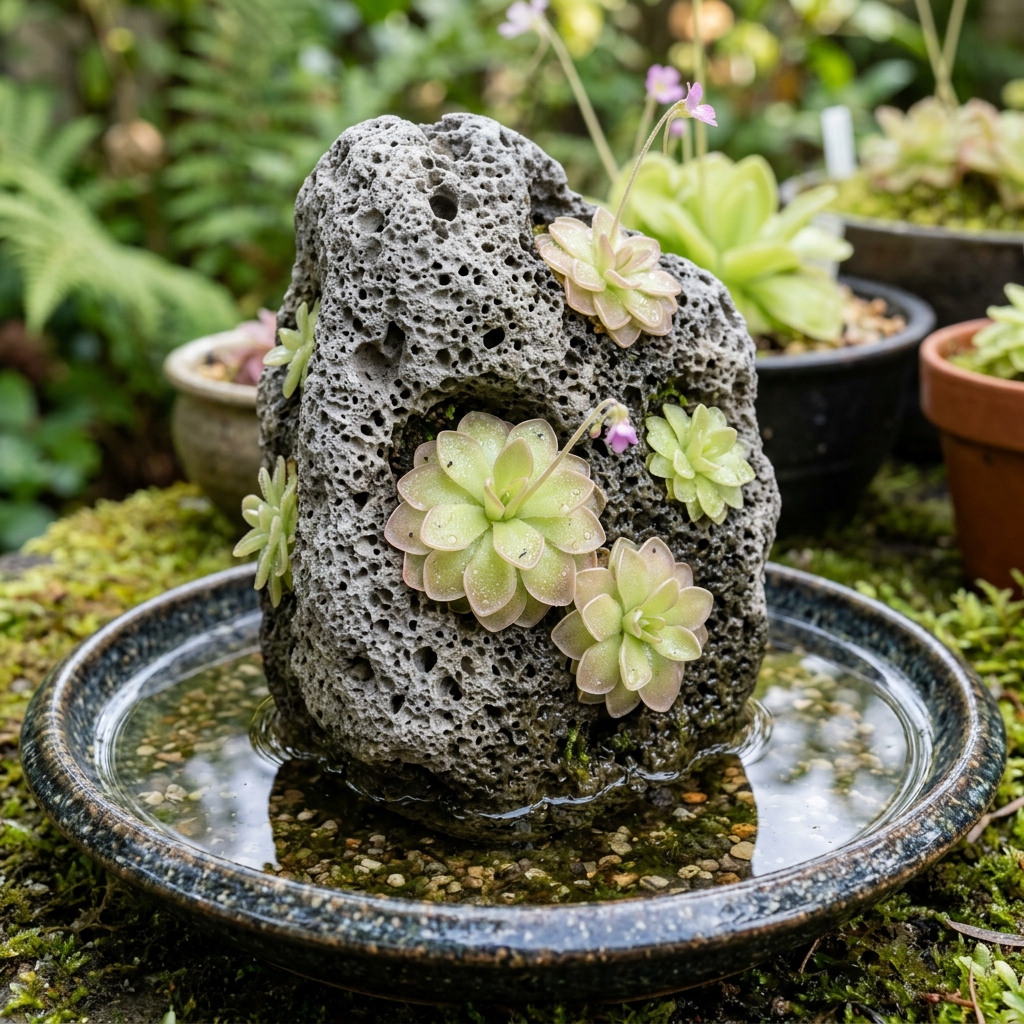
A Pinguicula rock is a vertical or sloped porous stone planted with Mexican butterworts, which are rosette plants that naturally cling to damp rock faces. Open-cell volcanic stone acts as both anchor and wick, pulling water up from a shallow reservoir while leaving the crowns and upper surface much drier than a pot would. This guide covers which rock to use and which to avoid, how capillary wicking works, how to carve planting pockets and secure rootlets, how to run the summer carnivorous and winter succulent phases, why RO or distilled water is essential, and how to handle gluing, feeding, algae, propagation and mineral crust.
Quick Answer
To build a Pinguicula rock, choose a porous volcanic stone such as feather rock or red/gray pumice, carve 1-2 cm shallow pockets with a masonry bit, and press each butterwort rosette's rootlets into a pocket with a long-fiber sphagnum plug or a mineral sand paste. Stand the rock in a 1-2 cm base dish of RO or distilled water (under 30 ppm TDS) so open-cell pores wick water upward by capillary action without flooding the crown. In summer, keep the dish topped up for sticky carnivorous rosettes. In winter, let the dish fall to a dry or near-dry level, mist sparingly, and keep the compact succulent rosettes bright and airy to prevent crown rot.
Key Takeaways
- Use open-cell volcanic stone such as feather rock or red/gray pumice for the best wicking. Dense basalt and granite barely wick, and calcite-dense limestone leaches alkalinity into the water.
- Carve pockets only 1-2 cm deep and seat the rootlets in long-fiber sphagnum or mineral sand paste. The rock supplies the moisture, so the pocket needs very little medium.
- Keep the base reservoir to 1-2 cm in the summer carnivorous phase. In winter, let the dish run dry or nearly dry and mist sparingly so the crowns of the compact succulent rosettes do not rot.
- Use only RO or distilled water under 30 ppm TDS. Dissolved minerals concentrate as water evaporates from the rock face and clog the capillary pores, which gradually stops the wicking.
- Feed with live prey or gnats rather than fertilizer, and watch the surface for algae and white salt crust. Both are early warnings that the rock is too wet, too bright or too mineral-loaded.
What Is a Pinguicula Rock?
A Pinguicula rock is a porous stone planted with Mexican butterworts, which in the wild often grow on damp, mineral-poor rock faces and cliff ledges rather than in deep soil. In cultivation the stone replaces the pot. It anchors the rosettes, holds a tiny amount of medium and, most importantly, wicks water upward from a shallow reservoir. The result is a display that stays tidy, drains freely at the crown and shows off the plants in a way no pot can. For a species to start with, see Pinguicula moranensis, a classic and forgiving Mexican butterwort.
Choosing the Right Rock
The rock decides whether the setup works. What matters is pore connectivity, meaning how many of the open cells in the stone link together to form continuous channels. Disconnected holes look porous but cannot move water. The second factor is mineral leaching, because anything the rock dissolves will end up in the plant's water.
Rocks That Work
- Feather rock: very light, soft and heavily interconnected, so it wicks well and carves easily.
- Red or gray pumice: solidified volcanic froth with open cells, wicks well over moderate heights and tolerates repeated wetting.
- Tufa or travertine: porous, but made of calcium carbonate. Treat it as conditional, since it can raise pH and hardness over time.
Rocks That Fail
- High-density basalt and granite: their crystal structure leaves almost no connected pores, so water cannot climb. Plants end up either bone dry or sitting in a puddle at the base.
- Calcite-dense limestone: it dissolves slowly in acidic or neutral water, releasing calcium and carbonate that push the water alkaline and load the surface with salts.
The first reference table above compares each stone on wicking, leaching risk, carving ease and recommendation. Rinse every new rock repeatedly in RO or distilled water before use to flush fines and loose dust, and soak it overnight.
How Capillary Wicking Works
Water rises through the stone because of capillary action. Water molecules cling to the pore walls and to each other, so water climbs through narrow connected channels against gravity. In a good volcanic rock, millions of tiny open cells form a network that behaves like a sponge standing on end. When the base of the rock sits in 1-2 cm of water, the lower pores fill and draw water upward. The upper face is damp but not saturated, which is exactly the condition Mexican butterworts prefer: constant moisture at the roots with an airy, quick-draining crown.
Wicking has limits. Smaller pores lift water higher but more slowly, and larger pores move it quickly but over a shorter distance. A rock that is taller than its wicking height will have a dry top and a wet bottom. Test a new rock by standing it in a dish and watching how high the wet line climbs over a few hours. Plant the pockets within that wet zone. If the rock is much taller, plant only the lower and middle sections, or use a rock with a broad, shallow profile.
The 1-2 cm reservoir depth also matters. A deeper dish floods the bottom pockets and keeps the crowns wet. A dish that is too shallow runs dry between top-ups and interrupts the wicking. A wide, shallow tray or dish, refilled frequently, is easier to manage than a deep container. For enclosed displays and humidity planning, read the carnivorous plant terrarium build guide.
Carving Planting Pockets
Each plant needs only a small hollow, because the rock provides most of the moisture. Pockets that are too deep trap water and rot the crown.
- Plan the layout. Mark planting spots on sloped ledges and angled faces, since these hold the plant and shed excess water. Keep spots within the wicking zone you tested.
- Carve the depression. Use a masonry bit in a hand drill at low speed or a small chisel to cut a shallow bowl 1-2 cm deep and slightly wider than the rootball. Work slowly, because pumice and feather rock crumble at thin edges.
- Slope the pocket. Angle the floor slightly outward so water cannot pool against the crown.
- Rinse the rock. Flush away carving dust with RO water and let the pores refill before planting.
- Wear eye and dust protection. Pumice and tufa dust is fine and irritating when carved dry.
Mounting the Rosettes
Butterworts have small, fine rootlets, so mounting is gentle work. The aim is to hold the plant in contact with the damp rock until the roots grip on their own.
Sphagnum Plug Method
Tease out a small pad of long-fiber sphagnum, moisten it with RO water and wrap it lightly around the rootlets. Press the plug into the pocket so the crown sits at or just above the rock surface, never buried. The sphagnum stays in contact with the stone and wicks water to the roots.
Mineral Sand Paste Method
Mix a little washed, low-mineral sand (or crushed pumice fines) with RO water into a thick paste. Press a small amount into the pocket, seat the rootlets in it and shape it so the crown remains clear. This holds the plant firmly and suits sloped faces where sphagnum might slip. Rinse the sand thoroughly first, because mineral content in the paste ends up in the plant's root zone. For general medium theory, see the carnivorous plant substrate guide.
After mounting, keep humidity high and light moderate for the first two weeks so the roots can grip the stone, then increase light gradually.
Heterophylly and Seasonal Water Management
Mexican Pinguicula are heterophyllous, meaning they produce two different kinds of leaves during the year. Your watering and light must follow this cycle, or the plant will rot or stall. The second reference table above summarises the cycle.
Summer Carnivorous Phase
In warm, bright months the plants form flat, sticky rosettes coated in mucilage glands that trap small insects. Keep the base reservoir at 1-2 cm and refill it before it drops out of the wicking range. The rock should stay evenly damp, and you rarely need to mist. Provide 12-14 hours of strong light so the mucilage production stays high. Sticky leaves also catch fungus gnats, which makes butterworts useful companions; see carnivorous plants for fungus gnats.
Winter Non-Carnivorous Succulent Phase
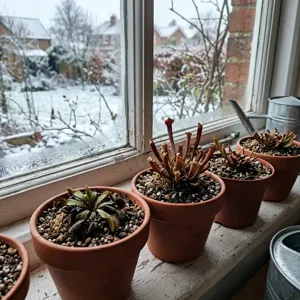
As light and temperature fall, the plants shift to compact, thick, non-sticky succulent rosettes that store water and resist cool, drier conditions. This is where most rock setups fail. A rock that stays saturated through winter keeps the crown wet, and rot sets in quickly. Drop the reservoir water level to a few millimetres or let the dish run dry between top-ups, so the pores dry out. Mist sparingly, only every one to two weeks, and only in the morning so the surface dries before night. Keep the light bright for 8-10 hours and the air moving. Winter rosettes may also produce small bulb-like gemmae, which are useful for propagation. For the broader dormancy context across species, see the dormancy requirements for carnivorous plants.
Transitions
Change the water level and light gradually over two to three weeks in both directions. A sudden switch is the second most common cause of failure after winter overwatering.
Water Quality: Keep It Under 30 ppm TDS
Use RO or distilled water only, and keep total dissolved solids under 30 ppm. Tap water, hard water and mineral-rich bottled water are all unsuitable. In a wicking rock, water evaporates continuously from the exposed surface and leaves its dissolved minerals behind. Over weeks, those salts accumulate in the pores and form a white or grey crust. The crystals block the capillary channels, slow the wicking and then burn root tips by concentrating salts in the pockets.
Test the reservoir and the runoff regularly with a TDS pen. Use the carnivorous water TDS calculator to check dilution when you blend RO water with a small amount of tap water, or to see how evaporation concentrates a reservoir. If the runoff reads much higher than the input, the rock needs flushing.
Light, Airflow and Placement
Mexican butterworts want bright light but not scorching heat on bare rock. A rock face absorbs heat and can dry unevenly, so place it where air moves gently. Bright indirect light or morning sun suits a windowsill display, while grow lights should be 20-40 cm above the plants. Good airflow keeps the surface from staying saturated and discourages algae and fungal rot. If you also keep sundews, Drosera capensis shares the same bright, mineral-free water requirement and can be planted at the base of the rock in the reservoir zone, where it tolerates the constant moisture.
Feeding and Pest Control
Butterworts catch tiny insects on their sticky leaves, and a rock setup in a room with fungus gnats or fruit flies will usually feed itself. If prey is scarce, drop a few thawed bloodworms or crushed dried insects onto a leaf during the summer phase. Do not feed in winter, when the plants have succulent leaves and are digesting very little. Avoid fertilizer on the rock, because salts build up in the pores.
Maintenance Routine
- Weekly: check the reservoir level, remove dead leaves and inspect for algae or white crust.
- Monthly: measure TDS of the reservoir and runoff, and rinse the rock surface with RO water.
- Every 6-12 months: lift the rock out, flush it with RO water from the top and soak it overnight to clear salts from the pores.
Troubleshooting Summary
| Symptom | Likely cause | Quick fix |
|---|---|---|
| Crown turns soft, brown or black in winter | Rock kept saturated during the succulent phase | Drop the reservoir, dry the rock, improve airflow and remove rotting leaves |
| Leaves stay small and not sticky in summer | Low light or a dry rock | Raise the water level to 1-2 cm and increase light hours |
| White crust on the rock | Mineral salts from evaporation | Flush with RO water and check TDS |
| Green film on the rock | Too much light on a constantly wet surface | Lower the water level, shade the rock and improve airflow |
| Plant slides off the rock | Pocket too shallow or roots not yet gripping | Re-seat it with sphagnum or sand paste and hold it still for two weeks |
Related Resources
Plan the enclosure with the carnivorous plant terrarium build guide, learn about growing media in the carnivorous plant substrate guide, plan the winter cycle with the dormancy requirements guide, use butterworts for pest control with carnivorous plants for fungus gnats, check your water with the carnivorous water TDS calculator, and meet the plants in the profiles for Pinguicula moranensis and Drosera capensis.
Frequently Asked Questions
Can I glue Pinguicula to a rock with cyanoacrylate (super glue)?
Some growers use a tiny dab of unscented cyanoacrylate gel to anchor the base of a rosette or a rootlet bundle to the stone, but it is a last resort. Never put glue on the crown, leaves or active growing point, and let it cure fully before wetting. Pressing the rootlets into a shallow pocket with long-fiber sphagnum or mineral sand paste is safer and lets the roots grip naturally.
Can I use fertilizer on a Pinguicula rock?
It is best not to. Fertilizer salts dissolve into the water and concentrate in the pores as the rock evaporates, which clogs the wicking and burns the roots. Feed butterworts with live or crushed insects during the summer phase. If a plant is badly underfed, a very dilute foliar spray at one-quarter strength, applied rarely, is a safer option than feeding the reservoir.
How do I deal with algae on the rock surface?
Algae grows where a wet surface gets strong light. Lower the reservoir level, shade the affected face, improve airflow and let the surface dry slightly between top-ups. Gently scrub it with a soft brush under RO water, keeping the water away from the crowns. Avoid bleach or algaecides, because the residue stays in the pores.
Can I propagate Pinguicula from flower stalks on a rock?
Flower stalks are not the most reliable source. Some growers lay cut stalks on damp sphagnum and occasionally get plantlets, but results are inconsistent. Leaf pulls taken in spring and the small gemmae that form on winter rosettes are far more dependable. Press a pulled leaf or gemma into a shallow damp pocket on the rock and keep it humid until new growth appears.
How do I remove white salt crust from the rock?
Lift the rock out and flush it slowly with RO or distilled water from the top, then soak it overnight in clean RO water to draw salts out of the pores. Brush any surface crust with a soft toothbrush, avoiding the crowns. Check the TDS of the runoff and repeat until it stops rising. Prevent a repeat by never using tap water.
Why can't I use basalt, granite or limestone for a Pinguicula rock?
Basalt and granite are dense and have almost no connected pores, so they cannot wick water and the plants either dry out or sit in a puddle. Calcite-dense limestone dissolves steadily and pushes the water alkaline, which stresses Mexican butterworts. Porous volcanic stone such as feather rock or pumice avoids both problems.
How deep should the water dish be?
Keep it to 1-2 cm during the summer carnivorous phase so capillary action can lift water through the rock without flooding the lower pockets. In winter, let the dish fall to a few millimetres or run dry between top-ups so the pores dry out and the crowns stay dry.
Do I need to mist the plants on a wicking rock?
Not in summer, because the wicking keeps the rock evenly damp. In winter, mist sparingly every one to two weeks in the morning, using RO water, so the succulent rosettes do not dry out completely but the crown never stays wet overnight.
What TDS is safe for the water I use?
Keep reservoir water below 30 ppm TDS, and use RO or distilled water. Water evaporates from the rock face and leaves its minerals behind, so even moderately mineral water leads to crust and blocked pores over a few weeks. Check the runoff with a TDS pen every month.
Can I grow sundews on the same rock?
Yes. Drosera capensis tolerates constant moisture and the same mineral-free water, so it can be planted in the lower, wetter zone of the rock or in the reservoir area. Keep butterworts on the drier upper ledges, especially in winter when they need to dry out.
Sources & References
-
Source: carnivorousplants.org
Type: horticultural-reference
-
Source: kew.org
Type: horticultural-reference
-
Source: missouribotanicalgarden.org
Type: horticultural-reference
Explore More
Related Articles
Related Plant Guides
Recommended next actions
Continue Exploring
Dive deeper into related plant care tools and profiles.
Calculator
Carnivorous Plant Water TDS Calculator: Safety & Dilution
Rate your water's TDS for carnivorous plants, calculate how much tap water can be blended with RO or distilled water to reach a safe target, and estimate how fast minerals build up in a pot.
Plant Guide
Cape Sundew
Drosera capensis, the Cape sundew, is a fast-growing, forgiving carnivorous plant with long sticky red-tipped leaves that curl around prey, grows all year without dormancy and doubles as a living flypaper.
Plant Guide
Mexican Butterwort
Pinguicula moranensis is a compact Mexican butterwort that switches between sticky carnivorous leaves in summer and a tight succulent rosette in winter, and thrives in pumice or on wicking rock.
Topic Guide
Carnivorous Plant Substrate Guide: Ingredients, Ratios & Zero Fertilizer
Master carnivorous plant substrate recipes: 50/50 peat-perlite/silica sand ratios, zero-fertilizer rules, rinsing minerals, and live sphagnum moss.
Topic Guide
How to Build a Carnivorous Plant Terrarium: Bog Layering & Drainage
Build a carnivorous bog terrarium with LECA drainage, mineral-free peat mix, RO water, species zoning, ventilation, and strong LED lighting.
Topic Guide
Carnivorous Plants for Fungus Gnats: Living Sticky Traps
Control houseplant fungus gnats naturally with carnivorous plants: Drosera sundews and Pinguicula butterworts as living flypaper, placement, and limits.