How to Build a Carnivorous Plant Terrarium: Bog Layering & Drainage
A carnivorous bog terrarium must reproduce the low-mineral conditions and moisture gradients associated with the habitats of the plants being grown rather than functioning like a conventional houseplant terrarium. The build described here uses a drainage buffer, non-leaching separation barrier, unfertilized mineral-free substrate, appropriate water quality, strong full-spectrum lighting, and active air exchange. Drosera capensis can occupy the wetter bog zone, Pinguicula moranensis should be positioned in a porous, fast-draining niche, and Nepenthes ventrata should be elevated in a well-drained epiphytic pocket rather than placed in standing water. Because these species differ substantially in root-zone requirements, a single sealed uniform water table is not appropriate for every mixed carnivorous planting.
Quick Answer
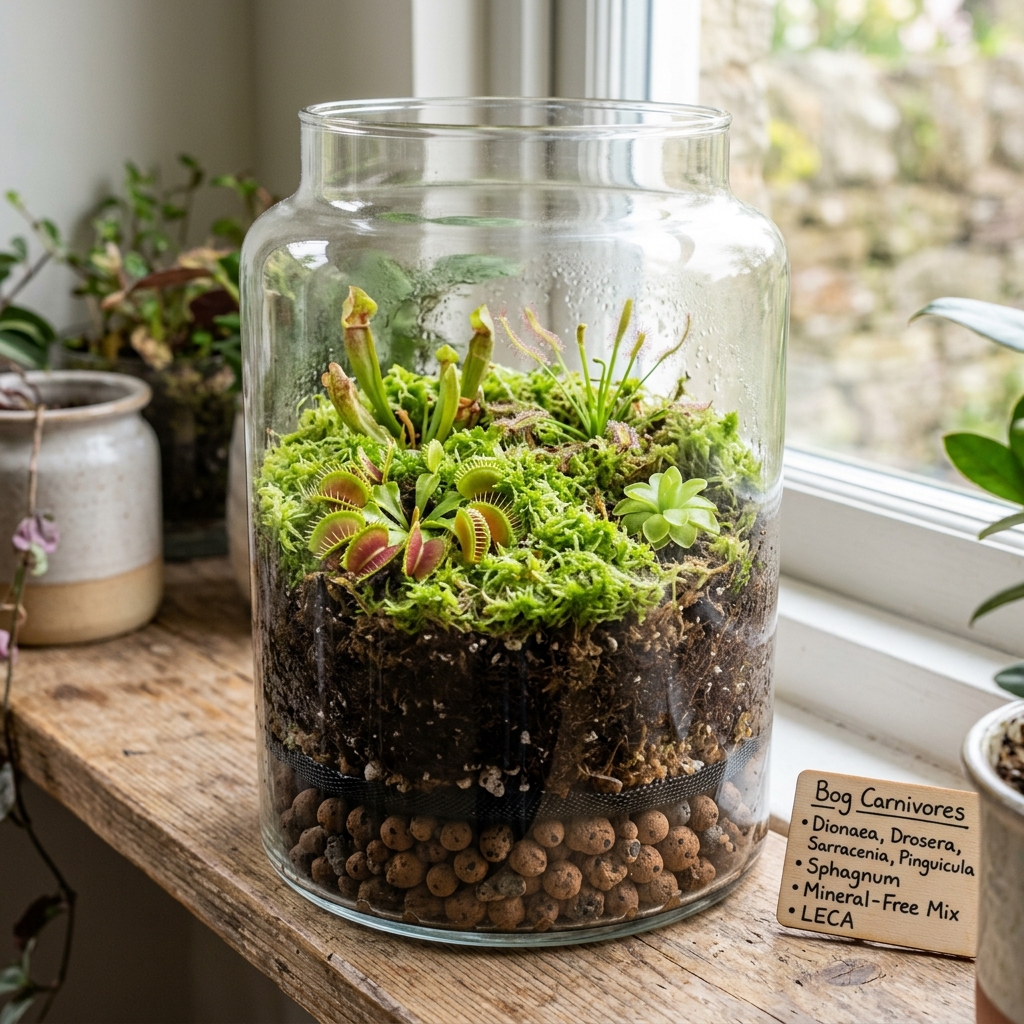
Build a carnivorous plant terrarium around mineral-free water, high drainage, and a nutrient-poor growing medium. Use a 3–5 cm LECA or equivalent false bottom, a non-metallic separation barrier, an 8–12 cm 50/50 peat-and-washed-silica-sand or perlite substrate by volume, and maintain water below 50 ppm TDS, ideally below 20 ppm.
Key Takeaways
- Keep irrigation water below 50 ppm TDS and preferably below 20 ppm; use reverse-osmosis, distilled, or suitably clean rainwater rather than ordinary mineral-rich tap water.
- Build a 3–5 cm drainage or false-bottom zone beneath an 8–12 cm growing medium, separated by non-woven synthetic geotextile or inert fiberglass mesh.
- Use unfertilized Canadian sphagnum peat moss with washed coarse silica sand or suitable horticultural perlite at 50/50 by volume; never use enriched or fertilizer-treated potting mixes.
- Zone plants according to their root-zone needs: Drosera capensis tolerates consistently wet bog conditions, Pinguicula moranensis needs a porous fast-draining niche, and Nepenthes ventrata should not sit in standing water.
- Provide approximately 150–250 PPFD of full-spectrum LED light with adequate air circulation so high humidity does not become stagnant, reducing the risk of mold and Botrytis.
How to Build a Carnivorous Plant Terrarium
A successful carnivorous plant terrarium is engineered around low dissolved-mineral content, appropriate root-zone moisture, drainage, light, and air movement. These plants evolved in nutrient-poor environments, so the goal is not to create a conventional fertilizer-fed houseplant enclosure. Instead, build a controlled microhabitat in which the growing medium supplies physical support and water while insects provide part of the plants' nutrient acquisition.
Before building, identify the plants and their individual root-zone requirements. A mixed enclosure containing Drosera capensis, Pinguicula moranensis, and Nepenthes ventrata requires deliberate zoning because these species do not share identical tolerance of standing water.
The Zero-Mineral Water Rule
Water quality is one of the most important engineering constraints in a carnivorous terrarium. Use reverse-osmosis water, distilled water, or suitably clean rainwater rather than ordinary tap water when the tap supply contains substantial dissolved minerals. As a practical control target, keep irrigation water below 50 ppm total dissolved solids (TDS), with less than 20 ppm preferable for a conservative low-mineral regime.
Repeated irrigation with mineral-rich water can concentrate dissolved salts in the root zone as water evaporates. Carnivorous plants adapted to nutrient-poor bogs are not generally suited to repeated exposure to fertilizer concentrations intended for ordinary container plants. Measure the actual water rather than assuming that a water source is safe because it is described as filtered.
Use the Carnivorous Water TDS Calculator to help interpret measured water quality and determine whether a water source fits a low-mineral carnivorous setup.
Build the False Bottom and Drainage Buffer
Start with a clean enclosure that can safely accommodate a 3–5 cm drainage zone. Washed LECA can provide an inert expanded-clay drainage layer, while an inert plastic egg-crate plenum can provide a physical void beneath the substrate. The purpose is to create a buffer where excess water can collect without forcing the entire substrate profile into stagnant saturation.
The drainage layer is not a substitute for correct watering. Do not fill the false bottom until the entire root-zone profile becomes waterlogged. The buffer should allow inspection of the water level and give the system somewhere for excess water to move.
Install a Non-Leaching Separation Barrier
Place a continuous sheet of non-woven synthetic geotextile or suitable inert fiberglass mesh above the false bottom. The barrier should allow water movement while preventing fine peat particles from migrating into the drainage zone.
Avoid metallic mesh and materials that can release calcium or other dissolved minerals. Carnivorous terrariums are unusually sensitive to cumulative mineral contamination, so every material that contacts the water or substrate should be considered for leaching risk.
Prepare the Carnivorous Substrate
Use an unfertilized Canadian sphagnum peat moss and washed coarse silica sand or suitable horticultural perlite mixture at 50/50 by volume. This ratio is a starting structural recipe, not a weight ratio. Do not substitute ordinary garden soil, compost, manure, enriched potting soil, limestone-rich sand, or fertilizer-treated peat.
For a detailed discussion of suitable components and their physical properties, see the carnivorous plant substrate guide.
To prepare a 10-liter batch at 50/50 by volume, combine 5 liters of suitable unfertilized peat with 5 liters of washed coarse silica sand or compatible perlite. Do not weigh the components and attempt to reproduce the same 50/50 ratio by weight because different materials have substantially different bulk densities.
Substrate Depth and Root-Zone Architecture
Install approximately 8–12 cm of prepared substrate above the separation barrier. The appropriate depth depends on the container and species, but the substrate should be deep enough to provide a stable root zone without creating an unnecessarily stagnant lower layer.
Do not compact the mix aggressively. A loose structure provides better air exchange around roots and allows water to move through the profile. After planting, allow the substrate to settle naturally rather than pressing it into a dense block.
Plant Zonation: Do Not Treat Every Carnivorous Plant the Same
Drosera capensis
Drosera capensis is well suited to the wetter portion of a bog-style setup. It can tolerate consistently moist to wet substrate and can occupy the lower-moisture-gradient end of a terrarium where the root zone remains reliably hydrated.
Give the plant strong light and avoid shading the rosettes with taller neighboring plants. Under appropriate light, the sticky dew on the tentacles can become visually prominent, but light intensity, temperature, plant condition, and acclimation all influence coloration and dew production.
Pinguicula moranensis
Pinguicula moranensis should not simply be placed in the wettest portion of a generic bog container. A porous vertical pumice or similarly fast-draining mineral niche can provide a more appropriate microhabitat, with the crown kept open and free from prolonged standing water.
Its seasonal growth behavior also needs consideration. Before combining it permanently with species that prefer continuously wet conditions, review the Pinguicula rock setup guidance and the species' seasonal requirements.
Nepenthes ventrata
Nepenthes ventrata should occupy an elevated, highly drained pocket rather than the saturated base of the terrarium. Its roots require moisture but also benefit from air-filled pore space, and prolonged standing water around the root system can create unfavorable conditions.
Use an open epiphytic-style pocket with good drainage and enough height for pitchers and vines to develop. A mixed bog floor that is ideal for Drosera should not automatically be used as the root zone for Nepenthes.
Live Sphagnum Top Dressing
A thin carpet of live sphagnum can be used as a living surface layer. It can help regulate surface humidity, retain moisture, and create a visually coherent bog microclimate.
Keep live sphagnum under control around plant crowns and growing points. A dense carpet should not be allowed to bury rosettes or trap stagnant moisture around sensitive foliage.
Lighting: Aim for High-Output Full-Spectrum Illumination
Use a full-spectrum LED system capable of delivering approximately 150–250 PPFD at the plant canopy as a practical starting range. A nominal 6500K spectrum can work well as a cool-white reference, but correlated color temperature alone does not define plant-usable light output; measure canopy PPFD where possible.
Strong light supports compact growth and can encourage anthocyanin expression, including stronger red coloration in suitable Drosera tissues and coloration in Nepenthes pitchers. Do not increase light intensity abruptly on newly moved plants. Acclimate them progressively while monitoring leaf stress, bleaching, curling, and temperature.
Humidity and Ventilation
A target relative humidity range of roughly 60–85% can be useful for a humid terrarium environment, but humidity should not be pursued at the expense of air movement. Warm, saturated, stagnant air around dense foliage creates conditions favorable to Botrytis and other fungal problems.
Use passive vents or a gentle fan-assisted exchange system as appropriate for the enclosure. Air should move around foliage without producing constant desiccating wind. Avoid sealing the enclosure solely to preserve a high humidity reading.
Feeding Versus Fertilizing
Carnivorous plants obtain nutrients through specialized trapping structures and should not be treated like ordinary foliage plants that require routine fertilizer in the substrate or irrigation water. Do not add conventional fertilizer to the 50/50 carnivorous substrate.
Where appropriate, naturally available small prey can contribute nutrients, but feeding should be species-appropriate and should not involve forcing large prey into traps. Avoid adding nutrient-rich organic waste, compost tea, manure, or fertilizer solutions to the root zone.
Dormancy and Mixed Terrariums
One of the main problems with mixed carnivorous terrariums is that different species may have incompatible seasonal requirements. A plant that benefits from a winter dormancy period should not automatically be enclosed under the same year-round warm, humid regime used for tropical species.
Review the dormancy requirements for carnivorous plants before combining temperate and tropical species. If a plant requires a distinct seasonal rest, a separate container can be safer and easier to control than forcing multiple species into one permanent microclimate.
Mold and Botrytis Prevention
Mold prevention should begin with sanitation, air exchange, appropriate moisture, and removal of dead plant material rather than routine fungicide application. Remove decaying leaves promptly, avoid persistently saturated foliage, and maintain enough air circulation to prevent stagnant pockets.
If fungus gnats become a problem, use the information in carnivorous plants for fungus gnats as part of an integrated approach rather than deliberately increasing prey pressure on plants.
Drainage Flushing and Water Management
The false bottom can accumulate dissolved minerals or decomposed material if the system is repeatedly irrigated with unsuitable water. With low-TDS water, occasional controlled flushing can help remove accumulated soluble material when the enclosure architecture permits safe drainage.
Do not flush a planted enclosure aggressively if doing so would disturb roots or wash fine substrate into the drainage zone. Remove or siphon excess reservoir water through an accessible inspection point where possible, then replace it with appropriate low-TDS water.
Construction Sequence
- Clean and inspect the enclosure and confirm that drainage and ventilation can be controlled.
- Add 3–5 cm of washed LECA or construct an inert egg-crate drainage plenum.
- Install a continuous non-metallic geotextile or inert fiberglass separation barrier.
- Prepare a 50/50 substrate by volume using unfertilized Canadian sphagnum peat and washed coarse silica sand or suitable perlite.
- Add approximately 8–12 cm of loose substrate without aggressive compaction.
- Construct separate wetter, drier, or elevated planting niches according to species requirements.
- Add live sphagnum selectively as a top dressing.
- Test the irrigation water and keep TDS below 50 ppm, preferably below 20 ppm.
- Install full-spectrum lighting and verify approximately 150–250 PPFD at the canopy.
- Establish ventilation before introducing plants so humidity does not become stagnant.
- Monitor water level, substrate moisture, foliage condition, and mold during the first several weeks.
Related Carnivorous Terrarium Guidance
For a deeper treatment of the growing medium, use the carnivorous plant substrate guide. For Pinguicula-specific mineral and rock placement, see Pinguicula rock setup. For seasonal management, consult dormancy requirements. For fungus-gnat management, see carnivorous plants for fungus gnats.
Frequently Asked Questions
Is tap water safe for a carnivorous plant terrarium?
It depends on its dissolved-mineral content, but ordinary tap water should not be assumed safe. Keep irrigation water below 50 ppm TDS and preferably below 20 ppm for a conservative low-mineral setup. Reverse-osmosis water, distilled water, or suitable low-mineral rainwater are preferable when tap water exceeds that range.
What happens if I use tap water with high TDS?
Dissolved minerals can accumulate in the substrate as water evaporates and may progressively increase root-zone mineral concentration. Carnivorous plants adapted to nutrient-poor environments can be sensitive to this accumulation. Test the actual water with a TDS meter rather than judging suitability from taste, clarity, or the label on a household filter.
Can I fertilize carnivorous plants in the terrarium?
Do not add conventional fertilizer to the root-zone substrate or routine irrigation water. The growing medium should remain nutrient-poor and free of fertilizer. Carnivorous species obtain nutrients through their traps and should not be managed like conventional foliage plants.
Can I feed insects instead of fertilizing carnivorous plants?
Insect prey can provide nutrients through the plant's carnivorous trapping mechanisms and is fundamentally different from adding fertilizer to the substrate. Feeding should remain species-appropriate, prey should not be excessively large, and plants should not be forced to process prey when they are stressed or dormant.
Can I keep Drosera capensis, Pinguicula moranensis, and Nepenthes ventrata in one terrarium?
They can be displayed together only if the enclosure provides separate microclimates, but their root-zone requirements differ enough that a uniform saturated bog is unsuitable. Drosera capensis tolerates wetter conditions, Pinguicula moranensis benefits from a porous fast-draining niche, and Nepenthes ventrata should be elevated and kept out of standing water.
How deep should a carnivorous plant terrarium substrate be?
An 8–12 cm substrate layer is a practical starting architecture for the bog-style build described here. The exact depth should reflect the plant's root system and container geometry. Do not compensate for poor drainage by simply making the substrate deeper.
Does a carnivorous terrarium need a false bottom?
A false bottom or drainage layer is useful when the enclosure needs a controlled water buffer beneath the substrate. A 3–5 cm layer of washed LECA or an inert egg-crate plenum can create an inspection and drainage zone. It does not make excessive watering safe by itself; root-zone moisture still needs to be managed.
How do I prevent mold without using fungicides?
Prioritize sanitation, air movement, appropriate moisture, and removal of dead plant tissue. Maintain approximately 60–85% relative humidity when appropriate for the enclosure, but avoid stagnant saturated air. Gentle ventilation is generally more useful for long-term mold prevention than simply increasing airflow resistance by sealing the enclosure.
Can carnivorous plants in a closed terrarium go through dormancy?
A permanently warm, humid closed terrarium is not automatically compatible with species that require a seasonal dormancy. Before mixing plants, determine whether each species needs a temperature, photoperiod, or watering change during its dormant period. A separate enclosure can be preferable when the seasonal requirements conflict.
How should I flush a carnivorous terrarium drainage layer?
If the enclosure has an accessible drainage reservoir, remove excess reservoir water and replace it with suitable low-TDS water when flushing is appropriate. Avoid aggressive flushing that disturbs roots or drives fine peat into the drainage layer. The goal is controlled removal of accumulated soluble material, not prolonged flooding of the root zone.
Can I use regular potting soil or Miracle-Gro peat for carnivorous plants?
No. Fertilizer-enriched potting mixes and treated peat products are inappropriate for this build. Use unfertilized Canadian sphagnum peat moss and washed coarse silica sand or suitable perlite, mixed 50/50 by volume.
What PPFD should a carnivorous plant terrarium receive?
A practical starting target for this build is approximately 150–250 PPFD at the plant canopy from a full-spectrum LED. Monitor plant response and temperature and acclimate plants to stronger light gradually. A 6500K specification can describe the visual color of the light, but PPFD is the more useful measurement for canopy light intensity.
Sources & References
-
Source: carnivorousplants.org
Type: horticultural-reference
-
Source: rhs.org.uk
Type: horticultural-reference
-
Source: missouribotanicalgarden.org
Type: horticultural-reference
Explore More
Related Articles
Related Plant Guides
No specific plant guides found matching this topic.
Recommended next actions
Continue Exploring
Dive deeper into related plant care tools and profiles.
Calculator
Carnivorous Plant Water TDS Calculator: Safety & Dilution
Rate your water's TDS for carnivorous plants, calculate how much tap water can be blended with RO or distilled water to reach a safe target, and estimate how fast minerals build up in a pot.
Plant Guide
Cape Sundew
Drosera capensis, the Cape sundew, is a fast-growing, forgiving carnivorous plant with long sticky red-tipped leaves that curl around prey, grows all year without dormancy and doubles as a living flypaper.
Plant Guide
Ventrata Pitcher Plant
Nepenthes ventrata is a hardy tropical pitcher plant hybrid that produces fluid-filled pitfall traps on its leaf tendrils, grows year-round without dormancy and tolerates household humidity better than most Nepenthes.
Plant Guide
Mexican Butterwort
Pinguicula moranensis is a compact Mexican butterwort that switches between sticky carnivorous leaves in summer and a tight succulent rosette in winter, and thrives in pumice or on wicking rock.
Topic Guide
Carnivorous Plant Substrate Guide: Ingredients, Ratios & Zero Fertilizer
Master carnivorous plant substrate recipes: 50/50 peat-perlite/silica sand ratios, zero-fertilizer rules, rinsing minerals, and live sphagnum moss.
Topic Guide
Carnivorous Plants for Fungus Gnats: Living Sticky Traps
Control houseplant fungus gnats naturally with carnivorous plants: Drosera sundews and Pinguicula butterworts as living flypaper, placement, and limits.