PPM Explained for Plant Feeding
PPM, or Parts Per Million, is a concentration unit indicating how many milligrams of dissolved solids, primarily fertilizer salts and minerals, are present in each liter of water. It gives growers an objective, numerical way to describe nutrient solution strength rather than relying on imprecise terms like half-strength or quarter-strength. PPM is closely related to EC and TDS measurements, though each is derived slightly differently: EC measures electrical conductivity directly, while TDS and PPM are typically estimated from that EC reading using a conversion factor. Understanding these relationships helps growers interpret meter readings consistently across different devices and brands.
Quick Answer
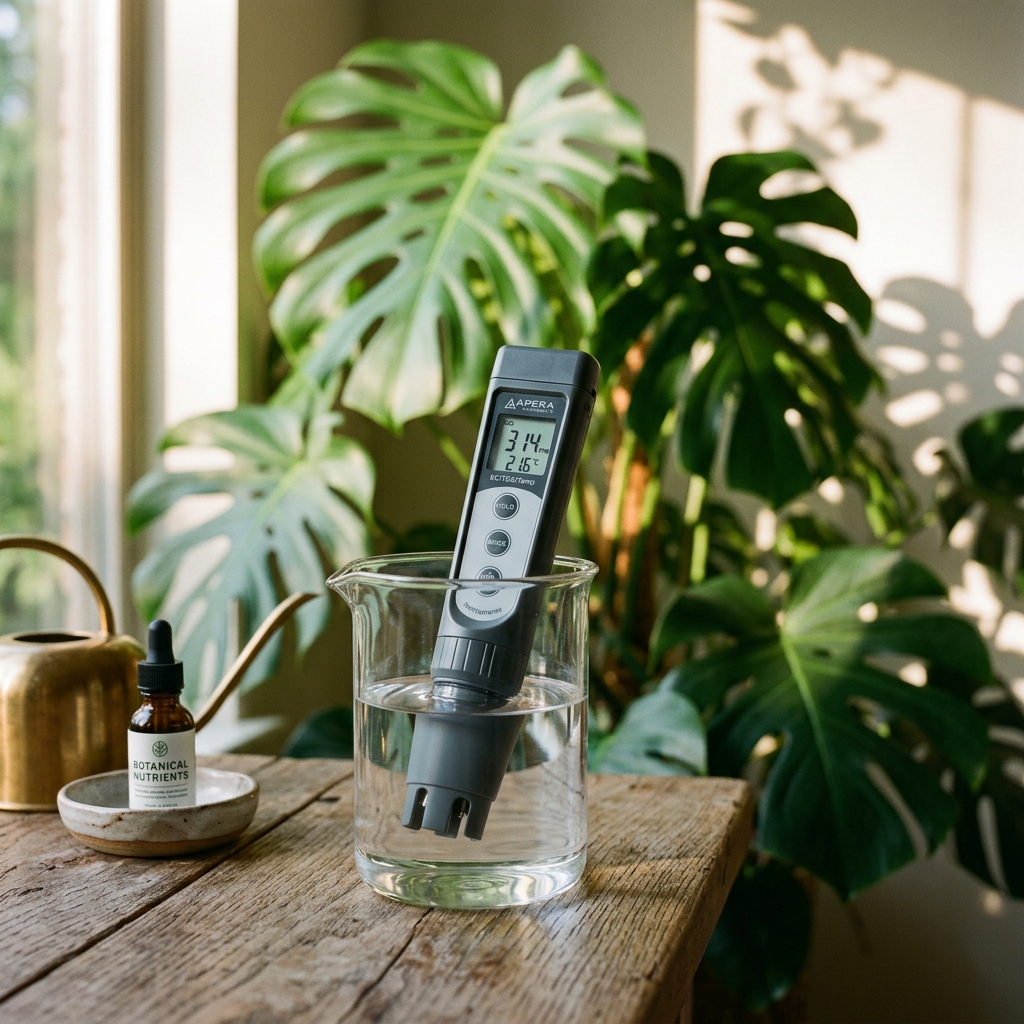
PPM (Parts Per Million) measures how many milligrams of dissolved fertilizer or minerals are present in one liter of water, indicating nutrient solution strength. It's related to EC and TDS but expressed differently, with TDS estimated from EC readings. PPM gives growers a precise, repeatable way to measure feeding strength instead of vague dilution terms.
Key Takeaways
- Use PPM to precisely quantify nutrient solution strength in water.
- Understand that TDS and PPM are usually derived from an EC reading.
- Prefer PPM over vague terms like half-strength for consistent dosing.
- Track PPM over time to confirm your fertilizing routine is accurate.
- Compare PPM meter readings cautiously, since conversion factors vary.
Symptoms
- Leaf tip burn (browning or necrosis at leaf margins): Classic sign of excessive nutrient concentration; salts accumulate at leaf edges and dehydrate tissue.
- White salt deposits on soil surface or pot rim: Evaporation leaves behind undissolved fertilizer salts, indicating PPM is too high or frequency is excessive.
- Pale or yellowing foliage despite adequate light: May indicate PPM is too low for the plant's growth stage, causing general underfeeding.
- Stunted or slow growth: Insufficient dissolved nutrients (low PPM) limit metabolic processes and cell division.
- Wilting despite moist soil: High PPM creates osmotic stress; roots cannot take up water against a strong salt gradient.
- Dark green, brittle leaves with clawing: Nitrogen toxicity from excessive PPM, often accompanied by over-dark coloration and downward curling.
- Root browning or reduced root mass: Chronically high PPM damages root hairs and encourages salt accumulation in the root zone.
Common Causes
- Mixing fertilizer incorrectly: Using volume measurements (teaspoons) instead of weight or PPM targets leads to inconsistent dosing.
- High baseline tap water PPM: Tap water with 200–400 PPM of calcium, magnesium, and bicarbonates adds hidden salts that inflate total readings.
- Ignoring EC and relying solely on manufacturer dilution ratios: Fertilizer labels assume average water; your actual PPM depends on source water quality and conversion factor.
- Using the wrong EC-to-PPM conversion factor: A meter set to 500 scale will read lower than one set to 700 scale for the same solution, causing confusion.
- Measuring with an uncalibrated TDS meter: Meters drift over time; an uncalibrated device can be off by hundreds of PPM.
- Evaporation concentrating nutrients: In hydroponic reservoirs or warm growing environments, water evaporates faster than nutrients, raising PPM.
- Stacking multiple nutrient products without calculating total PPM: Adding bloom booster, cal-mag, and base nutrients together can push PPM far beyond safe limits.
- Not accounting for growth stage: Applying flowering-stage PPM to seedlings causes immediate burn; applying seedling PPM to mature plants causes starvation.
Prevention
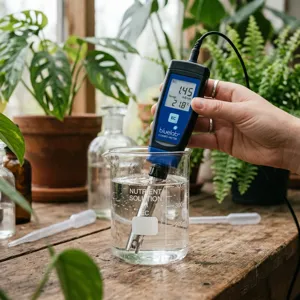
- Measure PPM with a TDS meter before every feeding or reservoir change.
- Keep a feeding log documenting date, fertilizer brand, dose, source water PPM, and final solution PPM.
- Calibrate your TDS meter monthly using a known EC standard solution.
- Use reverse osmosis (RO) or distilled water when precision matters, starting from a true 0 PPM baseline.
- Increase nutrient concentration gradually (100–200 PPM at a time) and observe plant response before raising further.
- Always subtract source water PPM from your final reading to calculate true fertilizer contribution.
- Monitor runoff PPM in container plants; a sharp rise signals accumulating salts.
- Match PPM targets to the plant's growth stage: seedlings < vegetative < flowering.
Best Practices
- Measure PPM of every nutrient batch before applying to plants—never assume consistency.
- Maintain a detailed feeding log with dates, products, doses, source water PPM, and final solution PPM.
- Check your source water PPM weekly; municipal water chemistry can shift seasonally.
- Know your meter's conversion factor (500, 640, or 700 scale) and stick to one standard.
- Monitor runoff PPM in potted plants every 2–4 weeks to catch salt buildup early.
- Allow mixed nutrient solutions to sit for 5–10 minutes before measuring; some salts dissolve slowly.
- Store your TDS meter in a dry place and calibrate monthly with a fresh EC standard.
What Is PPM (Parts Per Million)?
PPM—Parts Per Million—is a unit of concentration that tells you how many milligrams of dissolved solids are present in one liter of water. In plant care, those dissolved solids are primarily fertilizers, minerals, and salts. A reading of 500 PPM means there are 500 milligrams of dissolved material in every liter of solution. It is the standard language growers use to communicate exactly how "strong" a nutrient solution is, eliminating the guesswork of "half-strength" or "quarter-strength" dilutions.
EC vs. TDS vs. PPM: What's the Difference?
These three terms are often used interchangeably, but they measure different things:
| Metric | Measures | Unit | How It's Derived |
|---|---|---|---|
| EC | Electrical conductivity | mS/cm or µS/cm | Direct measurement of how well electricity passes through the solution |
| TDS | Total Dissolved Solids | ppm | Estimated from EC using a conversion factor |
| PPM | Concentration of dissolved substances | ppm | A unit of expression; in plant care, usually displayed by a TDS meter |
Importantly, TDS meters do not actually count dissolved particles. They measure EC and apply a mathematical conversion factor to estimate PPM. This is why two different TDS meters can give different PPM readings for the exact same solution.
The PPM Conversion Formula
Since PPM is derived from EC, understanding the formula is essential for accurate growing:
Common conversion factors used by manufacturers:
- 500 scale (NaCl): PPM = EC × 500 — Most common in North America (Hanna, BlueLab)
- 640 scale: PPM = EC × 640 — Used by some European manufacturers
- 700 scale (KCl): PPM = EC × 700 — Used by some Asian and Australian meters
Example: A solution with an EC of 1.2 mS/cm reads as 600 PPM on a 500-scale meter, but 840 PPM on a 700-scale meter. Always know which scale your meter uses.
Ideal PPM Ranges by Plant Type & Growth Stage
PPM targets vary dramatically depending on the plant's natural nutrient demands and its current growth phase:
| Plant / Stage | Soil / Coco PPM | Hydroponic PPM |
|---|---|---|
| Seedlings & Cuttings | 100–300 | 100–250 |
| General Houseplants | 400–800 | 400–700 |
| Orchids & Ferns | 150–350 | 150–300 |
| Succulents & Cacti | 250–500 | 250–450 |
| Leafy Greens (lettuce, spinach) | 600–900 | 700–900 |
| Herbs (basil, mint, cilantro) | 800–1200 | 800–1200 |
| Tomatoes & Peppers (vegetative) | 800–1200 | 1000–1400 |
| Tomatoes & Peppers (flowering/fruiting) | 1200–1800 | 1400–1800 |
| Cannabis (vegetative) | 800–1200 | 1000–1400 |
| Cannabis (flowering) | 1200–1600 | 1400–1800 |
These ranges assume you have already subtracted your source water's baseline PPM.
How to Calculate True Fertilizer PPM
The most common mistake growers make is trusting the total PPM reading on their meter without accounting for what's already in their tap water. Here's the correct method:
- Measure source water PPM. Fill a clean container with your unaltered tap, well, or RO water. Record the reading.
- Mix your complete nutrient solution. Add all fertilizers, supplements, and additives.
- Measure total solution PPM. Record the final reading.
- Calculate fertilizer contribution:
True Fertilizer PPM = Total PPM − Source Water PPM
Example: Your tap water reads 280 PPM. After mixing fertilizer, your solution reads 920 PPM. Your actual fertilizer dose is 640 PPM—not 920 PPM. If your target was 800 PPM, you are underfeeding, not overfeeding.
PPM and the Fertilizer Calculator Workflow
PPM measurement completes the fertilizer application journey:
- Calculate your target nutrient dose using a fertilizer calculator or manufacturer chart.
- Mix your solution thoroughly.
- Measure PPM with a TDS meter to verify the actual concentration.
- Adjust by diluting with plain water or adding more fertilizer.
- Retest until PPM falls within the target range.
- Measure pH and adjust if necessary.
- Feed your plants and log the results.
Skipping the PPM verification step is like following a recipe without tasting the food. The calculator gives you the target; the TDS meter confirms you hit it.
PPM in Soil vs. Hydroponics
Soil and Coco Coir: PPM is measured in the nutrient solution before watering. You can also measure runoff PPM to detect salt accumulation. If runoff PPM is significantly higher than input PPM, the root zone is accumulating salts and needs flushing.
Hydroponics: PPM is monitored directly in the reservoir. Because there is no soil buffer, PPM can shift daily due to plant uptake, evaporation, and microbial activity. Daily monitoring is standard practice. Top off the reservoir with pH-balanced water between full changes to maintain stable concentration.
Signs Your Nutrient Concentration Is Incorrect
| Symptom | Likely PPM Issue | Corrective Action |
|---|---|---|
| Leaf tip burn / brown margins | PPM too high | Dilute solution; flush growing medium |
| White crust on soil surface | PPM too high / overfeeding | Reduce concentration; increase flush frequency |
| Pale, yellowing new growth | PPM too low | Gradually increase fertilizer concentration |
| Stunted growth, small leaves | PPM too low | Raise PPM by 100–200 and observe |
| Wilting despite wet soil | Osmotic stress from high PPM | Flush immediately; reduce future PPM |
| Dark green, clawed leaves | Nitrogen toxicity (high PPM) | Dilute feed; reduce nitrogen component |
Why PPM and pH Must Be Measured Together
PPM tells you how much nutrient is present. pH tells you whether those nutrients are chemically available. A solution with perfect PPM (800) but wrong pH (8.0) will still cause nutrient lockout. Conversely, perfect pH (6.0) with excessive PPM (2000) will cause fertilizer burn. These two parameters are inseparable. Always measure both, adjust both, and log both in your feeding records.
Common PPM Scenarios
Scenario 1: Tap water is 350 PPM. You have hard water. Your "800 PPM" target is actually only 450 PPM of fertilizer. Consider using RO water for precision, or choose fertilizers formulated for hard water.
Scenario 2: Hydroponic reservoir PPM rises from 1000 to 1400 over 3 days. Evaporation is concentrating your solution. Top off with pH-balanced water (not nutrient solution) to dilute back to target.
Scenario 3: Runoff PPM is 400 higher than input PPM. Salts are accumulating in the root zone. Flush with pH-balanced water at 300–400 PPM until runoff matches input.
Frequently Asked Questions
What is PPM in plant care?
PPM stands for Parts Per Million. It quantifies how many milligrams of dissolved solids (nutrients, minerals, salts) are present in one liter of water. In plant care, it tells you the strength of your fertilizer solution.
What PPM should houseplants have?
Most houseplants thrive at 400–800 PPM during active growth (spring and summer). Reduce to 200–400 PPM in fall and winter when growth slows. Sensitive plants like ferns and orchids prefer 100–350 PPM.
Is higher PPM always better for plants?
No. Excessive PPM causes fertilizer burn, nutrient lockout, salt buildup, and osmotic stress that prevents roots from absorbing water. The goal is the right PPM for the plant's species and growth stage, not the highest possible number.
Is PPM the same as EC?
No, but they are closely related. EC (Electrical Conductivity) measures how well a solution conducts electricity, expressed in mS/cm or µS/cm. PPM is an estimate of dissolved solids derived from that EC reading using a conversion factor. A TDS meter measures EC and displays it as PPM.
What is a good PPM for hydroponics?
Hydroponic PPM targets vary by crop: lettuce and leafy greens prefer 700–900 PPM; tomatoes and peppers need 1200–1800 PPM; herbs typically thrive at 800–1200 PPM. Hydroponic systems require more frequent monitoring because there is no soil buffer.
Why should I subtract tap water PPM from my reading?
Because your fertilizer is not the only source of dissolved solids. Tap water contains calcium, magnesium, bicarbonates, and other minerals that register on a TDS meter. Subtracting the baseline gives you the true nutrient concentration you are adding. For example, if tap water is 250 PPM and your final solution reads 750 PPM, your fertilizer contribution is only 500 PPM.
What conversion factor does my TDS meter use?
Most consumer TDS meters use either a 500 scale (PPM = EC × 500) or a 700 scale (PPM = EC × 700). Hanna meters typically use 500; some European meters use 640. Check your manual—using the wrong factor when comparing readings with other growers will cause confusion.
Can I measure PPM without a TDS meter?
Not accurately. While you can estimate PPM from fertilizer label dilution ratios, this ignores your source water chemistry and assumes perfect mixing. A TDS meter is inexpensive and essential for precision growing.
Does PPM measure pH?
No. PPM measures total dissolved solids (concentration), while pH measures acidity or alkalinity. They are independent properties. A solution can have high PPM and low pH, or low PPM and high pH. Both must be measured together for complete solution management.
Why does my hydroponic reservoir PPM rise between changes?
Water evaporates faster than dissolved nutrients, leaving salts behind and concentrating the solution. Plants also take up water and nutrients at different rates. Top off with pH-balanced water between full reservoir changes to maintain stable PPM.
Explore More
Related Articles
Related Plant Guides
No specific plant guides found matching this topic.
Recommended next actions
Continue Exploring
Dive deeper into related plant care tools and profiles.
Topic Guide
Fertilizer
Learn everything about fertilizer for your indoor and aquarium plants. Expert care tips, troubleshooting, and related guides.
Topic Guide
NPK Explained for Plant Care
Understand what NPK means, how nitrogen, phosphorus and potassium affect plant growth and how to choose the right balance.
Topic Guide
Liquid Fertilizer: Benefits, How to Use, Dosage, Pros & Cons
Learn what liquid fertilizer is, how to mix and apply it correctly, when to use it, advantages over granular fertilizer, dosage recommendations per liter.
Topic Guide
EC Meter Guide for Plants
Use an EC meter to measure nutrient salt levels in soil or water and keep readings within the safe range for healthy plant roots.
Topic Guide
TDS Meter Guide: PPM, EC Conversion & Safe Ranges for Plants
Learn how TDS meters work, how they convert EC to PPM, what readings are safe for houseplants and hydroponics, and how to prevent over-fertilization with.
Topic Guide
Osmotic Pressure in Plant Roots
Learn how osmotic pressure moves water through plant roots and why excess fertilizer salts trigger fertilizer burn damage.