Fertilizer Burn: Symptoms and Treatment
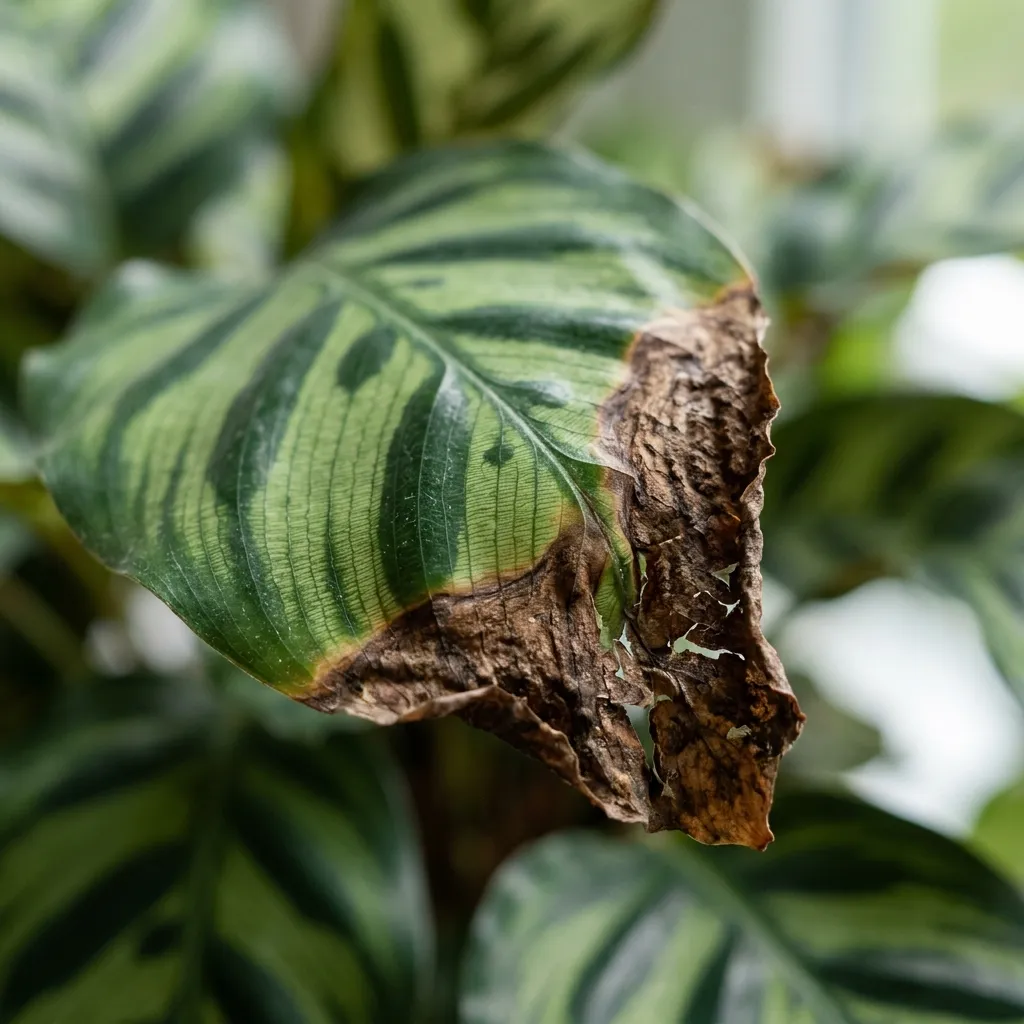
Fertilizer burn occurs when the salt concentration in soil solution exceeds the concentration inside plant root cells, reversing the normal flow of water and pulling moisture out of the roots through osmosis. This is why fertilizer burn is deceptive: the soil can feel completely moist while the plant is effectively dehydrating at the cellular level. The salts also directly damage cell membranes in roots and leaves, producing the characteristic crispy, brown margins growers associate with overfertilizing. Recognizing the early signs and flushing the soil promptly limits lasting root damage.
Quick Answer
Fertilizer burn is root and leaf damage caused by excess salt concentration in soil, which pulls water out of root cells through osmosis rather than heat or acidity. Symptoms include crispy brown leaf edges and stunted growth even in moist soil. Flushing the soil with plain water removes excess salts and can help the plant recover.
Key Takeaways
- Watch for crispy, brown leaf edges as the primary warning sign.
- Flush soil with plain water to wash out excess fertilizer salts.
- Reduce fertilizer strength going forward once symptoms appear.
- Understand that fertilizer burn is osmotic, not caused by heat.
- Check EC levels to confirm salt concentration before reapplying feed.
Symptoms
- Brown, crispy tips on leaves: The earliest sign; salt accumulation at leaf margins dehydrates tissue, causing necrosis that starts at the tip and spreads inward.
- Yellowing margins with brown edges: Chlorosis followed by necrosis along leaf edges as salt toxicity disrupts chlorophyll production and cell hydration.
- White or grayish crust on soil surface: Crystallized fertilizer salts accumulating on top of the soil as water evaporates, leaving minerals behind.
- Wilting or drooping despite moist soil: Roots lose turgor pressure because salts have pulled water out of root cells; the plant cannot rehydrate even when water is present.
- Leaf curl or cupping: Leaves curl downward or cup as a stress response to reduce surface area and minimize further water loss.
- Sudden leaf drop: Severe osmotic shock causes the plant to abort leaves as a survival mechanism, conserving resources for the roots.
- Stunted or arrested growth: Root damage reduces nutrient and water uptake, halting cell division and expansion even in optimal light and temperature.
- Blackened or mushy roots: Advanced salt burn kills root tissue, which then rots due to secondary bacterial or fungal infection.
- Slow decline over weeks after fertilizing: Unlike mechanical damage, fertilizer burn often manifests gradually as salts accumulate and osmotic pressure builds.
Common Causes
- Applying too much fertilizer at once: Exceeding the recommended dose creates an immediate salt spike that overwhelms the root zone's dilution capacity.
- Feeding too frequently: Even moderate doses applied too often cause cumulative salt buildup faster than the plant can absorb or leaching can remove.
- Fertilizing dormant or slow-growing plants: Plants in dormancy take up minimal water; salts remain concentrated around roots instead of being diluted by active transpiration.
- Poor drainage or lack of drainage holes: Water and salts cannot escape the pot; evaporation concentrates salts further while roots sit in a saline bath.
- High baseline EC or PPM in source water: Hard tap water already contains 200–400 PPM of salts; adding fertilizer on top pushes total concentration into the burn zone.
- Never flushing accumulated salts: Without periodic leaching, every feeding adds a new layer of salt on top of the previous one, compounding over months.
- Incorrect dilution or measurement errors: Misreading tablespoons for teaspoons, using weight instead of volume, or failing to account for concentrate strength.
- Stacking multiple fertilizer products: Combining base nutrients, bloom boosters, cal-mag, and supplements without calculating total combined PPM.
- Using full-strength synthetic fertilizer on houseplants: Manufacturer recommendations are often calibrated for outdoor garden beds or greenhouse production, not small containers.
- Fertilizing dry soil: Without moisture to dilute and distribute salts, fertilizer contacts roots at full concentration, causing instant chemical shock.
- Using hot or fresh manure or uncomposted organic matter: Decomposing organic materials release ammonium and salts rapidly, creating localized zones of extreme concentration.
Prevention
- Measure EC or PPM of your nutrient solution with a TDS meter before every feeding.
- Use a fertilizer calculator to determine precise doses based on container size, plant type, and growth stage.
- Reduce or eliminate fertilizing during dormancy (fall and winter for most temperate houseplants).
- Water thoroughly until runoff before applying fertilizer; never feed dry soil.
- Flush container soil with plain water every 4–6 weeks to leach accumulated salts.
- Measure runoff EC monthly; if runoff EC exceeds input EC by more than 20%, flush immediately.
- Start new fertilizers at half the manufacturer's recommended strength and increase gradually.
- Follow a plant-specific feeding schedule rather than a generic calendar.
- Use reverse osmosis or distilled water when source water EC exceeds 0.4 mS/cm (200 PPM).
Best Practices
- Feed only during active growth periods; withhold fertilizer entirely during dormancy.
- Always use pots with drainage holes; closed containers trap salts and prevent flushing.
- Water thoroughly until 10–20% runoff before every fertilization to pre-moisten roots and soil.
- Monitor runoff EC monthly as an early warning system for salt accumulation.
- Measure EC of every mixed nutrient solution before it touches plant roots.
- Reduce fertilizer concentration by 50% in winter or whenever growth visibly slows.
- Increase nutrient concentration gradually (100–200 PPM at a time) and observe plant response.
What Is Fertilizer Burn?
Fertilizer burn is a form of chemical damage caused by excessive concentrations of fertilizer salts in the soil. It is not caused by heat or acidity—it is caused by osmotic stress. When the salt concentration in the soil solution becomes higher than the concentration of dissolved salts inside the plant's root cells, water is pulled out of the roots through reverse osmosis. The plant dehydrates from the inside out, even when the surrounding soil is soaking wet.
This is why fertilizer burn is so deceptive: the soil feels moist, but the plant is dying of thirst at the cellular level. The salts also directly damage root cell membranes and leaf tissue, causing the characteristic brown, crispy margins and tips that growers recognize as burn.
The Science: Osmosis and Root Damage
Plant roots absorb water through osmosis—water moves from areas of low solute concentration (dilute soil solution) to areas of high solute concentration (inside root cells). This requires the soil to be less salty than the root interior.
When you over-fertilize, you reverse this gradient:
Even before roots die, the high salt concentration disrupts enzyme function, damages cell membranes, and interferes with nutrient uptake. Nitrogen and potassium—highly mobile nutrients—accumulate to toxic levels fastest, which is why leaf tip burn (where these nutrients are transported and deposited) appears first.
Early Warning Signs vs. Advanced Symptoms
| Stage | Symptoms | What to Do |
|---|---|---|
| Early (Days 1–3) | Brown tips on newest leaves; slight leaf curl | Flush immediately; stop all fertilizing |
| Moderate (Days 3–10) | Brown margins spreading inward; white salt crust; wilting | Flush 3–4 times; trim damaged tissue; hold fertilizer 3–4 weeks |
| Advanced (Week 2+) | Massive leaf drop; black roots; foul smell; plant collapse | Repot after trimming dead roots; treat as transplant shock |
How to Treat Fertilizer Burn: The Flush Method
Flushing is the immediate, first-line treatment for all severity levels. The goal is to dissolve accumulated salts and wash them out of the root zone:
- Stop fertilizing immediately. Do not apply any more nutrients until recovery is confirmed.
- Use plain water at room temperature. Tap water is fine unless your tap is extremely hard (>400 PPM); in that case, use distilled or rainwater.
- Calculate volume: Use 3–5 times the volume of the pot. A 1-gallon pot needs 3–5 gallons of water.
- Pour slowly and evenly over the soil surface, allowing water to saturate and drain completely between each pour.
- Collect and measure runoff with a TDS meter. Continue flushing until runoff PPM is within 100–200 PPM of your source water.
- Let drain thoroughly. Never let the pot sit in a saucer of flush water, which would reabsorb the salts you just removed.
For severe burn: If flushing 3–5 times fails to reduce runoff EC, or if roots are visibly rotting, proceed to repotting into entirely fresh mix.
Recovery Timeline: What to Expect
| Timeframe | Action | Expected Outcome |
|---|---|---|
| Day 1 | Flush soil thoroughly; stop all fertilizer | Salt levels begin dropping; no visible change yet |
| Days 2–7 | Maintain light moisture; stable environment | Root osmotic balance begins restoring; wilting may stabilize |
| Week 2 | Trim dead leaves; inspect for new growth | New buds or leaves should appear green and healthy |
| Week 3–4 | If new growth is healthy, apply ¼-strength feed once | Plant tests nutrient processing ability |
| Week 6–8 | Gradually return to ½-strength normal schedule | Full recovery confirmed by consistent healthy new growth |
EC Meters: Detecting Burn Before It Happens
The most powerful tool for preventing fertilizer burn is an EC or TDS meter. Visible symptoms appear only after significant damage has occurred. An EC meter reveals dangerous salt levels while roots are still healthy:
- Input EC: Measure your nutrient solution before feeding. Most houseplants tolerate 1.0–1.5 mS/cm.
- Runoff EC: Measure drainage water monthly. If runoff EC is >20% above input EC, salts are accumulating—flush immediately.
- Source water EC: Hard tap water at 0.5 mS/cm (250 PPM) adds hidden salts. Subtract this baseline from your target.
Think of EC measurement as a smoke detector for fertilizer burn: it alerts you to danger before you can see the fire.
The Fertilizer Calculator Journey: Preventing Burn Before It Starts
The complete workflow for safe, precise fertilization that eliminates burn risk:
- Identify your plant and growth stage — Seedlings, vegetative, flowering, or dormant?
- Use a fertilizer calculator — Enter your fertilizer's NPK, container size, and target PPM.
- Mix precisely — Weigh or measure exactly what the calculator specifies.
- Measure EC/PPM — Verify the mixed solution with a TDS meter before feeding.
- Water first, then feed — Pre-moisten soil to dilute and distribute salts evenly.
- Feed and observe — Apply solution and monitor plant response over 48–72 hours.
- Log and adjust — Record dose, EC, and plant reaction. Adjust next feeding if needed.
This闭环 (closed loop) removes guesswork. Burn happens when growers skip the measurement and verification steps.
Why Dormant Plants Burn So Easily
One of the most common scenarios for fertilizer burn is a well-meaning grower who continues their summer feeding schedule into winter. During dormancy:
- Transpiration rates drop by 60–90%
- Root metabolic activity slows dramatically
- Nutrient demand falls to near-zero
- Water uptake is minimal, so salts concentrate around roots
A dose that was perfectly safe in July becomes lethal in December. The rule is simple: when growth stops, feeding should stop (or drop to ¼ strength at most).
Fertilizer Burn vs. Other Problems
| Problem | Key Differentiator | How to Confirm |
|---|---|---|
| Fertilizer Burn | Brown tips + salt crust + recent feeding | High runoff EC; white soil crust |
| Underwatering | Dry soil + wilting + uniform browning | Soil is dry; plant perks up after watering |
| Nutrient Deficiency | Patterned chlorosis (interveinal, old leaves first) | Low EC; specific nutrient patterns |
| Root Rot | Mushy roots + foul smell + wet soil | Black roots; often follows overwatering, not overfeeding |
| Pest Damage | Spotting, webbing, or visible insects | Inspect undersides of leaves with magnification |
| pH Lockout | Yellowing with green veins (iron) or purple stems (phosphorus) | pH test; EC may be normal |
Frequently Asked Questions
Can fertilizer burn be reversed?
The damage to existing leaves is permanent—they will not turn green again. However, the condition itself is reversible if caught early. Flush the soil thoroughly to leach salts, then wait for new growth. Healthy new leaves emerging within 2–4 weeks confirm recovery.
Will damaged leaves recover or grow back?
No. Burned leaf tissue is dead and cannot regenerate. Trim severely damaged leaves with sterile scissors to redirect the plant's energy toward new growth. The plant will replace them with fresh, healthy foliage once the root zone is restored.
How long does recovery from fertilizer burn take?
Mild burn: 1–2 weeks for new growth to appear healthy. Moderate burn: 2–4 weeks. Severe burn with root damage: 4–8 weeks or longer. Recovery speed depends on the plant species, growing conditions, and how quickly salts were removed.
Can organic fertilizer burn plants?
Yes, though it is less common. Fresh manure, uncomposted organic matter, and concentrated liquid organics like fish emulsion at full strength can all cause salt burn or ammonia toxicity. Organic fertilizers generally release nutrients more slowly, but over-application still raises soil salinity.
How much water should I use to flush fertilizer burn?
Use 3–5 times the volume of the pot. For a 1-gallon (4-liter) pot, pour 3–5 gallons (12–20 liters) of plain, room-temperature water through the soil over 15–20 minutes. Allow full drainage between each pour. Repeat until runoff EC drops close to source water levels.
Is fertilizer burn permanent?
It can be if root damage is severe enough to kill the plant. But in most cases, plants recover fully once salts are leached and roots heal. The key is acting quickly—within days of noticing symptoms—and stopping all fertilizing until recovery is confirmed.
Should I repot a plant with fertilizer burn?
For mild to moderate burn, flushing is usually sufficient. Repot only if: (1) the soil is severely degraded, (2) roots are rotting, (3) the pot has no drainage, or (4) flushing 3–5 times fails to reduce runoff EC. Use fresh, well-draining mix when repotting.
How can I tell fertilizer burn apart from underwatering?
Both cause browning, but fertilizer burn typically affects leaf tips and margins uniformly across the plant, often with a white salt crust on soil. Underwatering usually causes wilting, dry soil, and more generalized browning. A TDS meter confirming high EC definitively identifies burn.
Why do my plants burn more easily in winter?
During dormancy or low-light winter conditions, plants transpire less and take up water slowly. Fertilizer salts remain concentrated around roots instead of being diluted by active water flow. Always reduce or stop fertilizing in fall and winter.
Can I prevent fertilizer burn by using slow-release fertilizer?
Slow-release fertilizers reduce but do not eliminate burn risk. They release nutrients gradually, but if applied too heavily, placed too close to roots, or used in small containers, they can still concentrate salts. Always follow application rates and keep granules away from the stem.
Explore More
Related Articles

Related Plant Guides
No specific plant guides found matching this topic.
Recommended next actions
Continue Exploring
Dive deeper into related plant care tools and profiles.
Topic Guide
Fertilizer
Learn everything about fertilizer for your indoor and aquarium plants. Expert care tips, troubleshooting, and related guides.
Topic Guide
Salt Buildup in Plants: Causes, Symptoms & How to Fix It
Learn what salt buildup is, how to identify symptoms like leaf tip burn, what causes it, and how to flush soil and prevent fertilizer salt accumulation in.
Topic Guide
Osmotic Pressure in Plant Roots
Learn how osmotic pressure moves water through plant roots and why excess fertilizer salts trigger fertilizer burn damage.
Topic Guide
EC Meter Guide for Plants
Use an EC meter to measure nutrient salt levels in soil or water and keep readings within the safe range for healthy plant roots.
Topic Guide
PPM Explained for Plant Feeding
Understand what PPM means for fertilizer strength and how to measure and adjust parts per million for safe plant feeding.
Topic Guide
Nutrient Lockout in Plants: Causes, Diagnosis & How to Fix It
Learn to identify and fix nutrient lockout. Discover why plants can't absorb nutrients due to pH imbalance, salt buildup, or overfertilization, and how to.