EC Meter Guide for Plants
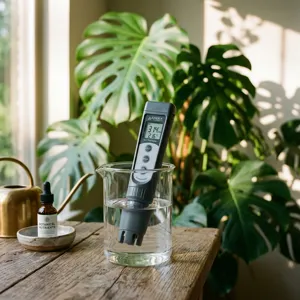
An EC (Electrical Conductivity) meter is a handheld device that measures how well a liquid conducts electricity, which correlates directly with the concentration of dissolved fertilizer salts present. Because fertilizer salts break into charged ions in water, higher EC readings mean a stronger, more concentrated nutrient solution. For home growers, EC testing removes the guesswork from feeding schedules by providing an objective number to track over time. It complements pH testing, since both salt concentration and pH availability affect whether a plant can actually absorb the nutrients present in its soil.
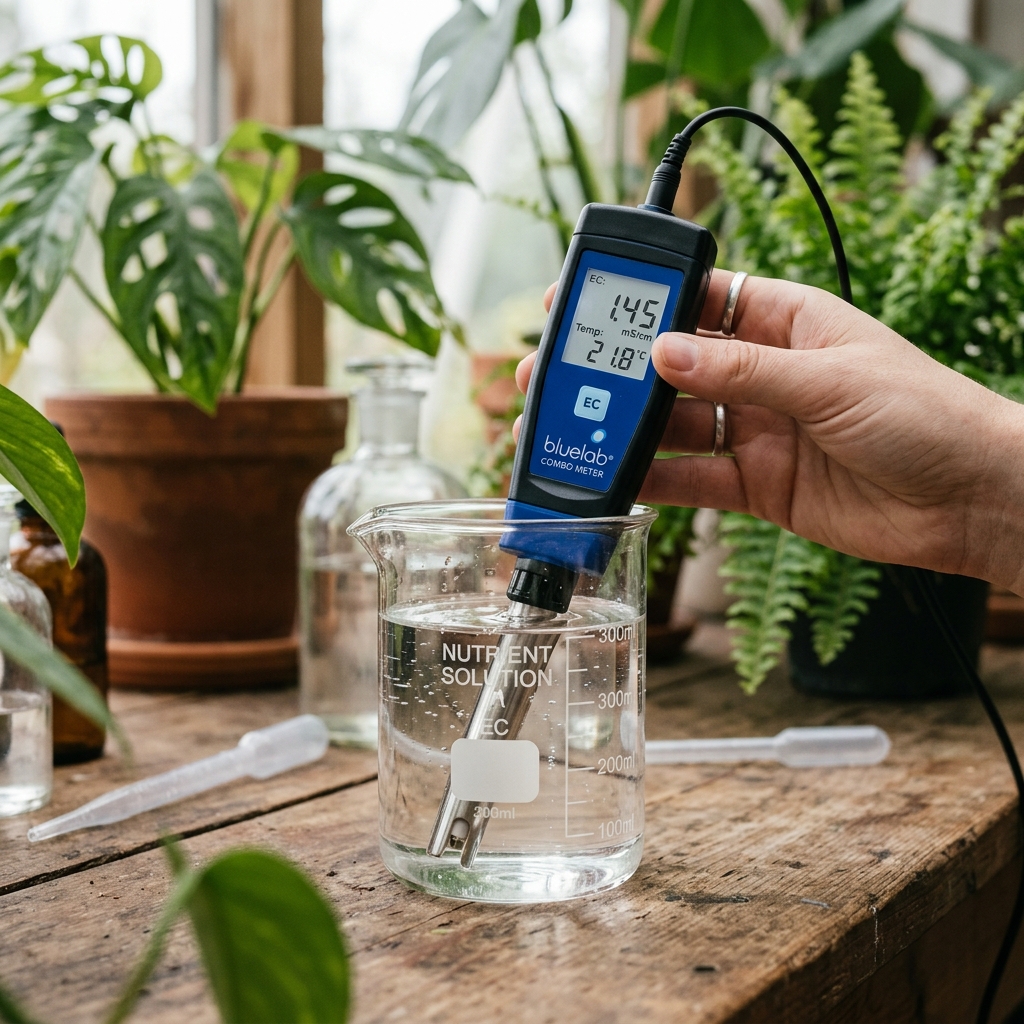
Quick Answer
An EC meter measures electrical conductivity to estimate the concentration of dissolved fertilizer salts in soil or water. Readings between 0.8-1.5 mS/cm are generally safe for most houseplants, while readings above 2.5 mS/cm signal a high risk of root burn. Regular EC testing helps confirm fertilizer dosing is accurate rather than guessed.
Key Takeaways
- Keep EC readings between 0.8-1.5 mS/cm for most common houseplants.
- Readings above 2.5 mS/cm indicate a high risk of fertilizer burn.
- Low EC readings suggest underfeeding and a need for more fertilizer.
- Test EC regularly to verify dosing accuracy instead of guessing strength.
- Combine EC testing with pH monitoring for a complete nutrient picture.
Symptoms
- Leaf tip burn: Brown, crispy edges on leaves, especially in succulents and houseplants
- White salt crust on soil: Visible crystalline buildup on the soil surface indicating accumulated fertilizer salts
- Poor growth despite fertilizing: Stunted growth with adequate light and water, suggesting nutrient lockout from excess salts
- Suspected over-fertilization: After using full-strength fertilizer, mixing errors, or following generic advice without measuring
- Hydroponic nutrient monitoring: Essential for maintaining correct nutrient strength in water-based growing systems
Common Causes
- Over-fertilization: Applying fertilizer at full strength or more frequently than needed raises EC beyond safe levels
- No drainage holes: Pots without drainage trap salts that would otherwise flush out with excess water
- Hard water: Tap water with high mineral content adds baseline salts before fertilizer is even added
- Infrequent flushing: Without periodic plain-water flushing, salts accumulate with each feeding
- Peat-heavy soil: Soils high in peat moss have poor leaching capacity and retain salts longer
Prevention
- Start fertilizer at 1/4 to 1/2 label strength
- Water until 20% drains from the bottom with each feeding
- Flush soil with plain water every 4–6 weeks
- Use pots with drainage holes
- Measure EC before and after fertilizing
- Adjust feeding for seasons—reduce by 50% in winter
- Use coarse, well-draining potting mix
Best Practices
- Calibrate your meter monthly with fresh standard solution
- Measure fertilizer solution after mixing, before applying
- Measure runoff EC monthly to detect hidden salt buildup
- Clean the probe with distilled water after each use
- Store the probe in storage solution or distilled water
- Use distilled water for soil slurry tests
- Record readings in a plant journal to track trends
- Use a meter with automatic temperature compensation (ATC)
What Is an EC Meter?
An EC (Electrical Conductivity) meter is a handheld digital device that measures how well a liquid conducts electricity. In plant care, it is used as a proxy for the total concentration of dissolved fertilizer salts in water, soil, or hydroponic nutrient solution. The higher the EC reading, the more dissolved salts are present.
EC is measured in millisiemens per centimeter (mS/cm) or sometimes decisiemens per meter (dS/m). For most home growers, mS/cm is the standard unit displayed on consumer-grade meters.
In one sentence: An EC meter measures the electrical conductivity of water or nutrient solution to estimate the concentration of dissolved fertilizer salts, helping prevent over-fertilization and root burn.
How Does an EC Meter Work?
When fertilizer salts dissolve in water, they break into positively and negatively charged ions (e.g., nitrate NO₃⁻, potassium K⁺, calcium Ca²⁺). These ions carry electrical current. An EC meter sends a small electrical charge between two probes and measures how easily the current flows. More ions = higher conductivity = higher EC reading.
Most modern EC meters also include temperature compensation, because water conductivity changes with temperature. A reading taken at 25°C is the standard reference. If your meter lacks automatic temperature compensation (ATC), readings will drift in hot or cold conditions.
EC vs TDS: What's the Difference?
| Feature | EC Meter | TDS Meter |
|---|---|---|
| What it measures | Electrical conductivity (mS/cm) | Total dissolved solids (ppm) |
| How it works | Measures current flow between probes | Measures EC, then converts to ppm using a factor |
| Units | mS/cm or µS/cm | ppm (parts per million) |
| Accuracy | Direct measurement; more precise | Converted value; depends on conversion factor |
| Best for | Scientific accuracy, hydroponics, research | Quick reference, general gardening |
| Conversion | TDS = EC × conversion factor (usually 500 or 700) | EC = TDS ÷ conversion factor |
Important: TDS meters are actually EC meters with a built-in conversion. The conversion factor varies by manufacturer (500× for NaCl standard, 700× for KCl standard). Always check which factor your meter uses. For fertilizer solutions, 640× is a common horticultural standard.
Why EC Matters for Plant Health
EC is the most reliable way to verify your fertilizer dose is correct. Here's why it matters:
- Prevents fertilizer burn — high EC means high salt concentration, which draws water out of roots through osmosis
- Prevents nutrient lockout — excess salts block uptake of other nutrients, causing deficiencies even when nutrients are present
- Optimizes feeding — low EC means underfeeding; plants grow slowly and leaves pale
- Monitors salt buildup — rising EC over time indicates accumulating salts that need flushing
- Calibrates custom mixes — homemade nutrient solutions need EC verification for consistency
When Should You Use an EC Meter?
Use an EC meter whenever you suspect salt-related problems or want to optimize feeding:
- Leaf tip burn — brown, crispy edges on leaves, especially in succulents and houseplants
- White salt crust — visible crystalline buildup on soil surface
- Poor growth despite fertilizing — stunted growth with adequate light and water
- Suspected over-fertilization — after using full-strength fertilizer or mixing errors
- Hydroponic nutrient monitoring — essential for maintaining correct nutrient strength in water-based systems
- After repotting — verify that new soil doesn't have residual high salts
- Before switching fertilizers — establish a baseline with your current product
Safe EC Levels for Different Plants
| Plant Type | Safe EC Range (mS/cm) | Notes |
|---|---|---|
| Seedlings / Cuttings | 0.4 – 0.8 | Very sensitive; use 1/8 to 1/4 strength fertilizer |
| Most Houseplants | 0.8 – 1.5 | Standard range for tropical foliage plants |
| Heavy Feeders (Tomato, Pepper) | 1.5 – 2.5 | Outdoor vegetables in peak growth |
| Succulents / Cacti | 0.4 – 1.0 | Low tolerance; prone to burn |
| Orchids | 0.6 – 1.2 | Epiphytic roots are sensitive to salts |
| Hydroponics (Leafy Greens) | 1.0 – 1.6 | Lettuce, spinach, herbs |
| Hydroponics (Fruiting Plants) | 1.8 – 2.8 | Tomatoes, peppers, cucumbers |
| Danger Zone | > 2.5 | Root burn likely; flush immediately |
How to Use an EC Meter: Step-by-Step
- Calibrate your meter — use a calibration solution (usually 1.413 mS/cm or 2.76 mS/cm) monthly
- Prepare your sample — for soil, mix 1 part soil with 2 parts distilled water, stir, let settle 30 minutes, then measure the liquid
- For nutrient solution — stir your fertilizer mix thoroughly, then dip the probe directly into the solution
- For runoff — collect water draining from the pot bottom after watering; this shows accumulated soil salts
- Read the display — note the mS/cm value and the temperature
- Compare to safe ranges — use the table above to determine if your reading is safe
- Record and track — keep a log to spot trends over time
Diagnosis: What Your EC Reading Means
| EC Reading | Interpretation | Action |
|---|---|---|
| Below 0.4 mS/cm | Very low nutrients; underfeeding | Increase fertilizer strength gradually |
| 0.4 – 0.8 mS/cm | Low; acceptable for seedlings and sensitive plants | Monitor growth; increase slightly if pale |
| 0.8 – 1.5 mS/cm | Optimal for most houseplants | Maintain current feeding regimen |
| 1.5 – 2.5 mS/cm | High; acceptable for heavy feeders only | Reduce strength or frequency for most plants |
| Above 2.5 mS/cm | Dangerous; root burn likely | Flush soil with 2–3× pot volume of plain water; retest in 48 hours |
Best Practices
- Calibrate monthly — EC probes drift over time; calibration solutions are inexpensive
- Measure after mixing fertilizer — always verify your mixed solution before applying
- Measure runoff occasionally — runoff EC reveals accumulated soil salts that surface readings miss
- Clean the probe after each use — rinse with distilled water and gently wipe dry
- Store properly — keep the probe moist (in storage solution or distilled water) to prevent drying out
- Use distilled water for soil slurries — tap water minerals will skew readings
- Measure at consistent temperatures — or use a meter with automatic temperature compensation (ATC)
- Record readings in a plant journal — trends are more informative than single measurements
Common Mistakes
- Measuring immediately after watering — wait until water has fully saturated the soil profile
- Not calibrating — an uncalibrated meter can be off by 20% or more
- Using tap water as a reference — tap water contains minerals that raise baseline EC
- Ignoring temperature compensation — a 10°C difference can change EC by 20%
- Confusing EC and pH — EC measures salt concentration; pH measures acidity. Both matter but measure different things
- Drying out the probe — dried probes lose sensitivity and may not recover
- Measuring dry soil directly — always create a soil slurry with distilled water
- Using the wrong conversion factor — TDS meters use 500×, 640×, or 700×; know which one yours uses
Related Tools & Topics
Tools
- TDS Meter — converts EC to ppm for quick reference
- pH Meter — measures acidity; essential companion to EC
- Fertilizer Calculator — computes exact doses before mixing
Problems
- Fertilizer Burn — high EC is the primary cause
- Nutrient Lockout — excess salts block uptake
- Salt Buildup — detected by rising EC over time
Concepts
- ppm (Parts Per Million) — TDS unit derived from EC
- Osmotic Pressure — the mechanism behind fertilizer burn
- Macronutrients — N, P, K measured indirectly by EC
- Micronutrients — trace elements also contribute to EC
Frequently Asked Questions
What EC is safe for houseplants?
Most houseplants thrive at an EC of 0.8–1.5 mS/cm. Seedlings and sensitive plants like succulents prefer 0.4–1.0 mS/cm. Heavy feeders like tomatoes can tolerate 1.5–2.5 mS/cm. Readings above 2.5 mS/cm indicate dangerous salt levels and require immediate flushing.
Is EC the same as TDS?
No, but they are closely related. EC (Electrical Conductivity) measures how well a solution conducts electricity in mS/cm. TDS (Total Dissolved Solids) is a converted value expressed in ppm. TDS meters measure EC internally and multiply by a conversion factor (usually 500, 640, or 700) to estimate total dissolved solids. EC is the more direct and scientifically accurate measurement.
Can an EC meter detect fertilizer burn before visible symptoms?
Yes. An EC meter can detect dangerous salt levels days or even weeks before visible leaf burn appears. If your soil or runoff EC exceeds 2.5 mS/cm, root damage is already occurring even if leaves still look green. Regular EC monitoring is the best early warning system for over-fertilization.
Should I buy an EC meter or a TDS meter?
Buy an EC meter if you want scientific accuracy and plan to do hydroponics or precision growing. Buy a TDS meter if you want a simple ppm reading for general houseplant care. Many modern meters display both EC and TDS. For serious growers, an EC meter with ATC (automatic temperature compensation) is the better investment.
How often should I measure EC?
Measure your fertilizer solution every time you mix a new batch. Measure soil or runoff EC monthly for established plants, or weekly if you suspect problems. In hydroponics, measure the reservoir EC daily. Keep a log to track trends—rising EC over time indicates salt buildup that needs flushing.
How do I calibrate an EC meter?
Immerse the probe in a calibration solution of known EC (typically 1.413 mS/cm or 2.76 mS/cm). Press the calibration button and wait for the reading to stabilize. Rinse with distilled water between calibrations. Calibrate monthly, or more frequently if readings seem inconsistent. Always use fresh calibration solution—old solution absorbs CO2 from air and changes conductivity.
Can I use an EC meter for soil?
Yes, but not by sticking the probe directly into dry soil. Create a soil slurry: mix 1 part soil with 2 parts distilled water, stir thoroughly, let it settle for 30 minutes, then measure the liquid. Alternatively, collect runoff water after watering—this gives a good indication of soil salt levels without disturbing roots.
Explore More
Related Articles

Related Plant Guides
No specific plant guides found matching this topic.
Recommended next actions
Continue Exploring
Dive deeper into related plant care tools and profiles.
Topic Guide
PPM Explained for Plant Feeding
Understand what PPM means for fertilizer strength and how to measure and adjust parts per million for safe plant feeding.
Topic Guide
TDS Meter Guide: PPM, EC Conversion & Safe Ranges for Plants
Learn how TDS meters work, how they convert EC to PPM, what readings are safe for houseplants and hydroponics, and how to prevent over-fertilization with.
Topic Guide
Osmotic Pressure in Plant Roots
Learn how osmotic pressure moves water through plant roots and why excess fertilizer salts trigger fertilizer burn damage.
Topic Guide
Salt Buildup in Plants: Causes, Symptoms & How to Fix It
Learn what salt buildup is, how to identify symptoms like leaf tip burn, what causes it, and how to flush soil and prevent fertilizer salt accumulation in.
Topic Guide
Nutrient Lockout in Plants: Causes, Diagnosis & How to Fix It
Learn to identify and fix nutrient lockout. Discover why plants can't absorb nutrients due to pH imbalance, salt buildup, or overfertilization, and how to.
Topic Guide
Fertilizer
Learn everything about fertilizer for your indoor and aquarium plants. Expert care tips, troubleshooting, and related guides.