pH Meter Guide for Soil Testing
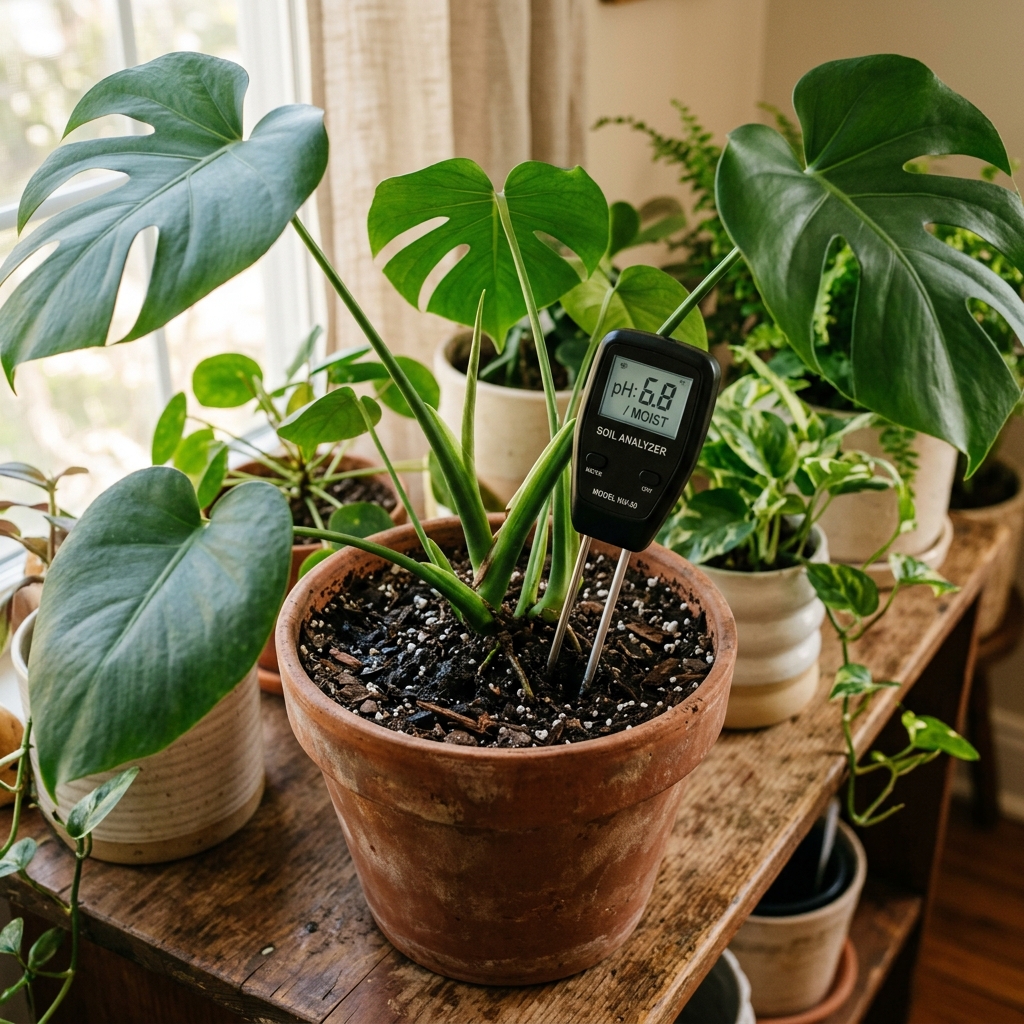
A pH meter is an electronic or chemical testing device that measures hydrogen ion concentration in soil or water, expressed on a logarithmic scale from 0 to 14. For growers, this reading acts as a gatekeeper for nutrient availability, since even well-fertilized soil can leave plants deficient if the pH is wrong. Because the scale is logarithmic, small numerical shifts represent large changes in acidity; a move from pH 6.0 to 5.0 is a tenfold increase. Regular pH testing helps explain deficiency symptoms that persist despite adequate fertilizing, pointing growers toward pH correction rather than more feeding.
Quick Answer
A pH meter measures hydrogen ion concentration in soil or water on a 0-14 scale, with 7.0 being neutral. Most houseplants absorb nutrients best between pH 6.0 and 6.5. Incorrect pH causes nutrient lockout, binding available nutrients into forms roots cannot absorb even when fertilizer is applied correctly.
Key Takeaways
- Keep soil pH between 6.0-6.5 for most houseplants' optimal nutrient uptake.
- Remember the scale is logarithmic; small shifts mean large acidity changes.
- Test pH before assuming persistent deficiency symptoms need more fertilizer.
- Correct pH imbalance to resolve nutrient lockout issues.
- Above pH 7.0, iron and manganese become increasingly unavailable to roots.
Symptoms
- Yellowing leaves with green veins (interveinal chlorosis): Iron and manganese lockout at high pH (>7.0); these micronutrients become insoluble.
- Purple or bronze discoloration on leaves: Phosphorus deficiency often triggered by low pH (<5.5) or very high pH.
- Poor flowering or fruit set: Boron and phosphorus uptake is pH-sensitive; suboptimal pH disrupts reproductive growth.
- Brown, crispy leaf margins despite adequate watering: Calcium lockout at low pH; often misdiagnosed as underwatering or salt burn.
- Stunted or slow growth: Broad-spectrum nutrient lockout reduces overall metabolic efficiency.
- Nutrient deficiency symptoms despite regular feeding: Classic sign of pH lockout—nutrients are present but chemically unavailable.
- Root rot or poor root development: Extremely low pH can damage root tissues and encourage harmful microbial shifts.
Common Causes
- Using hard tap water: High bicarbonate and calcium content in hard water gradually raises soil pH over repeated waterings.
- Excess lime or over-liming: Adding too much dolomitic lime or garden lime pushes soil pH into alkaline territory.
- Incorrect fertilizer formulation: Some fertilizers are naturally acidic or alkaline; mismatched products shift pH over time.
- Acidic peat-based potting mixes: Fresh peat can drop pH below 5.0, causing micronutrient toxicity and macronutrient lockout.
- High bicarbonate levels in irrigation water: Bicarbonates act as a pH buffer, resisting downward adjustment and slowly creeping pH up.
- Poor substrate buffering capacity: Inert media like coco coir or rockwool have little natural pH buffer; pH swings rapidly.
- Salt buildup in soil: Accumulated fertilizer salts can alter root-zone pH and create localized acidity or alkalinity.
- Improper pH adjustment technique: Adding too much pH Up/Down at once, or mixing brands, causes volatile swings.
Prevention
- Test soil or solution pH at least monthly, and weekly in hydroponic systems.
- Calibrate your digital pH meter every 30 days using fresh pH 4.0 and pH 7.0 buffer solutions.
- Use rainwater, reverse osmosis, or distilled water if your tap water is very hard.
- Flush soil with pH-balanced water every 4–6 weeks to prevent salt accumulation.
- Monitor runoff pH in container plants; a rising runoff pH signals accumulating alkalinity.
- Choose fertilizers matched to your water source and growing medium.
- Always adjust pH of nutrient solution AFTER adding all fertilizers and additives.
Best Practices
- Store the electrode in proper storage solution or pH 4.0 buffer—never let it dry out.
- Calibrate monthly, or more frequently if measuring daily or across wide pH ranges.
- Use fresh, unexpired buffer solutions; opened buffers degrade within 3–6 months.
- Rinse the probe with distilled water between samples to prevent cross-contamination.
- Measure at room temperature (20–25°C / 68–77°F); temperature compensation matters.
- Never wipe the glass bulb with a cloth or tissue—it creates static charge. Blot gently instead.
- Replace the probe every 12–24 months, or when response time slows and calibration drifts.
What Is a pH Meter?
A pH meter is an electronic or chemical device that measures the concentration of hydrogen ions (H⁺) in a liquid or soil slurry, expressing the result on a logarithmic scale of 0 to 14. A reading of 7.0 is neutral; below 7.0 is acidic, and above 7.0 is alkaline. For growers, this number is not abstract—it is the single most important gatekeeper of nutrient availability.
Why pH Matters for Plants
Soil and solution pH act as a chemical gateway. Even if your fertilizer contains abundant nitrogen, phosphorus, iron, and calcium, an incorrect pH will bind those nutrients into insoluble forms that roots cannot absorb. This condition is called nutrient lockout, and it is one of the leading causes of deficiency symptoms in otherwise well-fed plants.
Because pH is logarithmic, a shift from 6.0 to 5.0 represents a tenfold increase in acidity. Small numerical changes create large biological consequences.
The pH Scale & Nutrient Availability
Different nutrients become available or unavailable at different pH levels:
- pH 4.0–5.0: Micronutrient toxicity risk (iron, manganese, aluminum); macronutrient lockout.
- pH 5.5–6.0: Good for hydroponics; phosphorus and calcium availability begins to increase.
- pH 6.0–6.5: Optimal for most houseplants and soil gardens; widest nutrient availability window.
- pH 6.5–7.0: Acceptable for many vegetables and ornamentals; iron and manganese begin to decline.
- pH 7.5–8.5: Iron, zinc, boron, and manganese lockout becomes severe; phosphorus availability crashes.
Ideal pH Ranges by Plant Type
| Plant Category | Soil / Coco pH | Hydroponic pH |
|---|---|---|
| General Houseplants | 6.0–6.5 | 5.5–6.0 |
| Succulents & Cacti | 5.8–6.5 | 5.5–6.0 |
| Orchids (epiphytic) | 5.5–6.5 | 5.2–5.8 |
| Leafy Greens | 6.0–6.8 | 5.5–6.5 |
| Tomatoes & Peppers | 6.0–6.8 | 5.5–6.5 |
| Blueberries | 4.5–5.5 | N/A |
| Citrus | 6.0–7.0 | 5.8–6.5 |
Symptoms → Likely pH Problem → Action
| Symptom | Likely pH Cause | Immediate Action |
|---|---|---|
| Yellow new leaves, green veins | High pH (>7.0), iron lockout | Acidify input water; flush soil |
| Purple stems / poor flowering | Low pH (<5.5) or high pH, phosphorus lockout | Adjust to 6.0–6.5; check runoff |
| Brown leaf tips, slow growth | Low pH, calcium lockout | Raise pH slightly; ensure Ca in feed |
| General chlorosis despite feeding | pH drift out of optimal range | Test and recalibrate; remeasure runoff |
| Root rot in hydroponics | pH <5.0 or >7.0 stressing roots | Reset to 5.5–6.2; inspect reservoir |
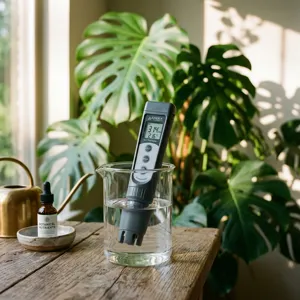
Using a Digital pH Pen
For liquid solutions (hydroponics, nutrient water):
- Turn on the meter and ensure it has been calibrated recently.
- Rinse the probe with distilled water.
- Immerse the probe 2–3 cm into the solution.
- Gently swirl and wait for the reading to stabilize (usually 10–30 seconds).
- Record the value, rinse the probe, and store in storage solution.
For soil:
- Use a specialized soil pH probe or create a 1:1 soil-to-distilled-water slurry.
- Ensure the soil is moist; dry soil gives false readings.
- Insert the probe directly or dip the slurry, wait for stabilization, and record.
Calibration Procedure
- Prepare fresh pH 7.0 and pH 4.0 (or 10.0) buffer solutions at room temperature.
- Rinse the probe with distilled water and blot—do not wipe.
- Immerse in pH 7.0 buffer and calibrate to 7.0.
- Rinse, then immerse in pH 4.0 buffer and calibrate to 4.0.
- Verify by retesting the 7.0 buffer; it should read within ±0.1.
pH Meter vs. EC Meter: Why You Need Both
pH and EC (electrical conductivity) measure fundamentally different things, yet they are inseparable in plant nutrition. pH tells you if nutrients are available; EC tells you how much total dissolved salt (nutrient) is present. A grower who measures only pH may over-fertilize to compensate for lockout. A grower who measures only EC may have perfect concentration but total unavailability. Always measure both, adjust both, and log both.
Troubleshooting Your pH Meter
- Drifting readings: Electrode is drying out or nearing end of life. Soak in storage solution for 24 hours; replace if unresolved.
- Slow response: Probe coating or contamination. Clean with mild detergent or dilute acid rinse.
- Inconsistent calibration: Buffers are expired or contaminated. Replace with fresh solutions.
- "OL" or error display: Probe is cracked or reference junction is dry. Replace probe.
Proper Storage & Maintenance
The glass bulb at the tip of a pH probe is coated in a hydrated gel layer that must remain moist to function. Never store a probe in distilled water (it will leach ions from the gel) or let it air-dry. Use manufacturer-recommended storage solution or pH 4.0 buffer. Replace the probe every 1–2 years depending on use frequency.
Frequently Asked Questions
What is the ideal soil pH for most plants?
Most houseplants and garden plants prefer a slightly acidic pH between 6.0 and 6.5. This range maximizes availability of nitrogen, phosphorus, potassium, and micronutrients.
What pH do hydroponic systems need?
Hydroponic and soilless systems typically run at 5.5–6.2. Because there is no soil buffer, pH can shift rapidly and should be checked daily.
Is a digital pH meter better than litmus strips?
Yes. Digital meters provide accuracy to ±0.1 pH units, while strips are subjective and typically accurate only to ±0.5–1.0 units. For plant care, precision matters.
How often should I calibrate my pH meter?
Calibrate at least once every 30 days with fresh pH 4.0 and 7.0 buffers. If you measure daily, calibrate weekly. Always calibrate if readings seem suspicious.
Why does my nutrient solution pH rise overnight?
Rising pH is usually caused by alkaline water (high bicarbonates), plant roots releasing hydroxyl ions during anion uptake, or microbial activity in organic systems.
Does pH really affect fertilizer effectiveness?
Absolutely. At pH <5.5, nitrogen, phosphorus, potassium, and calcium become less available. At pH >7.5, iron, manganese, boron, and zinc lock out completely.
Can incorrect pH cause yellow leaves?
Yes. High pH (>7.0) causes iron and manganese lockout, producing interveinal chlorosis—yellow leaves with green veins. This is one of the most common pH-related symptoms.
Can I use a pool pH tester for plants?
Pool testers measure the same property, but plant-care pH meters are calibrated for narrower, more precise ranges (typically 4.0–8.0) and have finer resolution. A pool meter will work in a pinch, but a dedicated pen is better.
What is the difference between soil pH and water pH?
Water pH is the acidity of your irrigation source. Soil pH is the acidity of the root zone, which is influenced by water, fertilizer, substrate, and microbial activity. They often differ.
Should I measure pH before or after adding fertilizer?
Always after. Fertilizers are acidic or alkaline and will shift pH. Adjust pH only after the full nutrient solution is mixed.
Explore More
Related Articles
Related Plant Guides
No specific plant guides found matching this topic.
Recommended next actions
Continue Exploring
Dive deeper into related plant care tools and profiles.
Topic Guide
Soil pH and Nutrient Availability
Learn how soil pH affects nutrient absorption in houseplants and garden soils. Discover how to test, raise, or lower soil pH effectively.
Topic Guide
Nutrient Lockout in Plants: Causes, Diagnosis & How to Fix It
Learn to identify and fix nutrient lockout. Discover why plants can't absorb nutrients due to pH imbalance, salt buildup, or overfertilization, and how to.
Topic Guide
Iron Chlorosis in Plants
Diagnose and treat iron chlorosis in houseplants, lawns, and trees. Learn how soil pH causes iron lockup and how to fix yellow leaves fast.
Topic Guide
EC Meter Guide for Plants
Use an EC meter to measure nutrient salt levels in soil or water and keep readings within the safe range for healthy plant roots.
Topic Guide
TDS Meter Guide: PPM, EC Conversion & Safe Ranges for Plants
Learn how TDS meters work, how they convert EC to PPM, what readings are safe for houseplants and hydroponics, and how to prevent over-fertilization with.
Topic Guide
Water Quality for Houseplants
Compare tap, filtered, distilled, and rainwater for houseplants. Learn which water is best for sensitive plants and how to prevent mineral buildup.