Soil pH and Nutrient Availability
Soil pH is one of the most fundamental chemical properties controlling plant health in both container indoor gardening and outdoor agriculture. Rather than directly feeding the plant, soil pH acts as a master control switch that determines whether fertilizers and minerals present in the substrate can dissolve into water for root uptake. When soil pH strays outside a plant's ideal target range, chemical lockup occurs. In overly acidic soils (pH < 5.5), nutrients like calcium and magnesium become unavailable, while heavy metals like manganese and aluminum can reach toxic levels. In alkaline soils (pH > 7.0), essential micronutrients like iron, zinc, and boron precipitate into solid minerals that plants cannot absorb, resulting in severe deficiencies despite adequate fertilizer application.
Quick Answer
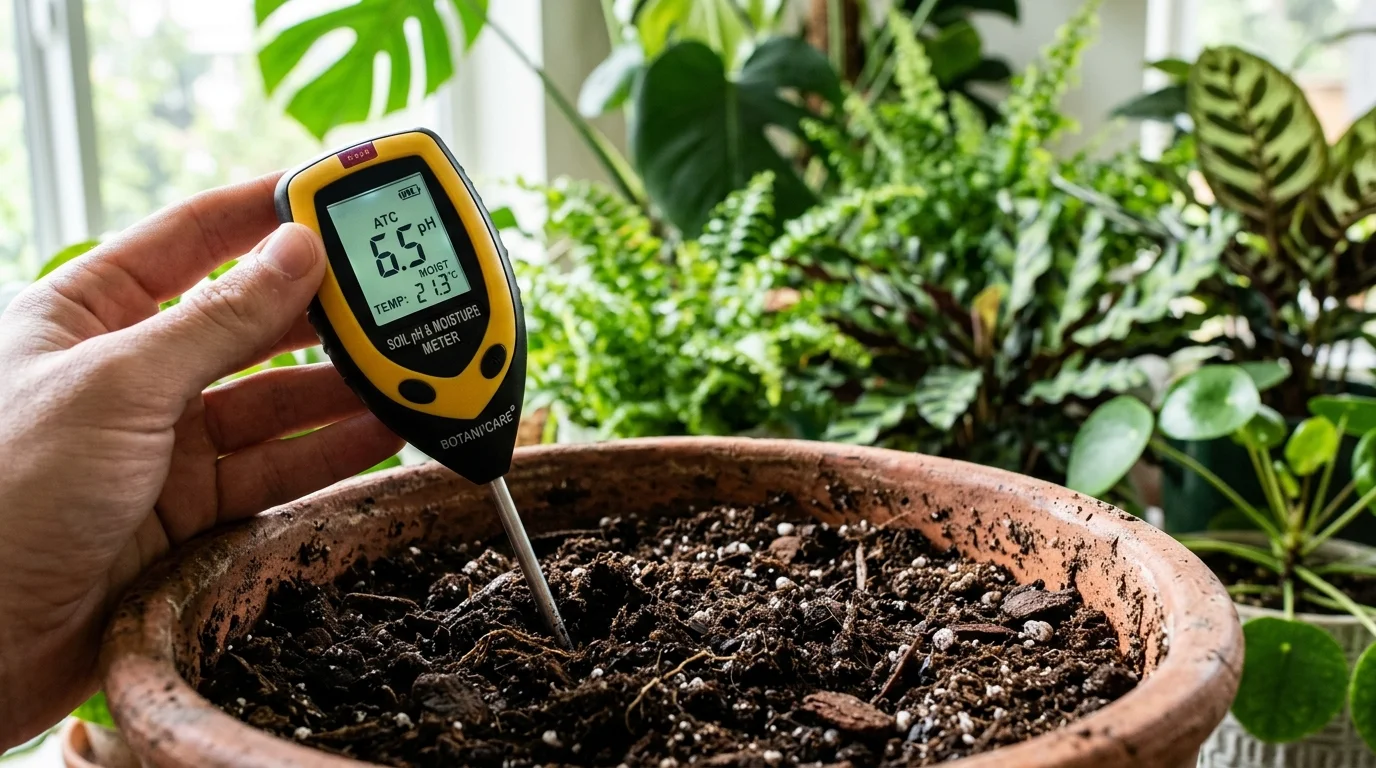
Soil pH measures how acidic or alkaline your potting mix or soil is on a scale from 0 to 14. A neutral pH is 7.0, acidic is below 7.0, and alkaline is above 7.0. Soil pH dictates nutrient availability: most plants thrive in a slightly acidic range of 6.0 to 6.8, where nitrogen and phosphorus are easily absorbed, while iron and other micronutrients become progressively harder for roots to take up as pH climbs toward neutral and beyond.
Symptoms
- Interveinal chlorosis on new foliage (High pH): Alkaline conditions lock up iron and manganese, producing yellow leaves with dark green veins.
- Stunted roots and purple leaf discoloration (Low pH): Strongly acidic soils bind phosphorus into insoluble compounds, leading to poor root growth and anthocyanin buildup.
- Blossom end rot or tip burn (Low pH): Calcium uptake collapses in acidic conditions, causing cell wall collapse in fast-growing foliage and fruit.
- Persistent deficiency signs despite active fertilizing: Adding fertilizer to soil with improper pH leads to salt buildup in the container rather than plant recovery.
Common Causes
- Tap water alkalinity: Repeatedly watering containers with hard, mineral-rich tap water gradually raises soil pH over time.
- Decomposition of peat moss and organic matter: Natural breakdown of peat or pine bark releases organic acids that lower soil pH over 12–24 months.
- Synthetic fertilizer residue: Ammonium-based nitrogen fertilizers acidify the root zone over time, whereas nitrate-based fertilizers tend to raise pH slightly.
- Parent rock material and native soil geology: Outdoor soil pH is fundamentally shaped by regional bedrock (limestone creates alkaline soils; granite/sandstone creates acidic soils).
- Soil texture and buffering capacity: Clay and high-organic-matter soils hold more exchangeable ions and resist pH change, requiring larger amendment quantities. Sandy soils have low buffering capacity, so pH shifts faster with less product but also drifts back or overcorrects more easily.
Prevention
- Test soil pH bi-annually using a calibrated digital probe or slurry test.
- Flush indoor plants periodically with distilled water or rainwater to flush out accumulating alkaline mineral salts.
- Buffer container mixes with 10–20% coarse organic matter or pumice to stabilize chemical fluctuations.
- Select fertilizers tailored to your water source (e.g., acid-forming fertilizers for hard water regions).
Best Practices
- Always check substrate moisture before taking direct probe pH readings.
- Adjust soil pH gradually—abrupt chemical changes shock sensitive root systems.
- Use dolomitic lime for low pH potting mix as it supplies both calcium and magnesium.
- Confirm any DIY vinegar-and-baking-soda fizz test with a calibrated meter or lab test — the fizz test only indicates direction (acidic vs. alkaline), not an actual pH value.
- Wait several weeks after applying lime or sulfur before retesting, since both amendments react with soil gradually rather than instantly.
What Is Soil pH?
Soil pH is a logarithmic measure of the hydrogen ion concentration in a soil solution. It indicates whether a growing medium is acidic, neutral, or alkaline. Because the scale is logarithmic, a soil pH of 5.0 is ten times more acidic than a pH of 6.0.
How pH Controls Nutrient Availability
Plants take up nutrients dissolved in soil water. Soil pH controls the chemical reactions that determine whether minerals remain dissolved or precipitate out as solids. At extreme pH levels, essential nutrients become chemically unavailable to roots—a phenomenon known as nutrient lockout. Iron and manganese are especially sensitive: their availability can drop roughly 100-fold for every full point increase in pH, which is why alkaline soils so often produce chlorotic, yellow new growth even when iron is technically present in the soil.
How to Test Soil pH
There are three common ways to check soil pH, ranging from a rough estimate to a precise number:
- Vinegar-and-baking-soda test: Add vinegar to one soil sample (fizzing suggests alkaline soil) and a baking-soda-and-water mix to another (fizzing suggests acidic soil). This is free and quick, but it only tells you which direction your soil leans, not an actual pH value.
- Home test kits and digital meters: Color-based test strips and inexpensive digital probes give an approximate numeric reading and are accurate enough for most home gardening decisions, provided the soil is properly moistened and the meter is genuine (avoid the cheapest 2-prong probes, which often measure moisture or conductivity rather than true pH).
- Lab or extension-office soil test: Sending a sample to a university extension office or independent lab gives the most reliable reading, along with nutrient levels, and is worth doing before any major outdoor soil amendment project.
How to Adjust Soil pH
Once you know your starting point, adjust gradually and retest rather than making one large correction:
- To raise pH (make it less acidic): Work in agricultural lime or dolomitic lime, which also supplies calcium and magnesium. Lime reacts with soil slowly, so allow several weeks before retesting.
- To lower pH (make it less alkaline): Elemental sulfur is the standard long-term amendment; soil microbes convert it into acid over several weeks to months. Iron or aluminum sulfate acts faster but the effect is shorter-lived. Both are more reliable for lasting change than temporary fixes like vinegar drenches.
Because clay and organic-matter-rich soils resist pH change more than sandy soils, the same amendment rate can produce very different results depending on your soil's texture — always retest after amending rather than assuming the first application was enough.
Frequently Asked Questions
What is the ideal soil pH for indoor houseplants?
Most tropical houseplants (like Pothos, Monstera, Philodendron, and Ficus) thrive in a slightly acidic pH range of 6.0 to 6.8.
How do I lower my soil pH naturally?
The standard long-term method is amending with elemental sulfur, which soil microbes gradually convert into sulfuric acid, or working in peat moss or leaf mold as the soil breaks down. Vinegar solutions can lower pH temporarily, but the effect fades quickly and repeated use doesn't build lasting buffering capacity the way sulfur or organic matter does — treat it as a short-term fix, not a long-term strategy.
Can tap water change my potting soil pH?
Yes. If your tap water is hard (high in dissolved calcium carbonate and magnesium), regular watering will gradually push your potting soil pH up into alkaline ranges above 7.0.
Can I test soil pH at home without a meter?
You can get a rough directional read with the vinegar-and-baking-soda test: add vinegar to one soil sample (fizzing suggests alkaline soil) and baking soda mixed with water to another (fizzing suggests acidic soil). This only tells you which direction your soil leans, not an actual pH number — for a real value, use a calibrated digital pH meter, color-based test kit, or a lab/extension-office soil test.
Explore More
Related Topics
Related Plant Guides
No specific plant guides found matching this topic.
Recommended next actions
Continue Exploring
Dive deeper into related plant care tools and profiles.
Topic Guide
Iron Chlorosis in Plants
Diagnose and treat iron chlorosis in houseplants, lawns, and trees. Learn how soil pH causes iron lockup and how to fix yellow leaves fast.
Topic Guide
Micronutrients for Plants
Spot iron, zinc and boron deficiency signs in houseplants and correct trace mineral shortages before growth is affected.
Topic Guide
Nutrient Lockout in Plants: Causes, Diagnosis & How to Fix It
Learn to identify and fix nutrient lockout. Discover why plants can't absorb nutrients due to pH imbalance, salt buildup, or overfertilization, and how to.