DIY Pon Recipe: Mineral Ratios, Particle Sizing & Preparation
A DIY Pon is a three-mineral blend in which each component does a specific job: pumice supplies air-filled macropores, zeolite supplies cation exchange capacity (CEC) to buffer fertilizer ions, and lava rock adds weight and trace minerals. Grain size matters as much as the ratio, because fines under 2 mm fill the pore space and turn the root zone into sludge. This guide gives the 3:2:1 ratio by volume, batch quantities, screening and washing protocols, fertilizer integration options, a comparison with commercial Lechuza-Pon, and fixes for the most common mix failures. Use it alongside the Pon guide, the conversion guide and the dosing guide to run a stable semi-hydro collection.
Quick Answer
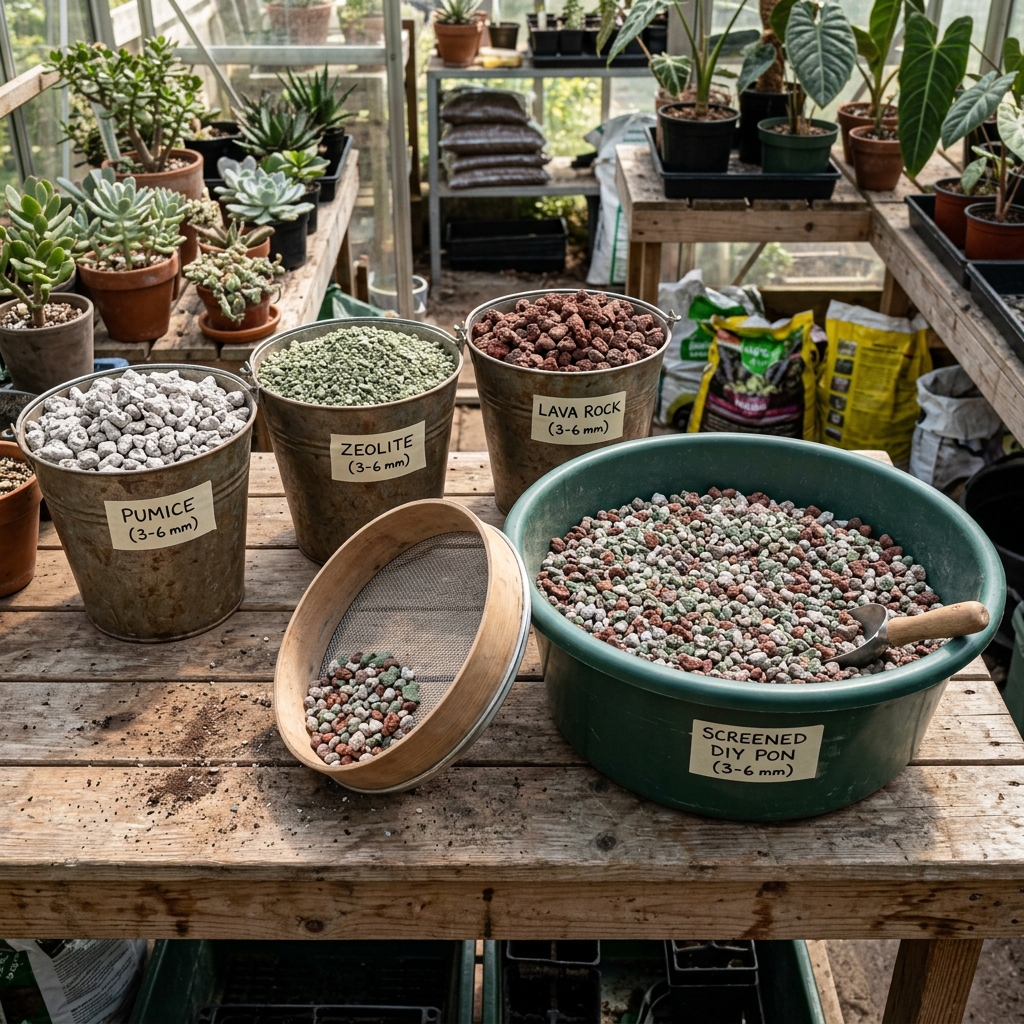
Mix DIY Pon by volume at 3 parts pumice (50%), 2 parts zeolite (clinoptilolite, 33%) and 1 part volcanic lava rock (17%), all screened to 3-6 mm. Rinse every mineral until the drainage water runs clear, then either leave the mix unfertilized and feed with liquid fertilizer, or blend in 2-3 g of 6-9 month controlled-release fertilizer per liter of mix. Use pure, unscented zeolite only, never clumping or scented cat litter.
Key Takeaways
- The base ratio is 3 parts pumice, 2 parts zeolite and 1 part lava rock by volume (about 50% / 33% / 17%), measured with one scoop or container for all three minerals.
- Screen every mineral to 3-6 mm (1/8 to 1/4 inch) and discard the fines under 2 mm, because fine particles clog the macropores and turn the root zone into a wet, oxygen-poor sludge.
- Wash all three minerals in a bucket and sieve or mesh bag until the drainage water runs completely clear, since mineral dust sticks to roots and chokes the air spaces.
- Use only pure, unscented clinoptilolite zeolite. Clumping (sodium bentonite), scented or silica-gel cat litters are unsafe for roots and ruin the mix.
- For fertilizer, either leave the mix unfertilized and feed with liquid nutrients, or blend in 2-3 g of resin-coated controlled-release fertilizer per liter of mix, and flush monthly to prevent salt buildup.
What Makes a Good DIY Pon?
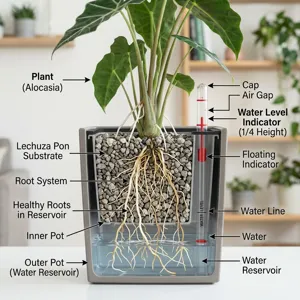
Pon is a mineral substrate designed so that roughly half of its pore volume holds water and half stays filled with air. Commercial Pon is a blend of zeolite, pumice and lava rock, and you can reproduce it from bulk minerals at a lower cost per liter and with more control over what goes in. The recipe below is a community standard for hobby growers, and all ratios are by volume, measured with one scoop or container for all three minerals. For how the finished substrate behaves in a pot, including capillary rise and reservoir depth, read the semi-hydroponics with Pon guide.
The Golden Mineral Ratio: 3 : 2 : 1
The base mix is 3 parts pumice, 2 parts zeolite and 1 part lava rock by volume, which is about 50%, 33% and 17%.
- 3 parts pumice (50%). Pumice is a lightweight volcanic glass full of internal pores. It supplies the structural macropores that stay filled with air, holds a moderate amount of water and is close to chemically neutral.
- 2 parts zeolite (33%). The useful zeolite for plants is clinoptilolite. It has a high cation exchange capacity (CEC), so it captures positively charged ions such as ammonium and potassium (and, to a lesser degree, magnesium and calcium) and releases them gradually. This buffers the swings between feeding and flushing. Zeolite also tends to stabilize the root-zone pH in a roughly neutral range, around 6.5-7.0 in many setups, but the exact pH depends on your water and product, so test it with a meter if you grow pH-sensitive plants.
- 1 part lava rock (17%). Basalt or scoria adds weight so tall plants do not tip, gives roots something to anchor to and releases small amounts of iron, magnesium and other trace elements.
To work out volumes for any pot or batch, use the semi-hydro Pon calculator. The batch table above covers common sizes.
Particle Sizing and Grading
The target grain size is 3-6 mm (1/8 to 1/4 inch). Particles in this range leave enough gaps between grains to stay air-filled, while the pores inside the grains hold water.
Why Fines Must Be Screened Out
Anything under about 2 mm behaves like sand or silt. These fines sift down between the larger grains, fill the macropores and hold water by capillary tension, so the root zone ends up wet, dense and short of oxygen. That is the opposite of what Pon is meant to do, and it is a leading cause of root rot in homemade mixes. Screening is not optional, even when the bag says it is graded.
How to Screen
- Stack two sieves or screens: a 6 mm mesh on top (hardware cloth of 1/4 inch works) and a 2-3 mm mesh below (a kitchen colander with small holes or window screen over a frame).
- Shake the mineral over the top sieve. Material that stays on top is oversize and can be crushed and re-screened, or used in the bottom layer of tall pots.
- Material that stays on the lower sieve is your target grade.
- Material that passes through the lower sieve is fines. Discard it or use it in garden soil.
Screen dry, outdoors or over a tarp, because mineral dust is irritating to breathe. Wear a dust mask, since fine pumice and zeolite dust contains respirable particles, and wet the minerals slightly if dust is a problem.
Washing and Dust Removal
Even screened minerals carry a coating of fine dust that sticks to roots and clogs pores once wet. Wash each mineral separately before mixing.
- Put a few liters of mineral in a bucket or in a mesh bag or sieve set inside a bucket.
- Fill with water, stir vigorously by hand or with a paddle, and pour off the cloudy water, keeping the minerals back.
- Repeat until the water runs completely clear. Pumice and zeolite usually need 4-8 rinses.
- Drain and spread the washed minerals to dry slightly, or mix them damp, then blend the three components thoroughly.
Do not pour the muddy rinse water down a household drain in large quantities, because mineral silt can settle in the pipes. Use a garden bed or a catch bucket.
Sourcing Each Mineral
- Pumice. Choose pumice sold for horticulture, bonsai or aquaria in a 3-6 mm grade. Landscape pumice is often a mix of sizes with many fines.
- Zeolite. Buy pure clinoptilolite sold for gardening, aquaria or soil amendment. See the cat litter warning below.
- Lava rock. Use undyed, untreated volcanic rock such as basalt or scoria. Avoid dyed, sealed or painted decorative rock. Large chunks need crushing and screening.
Cat Litter Zeolite: Read the Label Carefully
Some cat litters are made of zeolite, but many are not suitable. Avoid any litter that is clumping (usually sodium bentonite, which swells into a gel and seals the pores), scented or deodorized (fragrance and chemical additives), or contains silica gel crystals or antimicrobial additives. Only use a product that lists 100% clinoptilolite zeolite with no additives, and rinse it thoroughly. When in doubt, buy zeolite sold for plants or aquariums.
Fertilizer Integration
Pon holds some nutrients on the zeolite, but it does not feed plants by itself. You can supply nutrients in one of two ways.
Option 1: Unfertilized Mix with Liquid Feed
Leave the mix plain and feed through the reservoir with a dilute liquid fertilizer, following the schedule in the semi-hydro fertilizer dosing guide. This gives the most control, and it is the safer option for cuttings, seedlings and salt-sensitive plants.
Option 2: Controlled-Release Fertilizer in the Mix
Resin-coated pellets such as Osmocote or Nutricote (the 6-9 month types) release nutrients slowly as water moves through the coating. A common rate is 2-3 grams per liter of mineral substrate, blended evenly through the mix, which is about 0.5-0.75 teaspoon per liter. Weigh it if you can, because pellets vary in size and density. Always check the product label, since formulations and recommended rates differ.
- Mix the pellets evenly through the whole batch rather than layering them at the bottom, where they would sit in the reservoir water.
- Release speed depends on temperature. The labelled 6-9 months applies at about 21 °C (70 °F). Warm rooms release faster and cool rooms slower.
- Empty shells may show up in the Pon as the nutrients are used up. This is normal.
- Flush the Pon monthly with lukewarm water to remove accumulated salts, as described in the Pon guide.
- You can still add a weak liquid feed during peak growth, but reduce it when using controlled-release pellets to avoid overdosing.
Mixing the Batch Step by Step
- Screen each mineral to 3-6 mm and discard the fines.
- Wash each mineral until the water runs clear.
- Measure by volume using one container: 3 scoops of pumice, 2 of zeolite, 1 of lava rock.
- Blend in a large tub or on a tarp until the colors and sizes are evenly distributed.
- Add fertilizer if you are using controlled-release pellets, at 2-3 g per liter of finished mix, and blend again.
- Soak the finished mix in plain water for several hours or overnight, drain and use it damp. This hydrates the pores and removes any dust left over.
Use the finished Pon in the pot systems described in the Pon guide, and see the guide to converting houseplants to semi-hydro for planting steps. Large aroids such as Monstera deliciosa are a good first plant for a homemade mix.
Substitutes and Adjustments
- Perlite instead of pumice. Not recommended. Perlite is lighter, crushes easily, floats to the surface and breaks down into fines over time. Pumice is far more stable.
- LECA or calcined clay. These can replace part of the pumice, but they are more water-retentive or can break down. For a comparison of materials, see LECA vs Pon.
- No lava rock. You can skip it and use a 3:2 pumice-to-zeolite mix, but you lose some weight and trace elements. Use heavier containers for tall plants.
- More pumice for orchids and Hoya. Plants that dislike wetness benefit from a ratio nearer 4:2:1 or from adding bark-free coarse pumice.
- More zeolite for hungry plants. Heavily fed plants can use a 3:3:1 ratio, though a higher zeolite share holds more water.
Reusing Screened Minerals
All three minerals are inorganic and reusable. After a plant is removed, shake out roots and debris, rinse until clear, and sterilize by boiling for about 10 minutes or soaking in diluted 3% hydrogen peroxide. Re-screen the minerals, since grains break down gradually and produce new fines. Zeolite holds fertilizer ions, so flush reused mix thoroughly before replanting to avoid carry-over salts.
Troubleshooting Summary
| Symptom | Likely cause | Quick fix |
|---|---|---|
| Water is cloudy and the mix stays soggy | Fines or dust left in the mix | Re-screen and re-wash, or repot into clean Pon |
| Mix compacts into a gel or crust | Cat litter with sodium bentonite | Discard the mix and rebuild with pure clinoptilolite |
| White crust and brown leaf tips | Salt buildup from fertilizer | Top-flush with 2-3 pot volumes and reduce the fertilizer rate |
| Leaves pale or yellow on new growth | Nutrient shortage in an unfertilized mix | Start dilute liquid feeding per the dosing guide |
| Top-heavy plants tip over | Too little lava rock or too light a pot | Add lava rock or use a heavier container |
Related Resources
Learn how the finished mix behaves in the semi-hydroponics with Pon guide, move plants over with the conversion guide, compare materials in LECA vs Pon, set a feeding plan with the fertilizer dosing guide, calculate quantities with the semi-hydro Pon calculator, and see a classic aroid for semi-hydro on the Monstera deliciosa page.
Frequently Asked Questions
Can I use cat litter as a source of zeolite for DIY Pon?
Only if the label shows 100% clinoptilolite zeolite with no additives. Avoid clumping litters (sodium bentonite swells into a gel and seals the pores), scented or deodorized litters, and litters with silica gel or antimicrobial additives. Even a pure zeolite litter may be fine-grained, so check the grain size and rinse thoroughly. Zeolite sold for gardens or aquariums is a safer choice.
Can I use perlite instead of pumice in a DIY Pon?
It is not recommended. Perlite is lighter and more fragile than pumice, so it floats, crushes into fines and breaks down over time, which defeats the purpose of a stable mineral substrate. Pumice has a similar air-filled structure but keeps its shape. If you cannot find pumice, use calcined clay or expanded shale in a limited share, and expect more frequent re-screening.
How long do controlled-release fertilizer pellets last in Pon?
The 6-9 month types are rated at about 21 °C (70 °F), but release is faster in warm rooms and slower in cool ones, so the real lifespan can range from a few months to the full label period. Water movement through Pon can also speed it up. Watch your plants and flush monthly, and add a weak liquid feed only if growth slows.
Can I reuse screened minerals from an old Pon mix?
Yes. Remove roots and debris, rinse until the water runs clear, sterilize by boiling for about 10 minutes or soaking in diluted 3% hydrogen peroxide, and screen again to remove any new fines. Flush reused zeolite well, because it holds fertilizer ions. Top up with fresh minerals if the grains look worn.
What is the best particle size for DIY Pon?
Aim for 3-6 mm (1/8 to 1/4 inch). Smaller grains lift water higher but stay wetter, and larger grains drain faster and offer more air. Fines under 2 mm should always be screened out because they clog the pore spaces.
Why do I need to wash the minerals if they look clean?
Pumice, zeolite and lava rock all shed fine dust as they are handled. Wet dust becomes a paste that fills the air spaces and coats the roots. Rinse each mineral until the drainage water runs completely clear, which usually takes several rinses.
Should I add fertilizer to the mix or leave it unfertilized?
Both approaches work. An unfertilized mix with liquid feed gives the most control and is safer for cuttings and sensitive plants. Controlled-release pellets at 2-3 g per liter reduce the effort for established plants, but they can build up salts, so keep up the monthly flush and avoid doubling up with strong liquid feeds.
Can I leave out lava rock?
Yes, a 3:2 pumice-to-zeolite mix works, but you lose weight for stability and a small supply of trace elements. If you leave it out, use heavy or wide-based pots for tall plants such as Monstera, or add a layer of heavy stones at the bottom.
Is homemade Pon cheaper than commercial Pon?
Usually yes per liter when you buy minerals in bulk bags, and the saving grows with the size of your collection. For one small plant, a small bag of commercial Pon may be more convenient. Include the time for screening and washing in your calculation.
Why is my DIY Pon staying soggy?
The usual cause is fines or dust left in the mix. Other causes are too much zeolite, too fine a grain size, or a pot with poor drainage or too deep a reservoir. Re-screen, re-wash, adjust toward more pumice and check the reservoir depth rule in the Pon guide.
Sources & References
-
Source: edis.ifas.ufl.edu
Type: horticultural-reference
-
Source: extension.psu.edu
Type: horticultural-reference
-
Source: rhs.org.uk
Type: horticultural-reference
Explore More
Related Articles
Related Plant Guides
Recommended next actions
Continue Exploring
Dive deeper into related plant care tools and profiles.
Calculator
Semi-Hydro Pon Volume & Mineral Split Calculator
Calculate net Pon volume, root displacement, DIY mineral components (pumice, zeolite, lava rock), dry weight, and water reservoir depth in metric or imperial units.
Plant Guide
Swiss Cheese Plant
Expert care guide and diagnostic data for the Swiss Cheese Plant. Learn how to properly water, light, and troubleshoot common issues.
Topic Guide
Converting Houseplants to Semi-Hydro: Root Transition & Rot Prevention
Step-by-step guide to converting soil houseplants to semi-hydroponics: washing soil roots, 3% hydrogen peroxide soaks, water root transition, and rot prevention.
Topic Guide
LECA vs Pon: Semi-Hydroponic Substrates Compared
LECA vs Pon comparison: capillary wicking height, root stability, pH buffering, particle size, cleaning reuse, and which plants prefer each medium.
Topic Guide
Semi-Hydro Fertilizer Dosing: EC Targets, Nutrients & Salt Flushing
Master fertilizer dosing in semi-hydroponics: EC and PPM targets by plant family, hydroponic vs standard fertilizer, flushing salt buildup, and foliar feeding.
Topic Guide
Semi-Hydroponics with Pon: The Complete Passive Hydroponics Guide
Master semi-hydroponics using mineral Pon: passive capillary wicking mechanics, self-watering pots, water reservoir depth, root oxygenation, and flushing.