Semi-Hydroponic Pon Volume & Recipe Calculator
Calculate net Pon volume, root displacement, DIY mineral components (pumice, zeolite, lava rock), dry weight, and water reservoir depth in metric or imperial units.
Quick Answer
Calculate pot volume using the conical frustum formula: V = (π × h / 12) × (D_top² + D_top × D_bottom + D_bottom²). Deduct 10–20% for root ball displacement to get net Pon volume. For a standard 3:2:1 DIY recipe, mix 50% pumice, 33.3% zeolite, and 16.7% lava rock (3–6 mm). Set the water reservoir level at 25% to 33% (1/4 to 1/3) of total pot height.
Enter your details
Enter your details below to generate a custom recommendation.
Recommended Output
Standing water volume stored in bottom reservoir based on ~42% LECA/Pon pore void capacity.
Substrate required after deducting root displacement.
Target ~1.25 mL/L hydroponic foliage fertilizer per reservoir refill.
Full flush with plain water recommended every 2–4 weeks to clear accumulated fertilizer salts.
The Problem
Growers switching houseplants to semi-hydroponics struggle to estimate how much commercial Pon or raw mineral ingredients to buy, often under- or over-fill pots, or set the water reservoir too deep, which can cause stem and collar rot.
When to Use This Tool
When converting houseplants from soil to passive semi-hydroponic Pon or LECA.,When buying bulk pumice, zeolite, and lava rock to mix a custom DIY Pon recipe.,When sizing a cachepot or self-watering insert and deciding the reservoir water line height.,When estimating the structural load of large specimen plants on shelves or plant stands.
Who is this for?
- Houseplant collectors and aroid enthusiasts
- Semi-hydroponic growers using Lechuza-Pon or DIY mineral blends
- Indoor plant specialists managing self-watering pot collections
Why Volumetric Accuracy Matters in Semi-Hydroponics
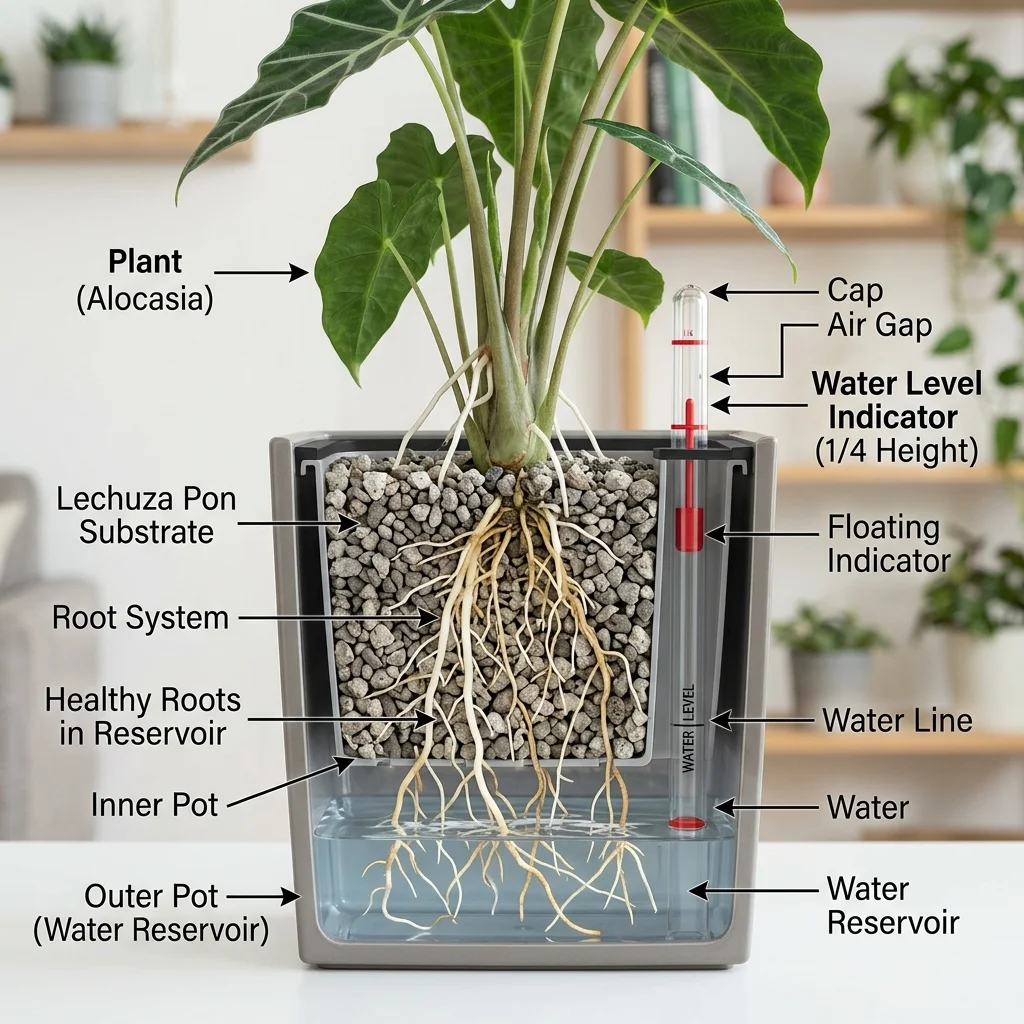
Inorganic mineral substrates do not compress or settle the way soil does. If you underestimate the volume, roots and crowns sit too low in the pot. If you overestimate, you waste expensive mineral media. Before planting, read our semi-hydroponics with Pon guide to understand how capillary wicking works, then use this calculator to size your purchase.
Why Cylinder Formulas Fail for Tapered Pots
Most nursery pots and planters narrow toward the base so they drain well and release from molds. The standard cylinder formula assumes the base is as wide as the rim, so it overestimates the volume of any tapered pot. For the 15 cm preset below, a cylinder at the top diameter would give about 2.47 L, against a true 1.87 L, an overestimate of roughly a third. The error is smaller for gently tapered pots and larger for steep ones.
The Geometry: Conical Frustum Volume
The calculator models the pot as a conical frustum, a cone with its tip cut off:
$$V = \frac{\pi \cdot h}{12} \left(D_{\text{top}}^2 + D_{\text{top}} \cdot D_{\text{bottom}} + D_{\text{bottom}}^2\right)$$
Measure the inside diameters at the rim and at the floor, and the internal height from floor to rim. For a heavily rooted plant such as Monstera deliciosa, raise the root displacement percentage so you do not overfill the pot. Enter the same top and bottom diameter for a straight-sided pot, and the formula becomes a cylinder.
The 3:2:1 Mineral Split
Commercial premixes are convenient, but mixing your own with our DIY Pon recipe is cheaper when you repot many plants. The classic blend uses three mineral components screened to 3–6 mm:
- Pumice (50%, 3 parts): a light, porous structural base that keeps the mix airy and wicks water without compacting.
- Zeolite (33.3%, 2 parts): a mineral with high cation exchange capacity that holds nutrient ions such as ammonium, potassium and magnesium, which helps buffer fertilizer swings.
- Lava rock (16.7%, 1 part): adds weight to anchor top-heavy plants and contributes fine pores.
The equal-parts and 2:1:1 options trade zeolite and lava for more or less pumice. If you are choosing between clay pebbles and mineral stone, compare them in our LECA vs Pon guide.
Reservoir Depth: Preventing Collar Rot
Passive semi-hydroponics relies on capillary rise: water climbs through the fine pores of the granules while air moves through the gaps between them. The water table must never reach the plant's crown or stem base.
- Standard aroids and established plants: keep the water line at about 25% (1/4) of pot height.
- Thirsty plants and warm conditions: raise it to about 33% (1/3) during peak growth.
- Newly converted plants, winter and low light: drop to about 20% (1/5), or follow the dry-start approach in our guide to converting houseplants to semi-hydro.
These are starting points. Adjust to how fast your plant uses water and how humid your room is.
Nutrients, Mass and Shelf Loading
Mineral substrates do not release organic nutrients, so plants in Pon need a regular dilute hydroponic fertilizer. Follow the concentration guidance in our semi-hydro fertilizer dosing guide and flush periodically to prevent salt buildup.
Minerals are heavy. At about 0.90 kg per liter, the 25 cm specimen tub in the reference table holds around 7 L of Pon, which is roughly 6.3 kg (14 lb) dry. Saturated, with about 0.35 kg of water per liter, it reaches roughly 8.8 kg (19 lb), before counting the plant, pot and reservoir water. Check that shelves and stands are rated for the total.
How to Use the Calculator
- Measure the internal top diameter, bottom diameter and height of your pot.
- Estimate root displacement: about 10% for small or sparse roots, 15% for average, up to 25% for root-bound plants.
- Pick a recipe, or choose Commercial Premix if you only need total volume.
- Pick a reservoir depth that suits the plant and season.
- Read the net volume, component volumes, dry weight and water line.
Recommended next actions
Next Best Actions
Use the result in a real care workflow with plant profiles, guides, and personalized quizzes.
Plant Guide
Monstera
Grow a thriving Monstera deliciosa with the light, watering and climbing support it needs to develop large, mature, fenestrated leaves indoors.
Topic Guide
Converting Houseplants to Semi-Hydro: Root Transition & Rot Prevention
Step-by-step guide to converting soil houseplants to semi-hydroponics: washing soil roots, 3% hydrogen peroxide soaks, water root transition, and rot prevention.
Topic Guide
DIY Pon Recipe: Mineral Ratios, Particle Sizing & Preparation
Make your own DIY mineral Pon substrate: exact pumice, zeolite, and lava rock ratios, mineral particle sizing (3-6 mm), rinsing, and fertilizer dosing.
Topic Guide
LECA vs Pon: Semi-Hydroponic Substrates Compared
LECA vs Pon comparison: capillary wicking height, root stability, pH buffering, particle size, cleaning reuse, and which plants prefer each medium.
Topic Guide
Semi-Hydro Fertilizer Dosing: EC Targets, Nutrients & Salt Flushing
Master fertilizer dosing in semi-hydroponics: EC and PPM targets by plant family, hydroponic vs standard fertilizer, flushing salt buildup, and foliar feeding.
Topic Guide
Semi-Hydroponics with Pon: The Complete Passive Hydroponics Guide
Master semi-hydroponics using mineral Pon: passive capillary wicking mechanics, self-watering pots, water reservoir depth, root oxygenation, and flushing.
Troubleshooting & Diagnostics Guide
1 Substrate overflows the pot rim when potting the plant
Diagnosis: Root ball displacement was underestimated, or old nursery soil was not fully rinsed from the root core.
Treatment: Remove the plant, wash all remaining soil from the roots, and use a thinner base layer of Pon. Raise the root displacement percentage in the calculator and recalculate.
2 Water reservoir runs dry within a day or two
Diagnosis: High transpiration in dry air, a large plant in a small pot, or a pot whose tapered base holds less reservoir water than expected.
Treatment: Raise ambient humidity, move to a larger or wider cachepot with a bigger reservoir, or step up to the 1/3 water line while watching the lower leaves for signs of overwatering.
3 Lower leaves turn yellow and mushy 10 to 14 days after repotting
Diagnosis: The water line is too high, leaving the crown or soil-adapted roots sitting in stagnant water.
Treatment: Lower the water line to 20–25% of pot height, drain stagnant water, and let the upper substrate dry and aerate for a few days before refilling.
4 White crusty salt deposits form on the top granules
Diagnosis: Fertilizer concentration is too high, or low humidity is driving fast surface evaporation that leaves salts behind.
Treatment: Flush the pot with several pot volumes of plain lukewarm water, reduce fertilizer strength, and flush on a regular schedule.
Glossary of Terms
- Conical Frustum
- The solid formed by cutting the top off a cone with a plane parallel to its base. It describes the tapered profile of most plant pots.
- Capillary Lift
- The upward movement of water through the fine pores of a substrate against gravity.
- Cation Exchange Capacity (CEC)
- A measure of how many positively charged nutrient ions a material, such as zeolite, can hold and release.
- Root Displacement
- The share of the pot's internal volume taken up by the plant's root mass and stem base, which reduces the substrate volume you need.