Semi-Hydro Fertilizer Dosing: EC Targets, Nutrients & Salt Flushing
Pon and LECA are inorganic, so they have no microbial community to convert organic fertilizer into forms roots can take up. They need a complete mineral nutrient solution that is dosed by electrical conductivity (EC) and pH rather than by guesswork. This guide explains why organic and urea-based feeds fail, what a complete hydroponic formula must contain, and how to set EC and ppm targets by plant group. It also covers the evaporative salt concentration cycle that turns a reservoir into a root-burning solution, the flush-and-reset routine, Cal-Mag and pH management with RO water, and low-strength foliar feeding for newly converted plants. Use it with the Pon guide, the conversion guide and the LECA vs Pon comparison.
Quick Answer
Feed semi-hydro plants only with a complete mineral hydroponic fertilizer, never fish emulsion, compost tea or urea-based houseplant feed. Dose by conductivity: about 0.6-0.8 mS/cm (300-400 ppm on the 500 scale) for sensitive plants, 0.8-1.2 mS/cm (400-600 ppm) for moderate feeders and 1.2-1.6 mS/cm (600-800 ppm) for heavy feeders, at a solution pH of 5.8-6.5. Start at the low end of the range, use weak solution often, and top-flush the medium with plain water every 3-4 weeks before refilling with fresh solution.
Key Takeaways
- Use a complete mineral hydroponic fertilizer with nitrate-based nitrogen and chelated micronutrients (such as Fe-EDTA or Fe-EDDHA, Mn, Zn, B, Cu, Mo). Organic feeds such as fish emulsion and compost tea rely on microbes that an inorganic medium lacks, and they foul the reservoir.
- Dose by EC, not by volume alone. Sensitive plants run at about 0.6-0.8 mS/cm (300-400 ppm), moderate feeders at 0.8-1.2 mS/cm (400-600 ppm) and heavy feeders at 1.2-1.6 mS/cm (600-800 ppm), using the 500 scale (ppm = mS/cm x 500).
- Reservoirs concentrate over time because the plant and surface evaporation remove water faster than they remove salts. Top up with plain water between changes, and flush the medium from above every 3-4 weeks before adding fresh solution.
- Keep the solution pH at about 5.8-6.5. If you use RO or distilled water, add a calcium and magnesium supplement or choose a fertilizer that already contains them, because tip curl and new-leaf distortion often signal a Ca or Mg shortage.
- Do not feed plants with immature water roots at full strength. Start only after white roots form, and use quarter-strength foliar mists sparingly on new cuttings.
Why Semi-Hydro Nutrition Is Different
In soil, microbes break down organic matter and release nutrients slowly, and the soil itself stores ions on clay and humus. In Pon, LECA and other inorganic media, almost none of that happens. The medium is a stable physical support, and the roots feed from the solution in the reservoir and the film of water on the grains. That makes the fertilizer you choose and the way you dose it far more important than in soil. The medium itself matters too: Pon holds some ions on its zeolite fraction, while LECA holds almost none, as described in LECA vs Pon. For the physical system, read the semi-hydroponics with Pon guide.
Why Organic and Urea-Based Fertilizers Fail
Standard houseplant fertilizers and organic feeds are built for living soil. In an inorganic medium they cause problems.
- Fish emulsion, compost tea and similar feeds. They contain proteins, fats, sugars and suspended solids that feed bacteria and algae in the reservoir. The result is slime, a sour or fishy smell, clogged slots and wicks, and low oxygen around the roots, which leads to root rot.
- Urea-based NPK. Urea is converted to ammonium by the enzyme urease, which is produced by soil microbes. In a clean inorganic medium that conversion is unreliable, and any ammonium that does form can build up. Together with the extra bacterial growth, this is a common cause of foul odors and rotting roots. Treat the details as hobbyist experience rather than a controlled result, but the practical advice is consistent: avoid urea-heavy feeds.
- Slow-release organic granules. They need microbes and soil moisture cycles to release nutrients. In a reservoir system they either do nothing or release unevenly.
What a Suitable Fertilizer Contains
Choose a complete, fully water-soluble mineral fertilizer designed for hydroponics and check the label for these features.
- Nitrate-nitrogen as the main nitrogen form. Nitrate is taken up easily and is less likely to burn roots or acidify the root zone than high levels of ammonium. A formula may still include some ammonium, but avoid products dominated by urea or ammoniacal nitrogen.
- Chelated micronutrients. Iron should be chelated as EDTA, or as EDDHA for higher-pH water. Look for manganese, zinc, boron, copper and molybdenum as well. Chelated iron stays available in the reservoir, while unchelated iron precipitates.
- Calcium and magnesium. Some one-part foliage formulas include them, and some multi-part systems provide them through a separate component. If the label does not list calcium and magnesium, plan to add a Cal-Mag supplement.
- A balanced N-P-K ratio for foliage. Leafy houseplants use more nitrogen than flowering plants do, and flowering orchids or Hoya in bloom may benefit from a bloom-oriented formula.
Follow the manufacturer's directions as a starting point, then adjust with an EC meter. Label doses are often written for high-light commercial growing, so houseplants indoors usually need less.
EC and PPM Targets
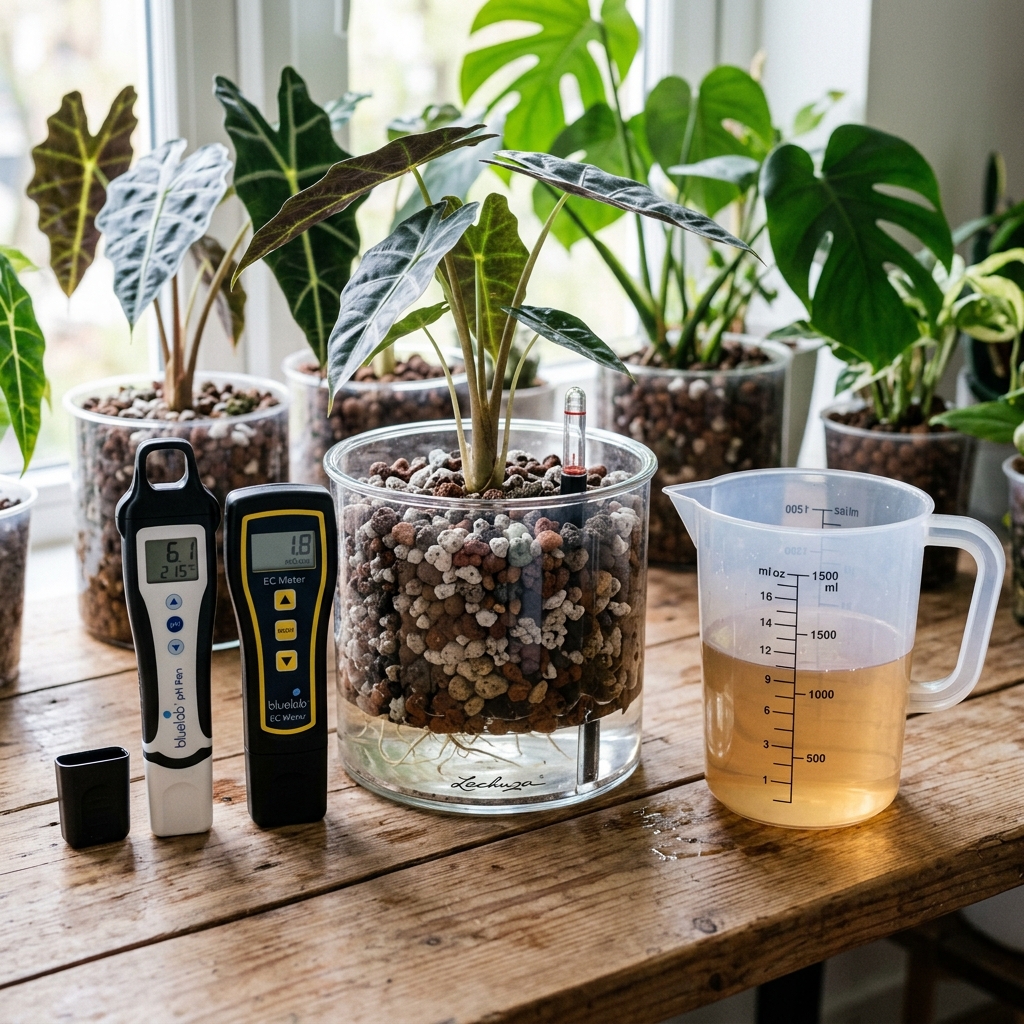
Electrical conductivity (EC) measures how much dissolved salt is in the water. It is expressed in millisiemens per centimetre (mS/cm). Parts per million (ppm) is a calculated figure, and it depends on the conversion factor your meter uses. This guide uses the 500 scale, where ppm = EC (mS/cm) x 500. Some meters use a 700 scale or report TDS directly, so check which scale your meter uses before you compare numbers.
- Sensitive or low feeders (Alocasia, Calathea, Anthurium, orchids, ferns): 0.6-0.8 mS/cm (300-400 ppm).
- Moderate feeders (Philodendron, Epipremnum, Hoya, Peperomia): 0.8-1.2 mS/cm (400-600 ppm).
- Heavy feeders (Monstera deliciosa, Ficus lyrata, Strelitzia): 1.2-1.6 mS/cm (600-800 ppm).
- Baseline water (RO or low-TDS): below 0.1 mS/cm (below 50 ppm).
These are working ranges, not laws. Light level, temperature, plant size and growth rate all change what a plant can use. Start at the low end, watch the new growth for a few weeks, and raise the strength only if growth is pale and slow. The first table above lists the targets by plant group. Remember that tap water adds its own EC, so measure the water before you add fertilizer.
How to Mix to a Target
- Fill a clean container with your water and measure its EC.
- Add a small amount of fertilizer, stir, and measure again.
- Continue in small steps until you reach the target EC, including the EC of the water itself.
- Check the pH, adjust if needed, and then fill the reservoir.
Keep a note of the amount of fertilizer per litre that gave the right reading, so that you can repeat it. Use the semi-hydro Pon calculator to work out how much solution a pot needs.
The Evaporative Salt Concentration Cycle
A reservoir does not stay at the strength you mixed. Plants lose water through transpiration, and the surface of the medium loses water by evaporation. Both remove nearly pure water, while the dissolved salts stay behind. As a result the solution becomes more concentrated, and salts also wick upward and dry on the surface, pot rim and wick as white crusts. Near the root tips the effective concentration can become high enough to burn them, even if the original mix was correct. The third table above shows how the EC drifts.
The Weak, Frequent Routine
- Use a weaker solution than you think you need and renew it often.
- Between changes, top up with plain RO or low-TDS water, not with more fertilizer solution.
- Replace the whole reservoir every 1-2 weeks.
The Flush and Reset
- Every 3-4 weeks, pour 2-3 pot volumes of plain, lukewarm water slowly through the medium from above, letting it drain fully.
- Empty the reservoir and rinse it or the cachepot, removing slime or crust.
- Refill with fresh solution at the target EC and pH.
- Flush sooner if you see a white crust, brown leaf tips or if the runoff EC is well above the fresh solution.
The same flush is described for pot systems in the Pon guide. Hard tap water, heavy feeding or high light shortens the interval.
pH and Cal-Mag Management
Target pH
Aim for a solution pH of about 5.8-6.5. Within this range most nutrients, including iron, manganese and phosphorus, stay available. Fresh LECA and some mineral media can shift the pH of the reservoir, so check it a few days after a change. Use a calibrated pH pen where possible. Liquid indicator drops are cheap but coarse, and the colour can be hard to read, so treat them as a rough check. Adjust with a small amount of a pH-down product made for hydroponics, and re-measure after mixing. If your water has high alkalinity, the pH will drift upward again, so check it more often.
Calcium and Magnesium with RO Water
RO and distilled water contain almost no calcium or magnesium. If your fertilizer does not supply them, plants can show deficiency within weeks: curled or distorted new leaves, brown or necrotic leaf tips and edges, weak growth and, for magnesium, yellowing between the veins of older leaves. To prevent this, use a complete fertilizer that contains Ca and Mg, or add a Cal-Mag supplement at the label rate, and then adjust the total EC. Some people blend a little tap water into RO to restore minerals. Whatever you choose, check the final EC and the calcium-to-magnesium balance, because too much of either can block the other.
Foliar Feeding for New Conversions
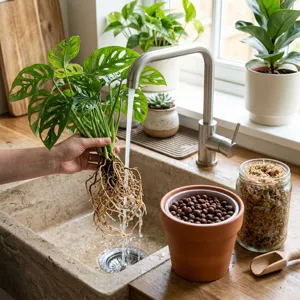
A plant that has just been converted has few working roots, so it cannot absorb much from the reservoir. During this period you can supply a little nutrition through the leaves, as long as you stay conservative. Mist a quarter-strength solution of a complete mineral formula onto the leaves, preferably in the morning, using a fine spray. Do this no more than once a week, and stop as soon as white roots form. Avoid strong sun right after misting, because droplets can scorch leaves, and keep the mist off flowers and the growing point of delicate plants. Foliar feeding supplements the roots and does not replace them. Details on the conversion period are in the guide to converting houseplants to semi-hydro, which also explains the plain-water start before any fertilizer.
Practical Feeding Schedule
- Weeks 0-3 after conversion: plain RO or low-TDS water, no fertilizer. Optional quarter-strength foliar mist for cuttings.
- Weeks 3-6: begin at about a quarter to half of the target EC for the plant group, and increase if growth is healthy.
- Established plants: use the target EC for their group, change the reservoir every 1-2 weeks and top up with plain water.
- Every 3-4 weeks: flush and reset.
- Low light or winter: reduce the strength by a third to a half, because the plant uses fewer nutrients.
If you make your own mineral mix, remember that it holds no nutrients unless you add controlled-release fertilizer, as explained in the DIY Pon recipe. A mix with slow-release pellets already supplies some nutrition, so reduce the liquid dose. To size the substrate for a pot, use the semi-hydro Pon calculator.
Troubleshooting Summary
| Symptom | Likely cause | Quick fix |
|---|---|---|
| White crust on the medium or pot rim | Salt buildup from evaporation | Flush with 2-3 pot volumes of plain water and lower the EC |
| Brown, crispy leaf tips | Excess EC, low humidity or a calcium shortage | Check the EC, flush, and add Cal-Mag if you use RO water |
| Pale new leaves with green veins | Iron shortage or a high pH | Check pH, use a chelated iron source and correct to 5.8-6.5 |
| Sour smell and slimy reservoir | Organic fertilizer or stale water | Switch to a mineral formula, clean the pot and change the water |
| Slow growth with pale leaves | Underfeeding or low light | Raise the EC in small steps and review the light |
Related Resources
Learn the full system in the semi-hydroponics with Pon guide, make your own mix with the DIY Pon recipe, move plants over with the conversion guide, compare media in LECA vs Pon, plan quantities with the semi-hydro Pon calculator and see a heavy-feeding aroid on the Monstera deliciosa page.
Frequently Asked Questions
Why is urea-based fertilizer a problem in semi-hydro?
Urea has to be converted to ammonium by microbial urease before plants use it efficiently, and an inorganic medium has few microbes to do that. Growers commonly report erratic uptake, ammonium buildup, bacterial growth and foul smells with urea-heavy feeds in reservoirs. A mineral fertilizer with nitrate-based nitrogen is safer and easier to control.
Do I need Cal-Mag if I use RO water?
Usually yes, unless your fertilizer already contains calcium and magnesium. RO and distilled water contain almost none, and deficiency shows up as curled or distorted new leaves and brown tips. Add a Cal-Mag supplement at the label rate or use a complete formula that includes both, then re-check the EC and pH.
What is the white crust on my LECA or Pon?
It is usually dried fertilizer salts and minerals from the water, left behind when water evaporates from the surface. A thin crust is common. A thick crust means the solution is too strong or flushing is overdue. Flush from above with 2-3 pot volumes of plain water, wipe the pot rim and lower the EC at the next mix.
Can I use Dyna-Gro Foliage-Pro or the General Hydroponics Flora series?
Both are hydroponic fertilizers that people use for semi-hydro. Foliage-Pro is a one-part foliage formula, and Flora is a multi-part system in which the components are mixed in ratios. Check the current label of whichever you choose for its nitrogen forms, its Ca and Mg content and its dilution, and then set the final strength by EC rather than relying on the label dose alone.
Should I use a pH pen or liquid indicator drops?
A calibrated pH pen is more precise and is worth buying if you mix solutions regularly. Indicator drops are cheap and good for a rough check, but the colour bands are wide and hard to read, particularly in tinted solutions. Whichever you use, check the pH after the fertilizer has dissolved and aim for 5.8-6.5.
Is foliar feeding safe for newly converted cuttings?
Used carefully, yes. Mist a quarter-strength complete mineral solution once a week while the water roots are still immature, in the morning and out of direct sun, then stop when white roots form. Strong solutions, frequent spraying or hot sun can burn the leaves.
How do I convert ppm to EC?
On the 500 scale, divide ppm by 500 to get mS/cm, so 600 ppm is 1.2 mS/cm. On a 700 scale, divide by 700 instead. The same solution can read differently on different meters, so check which scale your meter uses and stick to one.
How often should I fertilize plants in semi-hydro?
Most people feed at each reservoir change, every 1-2 weeks, using a dilute solution, and flush every 3-4 weeks. Reduce the strength in low light or winter. Start feeding only after a converted plant has white roots and new growth.
Can I use compost tea or fish emulsion occasionally?
It is not recommended. These feeds carry organic matter that feeds bacteria and algae in a reservoir, and the smell and slime can damage roots. If you want an organic element, use it in soil-grown plants and keep your semi-hydro plants on a mineral hydroponic formula.
What EC should a Monstera deliciosa get in semi-hydro?
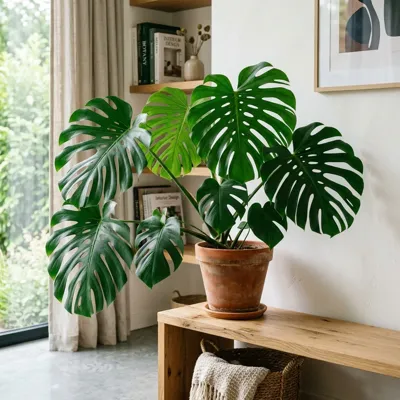
Monstera is a heavy feeder and usually does well at 1.2-1.6 mS/cm (600-800 ppm on the 500 scale) with good light. Start lower, for example 0.8 mS/cm, and raise the strength gradually if growth is pale and slow. Flush every 3-4 weeks.
Sources & References
-
Source: extension.psu.edu
Type: horticultural-reference
-
Source: edis.ifas.ufl.edu
Type: horticultural-reference
-
Source: rhs.org.uk
Type: horticultural-reference
Explore More
Related Articles
Related Plant Guides
Recommended next actions
Continue Exploring
Dive deeper into related plant care tools and profiles.
Calculator
Semi-Hydro Pon Volume & Mineral Split Calculator
Calculate net Pon volume, root displacement, DIY mineral components (pumice, zeolite, lava rock), dry weight, and water reservoir depth in metric or imperial units.
Plant Guide
Monstera
Grow a thriving Monstera deliciosa with the light, watering and climbing support it needs to develop large, mature, fenestrated leaves indoors.
Topic Guide
Converting Houseplants to Semi-Hydro: Root Transition & Rot Prevention
Step-by-step guide to converting soil houseplants to semi-hydroponics: washing soil roots, 3% hydrogen peroxide soaks, water root transition, and rot prevention.
Topic Guide
DIY Pon Recipe: Mineral Ratios, Particle Sizing & Preparation
Make your own DIY mineral Pon substrate: exact pumice, zeolite, and lava rock ratios, mineral particle sizing (3-6 mm), rinsing, and fertilizer dosing.
Topic Guide
LECA vs Pon: Semi-Hydroponic Substrates Compared
LECA vs Pon comparison: capillary wicking height, root stability, pH buffering, particle size, cleaning reuse, and which plants prefer each medium.
Topic Guide
Semi-Hydroponics with Pon: The Complete Passive Hydroponics Guide
Master semi-hydroponics using mineral Pon: passive capillary wicking mechanics, self-watering pots, water reservoir depth, root oxygenation, and flushing.