Semi-Hydroponics with Pon: The Complete Passive Hydroponics Guide
Pon is a mineral substrate engineered so that roughly half of its pore volume holds water and half stays filled with air. That balance lets roots drink from a reservoir without suffocating. This guide explains the capillary mechanics and the practical rise ceiling, compares self-watering pots, net pots in cachepots and wick cord systems, and sets a reservoir depth rule of 1/4 to 1/3 of pot height. It also covers transition methods, monthly flushing, how Pon compares with soil, and which plant genera suit it. Use it with the DIY Pon recipe, conversion, LECA comparison and fertilizer dosing guides to run a stable semi-hydro collection.
Quick Answer
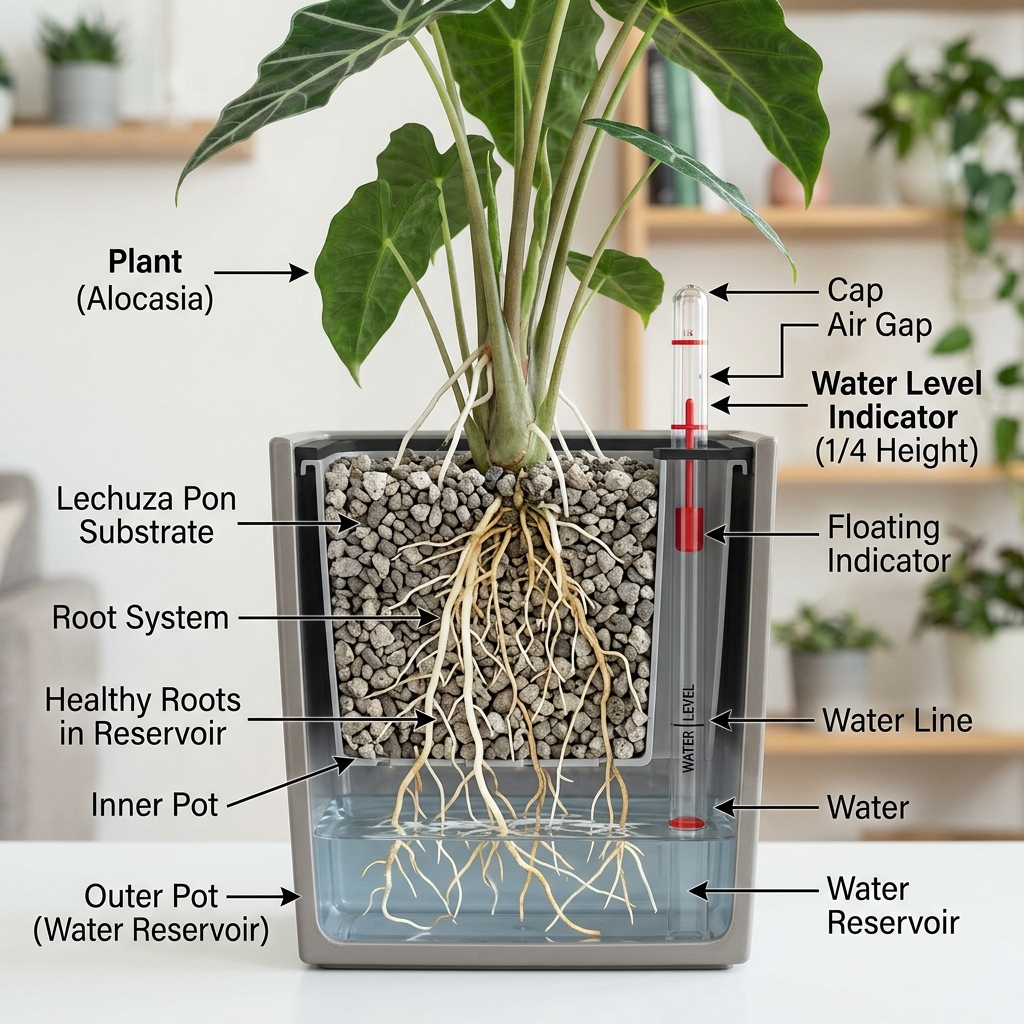
Semi-hydroponics with Pon grows plants in an inorganic mineral substrate (pumice, zeolite and lava rock) that sits above a permanent water reservoir. Capillary action lifts water 12-18 cm above the water line through the micropores, while the macropores stay filled with air. Keep the reservoir at 1/4 to 1/3 of the pot height, never submerge the crown or stem, and top-flush the Pon monthly with lukewarm water to prevent salt buildup.
Key Takeaways
- Pon lifts water by capillary action through micropores while its macropores stay air-filled, so roots get water and oxygen at the same time. The working capillary rise is roughly 12-18 cm above the water line, depending on particle size.
- Keep the reservoir at 1/4 to 1/3 of the pot height and never let the stem or crown sit in water. A deeper reservoir drowns the lower roots and removes the air gap.
- Choose the container to fit the plant and pot height: self-watering pots for convenience, net pots in cachepots for flexibility, and wick cords for tall or wide containers where capillary rise cannot reach the top.
- Flush the Pon from the top every month with 2-3 pot volumes of lukewarm tap or RO water to remove accumulated fertilizer salts, and keep the roots in a dark, opaque container to limit algae.
- Compared with soil, Pon eliminates fungus gnat breeding, most soil-borne fungi and compaction, but it holds no nutrients of its own, so every feeding schedule must be planned.
What Is Semi-Hydroponics with Pon?
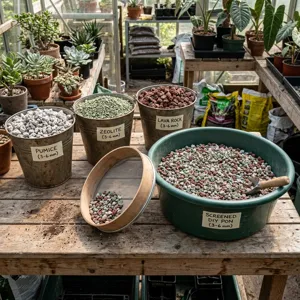
Semi-hydroponics grows plants in an inert, porous mineral medium that is fed from a water reservoir below, rather than in soil that holds both water and nutrients. Pon is the best known purpose-made substrate for this method. It is a mix of pumice, zeolite and lava rock, and hobbyists now make their own versions; see the DIY Pon recipe for ratios. Because the medium is inorganic, it does not decompose, compact or feed fungus gnats, and it gives roots a very stable balance of water and air. The trade-off is that Pon holds almost no nutrition of its own, so you must plan fertilizer and flushing. Read the semi-hydro fertilizer dosing guide for the feeding side.
How Capillary Action Works in Pon
Pon moves water upward by capillary action. Each grain is full of microscopic pores, and the narrow gaps between touching grains act as tiny channels. Surface tension draws water into those narrow spaces and pulls it above the free water surface, against gravity. The finer the pore, the higher the water climbs, but the slower it moves.
- Micropores (inside the grains and in the finest gaps) hold water. They provide the plant's reservoir of moisture between refills.
- Macropores (the larger gaps between grains) drain freely and stay filled with air. They supply the oxygen that roots need for respiration.
- The balance matters more than either value: a well-designed Pon holds roughly half of its pore volume as water and half as air, which prevents suffocation while keeping the roots hydrated.
The Capillary Rise Ceiling
In typical medium-grain Pon, the usable capillary rise is about 12-18 cm above the water line. Fine grains rise higher but stay wetter, and coarse grains rise less. Above this ceiling the medium is almost dry, which is ideal for aerial roots but means that tall pots need a different delivery method such as a wick (see below). The third table above summarises the effect of particle size. Treat these values as typical hobby ranges, because actual rise varies with grain size, packing, temperature and the age of the substrate.
Why the Air Gap Matters
A plant with its roots permanently in water will rot, because roots in standing water run out of oxygen within hours. Pon avoids this because only the lowest layer sits in water, and the layers above are moist but largely air-filled. This is also why the reservoir depth rule exists: it keeps a deep, aerated root zone above the water line. Plants with thick, fleshy or epiphytic roots, such as Hoya and orchids, are the most sensitive to wet feet.
Container and Pot Systems
Three systems cover almost every use case, and the first table above compares them in detail.
Self-Watering Pots with Level Indicators
These pots have a built-in reservoir and a perforated floor that holds the Pon above the water. A float or dipstick indicator shows the level. They are simple and reliable for most houseplants. Their weakness is the indicator itself: floats stick, mineral deposits jam them, and a tilted pot or a thick root mass can lift the float and give a false reading. Verify the indicator by lifting the inner pot or checking with a skewer every few weeks.
Net Pots or Slotted Pots in Decorative Cachepots
A slotted inner pot or net pot sits inside a decorative outer pot. The roots grow through the slots and into the reservoir. This system is more flexible, since you can set the water level exactly, move the plant between cachepots and inspect the roots if the outer pot is clear. Use an opaque cachepot or a sleeve over a clear one, because light on the reservoir encourages algae.
Wicking Cord Systems
In a tall container, the capillary ceiling means the top layer never gets water. A cotton or synthetic wick running from a lower reservoir into the medium delivers moisture to the root zone without standing water around the roots. Use a wick when the pot is taller than about 25 cm, when the container has no drainage floor, or for troughs and wide planters. Choose a wick thick enough to keep the medium evenly moist but not saturated, and replace it when salts or algae clog it.
The Reservoir Depth Rule
Keep the water level at 1/4 to 1/3 of the pot height, measured from the bottom of the inner pot. Never let the stem or crown touch the water. For sensitive genera, such as Hoya and orchids, use the lower end of the range and allow the reservoir to run nearly dry for a day between refills. For thirsty Araceae in bright light, the upper end of the range works well. The second table above lists suggested levels by genus. To calculate the reservoir volume and substrate quantities for a specific pot, use the semi-hydro Pon calculator.
Transition: Dry-Start or Immediate Reservoir?
When moving a plant from soil to Pon, roots grown in soil are not adapted to constant moisture and usually die back, to be replaced by water roots. Two approaches work:
- Dry-start. Pot the cleaned plant in damp Pon with an empty reservoir for the first 1-2 weeks, watering from the top as needed. Then add water gradually. This is gentler on thick or sensitive roots and suits Hoya, Ficus and orchids.
- Immediate reservoir. Fill the reservoir to the recommended level straight away. This works well for vigorous Araceae and cuttings, which root quickly in a humid medium.
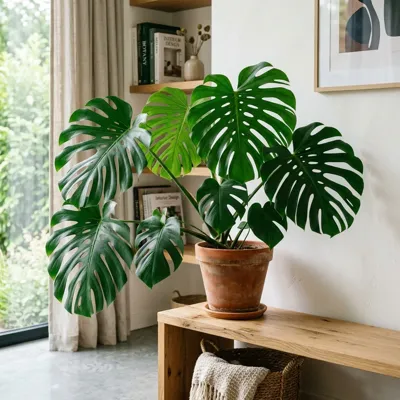
In both cases expect some yellowing or leaf drop in the first 2-4 weeks. Full step-by-step instructions, including how to wash soil from roots, are in the guide to converting houseplants to semi-hydro. Large aroids such as Monstera deliciosa convert well and are a good first plant.
Water Quality and Preventing Salt Buildup
Fertilizer salts and minerals from tap water accumulate in an inert medium, because there are no organic particles or microbes to buffer them. White crusts on the Pon or the pot rim, brown leaf tips and slowed growth are signs of buildup. To prevent it:
- Top-flush monthly. Slowly pour 2-3 pot volumes of lukewarm tap or RO water through the Pon from above, let it drain fully, then refill the reservoir with fresh water.
- Replace the reservoir water every 1-2 weeks, or whenever it looks cloudy or smells stale.
- Dose lightly. Use a fraction of the labelled fertilizer rate and follow the schedule in the fertilizer dosing guide.
- Match water to the plant. Use soft or RO water, with a small mineral addition if needed, for salt-sensitive plants such as Calathea and Anthurium.
Pon Compared with Soil
- Fungus gnats: gnats breed in damp organic matter. Pon is inorganic, so there is nothing for larvae to feed on, and infestations typically fade after a conversion.
- Soil-borne fungi and rot: without organic matter, pathogens such as Pythium and Fusarium have fewer places to grow, though poor aeration can still cause root rot.
- Compaction: Pon does not break down or compact, so aeration remains stable for years.
- Nutrition: soil holds nutrients, while Pon does not, so feeding is mandatory.
- Weight and cost: Pon is heavier per volume than many soil mixes and more expensive, but it can be washed and reused.
For a comparison with the other popular semi-hydro medium, see LECA vs Pon.
Light, Humidity and Algae
Semi-hydro does not change a plant's light or humidity needs. Tropical foliage plants still prefer bright, indirect light and, for many species, higher humidity; see the humidity guide. Algae appears wherever light reaches the wet Pon or the reservoir. Use opaque pots or sleeves, keep the Pon surface drier than the lower layers, and clean the reservoir when you replace the water.
Reusing and Sterilizing Pon
Pon is reusable because the minerals do not decompose. Remove all roots and debris, rinse until the water runs clear, then sterilize by one of these methods:
- Boiling: simmer for about 10 minutes, then drain and cool.
- Hydrogen peroxide soak: soak in 3% hydrogen peroxide diluted about 1:1 with water for 30-60 minutes, then rinse thoroughly.
- Dilute bleach soak (last resort): soak in a weak solution for 10-15 minutes and rinse many times, because porous minerals can hold residues.
Zeolite and lava rock also store fertilizer ions, so flush reused Pon thoroughly or run a rinse with plain water before replanting. Mix in some fresh Pon if the grains look worn or dusty.
Troubleshooting Summary
| Symptom | Likely cause | Quick fix |
|---|---|---|
| Mushy, brown roots with a sour smell | Reservoir too deep or water stale, oxygen shortage | Trim rotted roots, lower the water level, flush and refill with fresh water |
| Green film on clear pots | Light reaching the Pon and the reservoir | Use opaque pots, clean the pot and flush |
| White crust and brown leaf tips | Salt buildup | Top-flush with 2-3 pot volumes, reduce fertilizer |
| Wilting with a dry top layer in a tall pot | Capillary ceiling exceeded | Add a wick, top-water, or move to a shorter pot |
| Level indicator reads high but the pot is dry | Stuck or jammed float | Clean or replace the indicator and check with a skewer |
Related Resources
Make your own mix with the DIY Pon recipe, switch a plant over using the conversion guide, weigh your options in LECA vs Pon, set a feeding plan with the fertilizer dosing guide, work out volumes and ratios with the semi-hydro Pon calculator, and see how a classic aroid performs on its Monstera deliciosa page.
Frequently Asked Questions
Will my plant get root rot if its roots sit in a permanent water reservoir?
Not if the reservoir is kept at 1/4 to 1/3 of the pot height, so only the lowest roots are in water and the layers above stay air-filled. Root rot happens when the water is too deep, stale, warm or low in oxygen, or when the plant is a species that dislikes constant moisture. Replace the reservoir water every 1-2 weeks, flush monthly, and let sensitive plants such as Hoya run the reservoir nearly dry between refills.
Why is green algae growing in my clear semi-hydro pot?
Algae grows wherever light, water and nutrients meet. Clear pots let light into the wet Pon and the reservoir. Switch to an opaque pot or put a sleeve or cachepot around a clear one, keep the surface Pon drier than the bottom layers, and clean the reservoir when you change the water. Algae on the substrate is mostly cosmetic, but a heavy bloom can use up oxygen.
Can I reuse Pon, and how do I sterilize it?
Yes. Remove roots and debris, rinse until the water runs clear, and then boil for about 10 minutes or soak in diluted 3% hydrogen peroxide for 30-60 minutes. Rinse thoroughly afterwards. Because zeolite and lava rock hold fertilizer ions, flush reused Pon well before replanting, and top it up with fresh Pon if the grains look worn.
Do I need a wicking cord for Pon?
Not for most pots. If the pot is shorter than the capillary rise of 12-18 cm, or up to roughly 25 cm with a deep root system that reaches the reservoir, capillary action is enough. Add a wick for tall containers, wide troughs or pots without a drainage floor, where the upper layer would otherwise stay dry. Choose a wick that keeps the medium moist but not saturated.
How do water level indicators fail?
Floats stick when mineral deposits or algae build up, roots can lift or block the float, and a tilted pot gives a false reading. Some indicators also read the reservoir correctly but cannot show whether the Pon above is wet or dry. Check the indicator against a skewer or the weight of the pot every few weeks, clean it when you flush the Pon, and replace it if it stays stuck.
How deep should the water be in a semi-hydro pot?
Aim for 1/4 to 1/3 of the pot height, measured from the bottom of the inner pot, and keep the stem and crown out of the water. Use the lower end for Hoya, orchids and Peperomia, and the upper end for thirsty aroids such as Monstera in bright light. The reservoir volume calculator can help you work out the amount of water for a specific pot.
Should I start dry or fill the reservoir right away?
Both work. A dry start, with the reservoir empty for 1-2 weeks and the Pon watered from the top, is gentler for sensitive or thick-rooted plants. Filling the reservoir immediately suits vigorous aroids and cuttings. Either way, expect some leaf yellowing while soil roots die back and water roots form over 2-4 weeks.
How often should I flush Pon?
Top-flush once a month with 2-3 pot volumes of lukewarm tap or RO water, let it drain completely, and refill the reservoir with fresh water. Flush sooner if you see a white crust, brown leaf tips or slowed growth. Hard tap water or heavy fertilizing may require more frequent flushing.
Does Pon get rid of fungus gnats?
Largely, yes. Gnat larvae feed on damp organic matter and fungi, which Pon does not provide. Infestations usually fade after a plant is washed free of soil and moved to Pon. Keep the surface layer drier, avoid organic top dressings and rinse the roots thoroughly during conversion, since leftover soil can keep gnats going.
Which plants do not do well in Pon?
Succulents and cacti are the main problem group, since they rot easily in a permanent reservoir. Plants that need strong drying cycles or a mineral soil are usually better off in a gritty soil mix. Some fine-rooted plants, such as ferns and Calathea, also need good water quality and a careful flush routine.
Sources & References
-
Source: edis.ifas.ufl.edu
Type: horticultural-reference
-
Source: extension.psu.edu
Type: horticultural-reference
-
Source: rhs.org.uk
Type: horticultural-reference
Explore More
Related Articles
Related Plant Guides
Recommended next actions
Continue Exploring
Dive deeper into related plant care tools and profiles.
Calculator
Semi-Hydro Pon Volume & Mineral Split Calculator
Calculate net Pon volume, root displacement, DIY mineral components (pumice, zeolite, lava rock), dry weight, and water reservoir depth in metric or imperial units.
Plant Guide
Monstera
Grow a thriving Monstera deliciosa with the light, watering and climbing support it needs to develop large, mature, fenestrated leaves indoors.
Topic Guide
Converting Houseplants to Semi-Hydro: Root Transition & Rot Prevention
Step-by-step guide to converting soil houseplants to semi-hydroponics: washing soil roots, 3% hydrogen peroxide soaks, water root transition, and rot prevention.
Topic Guide
DIY Pon Recipe: Mineral Ratios, Particle Sizing & Preparation
Make your own DIY mineral Pon substrate: exact pumice, zeolite, and lava rock ratios, mineral particle sizing (3-6 mm), rinsing, and fertilizer dosing.
Topic Guide
Humidity
Learn everything about humidity for your indoor and aquarium plants. Expert care tips, troubleshooting, and related guides.
Topic Guide
LECA vs Pon: Semi-Hydroponic Substrates Compared
LECA vs Pon comparison: capillary wicking height, root stability, pH buffering, particle size, cleaning reuse, and which plants prefer each medium.