Air Layering
Air layering is a propagation technique that induces adventitious root formation on a stem that remains attached to its parent plant, rather than requiring a cutting to root independently first. A small incision above a node is wrapped in moist sphagnum moss or coconut coir to maintain humidity and encourage rooting. Once new roots develop at the incision site, the rooted stem section can be severed and potted separately as a genetically identical new plant, making this a reliable way to propagate plants with desirable traits like specific flower color or growth habit.
Quick Answer
Air layering propagates a plant by encouraging new roots to form on a stem while it's still attached to the parent, using a moist medium like sphagnum moss wrapped around a small incision. Once roots develop at the incision site, the stem can be cut and potted as an independent plant. This method preserves the exact traits of the parent plant.
What Is Air Layering?
Air layering is a horticultural technique used to propagate plants by creating a new root system on a stem while it is still attached to the parent plant. This method is based on the ability of certain plants to form adventitious roots, which are roots that develop from non-root tissues such as stems or leaves. Air layering is a useful technique for plant propagation because it allows gardeners to produce new plants with the same desirable characteristics as the parent plant, such as flower color, growth habit, or disease resistance.
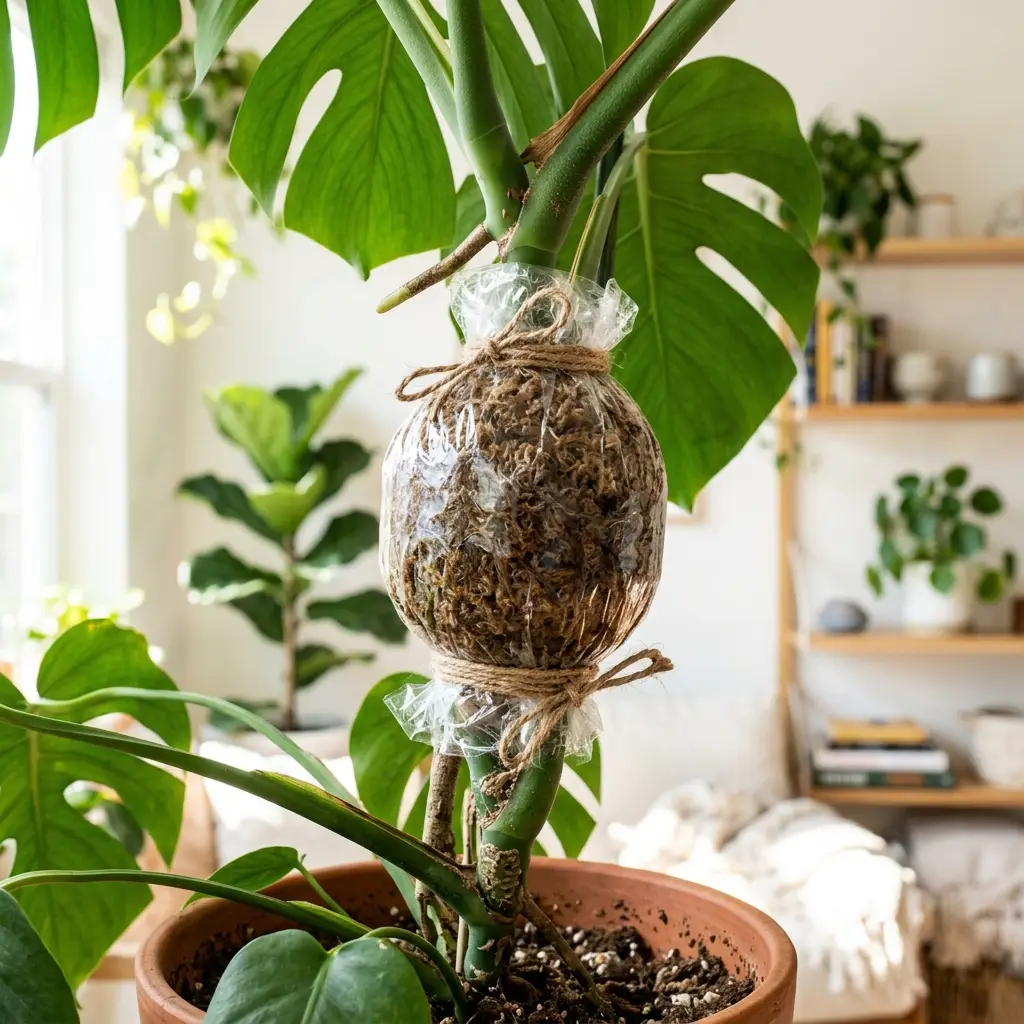
The process of air layering involves making a small incision in the stem of the plant, just above a node, and then wrapping the area in a moist medium such as sphagnum moss or coconut coir. The moss or coir helps to maintain humidity and promote root growth. Over time, roots will develop from the incision site, and the new roots will grow downward, eventually forming a new root system. Once the new roots have developed, the stem can be cut below the node, and the new plant can be potted up.
Air layering is an important technique for plant health because it allows gardeners to propagate plants that are difficult to root using other methods, such as cuttings or division. It also allows gardeners to produce new plants quickly, which can be useful for replacing plants that have been damaged or diseased. Additionally, air layering can be used to propagate plants that are rare or hard to find, which can help to conserve plant species and promote biodiversity.
Tools and Materials You'll Need
- A sharp, sterile knife or pruning tool
- A pot or container with good drainage
- A moist medium such as sphagnum moss or coconut coir
- Twine or wire for wrapping the moss or coir
- A clear plastic bag or cloche for maintaining humidity
- A thermometer for monitoring temperature
- A hygrometer for monitoring humidity
- A pair of gloves for handling the plant
Step-by-Step: How to Perform Air Layering
- Choose a healthy stem with at least two nodes, and make a small incision in the stem about 1-2 inches (2.5-5 cm) above a node, using a sharp, sterile knife or pruning tool. The incision should be about 1/4 inch (6 mm) deep and 1/2 inch (1 cm) long.
- Wrap the area around the incision with a moist medium such as sphagnum moss or coconut coir, using twine or wire to secure it in place. The moss or coir should be damp, but not soaking wet, and should be wrapped around the stem to a depth of about 2-3 inches (5-7.5 cm).
- Place the plant in a warm, humid location with a temperature of 65-75°F (18-24°C) and a relative humidity of 60-80%. You can use a clear plastic bag or cloche to maintain humidity and promote root growth.
- Monitor the plant regularly, checking the moisture level of the moss or coir and the temperature and humidity of the environment. You should check the plant every 2-3 days, and mist the moss or coir with water as needed to maintain a consistent level of humidity.
- After 1-2 months, roots should begin to develop from the incision site. You can check for roots by gently unwrapping the moss or coir and inspecting the stem. If roots have developed, you can cut the stem below the node and pot up the new plant.
- Once the new plant is potted, water it thoroughly and provide it with bright, indirect light. The plant should be kept in a warm, humid location with a temperature of 65-75°F (18-24°C) and a relative humidity of 60-80% for the first few weeks after potting.
- Monitor the new plant regularly, checking for signs of stress or disease. You should check the plant every 1-2 weeks, and provide it with fertilizer and pruning as needed to promote healthy growth.
Best Practices and Pro Tips
- Temperature Control: Keep the temperature between 65-75°F (18-24°C) to promote root growth and prevent stress.
- Humidity Management: Maintain a relative humidity of 60-80% to promote root growth and prevent drying out.
- Lighting: Provide bright, indirect light to promote healthy growth and prevent scorching.
- Watering: Water the plant thoroughly after potting, and then reduce watering to once a week to prevent overwatering.
- Fertilization: Fertilize the plant with a balanced fertilizer at a concentration of 10-20% once a month to promote healthy growth.
Quick Reference Table
| Factor | Recommended Range | Why It Matters |
|---|---|---|
| Temperature | 65-75°F (18-24°C) | Promotes root growth and prevents stress |
| Humidity | 60-80% | Promotes root growth and prevents drying out |
| Lighting | Bright, indirect light | Promotes healthy growth and prevents scorching |
| Watering | Once a week | Prevents overwatering and promotes healthy growth |
| Fertilization | 10-20% balanced fertilizer once a month | Promotes healthy growth and prevents nutrient deficiency |
Best Plants for Air Layering
The Ficus carica, or common fig, is a popular plant for air layering due to its ability to form adventitious roots easily. The Philodendron selloum, or tree philodendron, is another good choice, as it can be propagated using air layering to produce new plants with the same desirable characteristics as the parent plant. The Dracaena marginata, or red-edged dracaena, is also a good candidate for air layering, as it can be used to produce new plants with the same attractive foliage as the parent plant. The Peperomia obtusifolia, or baby rubber plant, is a small, compact plant that can be propagated using air layering to produce new plants with the same desirable characteristics as the parent plant. The Syngonium podophyllum, or arrowhead vine, is a versatile plant that can be propagated using air layering to produce new plants with the same attractive foliage as the parent plant. The Monstera deliciosa, or Swiss cheese plant, is a popular houseplant that can be propagated using air layering to produce new plants with the same desirable characteristics as the parent plant.
As we explain in our Leaf Propagation guide, air layering is just one of many techniques that can be used to propagate plants. Which we cover in detail in our Stem Cutting article, stem cuttings are another popular method for propagating plants. See our Division guide for a deeper look at how to divide plants to produce new offspring.
Common Mistakes to Avoid
- Overwatering: Watering the plant too frequently can lead to root rot and poor growth, so it is essential to water the plant only once a week and to monitor the moisture level of the moss or coir.
- Underwatering: Failing to water the plant regularly can lead to drought stress and poor growth, so it is essential to water the plant at least once a week and to monitor the moisture level of the moss or coir.
- Incorrect Temperature: Keeping the temperature outside the recommended range of 65-75°F (18-24°C) can lead to poor root growth and stress, so it is essential to monitor the temperature and to adjust it as needed.
- Incorrect Humidity: Failing to maintain a relative humidity of 60-80% can lead to poor root growth and drying out, so it is essential to monitor the humidity and to adjust it as needed.
- Incorrect Lighting: Failing to provide bright, indirect light can lead to poor growth and scorching, so it is essential to provide the plant with the correct lighting and to monitor its response.
Frequently Asked Questions
What is the success rate of air layering?
The success rate of air layering can vary depending on the plant species and the environmental conditions, but it is generally around 50-70% when done correctly. Factors such as temperature, humidity, and lighting can all impact the success rate, so it is essential to monitor these factors and to adjust them as needed. For example, maintaining a temperature of 65-75°F (18-24°C) and a relative humidity of 60-80% can help to promote root growth and increase the success rate.
What is the best season for air layering?
The best season for air layering is during the spring and summer months when the plant is actively growing, as this allows for the best root development and growth. However, air layering can be done at any time of the year, as long as the plant is healthy and the environmental conditions are suitable. For example, maintaining a temperature of 65-75°F (18-24°C) and a relative humidity of 60-80% can help to promote root growth and increase the success rate, regardless of the time of year.
Is it mandatory to use a clear plastic bag or cloche?
No, it is not mandatory to use a clear plastic bag or cloche, but it can be helpful in maintaining humidity and promoting root growth. If you do not have a clear plastic bag or cloche, you can use a damp cloth or a humidifier to maintain the humidity and promote root growth. For example, you can place the plant in a tray filled with water and pebbles to increase the humidity around the plant.
What aftercare is required for the new plant?
After the new plant has been potted, it will require regular watering, fertilization, and pruning to promote healthy growth. The plant should be kept in a warm, humid location with a temperature of 65-75°F (18-24°C) and a relative humidity of 60-80% for the first few weeks after potting. For example, you can water the plant once a week and fertilize it with a balanced fertilizer at a concentration of 10-20% once a month.
How do I troubleshoot common problems with air layering?
Common problems with air layering include poor root growth, drying out, and stress. To troubleshoot these problems, you can check the temperature, humidity, and lighting, and adjust them as needed. For example, if the temperature is too high, you can move the plant to a cooler location, and if the humidity is too low, you can increase the humidity around the plant. You can also check the moisture level of the moss or coir and adjust the watering schedule as needed.
Explore More
Related Topics
Related Plant Guides
No specific plant guides found matching this topic.
Recommended next actions
Continue Exploring
Dive deeper into related plant care tools and profiles.
Topic Guide
Leaf Propagation
Learn everything about leaf propagation for your indoor and aquarium plants. Expert care tips, troubleshooting, and related guides.
Topic Guide
Stem Cutting
Learn everything about stem cutting for your indoor and aquarium plants. Expert care tips, troubleshooting, and related guides.
Topic Guide
Division
Learn everything about division for your indoor and aquarium plants. Expert care tips, troubleshooting, and related guides.