Paludarium Water Volume: Calculating Your Usable Aquatic Space
Understanding paludarium water volume is essential for properly sizing filters, heaters, and selecting appropriate aquatic life. This guide explains why nominal tank capacity is misleading and how water depth, land zones, substrate, and hardscape displace water. It provides a conceptual framework, a worked 29-gallon example, displacement estimates, unit conversions, and equipment sizing guidelines using US gallons, with reference tables for quick lookup.
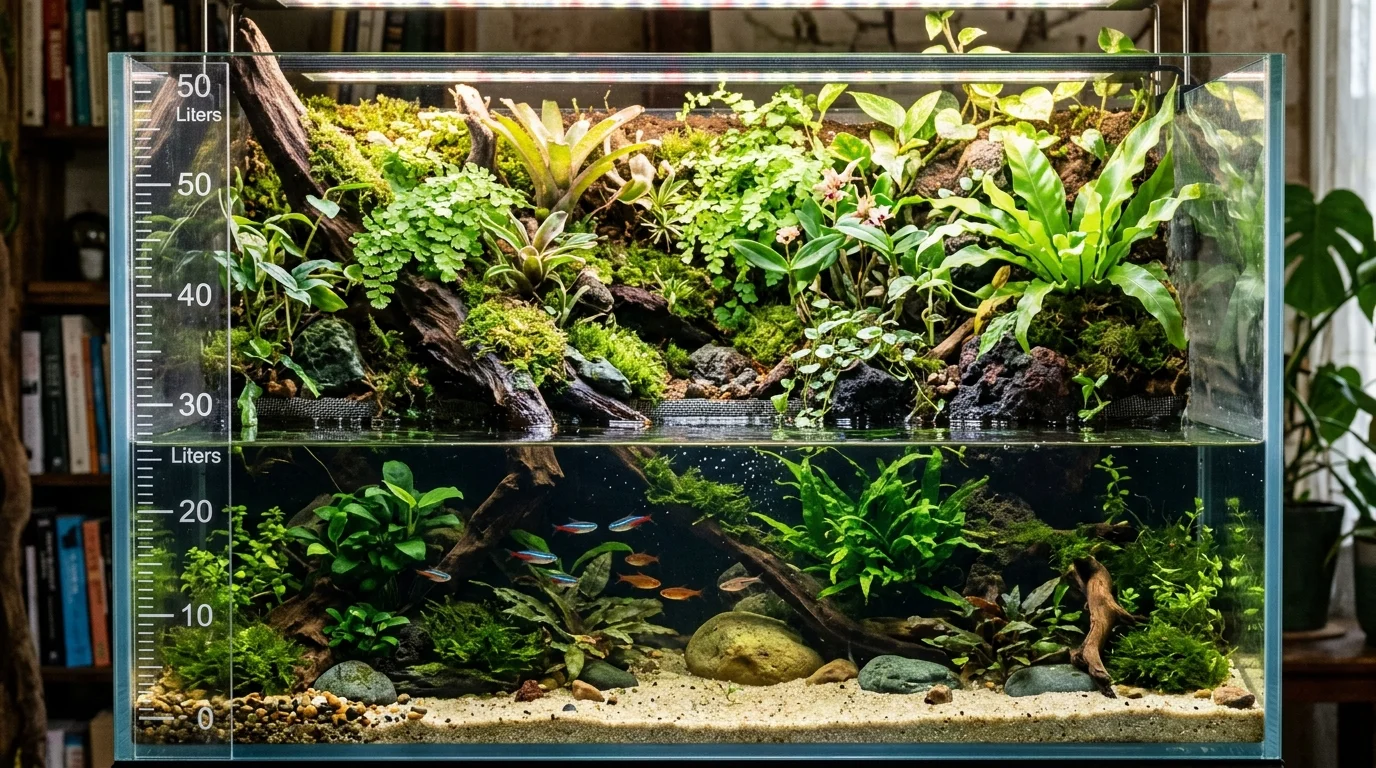
Quick Answer
To calculate usable paludarium water volume, calculate the gross aquatic volume using internal dimensions, then subtract the displacement of your land foundation, substrate, and hardscape.
Key Takeaways
- Nominal tank capacity does not reflect usable water volume in a paludarium, which is often only 15% to 40% of the rated size.
- Water depth is the primary constraint on gross aquatic volume; convert cubic inches to US gallons by dividing by 231.
- Solid land foundations and hardscape physically displace water, while hollow false bottoms do not and sand or gravel displace about 60% to 70% of their bulk.
- Avoid counting the land zone twice: subtract only submerged land features once the water footprint is defined.
- Size heaters, filters, water changes, and conditioner doses from usable water volume, not the tank's rated size.
The Nominal vs. Usable Gap
When setting up a paludarium, a common mistake is assuming that a 20-gallon tank will hold 20 gallons of water. In reality, the stated nominal capacity represents an empty tank filled to the brim. A paludarium divides the space between land and water, meaning your usable aquatic volume will be substantially less than the tank's advertised size, often only 15% to 40% of it. This difference is critical when planning filtration, heating, water changes, and selecting aquatic species. If you are still planning your build, see how to convert an aquarium into a paludarium.
Water Depth
The first factor reducing your water volume is the water depth. A paludarium usually has a water level that is only a fraction of the total enclosure height to accommodate the terrestrial zone above. Therefore, the gross aquatic volume is determined by the internal length, width, and actual water depth, not the total height of the tank. Many keepers aim for at least 4 to 6 inches of depth for small fish and shrimp, since deeper water is more stable. Use inside dimensions where possible, because glass thickness and trim reduce the interior size slightly. In US units, multiply length x width x depth in inches to get cubic inches, then divide by 231 to get gallons. For example, 24 x 12 inches with half the footprint as water at 6 inches deep gives 864 cubic inches, or about 3.7 US gallons.
The Land Zone
The terrestrial section further reduces available aquatic space. However, the amount of water displaced depends on how the land is constructed. A false bottom made of egg crate is mostly hollow and allows water to flow underneath, displacing very little total water volume. Conversely, a solid bank of gravel, soil, or expanding foam occupies physical space and significantly displaces water. Be careful not to count the land twice: if you already measured only the water footprint, the dry land beyond it is excluded, and you only need to subtract submerged parts such as slopes, ledges, and foundation walls that extend into the water zone.
Substrate and Hardscape
Beyond the land structure, any materials placed in the aquatic zone will displace water. Rocks, driftwood, and aquatic substrate all take up volume. It is important to remember that granular materials like gravel and sand have void space, meaning water fills the spaces between the grains, so they displace roughly 60% to 70% of their bulk volume rather than 100%. Solid rocks and dense wood, however, displace their entire underwater volume. As a rule of thumb, dense rock displaces about 0.045 US gallons per pound.
Measuring Displacement
Estimates work for planning, but measuring is more accurate for irregular pieces of driftwood or rock. Fill a bucket with water to a marked line, submerge the item completely, and measure how much water you need to remove to return to the line. That amount is the item's displacement. Add up the measurements for all submerged hardscape. The displacement table below lists typical estimates for common materials.
Calculation Concept
To find your usable water capacity, follow this conceptual model:
Gross Aquatic Volume (Length × Width × Water Depth)
− Land Foundation Displacement
− Aquatic Substrate Displacement
− Hardscape Displacement
= Usable Water Volume
Worked Example
Consider a 29-gallon tank (30 x 12 inches) where half the footprint is water at a depth of 8 inches. The gross aquatic volume is 1,440 cubic inches, or about 6.2 gallons. Subtract about 0.5 gallons for a 1-inch layer of sand, about 0.45 gallons for 10 pounds of dense rock, and about 0.3 gallons for a measured piece of driftwood. The usable water volume is about 5.0 gallons, only around 17% of the tank's rated capacity. The worked example table below shows each step.
Using Your Usable Volume
Once you know the real number, use it for every decision that depends on water volume. Size the heater at about 3 to 5 watts per gallon of usable water, choose a filter or pump that turns over about 4 to 6 times the water volume per hour, dose water conditioners for the actual volume, and calculate partial water changes (typically 10% to 25%) from the same figure. Also check manufacturer minimum water depths, because some heaters and filters will not operate correctly in shallow water. When choosing livestock, stock by usable volume, not rated size, since small water volumes build up ammonia quickly.
Common Mistakes
- Using the tank's rated gallons for heater, filter, and conditioner calculations.
- Calculating volume from the full tank height instead of the actual water depth.
- Forgetting to subtract hardscape and substrate displacement.
- Counting the land zone twice after already limiting the footprint to the water zone.
- Mixing up US and Imperial gallons when comparing product listings or tank sizes.
External Calculator
To accurately determine your exact volume without performing complex geometric reductions manually, you can use a dedicated tool. Calculate your paludarium water volume to ensure your heater and filter are properly sized for your setup.
Frequently Asked Questions
Why can't I use my aquarium's stated gallon capacity for a paludarium?
A paludarium incorporates both land and water zones. The stated capacity represents the volume if the tank is filled to the brim without any terrestrial features. Because the water level is significantly lower and space is taken by land structures, the actual water volume is often only 15% to 40% of the rated size.
How much water does a 20-gallon paludarium actually hold?
It depends on your layout. A 20-gallon high tank (24 x 12 inches) with half its footprint as water at a depth of 6 inches holds about 3.7 gallons before subtracting substrate and hardscape. With a 75% water footprint at the same depth, the gross volume is about 5.6 gallons.
Does a false-bottom land section reduce usable water volume?
It reduces the usable swimming space, but because structures like egg crate are mostly hollow, they displace very little actual water. The water can flow freely beneath the false bottom.
How do substrate and hardscape affect paludarium water volume?
Solid materials like rocks, wood, and foam physically displace water. Gravel and sand have void space between the grains, so they displace roughly 60% to 70% of their bulk volume, whereas solid rocks displace their full volume.
How do I calculate usable water volume when the tank has separate land and water zones?
First, calculate the gross aquatic volume by using the internal dimensions of the water zone and the target water depth, then divide cubic inches by 231 to get US gallons. Then subtract the volume displaced by any submerged land structures, aquatic substrate, and hardscape.
How do I measure how much water a rock or piece of driftwood displaces?
Fill a bucket or container with water to a marked line, submerge the item completely, and measure how much water you must remove to return to the line. Alternatively, dense rock displaces about 0.045 US gallons per pound, but waterlogged wood varies, so measuring is more accurate.
Should I size my heater and filter by usable water volume or the tank's rated size?
Use the usable water volume. A common guideline is 3 to 5 watts of heater power per gallon of water and a filter flow rate of about 4 to 6 times the water volume per hour. Also dose water conditioners by the usable volume, and check that your heater is designed to work at shallow depths.
How big should a partial water change be in a paludarium?
A typical routine is a 10% to 25% water change every one to two weeks, calculated from the usable water volume, not the tank's rated size. In a 5-gallon water zone, that is about 0.5 to 1.25 gallons.
How many US gallons are in a liter or an Imperial gallon?
One US gallon equals about 3.785 liters or 231 cubic inches. An Imperial gallon, used in the UK, equals about 1.2 US gallons or 4.546 liters, so check which gallon a product or tank listing uses.
Explore More
Related Articles
Related Plant Guides
No specific plant guides found matching this topic.
Recommended next actions
Continue Exploring
Dive deeper into related plant care tools and profiles.
Topic Guide
What Is a Paludarium? Design, Anatomy, and Ecosystem Setup
Learn what a paludarium is, how land and water zones work together, and how to plan drainage, circulation, substrate, planting, and maintenance.
Topic Guide
Paludarium Filter and Pump Guide
A practical hydraulic and equipment guide for sizing paludarium pumps and filtration around net water volume, operating head, plumbing resistance, shallow-water intake geometry, flow control, evaporation, heating, biological media, canister filters, and serviceability.
Topic Guide
Paludarium Waterfall Guide
A practical construction guide for paludarium waterfalls covering cascading flow paths, expanding-foam baffles, slate tiers, structural support, splash mitigation, acoustic dampening, mold prevention and hidden plumbing service access.
Topic Guide
Water Quality for Houseplants
Compare tap, filtered, distilled, and rainwater for houseplants. Learn which water is best for sensitive plants and how to prevent mineral buildup.
Topic Guide
Drainage
Learn everything about drainage for your indoor and aquarium plants. Expert care tips, troubleshooting, and related guides.
Topic Guide
Vampire Crab Paludarium Setup: Habitat, Husbandry & Care
Learn how to design a vampire crab paludarium with usable land, shallow water, suitable substrate, humidity, temperature, hiding places, and compatibility guidance.