Golden Pothos (Money Plant) Care: Watering, Light, Propagation and Vastu Tips
The ultimate beginner-friendly trailing vine. Valued for its air-purifying qualities, rapid growth, and ability to thrive in almost any indoor environment.
-
Difficulty
easy
-
Light
Highly adaptable. It thrives in bright, indirect light but will happily survive in low-light environments.
-
Temperature
65-85°F (18-29°C)
-
Growth
fast
-
Humidity
40-60%
-
pH range
6.0-6.5
-
Biggest Owner Mistake
Overwatering because its tropical appearance suggests it wants consistent moisture—but pothos stores water in its thick leaves and stems, making it extremely drought-tolerant. Waiting until the leaves show the very first sign of wilting (slight softening) before watering results in a far healthier plant than watering on a schedule.
-
What Nobody Tells You
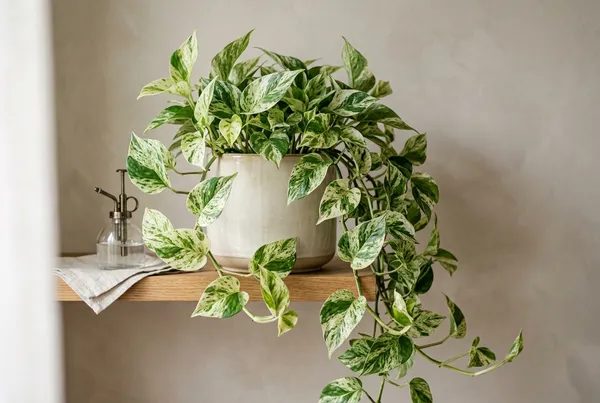
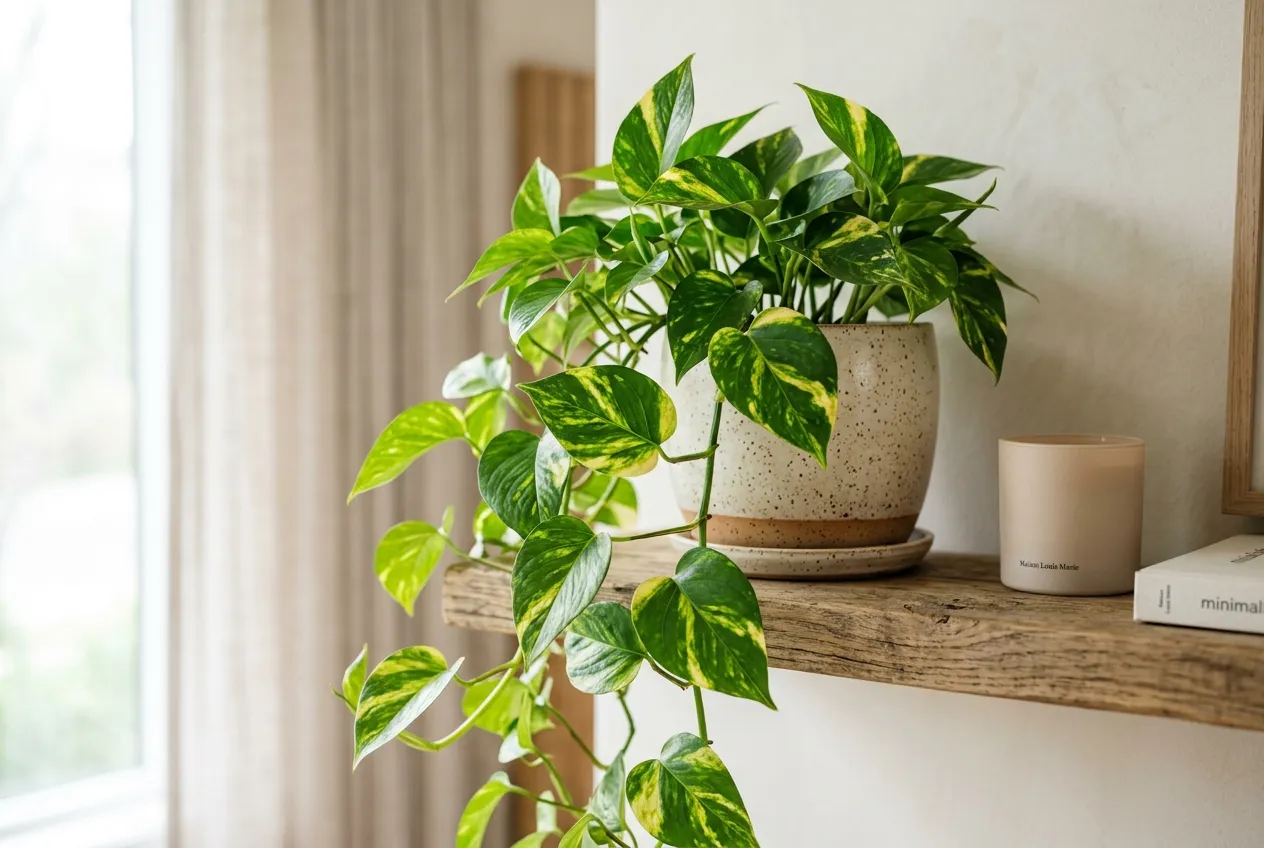
The golden-yellow variegation is produced by a pigment that only activates under adequate light—in dim conditions, the chlorophyll dominates and leaves come in solid green. Bright indirect light not only maintains the yellow pattern but actually intensifies it on new leaves.
-
Real Home Conditions
In genuinely dark corners it survives indefinitely but stops producing new leaves and loses all variegation, becoming an unremarkable green vine. Even moving it to a spot with some ambient indirect light makes a visible difference within weeks.
Quick Answer
The Golden Pothos (Money Plant) is incredibly easy to care for. Place it in low to bright indirect light, and only water it when the top two inches of soil feel completely dry. It can easily be propagated by placing stem cuttings in water.
Key Takeaways
- Provide bright, indirect light, though low light is well tolerated.
- Allow the top 2 inches of soil to dry completely before watering thoroughly.
- Prune trailing vines above leaf nodes to encourage fuller, bushier container growth.
- Propagate easily by rooting single-node stem cuttings in water.
Overview
If there is one plant that can survive almost anything, it is the Golden Pothos (universally known in South Asia as the Money Plant). Native to French Polynesia, this resilient tropical vine has become a staple in homes and offices across the globe. It earned the nickname "Devil's Ivy" because it is nearly impossible to kill and stays vibrantly green even when kept in the dark.
Whether you let it cascade from a hanging basket, train it to climb a moss pole, or simply let it trail across a bookshelf, the Golden Pothos is the ultimate confidence-builder for new gardeners.
Light and Placement
One of the best traits of the Golden Pothos is its adaptability. It genuinely thrives in bright, indirect sunlight—which helps maintain the beautiful yellow or white variegation on its leaves—but it will happily adapt to low-light corners, bathrooms, and fluorescent-lit cubicles.
The only lighting condition it despises is harsh, direct midday sun, which will scorch its leaves and bleach out the color.
Watering Strategy
The Golden Pothos is much more tolerant of being underwatered than overwatered. Let the soil dry out significantly between watering sessions. When the plant is thirsty, its leaves will start to droop slightly—this is your cue to give it a thorough soaking. Once you water it, the leaves will perk right back up within a few hours. If the leaves are turning yellow and the soil feels wet, you are watering too frequently.
Soil and Propagation
Any standard, well-draining indoor potting mix will work perfectly. They aren't fussy about soil.
Where this plant truly shines is in propagation. It is famously easy to clone. Simply cut a piece of the vine right below a 'node' (the little brown bump on the stem where the leaf attaches) and stick that node directly into a glass of water. Within a week or two, you will see fresh white roots sprouting. You can either transfer it to soil or let it live in the water permanently!
Pruning and Maintenance
Over time, Golden Pothos can grow incredibly long vines. If you notice the vines are getting "leggy" (large gaps of bare stem between leaves), don't be afraid to give the plant a haircut. Pruning actually stimulates the plant to push out new growth from the top of the pot, resulting in a much bushier, fuller plant.
Keep the leaves dust-free by wiping them down with a damp cloth every few months, which helps the plant photosynthesize more efficiently and keeps it looking glossy.
Recommended next actions
Next Best Actions
Use calculators and guides to turn this plant profile into a practical care routine.
Topic Guide
Watering
Learn everything about watering for your indoor and aquarium plants. Expert care tips, troubleshooting, and related guides.
Calculator
Plant Light Calculator: Find the Best Window for Your Plant
Determine the ideal indoor light placement for your plant based on species, window direction, and seasonal light availability.
Guide
Yellow Houseplant Leaves: Diagnose & Fix Guide 2026
After diagnosing hundreds of yellow-leaf cases across dozens of plant species, we've mapped the ten distinct causes that look nearly identical at first glance — and built the only systematic guide that tells you not just what's wrong, but exactly how to confirm it and fix it.
Topic Guide
Humidity
Learn everything about humidity for your indoor and aquarium plants. Expert care tips, troubleshooting, and related guides.
Topic Guide
Low Light
Learn everything about low light for your indoor and aquarium plants. Expert care tips, troubleshooting, and related guides.
Topic Guide
Overwatering Plants: Symptoms, Diagnosis & Prevention
Learn how to identify, treat, and prevent overwatering in your indoor and aquarium plants. Expert care tips and troubleshooting.
Structured Plant Data
Plant Data Profile
The following data is extracted directly from our botanical knowledge graph for accuracy and transparency.
Growth Characteristics
Growth Rate
fast
Mature Height
Vines can trail 10-15 feet indoors (up to 40+ feet outdoors)
Mature Spread
2-3 feet (container width)
Life Cycle
Perennial
Flowering Season
Rarely flowers indoors
Container Friendly
yes
Indoor Capable
yes
Environmental Parameters
| Parameter | Recommended | Survivable |
|---|---|---|
| Temperature | 65-85°F (18-29°C) | 50-95°F (10-35°C) |
| Humidity | 40-60% | 20-80% |
| Soil PH | 6.0-6.5 | 5.5-7.5 |
Lighting
Description
Highly adaptable. It thrives in bright, indirect light but will happily survive in low-light environments.
Nutrients
Nitrogen Demand
medium
Phosphate Demand
low
Potassium Demand
medium
Micronutrient Notes
Not a heavy feeder. If the plant is growing in water, use a highly diluted liquid fertilizer to prevent nutrient burn.
Fertilizer Frequency
Feed monthly during the spring and summer with a balanced liquid houseplant fertilizer.
Organic Options
Worm castings mixed into the top layer of soil annually.
Relationships
-
Low Light
Requirement | Strength 8
While it survives low light, heavily variegated varieties (like Golden or Marble Queen) will revert to solid green if they don't get enough light.
-
Overwatering
Vulnerability | Strength 9
The fastest way to kill a Golden Pothos is keeping the soil constantly wet, which leads to root rot.
Golden Pothos Growing Setup Comparison
| Setup Method | Light Level | Watering Strategy | Difficulty |
|---|---|---|---|
| Hanging Basket (Soil) | Bright Indirect | Dry out between watering | Easy |
| Water Jar / Hydroponic | Low to Medium | Top-up & change bi-weekly | Very Easy |
| Moss Pole / Climbing | Bright Indirect | Mist pole & water soil | Moderate |
Energy & Mindful Placement
Placement & Ancient Wisdom
In Vastu and Feng Shui, the Golden Pothos (Money Plant) is strongly associated with attracting financial luck and prosperity. The North zone is governed by Kuber, the deity of wealth, making it an excellent placement. Train the vines to grow upwards (using a moss pole or trellis) rather than trailing downwards to symbolize upward growth and rising wealth.
Best Directions
North, East, South East
Best Rooms
Living Room, Study, Entrance, Office
Light Range
Low, Medium, Bright Indirect
Care Profile
Beginner | Not pet safe | Indoor suitable
Common Goals
Reference: https://www.rhs.org.uk/plants/epipremnum
Troubleshooting & Diagnostics Guide
1 Yellow leaves near the base
Diagnosis: Overwatering, resulting in root rot
Treatment: Allow the soil to dry completely before the next watering. Ensure the pot has drainage holes.
Prevention: Maintain optimal care conditions.
2 Brown, crispy leaf edges
Diagnosis: Underwatering or extremely dry air
Treatment: Water more thoroughly when dry, and move away from direct heating or AC vents.
Prevention: Maintain optimal care conditions.
3 Loss of variegation (leaves turning solid green)
Diagnosis: Insufficient light
Treatment: Move the plant to a brighter location with indirect sunlight to encourage the patterns to return.
Prevention: Maintain optimal care conditions.
4 Leggy vines with few leaves
Diagnosis: Not enough light, or the vine needs pruning
Treatment: Prune the vine back to encourage bushier growth and move the plant to a brighter spot.
Prevention: Maintain optimal care conditions.
Authoritative Resources
For additional peer-reviewed information on plant diseases, toxicity, and care, consult these trusted botanical and agricultural extensions:
Glossary of Terms
- Node
- The joint on the stem where leaves and aerial roots emerge. When propagating, the node must be submerged in water or buried in soil to grow new roots.
- Variegation
- The appearance of differently colored zones in the leaves (like yellow, white, or cream stripes). In Golden Pothos, this is driven by genetics and light exposure.
- Aerial Roots
- Small brown nubs growing along the stem. In the wild, the plant uses these to climb up trees. In your home, they are the starting point for propagation.
Frequently Asked Questions
Is the Golden Pothos (Money Plant) toxic to cats and dogs?
How often should I water my Golden Pothos (Money Plant)?
Can I grow a Golden Pothos in water forever?
How do I make my Golden Pothos bushier?
Why are the leaves on my Golden Pothos turning yellow?
Why has my Golden Pothos lost its variegation (yellow/white stripes)?
Why are the tips of the leaves turning brown and crispy?
How do I know the exact watering frequency for my indoor setup?
Sources & References
-
Source: rhs.org.uk
Explore More